Apotheosis

In Chapter T: Wings we see Beatrice’s soul combined with the Galaxy Zephyr. She’s a giant ball of wings; now the Galaxy Zephyr has sixteen wings with jet-turbines for feathers, like a sci-fi seraph.

We can see why Dan was obsessed with Beatrice. She’s the first principal component of Earth’s life, a pure, shining example of undiluted sentience. Akayama says she’s not even just a component of humanity, but mostly of bacteria, arthropods, and reptiles. (Birds are adjacent to reptiles, right? That’s my reasoning for the feathers.) Akayama isn’t recreating humanity; she’s set her sights higher than that, endeavoring to restore Earth’s total population all the way down to single-celled organisms. Her god-like perspective has transcended anthropocentrism.

But the Galaxy Zephyr lets its guard down, and Faith gets lightning-bolted. Bummer.

I don’t have anything in particular to comment on for this section, so I’ll just talk about how everything’s wrapping up. In fancy-talk, “apotheosis” refers to a culmination or climax. Coincidentally, it can also mean elevation to the status of deity, which is sort of what happened to Beatrice.

I’ve heard that a video-game’s final boss shouldn’t just be the game’s most exciting moment. It should also test the player by confronting them with every challenge the game has to offer. At the end of each kingdom in the original Mario, the player confronts Bowser. The Bowser-fight combines platforming challenges with an enemy encounter. At the end of a Pokemon game the player fights the Elite Four, who are supposed to push the hero’s team to the limit while demanding understanding of the mechanics the player has learned throughout the game.

I think a book’s climax should do the same. The final confrontation should demand the main characters apply every lesson they’ve learned.

In Akayama DanJay‘s case this is a little difficult, since the weirdo narrative structure means there’s not really a main character. Lucille hardly learns a lesson, thriving because of her appropriately-directed lust for vengeance; Akayama and DanJay learn more, and are more deserving of the title ‘main character,’ but neither of them have much agency in piloting the giant robot.

Still, Akayama couldn’t preside over the afterlife if she hadn’t made Sheridan. That was her training-ground for godhood. DanJay failed to defeat Anihilato as Dan, but as Jay, he’ll have another shot. Lucille’s discovery of her parents’ fate pushes her to be merciless in battle.

Really, the ‘main character’ who’s learned the most lessons is the reader. Throughout Akayama DanJay the reader has come to understand (a fictional) reality as a temporary projection. They’ve learned the secrets behind the afterlife, and therefore they’ve conquered life and death. They know centipedes aren’t just a hallucinogenic drug, nor just transport to the afterlife, but a connection to the Hurricane, the presiding mind of the universe.

So the climax should wrap all these lessons in a nice package. Pulling Beatrice from the mortal plane to the afterlife and into the Galaxy Zephyr ties everything together.

If I reorganize Akayama DanJay like I’ve considered, I’d lose some of the surprise. Soon after the reader sees Beatrice hit by a bus, they’d watch chapter T as an episode of anime. This wouldn’t delay all the apotheosis to the end, but it would clarify to the reader exactly how the Galaxy Zephyr works. I think that would be for the best. Besides, there’s more to come.

The character DanJay is sort of a stand-in for the reader. As I’ve written it, DanJay’s stream of conscious is totally unbroken from beginning to end. So when DanJay finally joins the Galaxy Zephyr, all the lessons the reader has learned from his perspective will pay off at once.

There’s still a ways to go, and I have all the time in the world to rearrange sections as I see fit. We’ll see how everything turns out.

Keep eating your worms!

Next Section
Table of Contents

The Snowflake

Howdy!

I’ve decided to publicly outline the plot of my story far in advance, because I enjoy trying to explain/excuse my creative process. I’m not worried about spoilers; in fact, I’ll tell you how my story ends in this commentary, right now. I think a story should be enjoyable even if you know how it ends. Call it a challenge.

If you scour writing-advice websites, you’ll find the snowflake method of crafting a novel. The idea is you start small—with a one-sentence description—and snowball your way up to a paragraph, a page, ten pages, and eventually a whole novel. (The description in the link has some extra steps, like making character charts, but personally I feel like that’s a bit extraneous. But I’m not the published author, so what do I know?)

I added a step: I wrote the entire book ahead of time. My first draft—my “exploratory” draft—is 206 pages of double-spaced playfulness titled The Minotaur. I knew I wanted a story about a minotaur who’s great at board-games, and I wrote it without much planning. Narrative conflicts arose because conflicts are neat to write; characters had arcs because I winged ’em. My goal was to have fun. If you can have fun writing a first draft, I’d wager you can fix it up into a final draft which is fun to read.

Now, to follow the snowflake method, I’ve taken the best aspects of those 206 pages and made a several-sentence description:

War is impossible because impartial clockwork gnomes would summon demons to destroy the aggressor. Only a war-like board-game is allowed, for which civilizations of fantasy races take census of their populations to use as game-pieces.

Aria Twine used to be humanity’s champion at this war-game until her own game-piece was killed, so she’s no longer allowed to play. Aria took to raising dangerous beasts for humanity to register as game-pieces.

When she meets a minotaur with a talent for the game, she jumps on the opportunity to regain political relevance. She makes Homer, the minotaur, prove himself in a tournament against war-game champions from among humans, elves, and even monsters from the wild wastes and seas, before he’s able to combat the dwarfs who plan to claim the war-ending demons as their own and conquer the world by force. The dwarfs have a war-game-playing machine made of gnome-brains; Homer will defeat it with his flexibility.

Next, I wrote a quick description of each character’s desires and arcs.

Aria Twine desires the political power she wielded in her youth. To achieve this she’ll drive Homer the minotaur to the breaking point, using him as she would a pawn in a board-game. Eventually she’ll realize this isn’t the right way to lead, and thereafter become a worthy queen of humanity.

Homer the minotaur desires a place to belong. He initially follows Aria’s demand to become a champion war-gamer because it’s all he knows of the surface-world outside his labyrinth. He’ll even try to propose to her in marriage. He’ll eventually learn to fight for himself and for the sake of other fantasy creatures to whom he relates. His increasing understanding of the surface will be reflected in his increasing vocabulary.

The dwarfs want to conquer the world. By the end, the reader will learn that gnomes and dwarfs used to be the same underground-dwelling race before the demons split them apart. Dwarfs believe this robbed them of the right to world supremacy.

The gnomes claim to have no desires or emotions, which is why only they can control the demons. Nevertheless, they detest dwarfs. They hide it well.

Elves are like bees: their queen’s goal is to protect the forests from the dwarfs, and she mind-controls all her subjects with pheromones. There’s a class of drones, “shorties,” who only follow orders, and a taller class of “high-elves” who follow orders but secretly relish the chance to leave the forests and escape their queen’s mind-control. We’ll mostly see one particular high-elf, the one who killed Aria’s game-piece, as she learns to respect Homer as a person.

Sea-Creatures are a varied collection of different watery races who are largely mysterious to surface-dwellers. They frequently take unconventional, roundabout routes to accomplish goals landlubbers can’t even comprehend. They’re incredibly rich because they have access to all material wealth in the ocean. From their diversity, Homer will realize humans should accept him instead of treating him like a pawn.

The wild wastes are home to mostly-uncivilized fantasy monsters. A small cadre of these creatures will demand to compete in the tournament so they can prove themselves politically relevant. They’re terrible at war-games, but that’s beside the point. Homer will eventually consider himself aligned with these creatures, even if he fights under humanity’s banner.

Humanity is ruled by Queen Anthrapas, who’s old and near death. Anthrapas needs an heir, and knows Aria is suitable, but must teach her how to treat her subjects as people instead of pawns before she considers her worthy. We won’t meet many other humans, but they’ll mostly serve as antagonists for Homer and Aria.

For each chapter I’ve written something like this quick set of notes for the first chapter:

Aria vs the Elf:

Introduce Aria by having her reprimand her adolescent dragon, Scales. Scales the ice dragon shows how stressed animals warp their surroundings into their own habitat, presenting the work’s central theme about how we shape our world and, in turn, the world shapes us.

Introduce a gnome and remember gnomes have numbers for names. Show how brass cards represent a person or monster for use in the war-game by having Aria present her brass to the gnome. Remember the gnomes are rocky, machine-like, and mostly emotionless. Also have Aria see the giant ax embedded in the earth in the distance; the conversation with the gnome should tell the reader about the Demon War a thousand years ago and explain why war is now board-games. The gnome should foreshadow the evil dwarfs.

Aria should find the minotaur being assaulted by the elf who killed her game-piece. Aria will challenge her for the minotaur, and the game they play should teach the reader how the game works and how gnomes referee.

I hope you notice my emphasis on teaching. Mystery is a powerful tool, but more important, I think, is to let readers know how the world works. The first chapter of a book is like a video-game’s tutorial which teaches its player how the game is played. If I pull this off right, reading the first chapter will feel fun and new and interesting, and the reader will hardly realize it’s just the tutorial for the rest of the story.

See you next week! If you’ve enjoyed my commentary or you just want to know how Homer the minotaur becomes a war-game champ, consider following my blog. You’ll get an email whenever I make a post!

Next Chapter
Table of Contents

Wrapping Up

In Y4. The Dance on the Hurricane the Galaxy Zephyr cuts the Enemy Hurricane into a bajillion tiny little specks, then brushes those specks away. This is the penultimate section. Next week is the last update! It’s been a long time coming.

In this penultimate section, I want to wrap up some longstanding images and themes. Let’s talk about it.

The Galaxy Zephyr is still humanoid. It’s got four arms and legs in a sort of Vitruvian-Man design, but it’s still humanoid. It’s also got horns, because Lucille is a stand-in for Lucifer; the split-open heads on its horns are a direct reference to Dante’s vision of Satan with three faces.

Modern Satanism is, uh, interesting. It’s not really a religion as much as a secular social movement. On one hand, it denounces religion’s interference with government and promotes rationalism, which is neat. On the other hand, that wikipedia page says it emphasizes social darwinism and anti-egalitarianism, which is a recipe for “our slaves should thank us, they’d never make it on their own” and “don’t blame us, those minorities brought that genocide on themselves.” Plus, one satanic “rule of the Earth” is to abstain from sharing opinions unless asked, but one “satanic commandment” is to indulge rather than abstain, so it’s really just a hodgepodge. What can you expect from a group which self-identifies as intentionally provocative?

But Lucille is a Lucifer who’s not cast away from the godhead. Her Galaxy Zephyr’s version of Satan is more like Shiva the destroyer than any western interpretation of the devil. Lucille probably gets this from DanJay, who’s spent the whole book transcending duals, being masculine and feminine while straddling the mortal plane and the afterlife.

Meanwhile the Enemy Hurricane devolves from a human, to a scorpion, to a snake, to toads, to powder. It forms humanoids again, but soon the expansion of space-time will smear them into snake-shapes once more, as in the ending of Paradise Lost. I want this decay to contrast the Galaxy Zephyr’s growth: the Enemy Hurricane will do anything to achieve power, even discard its humanity; the Galaxy Zephyr achieves power by retaining its humanity, and as a result, its power is leagues beyond what the Enemy Hurricane even imagined possible.

A rationalist who uses physical determinism as a dogmatic excuse to be a self-interested dickhead will have only physical determinism to blame for their failure to compete against rationalists who work together for mutual benefit. The Enemy Hurricane discards morals because Might Makes Right, but the Galaxy Zephyr grows mightier by upholding its morals and fighting for Earth. The Galaxy Zephyr recreates Earth from dust and harvests power from it; the Enemy Hurricane is demoted to dust by its hubris.

This leads to Akayama DanJay‘s principle theme on identity. The Enemy Hurricane calls itself the sky-bearer, demanding respect for the position it pilfered and the identity it assigned itself. When it asks “who the hell do you think you are” (echoing Gurren Lagann and, interestingly, the penultimate episode of Full Metal Alchemist Brotherhood, when an evil scientist demands answers from the God called Truth), Lucille answers with a line which I’ve repeated a few times elsewhere in the text: “call me what you want.” True power isn’t controlling what other people think, say, or do; true power is being yourself regardless of what other people think, say, or do. At the end of the day, all we can chose in this life is which hill we die on.

As much as the Enemy Hurricane would like to imagine it controls itself, it only ever morphs its shape in response to the Galaxy Zephyr. The Galaxy Zephyr’s self-determination dictates the flow of battle. Now the Enemy Hurricane can be, think, say, and do whatever it likes—far, far away from everyone else.

In light of all this, the Dance on the Hurricane is modeled after the Nataraja, an iconic Hindu sculpture of Shiva dancing on the demonic dwarf which represents ignorance. Not every aspect of the sculpture is accounted for, but some have shown up in previous sections: the mandala of flames is here, for example.

Anyway, I hope you’ve enjoyed my explanation of whatever pretentious bullshit I’m on about this time. I’ll see you next week for the final chapter of Akayama DanJay!

Next Chapter
Table of Contents

The Rule of Threes and Fours

In Y3. The Final Form Lucille pulls the chain three more times, swelling the Galaxy Zephyr to twice the size of the observable universe, and making it all scary and stuff. Now that they’ve collected all the data they need to reconstruct Earth’s exploded population, there’s nothing to hold them back.

There are some numbers which keep coming up in fiction. The obvious number is three: there are three little pigs, three billy goats gruff, and Goldilocks eats three bears (right?). We’ll come back to three, but let’s talk about some other nice numbers.

I’ve heard that the number twelve comes up a lot in screenwriting for a very interesting reason: in English, it’s the highest number which is one syllable. This makes it attractive for anyone making a tight script. It’s also an appropriately biblical number: there are twelve apostles, for example.

Forty is another biblical number. Noah and Jesus both undertake trials for forty days and forty nights. Akayama DanJay has a few forties, like Anihilato’s forty limbs, or Akayama’s 3*40 = 120 years of age at the beginning, and her 140 years of age at the end. I like the number forty, because (to me) it feels nicer to say than twelve even if it’s an extra syllable. Same with twenty.

This list from Listverse explains why these numbers are important: they represent completion, or wholeness. Certainly 39 doesn’t feel as full as 40.

Different religions have different favorite numbers: Buddhism has lots of fives, representing the five senses, capped off with the sixth sense, consciousness. Check out this story about a man fighting a sticky monster. He smites the monster with five weapons, but each weapon gets stuck. He bashes the monster with his four limbs, then his head, and each limb and his head get stuck. Then something interesting happens: the man accepts his death, but warns the monster that inside his belly is a sharp object which will kill the monster if he’s eaten. There was a secret sixth.

I enjoy that approach to numbers. If the number five feels full, then the number six represents transcendence. The Galaxy Zephyr has five important pilots, plus a transcendent sixth: Lucille, Charlie, Daisuke, Eisu, and Feito, plus Akayama in the heart. There are ten thousand more pilots, but they’re mostly window-dressing, though 10,000 is a nice number as well.

Back to the number three. If you’re telling a joke, you might repeat the setup twice to establish a pattern, then put the punchline in the third repetition. In a fairy-tale, two characters can fail a task in opposite directions, and the third character can take the middle road to victory. It shouldn’t surprise us that threes pop up a lot.

Akayama DanJay has its share of threes, and I try to cap them with transcendent fourths. There are three islands of Sheridan, each larger than the last, but none as large as the Mountain in the next eternity. Beatrice, Faith, and Dan make a trio, joined by Jay. Dan visits the afterlife twice, once because he smoked centipede, then because he dies; Jay visits the afterlife a third time by smoking centipede, then a fourth time by dying to confront Anihilato. Anihilato appears once to Danonce to Faith, and once to Jay. In this section Anihilato appears a fourth time, as a skeleton.

Lucille pulls the chain four times. The first time, Beatrice joins the Galaxy Zephyr. Then Faith, then DanJay, then Anihilato.

I think these threes and fours just contribute closure. I could pretend I intentionally constructed everything to feel poignant and profound, but I’d be lying. I just wanted to write something about giant robots, and when I needed numbers, it felt best to use numbers everyone enjoys, like three, four, five, twenty, forty, and ten thousand. Those are some nice numbers.

Next Section
Table of Contents

Tulpas

In Y2. The House of Eyes Professor Akayama and Jay smoke Anihilato like a cigar, and then Akayama eats Jay. With all Earth’s data accounted for, they return to the Mountain.

A long time ago, I compared Stands in JoJo’s Bizarre Adventure to something called Tulpas. In Tibetan Buddhism, Tulpas are theoretical beings or objects created with the mind or spirit. In modern internet parlance, a Tulpa is a theoretical autonomous sentient being coexisting with the consciousness of its creator, a Tulpamancer. Various internet communities share guides, tips, and advice for creating and managing Tulpas.

At first glance, it’s easy to look down on this sort of thing. What kind of grown adult has an imaginary friend? It doesn’t help that many Tulpamancers choose to make Tulpas based on anime characters or My Little Ponies. Even if it’s true that Tulpas are autonomous, and not just imaginary friends whose actions are consciously directed, isn’t that just self-induced schizophrenia, or dissociative identity disorder?

But think about it this way: you can’t help but predict how your closest friend will react to events. You can even finish their sentences, or make them laugh with a knowing glance. In this sense, even if your predictions aren’t always correct, you mentally simulate your friend as a natural aspect of social interaction.

Likewise, in his book I am a Strange Loop, Douglas Hofstadter (author of Godel Escher Bach) discusses how his late wife, Carol, lives on in his mind:

Friends kept on saying to me (oddly enough, in a well-meaning attempt to comfort me), “You can’t feel sorry for her! She’s dead! There’s no one to feel sorry for any more!” How utterly, totally wrong this felt to me.

…I realized then that although Carol had died, that core piece of her had not died at all, but that it lived on very determinedly in my brain.

Douglas Hofstadter even describes moments where he is Carol, which coincides with the modern Tulpamancer’s notion of ‘switching’ so their Tulpa possesses the Ego, the ‘I’ of their consciousness:

For brief periods of time in conversations, or even in nonverbal moments of intense feeling, I was Carol, just as, at times, she was Doug… I shared so many of her memories, both from our joint times and from times before we ever met, I knew so many of the people who had formed her, I loved so many of the same pieces of music, movies, books, friends, jokes, I shared so many of her most intimate desires and hopes. So her point of view, her interiority, her self, which had originally been instantiated in just one brain, came to have a second instantiation, although that one was far less complete and intricate than the original one.

(In the case of the Tulpamancer with an ‘original character’ as a Tulpa, the Tulpa’s instantiation of consciousness can only be the primary one because it’s not gleaned from another person. For a Tulpa based on a cartoon character, the voice actor’s or animator’s mental conception of the character could be called the primary instantiation, but in that case I’d argue that the Tulpa’s total consciousness is so spread-out across its creators and its audience that there is no proper primary instantiation. Everyone’s idea of Mickey Mouse or Twilight Sparkle is uniquely their own.)

As a writer, I’m used to setting aside part of my consciousness and claiming it’s someone else. I can say Dan is allegorically Dante, or Jay is Jesus, but ultimately, all their words are mine. In that regard, writing a book is like playing with sock-puppets. Fictional characters tread the line between narrative tools and autonomous actors; spend long enough on any writing forum and you’ll hear people claim their characters have spontaneously diverged from the plot they’ve planned.

There’s no way around it: the fundamental structure of consciousness is built to house autonomous sentient beings. The most obvious example is the self. After all, if you’re not an autonomous sentient being, what are you?

If we accept that the brain can generate one autonomous consciousness, why not two? Or hundreds? When thoughts arise from the mind, we naturally label them as being from the self. A Tulpamancer chooses to label some thoughts as being from their Tulpa, ‘creating’ a second sentience which must be as real as the self, as both originate from the mind. One might argue the Tulpa is illusory, but I’d argue the self is illusory to begin with, so it’s a moot point.

To me, the concept is enlightening. Any aspect of phenomenology can be called a Tulpa. Take a look at this post from Tumblr-user “Emphasis on the Homo”:

Oh hay so, nifty tip for dealing w/ invasive irrational thoughts.

Pretend Spock is standing by your shoulder telling you it’s “illogical” or some shit.

Getting invasive thoughts that everyone you know secretly hates you? Spock is there to be all “That is statistically improbable Captain, several of your friends have told you many times that they enjoy your company.”

Paranoid that you’re going to get hit by a car every time you walk by a road? Spock is walking beside you, calmly explaining that “You are mostly like not going to be hit by a car. You’re walking on the sidewalk, and there are no cars in sight.”

Is someone not messaging you back right away, and part of you is terrified that they’re dead in a ditch somewhere? Spock is there to be all “Captain, your friend is currently at work. They’re probably helping a customer, not dead.”

Seriously, I spend a lot of time pretending that Spock is bluntly telling me why all of my irrational, invasive, and paranoid thoughts probably aren’t true. “Spock, someone’s watching me.” “Captain, you are alone in your apartment. Everything is fine.”

In this case it’s explicitly stated that the Spock is “pretend,” but we can imagine someone thinking Spock’s lines and labeling those thoughts as being from a separate, but contained, entity. In this context, not only can Tulpas be advantageous for mental wellness, but it’s not even a terribly outlandish concept.

Or, a Tulpa might be the symptom of mental sickness. It’s possible to convince yourself that aliens are beaming thoughts into your brain, or your dentist implanted a microchip in your teeth to track you. A cynic might delight in saying that particularly religious people, who claim to hear God’s voice, have just made a God-Tulpa without realizing it. If that’s the case, Tulpas are dirt-common.

Taking inspiration from Tulpas, Akayama DanJay treats consciousness as modular. Characters can be merged together or pulled apart. Characters can influence one-another, and that influence leaves an imprint. Anihilato is just a bunch of souls blended Hurricane-style. When Akayama is inside the Mountain, she says her pronoun is “they” because she’s connected to thousands of other sentient minds. Individual worms, representing dabs of psychic data, combine into people, separate, and recombine.

Now’s as good a time as any to talk about whatever the hell was happening in chapter I. Dan smokes centipede and turns into an amoeba. After panicking and turning into teeth, he dissolves into his component worms in a puddle. Faith takes those worms to Anihilato, but the puddle itself turns into Dan. Dan emerges as a man without worms. Perhaps that’s why he feels useless; he’s no longer contributing to the machine-learning algorithm conjuring Earth’s population. It’s like he’s sterile. Maybe that’s why he’s able to combine with Jillian. Or maybe I’m making stuff up as I go along.

Anyway, thanks for reading. I spend a lot of time thinking about consciousness and reality or whatever. It’s nice to have an outlet where I can talk about disparate authors like Douglas Hofstadter and tumblr-user “Emphasis on the Homo.”

Keep eating your worms.

Next Section
Table of Contents

Kaiji, the Ultimate Survivor

In Y1. The Staring Contest at the End of Time DanJay finally confronts Anihilato again. Last time Dan met the King of Dust, Dan’s soul was stuck in an egg until Jillian’s soul happened to free it, creating Jay. Now DanJay knows exactly what’s at stake in his staring contest. If Jay blinks, not only will his soul be devoured, but Anihilato will escape from the Biggest Bird, Akayama. As a result, Lucille’s Wheel of Reincarnation won’t be able to reconstruct Earth’s life. Even if the Galaxy Zephyr managed to defeat the Enemy Hurricane, it would be a Pyrrhic victory. Worse yet, DanJay can’t possibly win the staring contest: Anihilato has six eyes and closes them in pairs to keep constant vigilance. Even when Anihilato blinks, it faces no consequences.

Overcoming hopeless situations by understanding them is a narrative element executed beautifully in a manga/anime called Kaiji: The Ultimate Survivor. You can watch it for free on Crunchyroll, but be warned: it’s not for the squeamish.

Itou Kaiji is a gambling addict conned into betting his life. To survive and crawl out of debt, Kaiji must defeat opponents in card games, dice games, and even mahjong. But he doesn’t always win, and when he loses, it’s painful. Literally painful, as he sometimes wagers body-parts. (Remember to read manga right-to-left.)

Image result for kaiji crying

I can’t recommend this anime enough. I’ve never before had a panic attack over a fictional character trying to win the jackpot at a pachinko machine. There are TV shows about superheroes, ninjas, and superhero-ninjas which can’t match the nail-biting intensity of Kaiji playing rock-paper-scissors.

The intensity of Kaiji’s gambling is something I’d like to reflect in Akayama DanJay. While Lucille has a traditionally climactic fight in a giant robot, Dan and Jay have staring contests for the fate of mankind. So what makes Kaiji intense? Spoilers incoming.

First, Kaiji can lose. If you’ve watched a lot of anime, you might roll your eyes whenever a powerful enemy appears because you know the hero is just going to power up and beat them next episode. But by the end of the first season, Kaiji loses all his money, all his friends, an ear, and four fingers. Holy shit.
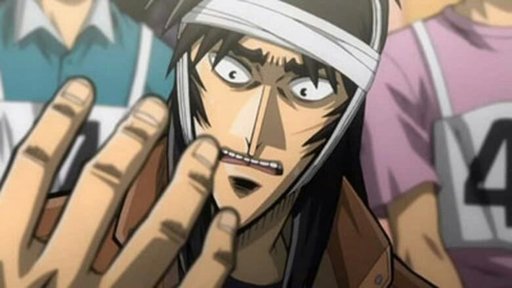
Image result for kaiji fingers

Likewise, Dan loses his staring contest with Anihilato. I hadn’t seen any Kaiji when I wrote that first chapter, but I think I did well enough: Dan eked out a small victory against a bird before his teeth-splitting defeat to Anihilato. Jay isn’t going to lose—it’s the end of the book, after all—but Dan’s failure shows the reader DanJay isn’t an invulnerable protagonist, making tension possible.
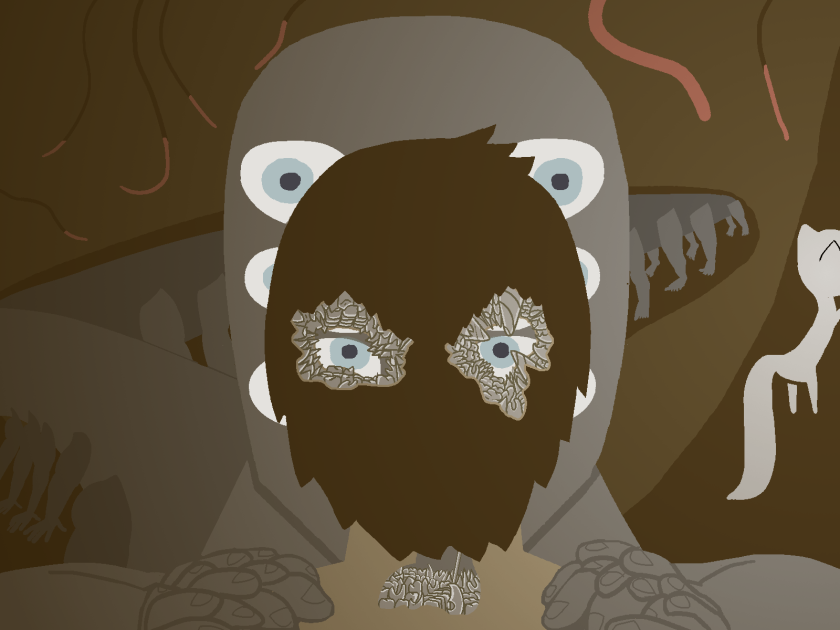
A4 pictb

Second, Kaiji’s gambles usually have simple rules. Kaiji’s first gambles are literally rock-paper-scissors. Mahjong isn’t so simple, but the version Kaiji plays is theoretically simple if you actually know how to play mahjong to begin with. Explicit and unbending rules let Kaiji pull off jaw-dropping wins which always feel deserved.

Image result for forty fivers kaiji

DanJay challenges Anihilato to staring contests. Everyone knows how those work; blink and you lose. It’s pretty one-sided, because Anihilato can blink with impunity; only DanJay would turn into teeth.

Third, Kaiji’s gambles have life-altering stakes. Maybe he’ll pay off his debt, or maybe he’ll be subjected to a lifetime of slavery. Maybe he’ll make millions of yen, or maybe he’ll lose his fingers. The incredible and escalating stakes make every episode nail-biting, even when Kaiji just rolls some dice. Often, it’s not just his own fate on the line; other gamblers stake their lives on Kaiji’s. This serves double-duty by raising the stakes while making Kaiji a ‘good guy’ the audience can root for.
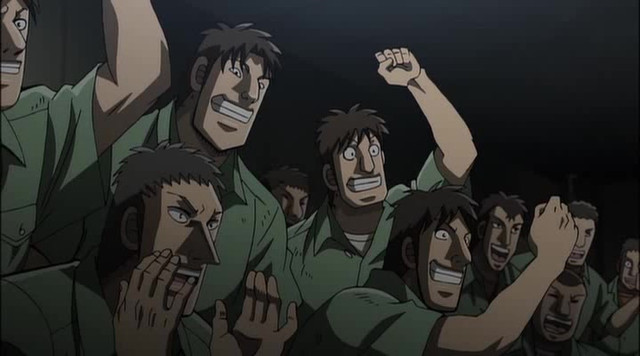
Image result for forty fivers kaiji

Dan is already dead when he challenges Anihilato. What’s at stake is his soul, which I’d argue is a step above gambling his life. Dan gambles his soul for the sake of Faith, then for the sake of Beatrice. Even though Beatrice doesn’t need to be saved, these bets let Dan ‘save the cat,’ a screenwriting concept stating that a story’s protagonist should demonstrate very early they’re worth rooting for by performing a kind, selfless act. Dan trying to save Beatrice is arguably a selfish act, because he’s trying to curry her favor, but Dan ups his bet to saving all the souls in Anihilato’s box. Dan loses, so his soul is chewed up and he’s shoved into an egg.

When Dan returns as Jay, Jay understands the REAL stakes. If he loses, it’s not just that his soul will be eaten for good; all sentient life in the universe rests in the balance. However, Jay declares he’s not fighting for anything:

“I am the inevitable,” said Jay, “and so are you. What happens happens. I’m subject to reality, just as you are.”


“This doesn’t mean anything,” said Anihilato. “You’ve failed. You and that frigid rat!”

“You’re half right,” said Jay. “This doesn’t mean anything.”

The progression of stakes—from Beatrice, to all souls, to all sentient life, to nothing at all—shows DanJay’s progression from self-centered to selfless. The only reason Jay is worthy of winning a gamble for the sake of the universe is because he doesn’t make it about himself.

Fourth, Kaiji’s gambles take twists and turns. Some people think Kaiji playing the pachinko machine drags on too long, and I agree, but I still love it because from moment-to-moment Kaiji can seem to have no way to win, or no way to lose. The back-and-forth, with upset after upset, renews the anxiety every episode. Kaiji usually begins at a disadvantage he must overcome; in the first season, he’s immediately tricked and loses most of the resources he has to gamble with.

Dan barely beats a bird, then is quickly bested by Anihilato. When Dan closes one eye, then opens it and closes the other, it barely buys him seconds. The delay makes his inevitable loss more painful, I think.

Jay begins at a disadvantage when Anihilato throws sand in his face. Then tears, sunlight, shadows, and sweat shift the tide of battle. My goal is to make the reader clutch their hair and scream, “all sentient life in the universe is doomed because Jay gets sweat in his eyes? Aaaugh!”

Fifth, Kaiji and his opponents cheat. Kaiji’s victory often depends on understanding how the opponent is cheating and using that knowledge to parry. When he learns an opponent is monitoring his biorhythms from his ear, he cuts off his ear for a slim advantage.

Image result for kaiji ear

Dan doesn’t cheat, unless you count closing one eye at a time. Anihilato cheats against Jay by throwing sand. Jay sort of cheats: he knows Akayama will arrive eventually, and he let the staring contest commence just to keep Anihilato in place until then. Jay will win by exploiting his knowledge of the secrets behind reality.

Sixth, and most importantly, Kaiji’s gambles are often thematically relevant. The most obvious example is a card game with three kinds of cards: emperors, citizens, and slaves. Emperors beat citizens, citizens beat slaves, but slaves beat emperors because slaves have nothing to lose. In this game Kaiji manages a few decisive victories against an evil company by cutting off his own ear. Just like the slave against the emperor, Kaiji wins because he has nothing to lose. Kaiji’s first gambles, over rock-paper-scissors, echo the theme song’s insistence that “the future is in our hands.” Kaiji plays mahjong, a four-player game, against only one opponent; the empty spaces at the table remind us of his two friends helping him cheat.

I hope a staring contest seems thematically relevant for Akayama DanJay. Eyes are important: Akayama grows compound eyes to demonstrate her godly perspective; the Hurricane Planets communicate with their eyes; Leo always wears suspicious sunglasses. In my art characters rarely have eyes at all, except to represent penetrating understanding.

So when Dan and Jay stare at Anihilato, it’s not just a staring contest. Thematically speaking, satan-allegory Anihilato is administering judgmental glares. Dan withers under that glare. Jay knows the gaze is powerless compared to that of Akayama, who has compound eyes Anihilato could never hope to cope with. Jay’s gaze is not divine judgement, but divine acceptance. He knows Anihilato is necessary to Akayama in the same way it’s necessary to remember horrifying historical events. To stop staring at Anihilato would be like trying to ignore Leo. We’d like to ignore people like Leo, but we mustn’t. We must stare them down and not let them escape.

Jay begins his contest with an explosive entrance. I want Jay emerging from the egg to reflect Christ’s harrowing of Hell, in which Jesus crushes a demon under a door on his way to salvage the damned. Jay’s death last section was a thinly-veiled crucifixion. I try to dilute the Jesus-imagery with Faith’s protective tail, which echoes the Buddha’s shelter under a cobra as it rained during his meditation.

The concept of a staring contest against all humanity’s foulness also reflects this line from The Once and Future King, a book about King Arthur’s childhood and rule:

I should pray to God to let me encounter all the evil in the world in my own person, so that if I conquered there would be none left, and, if I were defeated, I would be the one to suffer for it.

Dan, the mortal everyman with self-destructive compulsions, takes on Anihilato and fails, but it’s this failure which turns him into Jay, who can defeat Anihilato for good. Attacking all of humanity’s ills at once might seem to be a reckless, impossible task, but the first step is trying. Just as Merlin propels Arthur to greatness by preparing him for the horrors of the future (Merlin, who lives backwards, warns Arthur of World War II and Adolf Hitler), all the Blue Virgils residing in Anihilato keep the monster intact for Jay to properly challenge.

I hope all these elements combine to make a thrilling emotional climax for DanJay. What Dan could never do, he’s learned to accomplish as Jay.

Go watch Kaiji.

Next Section
Table of Contents

The Teachings of Don Juan

In Chapter X. DanJillian Jay is still dissociating from his centipede trip and manages to glimpse the dual nature of his own soul: Jay is what remains after the collision of Dan and Jillian. With this understanding, Jay demands Jango Skyy send him to the afterlife. Next chapter he’ll be face-to-face with Anihilato, completing the narrative arc started all the way back in chapter A.

I want to talk about another book I read; it feels like more retroactive inspiration. Carlos Castaneda’s The Teachings of Don Juan: A Yaqui Way of Knowledge markets itself as an anthropological account of the author’s training in the 1960s under don Juan, a native Yaqui spiritualist, although critics claim the story is fictional. Personally my guess is it’s a heavily fictionalized narrative based on a few real events. (I’ve got no doubt that Castaneda has taken some interesting drugs, for instance, but no real don Juan has been found.)

If that’s the case, Castaneda cleverly presents his work as genuine anthropology to rope the reader into an intriguing exploration of mysticism, then pulls the rug from under the audience with fantastical elements just barely in the realm of plausibility. Maybe this approach betrays the culture it claims to present, but it’s a hell of a ride; it forces the reader to share the protagonist’s increasing paranoia regarding reality.

Throughout the book and its sequels, Castaneda (allegedly) takes powerful psychoactive drugs under the direction of don Juan, a brujo or sorcerer. These drugs include peyote (called Mescalito), datura (Jimson weed or yerba del diablo, devil’s weed), and psychedelic mushrooms smoked from a pipe (humito, the little smoke). The drugs are often personified: Mescalito appears to Castaneda as a humanoid, while the other drugs are called a sorcerer’s allies. These aren’t drugs to mess around with. Datura in particular causes hallucinations the user can’t even differentiate from reality. Check out this reddit thread from r/drugs where someone takes datura, then posts “Google.com how normal again stop now” as if struggling to end their existential cognitive agony. I’m glad I can read other people’s accounts of drug use, because I’d never want to put myself through anything like that.

While the altered states of consciousness Castaneda experiences obviously relate to Akayama DanJay, in which characters smoke crickets and eat centipedes to visit the afterlife, The Teaching‘s real strength is in the relationship between Castaneda and don Juan. I want to take inspiration from this relationship for the banter between Jay and Jango.

Don Juan is a man of mystery. Throughout the narrative it’s impossible to tell if his lessons actually relate to ‘reality’ as we know it. Castaneda seems impatient with don Juan’s inability to explain these lessons with words, while don Juan seems impatient with Castaneda’s insistence on using words at all. This clash and Castaneda’s slow understanding of don Juan’s lessons produce the narrative tension.

Don Juan wants to teach Castaneda the same way don Juan was taught by his ‘benefactor,’ of whom we hear very little. This teacher-to-student transmission of knowledge—knowledge which cannot be contained in words—seems to originate from the time of unrecorded history.

In Akayama DanJay Virgil Jango Skyy leads a monastery on the main island of Sheridan. Although in principle he’s subordinate to Virgil Blue, Virgil Blue turns out to be a pile of centipedes, so Jango is obviously in control. I like how this combines don Juan’s mysterious benefactor with personified visions of drugs like peyote: Jango passes his teachings and his centipedes to Jay simultaneously. The transmission of knowledge is transformed into a more direct emblem.

When Jango isn’t teaching with centipedes, he’s teaching with words which only seem to complicate things. Jango tells the story of meeting Faith as a time-traveling white fox, which denies the easily-understood-but-incorrect notion of linear time in favor of the impossible-to-understand-reality of toroidal time. This story profoundly affects Jay. Jay is a photographer, perhaps to cope with confusion regarding his identity; he remembers being Dan in the afterlife, and tries to make sense of reality by putting it in pictures. When he hears Jango’s story, Jay’s belief in a concrete reality begins to falter. By the time Jay meets Virgil Blue, he’s not even looking for the truth. He just wants to hear what’s there to be heard. Reality can’t fit in a photograph any more than it can be understood in words. Jango’s impossible story convinces Jay to accept reality as an illusion formed by subjective sensory experience.

Although I haven’t read any hint of this in Castaneda’s work, I suspect finding a pupil is a natural step in the life-cycle of the brujo. Don Juan was student to his benefactor, then takes Castaneda as a student to become a benefactor himself and complete the cycle. When Jay promotes Jango to Virgil Blue, he’s ending the succession of Virgils by completing their cycle with a closed loop. As Virgil Blue, Jango will send Dan to become Jay. The relationship between teacher and student, here, has no loose thread, signaling the beginning of the end.

In Castaneda’s second book with don Juan, A Separate Reality, don Juan discusses the art of seeing. Beyond merely perceiving objects subjectively, a sorcerer can see the world as it really is. I notice parallels between this notion of seeing and trivialism, the tongue-in-cheek philosophy that ‘everything is true’ because truth and falsehood are fundamentally undefined. “It doesn’t matter to me that nothing matters,” says don Juan. Asks Castaneda,

“Do you mean that once a man learns to see, everything in the whole world is worthless?”

“I didn’t say worthless. I said unimportant. Everything is equal and therefore unimportant… All things are equal and by being equal they are unimportant… [A man of knowledge] knows that his life will be over altogether too soon; he knows that he, as well as everybody else, is not going anywhere; he knows, because he sees, that nothing is more important than anything else. In other words, a man of knowledge has no honor, no dignity, no family, no name, no country, but only life to be lived, and under these circumstances his only tie to his fellow men is his controlled folly… But there’s no emptiness in the life of a man of knowledge, I tell you… Everything is filled to the brim, and everything is equal… Upon learning to see a man becomes everything by becoming nothing. He, so to speak, vanishes and yet he’s there… Nothing is any longer familiar. Everything you gaze at becomes nothing!”

This notion of “controlled folly” nestles perfectly into Akayama DanJay. The way I understand it, controlled folly is how someone who realizes that nothing means anything continues living life in the face of nihilism; you know you’re meaningless in a cosmic sense, but you’ve still gotta get groceries and stuff.

Anihilato, the monster which calls itself Master of Nihilism, wields nihilism like a sword when it claims to obliterate people’s souls. The tactical response to this is controlled folly: “You’ve obliterated me, but here I am. Before you thought to vanish me, I was already vanished. I’m vanished right now, and yet I’m here. Obliterate me and I remain as I was before.” Suddenly you can’t be obliterated because you never existed in the first place. Jay becomes Master of Nihilism precisely because he’d never call himself that, because he knows there’s no reason to do so. Of course, Anihilato can’t obliterate souls at all. It puts them in eggs, or eats them and adds them to its bulk.

Coincidentally, don Juan describes seeing a person as like looking at an egg. Not just an egg, but an egg with strings coming in and out of it. Akayama DanJay‘s eggs and worms suddenly seem more relevant than ever.

Now that I’ve read Castaneda’s work, I’d describe Akayama DanJay as The Teachings of Don Juan crossed with Tengen Toppa Gurren Lagann by way of Christian epic poetry. That’s a weird tagline, but a fitting one which hits all the major notes of my peculiar niche. A tagline like that helps me remember the tones and themes I want to express.

I think this is the first commentary which is longer than the section it’s commentating on. I hope it was worth the length! See you next week.

Next Chapter
Table of Contents

Just Desserts

In W2. Leo Ascends we watch Leo, the drug-smuggler with a swastika tattoo, get goaded into eating his own fingers before Nemo eats the rest of him. Nemo, the first man and the first Virgil Blue, has apparently eaten a host of undesirable characters, and diluted them by munching every Virgil Blue, himself included.

I’d like to reiterate that Leo doesn’t represent Republicans, or conservatives, or Libertarians, or whatever. If you asked Leo, he might call himself those things, but that’s because Leo would call himself anything if he thought it would upset someone. Calling Leo basically anything is falling for Leo’s con, because Leo associates himself with controversial imagery as an excuse for why no one likes him.

Some might say it’s contradictory for Leo to simultaneously embrace the racism, misogyny, antisemitism, and symbolism of fascism alongside small-government (or no-government) ideals. That’s correct. Leo thrives in hypocrisy! Leo represents a desire to separate people into two groups: an in-group which is protected by the law but not subject to it, and an out-group which is subject to the law but not protected by it. That’s how he can denounce taxation as theft even while literally stealing centipedes, ferry fares, and passports. His notion of personal responsibility evaporates the instant it inconveniences him. He can feel victimized by any action taken by another, while excusing his own actions as exercises in freedom. Take a look at this:

2d833f2

(I believe I saved this photo from r/trashy, a subreddit devoted to sleaze.) First notice the Gadsden flag (with pot leaves added for good measure), which borrows the snake symbolism from Ben Franklin’s “Join or Die” cartoon below to represent America’s determination to secure independence. Beside flies a German swastika. On the face of it, this is a heap of contradiction: the Gadsden flag is currently associated with the Tea Party movement, which calls for a small government, while the swastika demands a powerful government to smite whatever is ‘infecting’ the nation.

Benjamin_Franklin_-_Join_or_Die

But this hypocrisy is by design. While cooler heads dissect their contradictory statements, the fascist builds concentration camps. In this context, the “don’t tread on me” snake is reminding the government to tread on the out-group in service to the in-group. (Zooming in, it appears the pot-leaf Gadsden says “don’t tread on weed,” but Nazis weren’t fans of weed, if I understand. Such is the plight of pick-and-choose authoritarianism.)

I’ve already used snake imagery, briefly. Jango and his brother Jun watch an anime about a giant robot whose every limb is a dragon’s face, echoing the “Join or Die” image above. The combining dragon-robots, in their fiction-within-fiction, were necessary to protect Earth from cosmic threats. Lucille’s Galaxy Zephyr isn’t snakelike at all, because the Enemy Hurricane isn’t an outside threat; it was made by Akayama. If anything, the Enemy Hurricane is an overgrown boa constricting the universe. It secured power, and now endangers others to maintain that power. In a position of power, any action is justifiable as self-defense.

Leo justifies his actions with the invisible hand of the free market. The phrase comes from Adam Smith, who mentioned the hand in passing as a metaphor describing how self-interested actors in competition can contribute to public welfare. Some economists downplay the hand’s power to cope with monopolies or in unregulated markets, and someone like Leo might exploit the phrase to justify ludicrous transgressions of human decency like sweatshops with hazardous working conditions. Just as the Enemy Hurricane claims to have saved every human worth saving (‘coincidentally’ just its original pilots), Leo recontextualizes victims of his fallout as responsible for their own suffering. He’s an atheist and proud of his atheism because there’s nothing else interesting about him, but he still has a “shoot ’em all and let God sort ’em out” conception of morality and economics.

If Leo represents any political alignment, he’s a sovereign citizen. The sovereign citizen movement is widespread and takes many forms, but its crux is the notion that if a person doesn’t ‘consent’ to citizenship in their home-country, they enjoy all the benefits of citizenship, but none of the drawbacks. The typical image of a sovereign citizen is a person with no driver’s license driving drunk in a car with no license plates. When pulled over, they insist they were not driving at all; they were ‘traveling,’ which is totally different! Why would they need to obey traffic laws when they aren’t a citizen, but a ‘freeman on the land’ subject to no one? Likewise, Leo marches into Sheridan with a fake passport because he thinks he’s above such pedestrian rules.

The most irritating aspect of the sovereign citizen movement, in my eye, is how it comes a hair’s-breadth from profundity. As a trivialist I’d agree (in a cosmically broad, abstract, pretentious philosophical sense) that government and legality are mass hallucinations sustained by usefulness and inertia. But the sovereign citizen movement isn’t content with that: many sects claim birth certificates are secret contracts which the clever can exploit to receive cash from the government they denounce. Sovereign citizens might enter legal trials with reams of frivolous claims which nonsensically ‘debunk’ the authority of the court. It’s less of a political affiliation and more of a conspiracy theory stating rules don’t apply if you know the magic words. Leo doesn’t buy into the invisible hand of the free market out of economic anxiety. He worships it as a get-out-of-jail-free card.

Leo’s also an incel. The notion of an ‘involuntary celibate’ arose from good intentions: a support group for lonely people feeling self-conscious about their virginity. It’s evolved into a hate-group (as defined by the Southern Poverty Law Center) responsible for at least four mass murders in North America. Leo’s never murdered anyone as far as we know (though he’d excuse any murder aligned with his ideals), but he’s a bitter misogynist who hopes to have sex with his underage stepdaughter. He “bought” her mother, which suggests less of a mail-order-bride situation and more of a non-consensual, less-than-legal trafficking exchange.

Compare Leo to DanJay. Dan bemoans his lack of luck with ladies because Beatrice isn’t interested in him. He naively kills himself for Beatrice’s sake and gambles his soul for hers. When Dan is reborn as Jay, he finds everything he needs inside himself.

Compare Leo to Nemo. Nemo has no parents unless you count a cosmic-horror and a bird-monster. He’s chaste, having produced his children by ejaculating on an egg. He’s totally self-contained—almost literally, in eating himself alive.

When Nemo realized he couldn’t keep eating people’s fingers in polite company, he retired above the clouds where he can peacefully practice devotion to the Biggest Bird. Leo follows Nemo to the clouds seeking ‘freedom,’ but doesn’t realize the sacrifices required since Leo’s notion of freedom includes immunity from, and power over, all exterior forces. Leo trusts the invisible hand of the free market to buoy him to this lofty, impossible position. Nemo perverts this trust by goading Leo into eating his fingers, softening his ego for consumption. Who can Leo blame but himself? No one controls him, least of all the quadriplegic Nemo. Leo demonstrates his power and his freedom by self-destructing. In his fervor to prove himself, his own body-parts join the out-group of entities acceptable to destroy—nay, demanding destruction.

Leo’s rolled into Anihilato, King of Dust. Anihilato is every aspect of humanity we’d like to ignore, but to recreate Earth’s life, it can’t be swept under the rug.

See you next week.

Next Section
Table of Contents

PS. Nemo with no limbs is reminiscent of Boddhidarma, a 5th or 6th century monk who supposedly brought forms of Buddhism from central Asia or India to the far East. Legend has it Boddhidarma retreated to a cave and sat in meditation until his arms and legs atrophied. If you watch much anime you might recognize his image in this object, a Daruma:

Daruma_doll,_cut_out,_03.jpg

I think Nemo’s nod to Boddhidarma is appropriate. Boddhidarma often mentions the emptiness and meaninglessness of life, the self, and even Buddhism. When Emperor Wu of China asks how much divine merit he’s earned by building temples, Boddhidarma says “none.” Here are some excerpts of the conversation from websites Zennist and MonkeyTree; I don’t know if these are highly regarded sources for this sort of thing, but Akayama DanJay certainly isn’t, so whatever.

“Being a temporal matter it is in no true sense meritorious. True merit as such resides in the pure buddha, the seed of salvation within us which by inner revelation becomes true merit. Measured against that, these things can only be evaluated as transitory.”

The emperor asked his next question, “What then, is the essence of Buddhism?”

Bodhidharma’s immediate reply was, “Vast emptiness and no essence at all!” 

Leo tries to impress Nemo with his worldly wealth, but Nemo knows this world and its wealth are meaningless. Nemo even knows the afterlife is empty, in the sense it’s not the “real” reality where Lucille fights in a giant robot. Nemo’s unique vantage point lets him see existence as mere coincidence without intent.

Jay, seeing all this in his centipede hallucination, can only arrive at the same conclusion.

Next Section
Table of Contents

A Torus of Timelines

In W1. Leo Climbs we watch Leo, the drug smuggler with a swastika tattoo, climb the main island of Sheridan to steal centipedes. On his way he relates to a bird, then betrays it. He’s not exactly a nice guy.

I don’t have anything in particular to discuss this section, so I thought I’d explain what I mean when characters in Akayama DanJay talk about time as a torus. I can’t explain too thoroughly, though, because one reason I describe time as a torus is to inject plausible deniability into my time-travel. I can’t be inconsistent if no one knows how it’s supposed to work!

In the “real” reality Akayama says time is linear. To produce the eternities, the two sub-realities in which Earth’s population is reconstructed, she “[wraps time] in a circle and [revolves] it” to make a hollow donut of time, Lucille’s Wheel. Wikipedia has a nice photo:

We can see the torus is made by taking the red circle and revolving it along the purple circle. If the direction of the red circle represents Earthly time, time in the realm of Sheridan, then the direction of the purple circle represents Heavenly time, time in the desert of the Hurricane Planet. That’s why dead characters tend to disobey our Earthly notion of time; the afterlife moves perpendicularly to us.

When Dan dies, his life-force ceases following the red circle and follows the purple circle. When he’s kicked out of reality, he’s booted into the interior of the Wheel. Then he returns to circling the ‘handle’ of the donut as Jay.

Dantorus

Faith’s path is more complicated. She lives on Earth, in the red circle, until she dies and follows the purple circle. Then she’s ushered into the Mountain, into the torus’ interior. From there she can appear anywhere in time and space, which she demonstrates by visiting Virgil Jango Skyy as a fox around the time of her own birth. As she wraps Beatrice’s wing around the Wheel, she’s securing the torus. She meets Anihilato, then visits the red circle to see Jay and returns to the afterlife satisfied. Eventually she meets Dan and takes him to Anihilato.

Faithtorus

Finally, Nemo sees the torus in its entirety. He was born before the Wheel. He’s immortal, so his earthly life spans the whole red circle. Akayama tells him that when he dies he will enter the afterlife in one contiguous piece instead of decomposing into worms, so his life spans the whole purple circle, as well. Along the way Nemo absorbs other souls from the circular cross-sections beside him.

Nemotorus.png

Anyway, that’s my rationale for the aggressively non-linear structure of my story.

But time’s not the only dimension. If the Earthly reality and the desert of the afterlife both have three spatial dimensions plus time, then there are eight dimensions total. An eight-dimensional hyperdonut is complicated enough to let me hand-wave concerns for sensibility. I can pretend my story makes sense, and dismiss worries about the authenticity of my time-traveling fox, by reminding readers we’re in the weaponry of a giant anime space-robot fight. I think that concept’s cool enough to grant me some leeway.

Keep eating your worms.

Next Section
Table of Contents

Titles

In Chapter V. The Plan Professor Akayama, currently called Nakayama, the Heart of the Mountain, reveals an element of her plan which warps our understanding of the earliest sections of the story. She anoints the first man Nemo with a new title: Anihilato, King of Dust. His incomplete understanding of Akayama’s intent led Nemo to eat his followers’ fingers until society rejected him. The centipede-person who ejected Dan from the afterlife is all that remains of Akayama’s humble servant after he absorbs all Earthly disobedience.

An important notion in Akayama DanJay is that titles don’t make someone who they are. Dan turns into Jillian turns into Jay (and briefly into Jadie and Leo). Leo is Henry. Nemo is Virgil Blue and Anihilato, King of Dust. Akayama/Nakayama is the Biggest Bird and Heart of the Mountain. While names might change how characters interpret one another, they don’t change the characters themselves.

On a related note, I’d like to talk about the title of my story.

What’s a story’s title supposed to do? There are loads of listicles on the subject, and for the most part, they highlight these values:

  • A title should be memorable and catchy
  • A title should interest readers by telling them what the story’s about
  • A title’s acronym should be distinct and attractive in case people use the acronym to discuss the story online

Currently the title is Akayama DanJay. It’d be tough to change that now, so late in the game, as I’d have to get a new website and make new art. But if I compiled a final draft I could totally change the title, and I probably should.

As the working title for a passion project, Akayama DanJay is acceptable. Personally I think it’s catchy, but for anyone who speaks no Japanese, it can be intimidating and hard to remember. I like how the only vowel is “a.” The title doesn’t convey anything initially, but over the course of the story it should dawn on the reader that the double-character DanJay emerges from Akayama’s machinations. The acronym, ADJ, is nice and striking.

When I first conceived of the narrative, the working title was Whence Came Jay. It’s more explanatory, telling potential readers that this is the story of a person named Jay discovering their origin and their destiny, but Whence is a clunky word. Its acronym, WCJ, has a W in it, and W is equally clunky. It’s the only multi-syllable English letter! I don’t like it.

At the moment my idea for a final-draft title is either Bright Mountain DanJay or Red Mountain DanJay. Either way this is more memorable for English speakers (my goal is to limit myself to Japanese words which dweebs have gleaned from anime). It more clearly declares the story to be the tale of DanJay, a person from the Mountain. If you don’t realize DanJay is a person’s name, you can at least understand the Mountain part of the title. The acronym, either BMDJ or RMDJ, is pretty good, although BMDJ sounds like a scatological techno artist.

Regardless, I’ve got time to think about it. I’ll tell you if I come up with something better.

Next Section
Table of Contents