
The Shape of a Story

In K2: Outside Reality Faith follows the Biggest Bird into the Mountain. The Biggest Bird escorts Faith beyond the bounds of reality as we know it and tells her to jump into a specific moment. When Faith enters reality, Jay explains he’s already heard this part of the story.

To recap, Jay entered the monastery of Sheridan to hear a story from Virgil Jango Skyy. In the story Faith appears from smoke to learn about Jango’s brother Jun, then returns whence she came. The first time we read these sections we read them from Jay’s perspective. Now we reconsider those sections with Faith’s perspective in mind, and we see the intersection of strange timelines.

One of my goals with Akayama DanJay is to write a story which feigns linearity, but cannot be understood linearly. When the reader realizes they cannot depend on chronological order, they must consider the whole story at once as a simultaneous object.

If the reader can hold the whole book in their mind at once, and consider its beginning and ending to be concurrent with every other part, they become like the aliens in Kurt Vonnegut’s Slaughterhouse-FiveSL5 features aliens called Tralfamadorians (who appear in different forms throughout Vonnegut’s works) who can see every point in space-time simultaneously. The Tralfamadorians describe the end of the universe as if it had already happened, and they keep humans in a zoo to speculate about the nature of our limited minds.

SL5 follows one human, Billy Pilgrim, as they struggle with Post Traumatic Stress Disorder after WWII. The disorder is likened to being “unstuck in time” as Billy perceives events in an unconventional order; the reader is whisked from past to future to present and back. In this manner Vonnegut enforces upon the reader a feeling of disconnection with reality. Vonnegut’s Post-Modernist story-shape induces a symptom of PTSD within the reader, temporarily, in order to convey the senselessness of war and the meaninglessness of life. “So it goes,” says Vonnegut.

Akayama DanJay is less bleak but no more straightforward. The dual character DanJay begins the narrative by immolating himself in a furnace as Dan, led by an obsessive desire for spiritual cleansing. He is reincarnated as Jay alongside his previous life, and the vantage point allows Jay to come to terms with his destiny. Dan feels incomplete without his fantasy of idealized love in Beatrice; Jay knows he contains everything he needs.

And Faith connects them all. In life, she brought Dan to Beatrice. In death, she visits Jango and Jay. Now the Heart of the Mountain requests Faith to wrap the Wheel with the white wing—Faith literally binds reality together.

The white wing belongs to Beatrice, who appeared as the wing-thing in the afterlife after she was hit by a bus. Beatrice’s compassion and spiritual purity manifest as indestructible wings of infinite length. My vision of reality as a spinning circle, maintained by Faith’s application of compassion, is generally optimistic. Faith is even reunited with her lost love, even if she hasn’t caught on yet.

Kurt Vonnegut described the “shape of a story” in a delightfully mathematical way: graph the protagonist’s state over time. From the beginning of a book to the end we can draw a line which dips when the hero struggles and spikes when the hero overcomes. I especially like this description of a story’s shape because Vonnegut’s own books can be difficult to graph: should Slaughterhouse-Five be graphed using time in the traditional sense, or using the non-chronological order presented to the reader?

When writing SL5, Vonnegut planned the story by unrolling toilet paper and drawing each character’s “lifeline” across its length. When a character died, their line stopped. I imagine Vonnegut felt like a Tralfamadorian as he reviewed his toilet paper plotting: he could see the beginning and the end and everything in between at once, if only in a fictional universe of his own creation. Maybe he drew a line which curved back on itself, or disappeared and reappeared elsewhere, representing Billy Pilgrim or the reader themselves, who journey through time in the unconventional order presented in the text.

Whatever timeline we use to “graph” SL5, flattening out a book gives readers a “god’s eye view” of the narrative. In Akayama DanJay, I describe the whole of reality as a spinning circle which the characters can observe. I hope viewing the universe from the outside—even within a story—is an intriguing experience.

At the same time, the reincarnation of Dan as Jay presents a circular story-shape. DanJay lives as Dan, then simultaneously as Jay, walking the same path again. In an abstract sense, DanJay’s reality really is a spinning circle, as I depict it. Or maybe I’m just being pretentious.

So it goes.
Next Section
Table of Contents

How Many Gods

In K1: Instinct Faith wakes in the afterlife and she hopes she’s hallucinating. She meets the Heart of the Mountain, the twenty-foot-tall bird with tentacles and human hands hidden in its robes. Faith asks the Heart of the Mountain about the Zephyrs. The Heart’s talk of Zephyrs confuses Faith more than it enlightens her.

Faith asks the Heart of the Mountain how many Zephyrs there are. The Heart says there are uncountably many. Faith presses the Heart until it admits that in a fundamental sense, there is only one Zephyr.

I mean this to mirror a story from the Vedas. Says a website called “hinduwebsite,”

In the Brihadaranyaka Upanishad, when Vidadgha Sakalya asked Yajnavalkya, how many gods were there, he began the answer saying, “As many as mentioned in the offerings made to the gods of the universe, namely three hundred and three, three thousand and three.” On being queried further, he reduced the number gradually from three thousand three to thirty three, then to six, then to three, then to two, then to one and half and finally to one.

When I first heard this story I wanted to know what would have happened if the pesky mortal asked the sage Yajnavalkya just one more time, “How many gods are there.” Could the sage say there are zero gods? Would he use another fraction? Would he start ascending back up to thousands?

As I understand it, Yajnavalkya’s answers reflect the modus operandi of Hindu deities. One singular god, Brahman, is the ultimate transcendental reality and the supreme cosmic being. Brahman never changes, yet causes all change. The three gods Shiva, Vishnu, and Brahma are said to have emerged from Brahman. From these gods emerge countless subordinate deities. However many millions of gods are mentioned in texts related to Hinduism, they are manifestations of a singular identity.

Compare this to the Christian idea of a three-pronged God in the Father, Son, and Spirit—or, in fact, to any number of theoretical absolutes.

In Akayama DanJay Faith asks the Heart one more time, “How many Zephyrs are there,” and the Heart responds, “I’m done playing this game.”

Faith, who appears in the afterlife as a fox, is mischievous. She keeps asking how many Zephyrs there are because she thinks it’s funny the Heart keeps changing its answer. The Heart continues to answer until it catches on that Faith is merely playing. But the act of asking once more, even in jest, after the Heart claims there is only one Zephyr, advances Akayama DanJay‘s goal of transgressing boundaries to observe sheer absolute reality.

So whatever a Zephyr is, and whatever a god is, there seem to be exactly as many as you need at the time. The All, The Absolute, The Everything, or whatever you’d like to call it, is an infinite well-spring of diversity. In it, you will find anything you’re looking for.

In the same way, we often say there are seven continents: Africa, North and South America, Antarctica, Asia, Australia, and Europe. But there’s no single consistent definition of a continent, except to point at that list of seven of them. If continents were determined solely by contiguous landmasses, Europe and Asia would be combined. If mountain ranges separated continents, then the Rockies and Andes would define East and West Americas. If we based continents on tectonic plates, there would be thousands. A more holistic approach might call planet Earth one big continent just to get it over with.

In the next section Faith will ask the Heart of the Mountain what gender they identify as. How many genders are there? Same bucket of worms. Chromosomal abnormalities and the various mating practices of different species make any single definition of gender untenable. There are two genders, and there are ten thousand genders, because fundamentally speaking, there are zero genders. We made them up, like I made up Zephyrs.

See you next week.

Next Section
Table of Contents

Hallucinatory Ordinariness

In J4: The Magritte Jay realizes he’s a little too high and steps out for some fresh air. While he’s outside a cloud shaped like a fox steps from the sky to talk to him. This is Faith, who was struck by lightning and died.

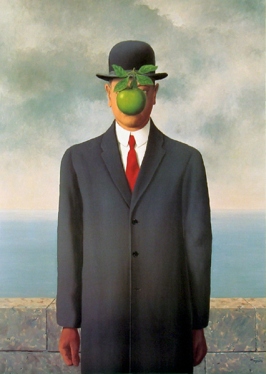
She steps from the sky with the “misunderstanding of a Magritte.” Rene Magritte was a Belgian surrealist painter born in 1898. You’ve probably seen his apple-face-guy, the Son of Man:

Ren? Magritte, The Son of Man, 1964, Restored by Shimon D. Yanowitz, 2009  øðä îàâøéè, áðå ùì àãí, 1964, øñèåøöéä ò"é ùîòåï éðåáéõ, 2009

Magritte’s brand of experimental modernism is entrancing. His impeccable symbolic style influenced Pop Art of the 1950s. I’m not an artist (just check any section of Akayama DanJay) or an art historian or anything like that, but I do have art-critic Robert Hughes’ introduction to The Portable Magritte to vouch for me in Magritte’s applicability to the story I’m trying to tell.

Says Hughes,

Magritte’s turning point was 1927, when he went to live in Paris. There, immersed in the Surrealist movement, he was no longer a provincial spectator. And he quickly realized where his contribution to it might lie… in hallucinatory ordinariness. …Magritte’s combinations [of ordinary objects] were another thing entirely. His poetry was inconceivable without the banality it worked on and worked through: it subverted ordinary naming.

Magritte’s paintings have a knack for pointing to the illusory nature of reality. His painting The Human Condition is my favorite:

renc3a9_magritte_the_human_condition

Says Hughes,

The canvas on the easel bears a picture of the view through the window, and this picture exactly overlaps the view, so that the play between “image” and “reality” inside the fiction of Magritte’s image asserts that the real world is merely a construction of the mind.

When I look at that painting, my first question is “does the picture on the canvas accurately reflect the real view through the window?” This is precisely the trap Magritte has laid: there is no real view through the window. It’s a painting. In the same way, we might try to “peek around” our sensory perceptions to glimpse reality as it truly is, but that glimpse would necessarily be filtered through sensory perception. No matter how hard we try, we cannot wrangle objective reality. These words on your screen are filtered through your mind, which lies to you every night when you dream. If there exists something called an “I” it is a bubble of lies which pops when self-observed.

Akayama DanJay begins with Dan dying and touring the afterlife. When he is obliterated, he returns as Jay. Is Jay’s memory of being Dan a dream? Is Dan’s experience as Jay illusory? The continuity of DanJay’s consciousness across the afterlife and back is my attempt to reproduce, in writing, the effect of Magritte’s The Human Condition. Which parts of DanJay’s experience are real? Are his hallucinations a greater reality than his perceptions of waking life? Of course not! Akayama DanJay is fiction. None of it is real! Our mind betrays us by imagining reality when there can be no such thing.

Not everything in Akayama DanJay is ordinary. Crickets grow like grass from the ground.  A bird-monster scours the afterlife. But the characters don’t treat crickets as unordinary, and the bird-monster appears only in hallucinogenic stupors. I hope to blend the normal and the weird so thoroughly that the reader never knows what to expect. When the characters are supposedly sober, they see congregations of monks worship a pink penguin. When the characters hallucinate, anything goes, yet their visions have internal consistency.

Anyway, that’s why I mentioned Magritte. Even my crude artwork sometimes echoes his composition and themes.

D3 pict

I hope this was interesting, because I’m grasping for ideas to write about as commentary. I don’t have much writing advice, because I mostly wing it. Maybe I’ll just talk about one of my inspirations every week!

See you next Friday. Keep eating your worms!

Next Chapter
Table of Contents

Fighting Dirty

In Chapter U. Spokes Lucille distracts the Enemy Hurricane while her Galaxy Zephyr’s Wheel is repaired. Long-time readers know Faith is wrapping the Wheel with Beatrice’s wing to subdue the bulge. This means the lightning bolt which killed Faith also caused the bulge which Faith mends. The bolt caused two problems, one of which solves the other. With Faith, every problem is its own solution. Closing doors opens windows.

In the same way, the Enemy Hurricane birthed the tools of its own destruction. Besides frightening Akayama’s Hurricane Planet into following the professor’s every order, it caused the perfect storm to generate its executioner, Commander Lucille, by killing her parents.

Admittedly, the Hurricane Planet which killed Lucille’s parents eventually pledged allegiance to Akayama, but since all Hurricane Planets used to be identical, it’s not a stretch to blame the Hurricane in general. Also admittedly, that Hurricane Planet didn’t actually kill Lucille’s parents: Commander Bojack self-detonated to protect his crew, and Princess Lucia died as a result of over-exertion.

Yet Lucille blames the Enemy Hurricane for the death of her parents, and she’s not totally wrong. The Hurricane created a universe in which robot-pilots had to put themselves in danger to protect the galaxy. In this sense, just like the lightning bolt killed Faith and caused the bulge which Faith repairs, the Hurricane threatened humanity in a way which generated its greatest enemy, Commander Lucille. She doesn’t care about technicalities. She doesn’t even care about Earth. She has nothing to lose or gain by fighting; fighting is its own reward and she relishes every instant.

Lucille demonstrates this by fighting dirty. The Enemy Hurricane fights dirty, too, so really, it had this coming.

When Lucille asks the Enemy Hurricane about her parents, she’s leading it on. She knows it’s lying. She’s playing dumb to invite foul play. She insists only that the Enemy Hurricane return her parents as ‘ordinary, breathing humans’ so she may inspect them.

The Enemy Hurricane makes facsimiles of Bojack and Lucia to lure Lucille close. Both replicas are traps meant to kill Lucille in front of her crew. Lucille preempts the favor by tearing out her parents’ throats, exploiting her insistence that they be ‘breathing.’ The situation is really her own trap. If her parents’ facsimiles were really copies of the Enemy Hurricane, then she kills it in front of itself three times (she kills Bojack in front of the Enemy Hurricane AND Lucia, then kills Lucia in front of the Enemy Hurricane). By baiting the Enemy Hurricane she delivers poetic justice, perhaps to a degree which could be considered overkill.

Is it really fighting dirty if you match your opponent tit-for-tat by predicting their deception? One might argue turnabout is fair play. Lucille, the stand-in for Lucifer, has a knack for exploiting her opponent’s attempted treachery. It’s common to say that super-heroes shouldn’t kill super-villains because then “they’d be just as bad,” but Lucille doesn’t seem to mind being bad as she wipes blood off her jaw.

Lucille also points out “It’s just us and the Hurricane. Legality falls with the chips.” It’s hard to justify, say, adhering to the Geneva Convention after Geneva Switzerland has been vaporized. As the only two entities remaining in the entire universe, the positions of the Enemy Hurricane and the Galaxy Zephyr can only be stated relative to one-another, speaking both physically and morally. Lucille is the equal and opposite reaction to the reality-devouring entity which produced her.

Also notice, the Galaxy Zephyr would have no hope if the Enemy Hurricane didn’t destroy Earth. Without Earth’s destruction the Galaxy Zephyr would have no Wheel. It wouldn’t have Beatrice’s wings or Faith’s assistance. Every step of the way, the Enemy Hurricane’s displays of power only manage to doom itself. It lacks Lucille’s satanic charisma, the quality which allows her to violate battle-decorum.

Keep eating your worms.

Next Section
Table of Contents

Writing with Color

In J2: Sheridan Jay drags Dan to the town in Wyoming where Faith first met Virgil Blue. Faith’s Uncle Bob asks Jay for a frozen-slush-drink-thingie from a gas-station. Jay brings him a blue one instead of an orange one.

I don’t pay conscious attention to details like color when I write my first drafts. I try to use a variety, but I don’t go out of my way to use colors with special meaning. Meaning is a second-draft concern, when I can recall all the colors I intend to use, and mix them and match them.

Akayama DanJay is about the unity of opposites. Blue and orange are famously opposite; movie posters use blue/orange color contrast to get people’s attention all the time. We often think blue is the opposite of red, but most color wheels disagree.

Dan wears orange robes and orange shirts (he briefly wears blue in mourning after his father’s death). He meets Jango’s Virgil Blue, who wears blue (obviously). After Virgil Blue sends him to the afterlife and Dan meets Anihilato, Dan becomes Jay (or Jillian), who is associated with the color purple. This symbolizes Dan’s internalization of Virgil Blue’s lessons: orange and blue make grayish, but it’s close enough to purple (blue and red) to get the point across. Even though Jay does not totally remember his past life, its indelible impression remains.

Leo wears red. Red is close to orange, and red is associated with strong emotion. So, Leo is shown to be angry and passionate and irrational, and Dan is shown to be not much better. Jay’s redness is tempered by the wisdom of blue.

The Heart of the Mountain is also blue, but it shows the different kinds of blue available. There’s sky-blue (which Jango wears) and dark blue (which the previous Virgil Blue wears).

D2 pict

The Heart’s dark blue parts are harsh: they are binding tentacles and limbs. The sky-blue robes hide the harsh reality. Jango’s Virgil Blue is a kinder version of the Virgil Blue before him, who is cloaked in navy.

The Heart also has yellow and green. Yellow reminds me of the sourness of lemons and the painful brightness of the sun; the Heart’s hard, sharp beak is yellow. Yellow and blue make green, so the Heart’s green eyes combine an unpleasant burn with wisdom and understanding. God’s glare of judgement is penetrating and scrutinizing, but compassionate and accepting.

Faith is white, symbolizing purity. Whatever happens to Faith she escapes unstained. Beatrice is also light-colored, but her texture is cloudy. She’s more distant and reserved, but just as pure as Faith, if not purer. Combined with the rest of the Beatific imagery, we understand Beatrice to be a figure of supreme spiritual power in the universe of Akayama DanJay. But she is clouded and opaque; none may view her from outside. Dan’s only path to Beatrice is through Faith.

Inside the Mountain, the yellow and blue skies mix into green.

In LLS-TA, there are robots of every solid color, just like Sheridanian Big Birds.

F1 pictb

I hope this color-commentary seems intriguing, because I’m not totally sure where I’m going with it. I just want to make sure colors have enough meaning to allow for some apotheosis by the end.

That’s it for this week. Keep eating your worms!

Next Section
Table of Contents

Conspiracy Theory

In J1: Uncle Featherway Jay interviews the conspiracy theorist with tinfoil lining his fedora. Uncle Featherway’s impression of Virgil Blue happens to involve space-aliens and cargo cults, just like the grand unified theory he outlined for Faith in C1: The Sheridanians. Like he tells Jay, sometimes we see what we want to see.

Jay doesn’t seem to take Bob Featherway’s conspiracy theory too seriously. Jay humors Bob by saying things like “huh” and “hm” and “how insightful.” But as I said in this commentary, I find the idea of an objectively true philosophy philosophically unfounded. As Jango says, there are no coincidences; maybe Bob’s onto something with his aliens.

So let’s talk about conspiracy theories.

In a broad sense, everything we think we know is a theory. When you’re trapped in Plato’s cave you have to guess at the form of some so-called ‘reality’ based on your sensory perceptions. We assume there’s something called an ‘I’ because we have to assume something at some point, if we want to say anything about anything. This relates to Hume’s problem of induction, which calls into question our ability to ‘know’ anything in the first place.

That’s not to say that everything is a conspiracy theory—just that everything is, in a philosophical sense, unproven. A conspiracy would require some agents behind the scenes acting to fool us. So, in the case of whether sensory perceptions can be trusted to assure us of our personal existence, we have to ask who could possibly be pulling the strings.

Rene Descartes said Cogito Ergo Sum, I think therefore I am. He reasoned that even if God or some all-powerful demon tried to deceive him into thinking he exists—well, he’d have to exist, in order to be fooled.

Is that a conspiracy theory? It’s sort of a mathematical proof which obnoxiously proves a point without providing a satisfactory reason. It shows that we exist because, for contradiction, if we didn’t exist, but we believed we exist, then the thing which is believing is the thing which exists, which we can call “I.”

Can “the thing which is doing the believing” be called a conspirator? I don’t see why not. It’s the thing which convinces us we exist, whether or not it is our self. If “I” exist, the conspirator convincing me I exist must exist as well.

So in order to keep up the illusion of a self which exists, we must add things to its definition. Things become self and non-self. Our nose? Probably our self. Our feet? Yeah. The food we eat? Maybe, while it’s inside us. Our heritage? Of course. Our religion? Equal to reality, which we call the self. Our ideas? Well, what else could be called self?

But once our ideas become self, other ideas become non-self. Suddenly every theory you don’t believe is a conspiracy theory by virtue of its propagation by the “other,” the “outside.” We form social circles like cell walls to maintain the integrity of the ideas we associate with ourselves, which has suddenly become a group self. We cease to be individual organisms and become amoebas of ideas whose pseudopods are all our bodies, and whose sense organs are all our minds, and whose interstitial fluid is media distributing rhetoric.

Maybe this is what Krishna meant when he spoke to Arjuna of the science of uniting the personal self with the universal self. Or maybe this is what Krishna meant for Arjuna to avoid, in associating with a particular group instead of with the whole. Or maybe both are the same.

Personally, I’m a trivialist. I believe all things are true. I understand there are a great many arguments against trivialism from brilliant philosophers through the ages dismissing the idea as “absurd” and “pointless,” and I totally agree with them. I agree with everything; everything is true. Everything is also false, and every other possible state, and in a super-position of all values at once, because all categorization is meaningless, including meaninglessness.

Relating this back to the sense of self, surely I exist. I also don’t exist. I am realized and derealized. I’m a non-sentient automaton and the one true God peering through everything’s eyes at once, and any other statement you’d like to label me with. All comparative statements are tautological.

But that’s just, like, my opinion, man.

Next Section
Table of Contents

Divine Revelation

In my commentary to H4 I discussed the Beatific vision. The Beatific vision is usually meant to represent the ultimate divine revelation, but not quite so in Akayama DanJay. In Dante Alighieri’s dreams, his unrequited, courtly love Beatrice Portinari ate his heart to purify him for God. In Akayama DanJay the Beatific vision is understood to be preparation for the ultimate divine revelation, not the thing in itself.

In I4: Inside the Mountain Dan walks along a wide white path. This is the reader’s first glimpse of the inside of the Mountain.

Close readers will remember that the white wing which becomes Dan’s path belongs to Beatrice; when she’s hit by a busshe appears in the afterlife as a giant Zephyr. The Heart of the Mountain said no one should enter the Mountain unless they never hoped to emerge; somehow Beatrice’s wings allow Dan and Faith to enter the Mountain and return.

The inside of the Mountain represents some kind of ultimate reality, outside of life and death. Dan follows his path and quickly determines how to walk it in a way which satisfies his senses. Then he finds a goal, the sun. His path doesn’t lead to the sun but another path does. He changes paths.

The character ‘DanJay’ is associated with the number two. DanJay has two lives, once as Dan, once as Jay. Jay opens an egg with two yolks. Here Dan walks two different paths.

The second path nears the sun, and Dan is hit in the head with an egg. The egg orbits the sun, which the Heart of the Mountain claims births reality. If the egg merely orbits birth without moving further from it or closer to it, it must be stationary in its life’s progression. Also, the bird looks exactly like the bird Anihilato presents to Dan. (As the Heart of the Mountain says, even things outside the Mountain are in the Mountain.) Anihilato’s eggs are not things which are utterly obliterated, they are things which are held in stasis.

The Biggest Bird, the Heart of the Mountain, wraps its wings around Dan. Perhaps this movement is affectionate, but maybe the hug is to hold Dan back from the sun, lest he lose himself to devotion.

Dan says reality is shaped like a high-dimensional torus, and describes that shape as a circle swept in a circle swept in a circle. A torus is like a donut.

In the ParadisoDante Alighieri describes heaven as a series of concentric circles. The highest circle is beyond the material plane and is the abode of God. Here Dante understands predestination and comprehends the full glory of the divine trinity.

Ezekiel describes wheels within wheels like gyroscopes which are the chariots of gods, encircled with eyes.

For research I subscribe to r/Psychonauts, a subreddit where people describe psychedelic experiences. In that link they describe cognition and reality as a torus.

In my senior thesis I describe the De Bruijn Hypertorus, a combinatorial object in discrete mathematics which contains every possible combination of binary elements with length two in any finite number of dimensions.

There is divinity in the donut. Even Stephan Hawking considered the possibility of a donut-universe.

So, the idea of a high-dimensional torus representing the ultimate conception of reality presses a surprising number of buttons. It’s consistent with multiple conceptions of the religious ultimate including the entheogenic. It relates to concepts in topology and mathematics. And it might just be the shape of the universe.

But anyway, who knows. Keep eating your worms.

Next Chapter
Table of Contents

Wasting Time

In I3. The Agony is Over Dan sculpts himself from froth. I had considered joining this section to the one before it. Both sections are barely 1000 words, and relatively little happens in them: Dan says nothing and hardly moves twenty feet. Most of these sections are devoted to disturbing imagery.

In a narrative sense, these sections could be considered a waste of time. They hardly move the plot forward even if they explore Dan as a character. We don’t learn anything new about the afterlife, as we’ve been there twice before. If these sections are a waste of time, should they be shortened or cut?

Maybe. But I like these sections as they are. Here are a few notes in defense of wasting time.

1. The reader needs time to process.

Not every chapter can kill a main characterkill a main character’s dadreveal secrets about an antagonist, and propose a cognitive explanation for religious experience. This is a chance for the reader to lean back from the heavier fare of Chapter H and enjoy an unadulterated glimpse at the Teeth that Shriek.

2. These scenes let me experiment with our thematic imagery.

Dan is initially an amoeba, a formless mass, tabula rasa, a blank slate. But Dan’s feelings of anger and guilt manifest as the Teeth that Shriek. Once he collects himself he decomposes into a puddle of water and a pile of worms. Faith carries the worms away and the puddle recreates Dan entirely. If worms represent the physical aspects of human existence, the puddle is the intangible aspects.

Dan is an allusion to Dante Alighieri, the poet, and Dante, the character in The Divine Comedy (as it’s not clear the author meant his character to literally be himself). Dante, the character, is something of an allegorical everyman. His journey through hell, purgatory, and heaven is a tour for the reader of the possible outcomes of life. My Dan is also an everyman; he’s a specific person, but he represents man’s mortal nature.

His experience building himself out of water shows that man’s nature is not based on his raw physicality. When the worms are gone, some water remains. From the foam of this water we sculpt ourselves.

3. This is necessary for Jay to know, to provide tension.

The character ‘DanJay’ begins as Dan, dies, and is reincarnated as Jay with hardly any memory. Jay is not the mortal everyman like Dan: Jay has transcended death in his reincarnation. If death isn’t an obstacle, where is the tension in Akayama DanJay?

When Jay hears about Dan’s experience with the Teeth that Shriek, it must be like remembering trauma buried deep. Jay was Dan. He knows precisely what’s at stake when he messes with centipedes and the afterlife. If Jay has a bad trip, or if he dies and wakes in the afterlife, he might be trapped forever in a ball of shrieking teeth. Could he save himself again, or was Dan’s reconstruction a lucky fluke?

Overall these scenes might not move the narrative forward, but they contribute something invaluable to the narrative anyway. Every story benefits from breaks in the action, thematic clarity, and high stakes. In Akayama DanJay the worst possible ending is eternal, self-inflicted torment.

Next Section
Table of Contents

Body Horror

In I2: Ten Thousand Earthworms Dan gives the reader a closer look at the Teeth that Shriek. The last time we saw the teeth, I explained that they represent panic and anxiety. Today Dan consumes himself with terrible teeth in some sort of psychotic breakdown. On psychoactive, hallucinogenic centipede-dust, this breakdown manifests as a living nightmare.

I have a history with horror. As a kid I watched horror movies knowing that the scary images would be burned into my mind. I knew I’d lie awake imagining monsters in my closet. And yet, I couldn’t look away. Nowadays I enjoy watching horror movies, especially surreal flicks like David Lynch’s Eraserhead and practical-effect showcases like John Carpenter’s The Thing. If a scene lingers in my mind, that’s just the mark of a well-made movie.

A common thread in many of those movies is body horror. The Thing mutilates people and shape-shifts into awful monsters. Eraserhead‘s supposedly human child is an inhuman shape inspiring morbid curiosity. As humans, we have a mind-map of our body. The idea of altering that mind-map is disturbing. The thought of uncontrollably becoming something wretched is terror of a fundamental sort. Compare to Kafka’s Metamorphosis.

Torture-porn movies like the Saw franchise try to ground this terror in reality (sort of). I prefer abstracting that terror to the rules of the subconscious. In David Cronenburg’s Videodrome, the main character’s firearm is fused with his flesh; in deciding to kill, he binds himself irrevocably with the concept of killing. Tetsuo the Iron Man has a character’s penis mutate into a power-drill which kills his girlfriend.

Now, in Akayama DanJay, Dan turns into a ball of nerves and gums consumed by his own teeth. He is like a “cramping gonad” and grows an impacted narwhal tusk. It’s obviously an unpleasant experience.

Then he manages to pull himself together. As a person with anxiety, Dan has probably practiced breathing exercises before; he seems to use the technique to withdraw the teeth. With concerted effort Dan is able to retrieve even the narwhal tusk and subsume it back into his form.

Then he melts into earthworms. I’ve previously mentioned that earthworms are the souls of sentient beings; death forces humans to be humble, so it only fits that our souls are disgusting, wriggling piles. The earthworms that were Dan squirm in a puddle combining into bigger and bigger worms. When all of them have combined, the worm-thing tries to escape into the desert.

What must it look like, this worm-thing? My crude artwork notwithstanding, I imagine it looks like a human brain: a ridged, pink mass. This pink mass rejects the Mountain even though half the characters in Akayama DanJay seem to worship the Mountain as Heaven and God rolled into one. The worm-thing seeks only darkness in cool, damp soil. Even when humans know better, we seek sensory pleasure above all else.

But Faith the white fox catches the worm-thing before it can go. The Heart of the Mountain told her to take it to Anihilato in the last section, so she whisks the worms into the desert.

Anihilato eats earthworms. Is this a good thing? Is this a bad thing? We’ll have to wait and see. Thank you for reading!

Next Section
Table of Contents

Breaking Bad

In I1. Salt and Alcohol Dan cleans a bong. We’ve gone full circle: the bong named Leo from C3 has now been properly introduced. I didn’t think I had much commentary for this section, but I’m watching Breaking Bad right now and I realized that Dan’s downward spiral is worth reviewing.

Breaking Bad was a TV show about a high-school chemistry teacher who starts cooking meth when he’s diagnosed with cancer. It was and still is highly regarded, not least for its grim depiction of an ordinary man whose decisions drag him deeper and deeper into a life of darkness.

Dan’s experimentation with drugs is totally different (in fact, I only mention Breaking Bad for search-engine-optimization). But Dan’s still an ordinary-ish person, and his path from normalcy to a horrifying drug-trip is illuminating.

In the last sections we’ve watched Dan watch his dad die. We’ve watched Dan’s smoldering anger stoked by Leo. We’ve watched Dan leave his beloved Beatrice to pursue that anger. Now even Faith has kicked him out. It’s not much of a stretch to think Dan would want to unwind with some substance abuse. He smoked his first cricket the previous night with Beatrice; maybe he hopes to recapture the magic of that moment by smoking some ground-up cricket from Leo’s bong.

But not before he cleans it. In cleaning the bong, Dan externalizes his desire for self-cleansing. He names the bong Leo and throttles it to further externalize the parts of himself he does not want to acknowledge. He wishes to undo actions, rewind time, and absolve himself of perceived sins; he only manages to scrub the bug-crust from his water-pipe.

Dan’s meticulousness in cleaning the bong makes it a little ironic that he doesn’t make sure the bong contains only cricket powder and not any centipede. In later sections, when Dan regains his composure but is still hallucinating, he’ll wonder if Leo purposefully prepared the bong with centipede powder to trick Dan (which is ridiculous; Leo couldn’t have known Dan would end up with the pipe). But it’s possible Dan realized there might be centipede in the bong. In Dan’s mind, he’s lost everything he lived for. If he smokes centipede, so be it.

His bad drug-trip begins so abruptly I don’t soften the transition: I throw Dan from his couch into the afterlife. Dan appears as an amoeba in unthinking agony. He has no arms or legs or sense organs; he’s built only to be torn apart by teeth. The teeth inside him mirror the jagged salt and burning alcohol he used to clean Leo.

He has no mouth but he tries to scream, a quick reference to a famous short story with that title. In that short story, a giant computer torments the last remaining humans and turns one of them into a blob which can’t scream. Eventually we’ll learn this reference is a little on-the-nose, but so far we haven’t seen any giant hell-computers in Akayama DanJay.

The Heart of the Mountain wanders by Dan and apologizes for not being able to help him. The If Dan gets out of this situation, he’ll have to do it alone.

Thanks for reading! Keep eating your worms!

Next Section
Table of Contents