
Crafting a Culture

In E1. The Red Card-Stock Pamphlet Jay reads the pamphlet Faith got from Virgil Skyy. He’s still hallucinating, so he interprets the pamphlet’s religious message as a command to visit the Islands of Sheridan. In Chapter F, we’ll travel Sheridan and learn about the people who live there. Until then, this red card-stock pamphlet lays the groundwork for world-building.

World-building means making up cultures, places, and peoples for the universe of a fictional story. Good world-building can mean the difference between boring characters against copy-pasted backdrops and interesting characters who interact with fleshed-out areas and ideas. Some triumphs of world-building include Harry Potter and The Lord of the Rings. If anything, Harry’s rivalry with Voldemort is an excuse to give the reader a tour of Hogwarts. Lord of the Rings is just a jaunt across a continent so J.R.R. Tolkien can make readers witness his linguistic inventions.

The common element of stories with great world-building is the interaction of the fictional setting with the themes and plot. Hogwarts changes as much as Harry, sometimes a safe haven and sometimes a war-zone. Tolkien’s linguistic efforts built the elves and dwarves we know today and sent them on a quest.

In Akayama DanJay, the Islands of Sheridan are remote to reflect their reclusive, mysterious, and thematically significant religious traditions. For the same reason, in section A1, I show the islands only briefly before focusing on furtive monks. In B2 Jillian’s teacher warns of secluded islands where crickets grow. Until Virgil Jango Skyy reappears in C1, all we know about Sheridan and crickets and centipedes is hearsay. Even Jango is tight-lipped, refusing to tell Faith a story about the Biggest Bird because she is not a monk in C2. These details make Sheridan seem a secretive place with mysteries to solve. The reader does not know what to believe yet, but should be eager to learn more.

The pamphlet provides the reader with concrete details about the islands, but Jay’s mental state means we can’t trust what he reads. Even if we could, it’s still surreal and raises more questions than it answers. Is the Biggest Bird the same creature as the Heart of the Mountain? Is “the Mountain” the mountain Jay and Faith saw on their drug trip? If so, why did the bird make Sheridan, and why did it leave? What’s its plan? Who is this Nemo person, why were they named Virgil Blue, and why do the islands follow Virgil Blue’s word? Why are the three commandments such random things like “don’t eat centipedes” or “don’t take pictures of birds,” instead of normal religious commandments like “don’t steal” or “don’t murder?”

These are questions the reader might ask themselves, and therefore it’s my responsibility as a writer to make sure most of them are answered. Every domino I set up should be knocked down. Anything which occurs in a story but does not contribute to the themes and plot of the story should be cut, even world-building work the writer is proud of. Make each big element of your world impact the story at least three times: when it’s introduced, once again as a reminder, and one last time as a resolution to some conflict, a payoff.

In Akayama DanJay, Jango mentions the Biggest Bird in a conversation to Faith, but refuses to tell her its story. Then Jay and Faith meet a big bird, and Jay reads about the Biggest Bird in the pamphlet. On the islands we’ll see more reminders of the bird’s presence and influence in worldly events. Eventually we will see its story firsthand, and it will answer some long-lingering questions.

Smaller details might not need to be repeated as much for impact; they may be set up and then later called back for a payoff, or a punchline. In this pamphlet I mention several religious sects who will appear along Jay’s journey. I’ve set them up, Jay will interact with them for the payoff, and the reader won’t mind if they don’t appear again.

So world-building can be fun, but a dedicated writer should make sure it’s in service to the story. There’s another concern which I’ll address in more detail as we see more of Sheridanian culture:

In crafting a culture, one must be aware of cultures in real life. If a fictional society is too far removed from feasible real-world cultures, it may ruin the readers’ suspension of disbelief. Too closely copying a culture will make the writing appear lazy, if not offensive. In the case of Sheridan, I’m trying to make a religion which reminds readers of real religions without stealing those religions wholesale. On these islands exists a complex ecosystem of practices borrowing from island cultures and multiple varieties of monasticism, Christian and otherwise. Maybe I’ll discuss specific influences as we see them.

Meanwhile, thanks for reading! I’m having a great time writing and talking about my process. Next week, let’s see how leaving out details can increase the impact of events. Keep eating your worms!

Next Section
Table of Contents

Scene Transitions

In D4. The Man on the Mountaintop Jay returns to the realm of the living. The way he finds himself back on Dan’s couch demonstrates his still-altered mental state: he transitions from looking outward at a man in the sky, to looking inward at an anime robot on his own T-shirt. If I handled this transition well the reader should feel just like Jay, adrenaline rushing as they remember their location, like waking up in a hotel room. Maybe they’ll reread the paragraphs to take in the magic trick. Like a cinematographic dissolve, this transition aids the flow by moving the narrative while subtly contributing to the themes of the work overall. There may be spoilers for Akayama DanJay ahead, so be warned!

A scene transition can be notated with one of these things:


That line’s a hard break. Maybe the point of view and setting change over that line. A line like that makes a nice place to put a book down and take a breather. Gotta digest the last scene before moving to the next.

That’s precisely the reason I couldn’t use a line to bring Jay back to our world in D4. I didn’t want to allow the reader that pause. I needed to thrust the reader bodily across dimensions. The reader must be as shaken as Jay so that his actions make sense: of course he’s not acting perfectly logically, his world is dissolving around him!

Abstract transitions like this, from one subject to a related subject so quickly that the two concepts fuse in the audience’s mind, are perhaps most popular in film. Directors must carefully choose how to thread scenes together using cuts to transition the viewer from the previous scene to the next. The connection between scenes can be subtle, or it can be emphasized for shock. In a boxing movie you can bet a conversation will be cut short by a shot of a ringing bell. In comedy the Gilligan Cut can draw a cheap laugh: just show a character saying “I’ll never to that!” and then show the character doing that. These cuts can reset the setting, tune the tone, and imply connections between the scenes they combine.

So what does Jay’s transition say? Aside from the way it whisks the reader around, what does it contribute to the piece?

Jay sees a man in the sky. Such a cosmic man should be a deity, or a God. In a Dante’s Inferno allegory, God must be an important figure. Jay is communing directly with the upper echelons. But the godly figure is not in the sky. Jay is actually looking at his shirt. He’s looking at his own chest—inside himself. This transition, and the way I’ve avoided the hard line,


directly shows Jay’s internalization of higher power. Dan died an incomplete person, and his incompleteness drove him to Limbo. Now, reborn as Jay, he contains the celestial whole. He is complete and self-contained. He has traveled to another world and retrieved a symbol of inner holism, and he’ll only get stronger from here.

Moreover, that God turns into the robot on Jay’s shirt—the Zephyr, from LuLu’s Space-Time Acceleration. Eventually we will learn there is literally a giant anime robot in space. The reader won’t get to call bullshit; I’ve spoiled the ending for them with this transition. They should have seen it coming.

Have you seen 2001: A Space Odyssey? In the beginning a monkey throws a bone into the air and it becomes a spaceship, through a jump-cut. It whisks the reader through time and space, implying all of human evolution in an instant. I’m sort of attempting the reverse: a space-man becomes a shirt. It’s one last call of the extra-ordinary before we return to the normal world, giving the reader a taste of what’s to come.

‘Till next time, don’t forget to eat your worms!

Next Chapter
Table of Contents

Anxiety and Panic

In D3: She Has Arrived the new Zephyr is flung into the Mountain. This causes a quake which breaks both Jay’s knees. His knees quickly right themselves, but the psychological impact dealt is devastating. Like Beatrice says in C4, panicking is the worst option on a psychedelic. On centipede dust, panicking leads to the Teeth that Shriek.

As a writer who grapples with issues like anxiety and depression, I find the conflicts in my stories reflect my mental state. In high school, when I worked 14 hours day to keep up with frankly inhumane homework expectations, I wrote a short story about Hercules fighting a multi-headed hydra. When the hydra died, two more hydras appeared. It turned out their tails were connected to a meta-hydra, and whenever one hydra died, two hydras would grow from the meta-hydra. Hercules had to kill the meta-hydra. But having done so, four more meta-hydras appeared. There was a mountain-sized meta-meta-hydra, whose neck birthed four meta-hydras each having hundreds of hydras. Hercules hung himself. I find that especially depressing in retrospect, as Disney’s Hercules was my childhood hero. Somewhere along the way I lost my faith.

During my next project I was taking antidepressants. I wrote a story about a world where recreational drugs were replaced by arcane rituals which also summoned monsters. Some monsters were harmless, but some monsters were huge, dangerous beasts. The main character was a woman who hated these monsters and the people who made them. She joined a group which fought those largest monsters. Injured in the line of duty, she turned to making monsters herself as painkillers. Soon she was addicted. It turned out these drug-monsters were sent by an extra-dimensional deity called the Skull God, who needed humanity to be addicted so he could infiltrate our universe.

After the first draft, some kid shot a bunch of people near UCSB, where I study math. I felt affected by the shooting and didn’t really have anyone to talk to, so the second draft made oblique references to the event: the Skull God was more needy and pathetic. His lines were drawn from the shooter’s manifesto, and when the main character decapitated him and beat his skull to dust, he moaned and cried about having been the supreme gentleman.

In college my workload decreased, but the competition between the students increased. I wrote a story about a man who must win a hundred mile footrace against a horse. By the end, both man and horse were bloody and hallucinating, barely able to lurch forward. The horse’s rider was a cruel man who used any tactic to drive his animal on, leading to its collapse just before the finish line. The main character crawled across the finish line with a torn knee.

For a lot of college, I felt lonely and misunderstood. I wrote a story about a minotaur whose experience escaping a labyrinth helped him excel in a game like chess. The surface world made him a political pawn, having him play the game against ambassadors as a demonstration of military superiority. The main character, a woman who used to be the world champion of the game and a respected political figure, initially reared him to be that pawn. But by the end she learned to appreciate him. When he hid in a labyrinth, she came after him. She found him when no one else could, or even tried. With her help the minotaur made a political statement not just for his home country, but also for other groups of mistreated fantasy animals.

Of course, in The Bucket, alcoholic chemist Arnold vomited up extra-dimensional being Trip. Trip needed Arnold to keep drinking and vomiting to take over our universe. I’m not an alcoholic, but when I learned to really drink (in Japan), I saw how alcohol dependence could affect a person. The Bucket shows my interpretation through Arnold’s struggles appeasing the monster he hurled into a bucket. This marks a turning point for me: I didn’t write about alcoholism because I was dealing with it. I chose the theme purposefully. Addiction is powerful and universally understood.

What I’m trying to say is, I think stories which are just about anxiety, or depression, or loneliness, or love, or whatever—those stories are missing the point. Writing has power to marry the murky objective world to ultimate subjective clarity. Genre is not a backdrop: it is a tool, like a drill. We must select our tools and machine their pieces finely, so our final product has power.

I’ve had panic attacks before. They’re not fun, like the opposite of an orgasm. A great acid reflux of shame and guilt and worthlessness. But just writing that in a book won’t make people understand. To convey the power of panic, I must reach both hands into the wealth of vital human imagery, the realm of the subconscious, where Hercules fights hydras and the minotaur haunts his maze.

This article from NPR shows where we feel emotions. Anxiety is a hot iron ball in our chest. Shame is on our cheeks and in our throat. That’s where Dan and Jay feel the Teeth that Shriek. The words ‘Teeth’ and ‘Shriek’ require a high-pitched whining intonation, which might cause anxiety. To have vulnerable tissues bitten by uncontrollable teeth seems primordially nightmarish, and shrieking would be an appropriate response. This is the symbol which will represent pure, self-destructive panic.

I hope you can agree it’s more powerful and more universally interpret-able than describing a panic attack. Now someone who has never been seized by self-destructive fervor is forced along for the ride.

(Why didn’t Jay panic while falling onto the Mountain? Look back at D2. Jay’s dark humor saves him from losing control. From there he keeps a cool head running through fog from the Mountain’s Heart. When Faith appears he turns maliciously compliant, telling the Mountain’s Heart he had been thrown onto the mountainside. Then he’s solidly assertive. It takes both kneecaps broken to knock him from his high-horse. Jay is clearly a sturdier fellow than Dainty Dan, but he has his limits. Grievous bodily harm would push anyone to panic.)

Next Section
Table of Contents

Constructing Parallels

In D2: The Wheel Spins we see the same brushstrokes I’ve painted since the beginning. In writing, ‘parallelism’ specifically refers to repeated sentence structure, but let’s broaden the term. We’ll call something a ‘parallel’ if it echoes an earlier scene or even another work. As writers we may construct scenes in parallel to one another to highlight differences between characters or show a character’s growth. Today, let’s look at some examples from Akayama DanJay and other stories.

You folks know Star Wars, right? The prequels aren’t great (in fact, they’re not great at all) but at least Anakin is a dark reflection of Luke: they come from the same planet; Luke’s Uncle and Aunt and Anakin’s mom are killed while they’re away; they both get robot bits; and so on. The parallels starkly portray the characters in opposition to one another by forcing them to grapple with the same threats. That’s why it’s so powerful to see Luke in black at the start of Episode Six; we saw Vader’s descent down the same road. It’s Luke’s ability to leave the path to the Dark Side which differentiates them.

In The Matrix, Neo just gets faster and faster. When the Agents have the upper hand at the beginning they kidnap Neo and hold him stationary and put a parasite into his belly; when he’s freed of their parasite, Neo is in a moving car. Then he learns he’s really been totally stationary his whole life, and learns kung-fu on a future spaceship. The Agents start fast, but soon Neo “moves like they do.” In the end he can go all bullet-time and then flies away. Repeating images and events shows Neo’s increasing power. By using the super-speed motif over and over again there’s no way to miss Neo’s improvement. Where he once failed he now excels.

Now let’s look at Akayama DanJay. In C4 Jay smoked centipede dust, then Faith smoked centipede dust, then Beatrice was hit by a bus. In D1 Jay appeared in the desert. In D2 Faith appeared in the desert. At the end of D2 something appeared over the desert. Wham. By using parallel structure and repeating the same beats, we understand Beatrice is accounted for in the afterlife and the Heart of the Mountain recognizes her as a Zephyr, some kind of powerful being. And technically, Beatrice was led here by a Virgil: Dan, Virgil Orange. Dan even wore orange robes in A1. Everything is connected.

Speaking of A1, Virgil Blue (whose real name is Jango Skyy) leads Dan into a kitchen on his way to a furnace. In A2 Faith brings Dan out of the furnace. In A3 Dan enters Anihilato’s underground lair. In A4 he’s obliterated.

In B1 ‘Dan’ follows his cat Django into a kitchen on his way to his parent’s room. In B2 Jillian meets Faith. In B3 there’s some hellish imagery and Jillian becomes Jay (paralleling Dan’s descent to Anihilato’s domain and obliteration).

In C1 Faith enters a lecture hall. In C2 she leaves the lecture hall and Jango Skyy follows her. In C3 she comes to Dan’s apartment. In C4 she smokes centipede dust, signifying obliteration. (Beatrice’s death reflects obliteration, as well.)

In D1 Jay wakes in the desert and the Heart of the Mountain pries him out of a gorge. In D2 the Mountain’s Heart tries to stuff him in a hole and he’s saved by Faith. In D3 Beatrice is… Well… You’ll see next week.

In this manner I hope to convey a message about death, wisdom, and morality. Jango is a leader; he leads Dan to the furnace. But Faith leads Dan out of the furnace and she leads Jango out of the lecture hall in C2. In this way we see how Faith’s wisdom rivals Jango’s; even Virgil Skyy follows Faith. Consider how Faith leads people around. Who leads who? How do they do it?

Dan follows Jango Skyy as Virgil Blue, and then he follows Django the cat. Django the cat is not Jango; it is Dan’s memory of Jango. Dan follows Django because he followed Jango. But Dan’s Django is orange; it is colored by his perspective. It is almost the opposite of Jango’s sky blue. In this manner we see that Jay is subconsciously chasing the afterimage of Jango, but he is unaware of doing so.

Compare Faith meeting Dan in the desert, to the Heart of the Mountain yanking Jay out of the gorge. Faith waited outside the furnace for Dan. The Heart of the Mountain chased Jay across the desert and snaked a tentacle into his hidey-hole. Faith suggested Dan go to the Mountain but led him where he wanted to go. Jay begged the Heart of the Mountain to leave him alone but the Heart threw him over the dunes. Faith stays with Dan until he makes it clear he doesn’t want to go to the Mountain. The Heart of the Mountain will leave Jay because it finds its real goal in Beatrice, the Zephyr. By setting up parallel situations we show how Faith’s approach and the Heart’s approach differ. Faith is patient and compassionate. The Heart demands results. That’s a thesis statement right there, written in parallels.

In B2 Jillian is worried about meeting people in High School and says she didn’t want to come to California. In B3 she tells Dan that her father takes her all over the world. In C4 we learn Jay travels around the world on his own. Soon he’ll be investigating the Islands of Sheridan. I show Jay’s improvement and independence by showing developing reactions and sensibilities to parallel situations. He’s an adventurer, and showing how he copes with his concerns brings the reader along for the adventure.

Finally, I’ve got lots of worm imagery, and now we have the Heart of the Mountain, a giant bird. Maybe the Biggest Bird and the Biggest Worm should get together. See you next time!

Next Section
Table of Contents

Chaining Sentences

In D1: The Chain is Pulled Jay returns to the desert he visited as Dan. Jay sees interesting images and surprises, but I want to talk about how to make sentences which flow into one another naturally.

I’m a mathematician at the University of California, Santa Barbara, where all students are required to take a certain writing course. This writing course had us writing the same old essays I churned out in High School but I loved the last lesson: sentences flow when the subject at the end of the first sentence relates to the subject at the start of the second sentence. This example is so simple the technique doesn’t add a whole lot, but take a look anyway:

I went to a park with my friend and saw a duck. The duck had yellow feathers.

The last word of the first sentence is “duck.” The second sentence starts by mentioning the duck. This is a simple way to ensure each sentence seems to be a natural extension of the previous. Compare to this:

I went to a park and saw a duck with my friend. The duck had yellow feathers.

Here it looks like the speaker forgot to mention the duck’s feathers until after mentioning the friend. This would be fine in spoken conversation, but in writing we have all the time in the world to reread each sentence and see how it flows into the next. At the end of each sentence we throw the reader into thin air. We must ensure they can grasp the next sentence swiftly, like trapeze artists.

Not every sentence has to lead directly into the next, and not all of them should. But when your point of view is transported to a new area (say, the afterlife, via centipede dust) or characters perform actions which may be difficult to visualize, the concrete linking of sentences can help the reader follow along. Here’s some nice chaining I used in D1:

He slid down the mile-high dune and rolled over hot sand. Deeper sand was cooler and damper until he tumbled into a moist, shadowy crevasse. He pressed his limbs against the narrow walls of the crevasse to slow his descent but found no purchase with the sand. Falling sand revealed tiny holes in the walls, tunnels left by worms.

Hot sand, deeper sand. No purchase with the sand, falling sand. In the middle there’s a stumble with “shadowy crevasse. He pressed his limbs,” but here maintaining the motion of the character takes precedence, I think. Jay has been tossed into a crevasse; he must react. An unbroken motion from action to reaction is another way to chain sentences.

The idea made him anxious and he decided to move. He stood and jogged up the shallow dune.

Jay decides to move, so he stands and jogs. The end of the first sentence leads to the start of the second.

When he finally crested the dune he surveyed the desert. The taller dunes blocked his view but he could now see most of the mountain. It sat on a mesa like a king ruling the rippling sand.

He surveyed the desert and saw tall dunes. He saw the mountain and it sat on a mesa.

When he hit the bottom of the valley he turned to see if the shape had followed him.

A sapphire bird joined the mountain in peeking at Jay over the dune. The bird had great green bug eyes.

Did it follow him? Yes it did. This one seems like a cinematography trick: show the character looking at something, then show what they’re looking at. Act-React. It flows smooth and easy.

Another way to link sentences is through parallelisms. Repeated words and phrases in succession can hammer in a point or note a contrast. Look at this:

When my political party was in power, blah blah blah. When your favorite political party was in power, blah blah blah.

Even though it’s abstract we can’t miss the fact that the speaker is comparing political parties. If it weren’t abstract, we would know precisely the perceived difference between the two parties. Politicians must be masters of rhetoric to make their points clear and to make sure their voters have strong-sounding phrases to shout at one another. Here are some parallel lines in D1:

“One, two, three, four, five,” he counted on his left hand. “Six, seven, eight, nine, ten,” he counted on his right. “I’m not dreaming. I’m awake right now.”

Repeated phrases assert structure. This structure reduces strain on the reader. They know what to expect from the second sentence after the first and I satisfy that expectation. In later sections, Jay will actually be asleep. It’ll be a shock to the reader when Jay violates the parallel structure by counting to thirteen. Here, parallel structure aids flow. Later that flow will carry the reader away, surprising them.

As he rest he noticed he was nude. This wouldn’t be a problem if he were dreaming, but without cover in the desert he would shrivel like a raisin. He also noticed he had no genitals: his crotch was a smooth, flat, rounded area like the summit of the mountain over the dune.

First Jay notices one thing. Description expands on it. Then he notices another thing. Description expands on it. I don’t want to spend the whole story inside a character’s head; when Jay must have a moment of quiet introspection I compact it using parallel structure.

These sentences combine both tactics, parallels and matching subjects at the starts and ends:

He pulled himself to his feet using the East and West gorge walls for leverage and looked North and South. To the North the gorge-bottom grew impossibly steep until it became an overhanging sand cliff. To the South the gorge expanded into a wide valley. He clambered South.

First I mention North and South. Then I describe North. Then I describe South. Then Jay makes his decision, and it’s the option most recently described. This clearly lays out the geography of the location, which becomes important when the Heart of the Mountain chases Jay back into the gorge.

As writers, we fling readers from location to location and from action to action. With an eye for flow, we can make those locations and actions crystal clear in the readers mind by making the text easy to read. The reader should not be left in free-fall for long.

Characters, however, can be in literal free-fall for as long as need be. At the end of this section, Jay is flung. The next section starts with Jay airborne. This is analogous to the chaining tactic we’ve discussed today, on a broader scale! Also, Chapter D parallels Chapter A (but we’ll discuss that next week). The techniques we use to link sentences can be used to link sections! As in the sentence, so too in the section. As above, so too below. And always towards the flow!

Next Section
Table of Contents

Killing Characters, and Japanese

You can probably guess what happened in section C4: Beatrice is Hit by a Bus. It’s generally frowned upon to off side characters just to motivate your protagonists, especially if that side character is the only woman in your story and that’s the only reason they existed. I’ve heard it called “getting fridged,” after an eponymous event in superhero comics where a woman ended up in a refrigerator. I already toyed with the trope when Faith was obliterated in A3 and re-materialized in A4. It seems like Beatrice is gone for good, though, being “smeared” across an intersection, and all. Luckily Beatrice isn’t my only female character, and dying isn’t the end of the road in Akayama DanJay. Let’s talk about how I’ve tried to set up a meaningful death:

Beatrice is a side character but she weighs heavily on the context of previous scenes. Dan mentions her back in Section A4 and wagers his soul to save hers. Throughout C1, 2, and 3, Faith reminds us of her affection for Beatrice. Faith’s conversation with Dan before Beatrice arrives at the centipede-party establishes just how important Beatrice is to both of them.

The reader even gets to watch Beatrice open up. In B2 she’s almost silent (perhaps because Dan is staring at her) but in B3 we learn about her through her relationship with Faith. By the time she dies the reader knows her fairly well. Since I’ve always kept her at arm’s length from the reader, she maintains the unattainable aura Dan sees in her—but she’s a person. She’s not just a walking corpse waiting to die to make the conflict personal.

Until, of course, the title of C4 forewarns the collapse of the love-triangle built around her. Along the way we learn she’s a nurse at a religious hospital, she’s concerned about Faith’s well-being, and she’s fairly kind to Dan despite being understandably uncomfortable around him. Since we know she’s about to die, hyping her purity and innocence pumps up the dark humor.

It also highlights her as a moral beacon. Beatrice is a symbol for a direct link to something wholesome and pure, a la the Beatific Vision we talked about in the commentary to B2. In order to demonstrate the main themes of Akayama DanJay we need characters who represent a wide variety of moral platforms. In Dan’s vision Beatrice is the epitome of those moral platforms, an ideal to be sought. So when she arrives in the afterlife, what happens to her must be highly relevant to the main themes of the book. Even after death she will influence the narrative—if only symbolically.

Beatrice Portinari, the woman Dante Alighieri obsessed over, died at 24. My Beatrice dies not much older, and has as large an impact after her death.

Anyway, that’s my two cents. By using proper narrative framing I make Beatrice’s death important and meaningful, instead of predictable and in service to a male-dominated story-line.

Now, let’s talk about Japanese. I’m not fluent in Japanese, and I don’t expect the reader to be, but putting foreign words in context lets the reader learn their meaning on the fly. In B4 Professor Akayama is sometimes called Akayama Hakase, so readers can guess Hakase means Professor or something like that. She cries “Mou iya dawa” when her student Bunjiro is hurt, so readers can guess this is a complaint. That’s good enough to understand the story, and knowing the real translation (more like “I can’t take anymore!” or “Not again!”) adds depth which foreshadows an eventual plot-twist.

At the same time, kanji characters (a system of Japanese writing related to the Chinese alphabet) create the opportunity for meaning hidden in pictographs. Professor Akayama spells it out:

She pulled a clipboard and pen from her lab coat. “You were brave to try writing my name in kanji, but you wrote Akayama…” She drew a sun and moon beside a trident. “Bright mountain. My name is Akayama…” She drew a cross on four legs and another trident. “Red mountain. Akai Yama Hakase, not Akarui Yama Hakase. Understand, deshou ka? Still, not a bad try for an American. Just write in English from now on.”

The title of this book is Red-Mountain DanJay. Dan seeks a mountain in the afterlife, a Mountain with its Peak in Heaven. Clearly Akayama is somehow instrumental to the narrative. There are no coincidences in a book. Everything must be connected.

Speaking of, the phrase ‘continuous and unbroken even in the most minute detail’ could be represented using the Japanese phrase 縷縷 (or 縷々 or るる). That’s pronounced RuRu, and the kanji are composed of several parts. One of those parts is the kanji for ‘woman,’ 女. To me, 縷 looks like a winged woman holding a chainsaw over her head. That’s how I memorize kanji. I make stories around them. Akayama DanJay is just a really long one.

On a different note, Lucia could stand for ‘Lucifer.’ There’s a Paradise Lost allegory hiding in my Inferno allegory. Let’s talk about this once we watch more 縷縷の時空加速 (RuRu’s Spatiotemporal Acceleration)!

Next Chapter
Table of Contents

Drugs in Fiction

In C3. Leo, the Water-Pipe I describe some drug paraphernalia. Next Friday Faith and Jay will smoke centipede powder and hallucinate. Drugs aren’t anything new to fiction: folk lore and myths from around the world can be interpreted as describing altered states of consciousness due to drug use. Let’s review drugs in ancient and modern writing as a defense for the drug use in my book!

Although Hinduism “generally disapproves” of drug use (says this article from the BBC), the early Vedas describe a drug called Soma involved in the worship of a deity with the same name. Some say the Oracle of Delphi fell into prophetic trances with the aid of hallucinogenic vapors. You’ve probably heard of the Rastafari, who see cannabis as a connection to Jah. The idea of an Entheogen—a drug which causes God to manifest within an individual—is well-established in religions around the world and the study thereof. This connection between religion and drugs inspired the “Hippie Movement,” which this Wikipedia article mentions but leaves tantalizingly blank. (Edit: Michael Pollan’s latest book, How to Change your Mind, describes this history in detail. Traditionally known for his writing in botany and agriculture, Pollan’s take on hallucinogens is unexpected, thorough, and fascinating.)

In Homer’s Odyssey, pictured above, Lotus-Eaters eat—you guessed it—lotuses, a powerful narcotic. Odysseus sends three men to talk to the Lotus-Eaters and they start pigging out on lotuses, too. It’s so addicting the men don’t even care about getting home anymore, which you may recall is the whole point of the Odyssey. (Speaking of the Odyssey, Odysseus ties himself to a mast to hear the sirens’ song and live. It’s not a drug, per se, but it connects the ideas of addiction, desire, and human transgression of nature’s laws.)

Adolf Huxley’s Brave New World contains the drug Soma, whose name we remember from the Vedas. Soma dulls the minds of the future-society’s population so they don’t mind all the eugenics. In the climax the main characters spray Soma over a crowd of people. It’s been a while since I read BNW, but I recall Soma being ‘an opiate to the masses,’ enforcing submission and servitude.

In the Cronenberg movie The Naked Lunch (based on a book by the same name, but I’ve never read it, so I don’t want to talk about it and get something wrong) an exterminator discovers his insecticide is an addictive drug. He takes a surreal, dreamlike journey guided by his typewriter, a secret-agent insect. He investigates a drug ring in which thick, black centipedes are turned into narcotics. I love how The Naked Lunch becomes less comprehensible the more drugs are involved. It’s a descent into madness and bug-drugs are the motifs that drag us deeper. This movie obviously influenced Akayama DanJay, where crickets and centipedes connect people to a bizarre religion.

Anyway, there’s literary precedent to my characters smoking crickets and centipedes. I hope when Faith and Jay toke up next Friday it’s not decried as a public morality issue, or whatever. The perceived spiritual, metaphysical link between drugs, the subconscious mind, and the wholly/holy “other” is the playground of writers, and has been for millennia.

Next Section
Table of Contents

Writing Dialogue

In C2: Jango Skyy, Faith smokes her first cricket, a gift from Virgil Skyy. The two discuss the Islands of Sheridan, setting up plot points and displaying their character to the reader along the way. I believe dialogue should be balanced along two axes:

First, the realism-to-instrumentalism axis. Dialogue should be realistic, seeming like something someone might actually say. Simultaneously, we as artists must artificially construct the dialogue to take the reader on a tour of character traits and plot points. Otherwise, the story just circles the drain.

Here’s some dialogue which might be realistic but serves no purpose:

“Hey, Jangster. What are you doing?”

“Faith. I was looking for you.”

“I like your robes.”

“Thanks. I only have one set.”

Well actually, that non-canon exchange sort of conveys some character, so it’s not totally purposeless. But compare it to something with no realism, no spark of character, and just pure functionality:

“I’m dating Beatrice, so I want to tell her about those birds. She likes birds and I want to tell her something nice about birds because I am dating her.”

“I won’t tell you the thing about birds. I’m offended at the thought. Later in the story, this will be important,” he said, winking. “Also I will be offended if people photograph the birds. Take note!”

Really, when we write dialogue, we must write it twice. We must understand it on the level of the characters, their feelings, and their interactions, while also managing the plot, introducing settings, and reminding readers of important details. In the final text, my take looks like this:

“Is that where the birds live?” Faith leaned on the fence and fished the brochure from her purse. She showed him the picture of the little flightless birds. “They’re adorable!”

Jango shivered and stuck one finger in his mouth.

Faith put away the pamphlet. “Is something wrong?”

“Those fledglings are supremely sacred,” he said. “Their photography is absolutely forbidden. It’s not your fault; you did not take the picture, and it is a superstition in any case. But when tourists visit our islands, we take great pains to remind them to photograph anything except the birds.”

“Gosh, sorry. I just have this friend who loves birds. I’d love to know more about them.”

This also demonstrates the second axis, the vocal-to-physical axis. Characters say some things and show others. In the section above, Jango responds to Faith’s bird picture using only body language. Then he explains verbally why he performed that action. Pixar’s Wall-E had no dialogue for almost the first half, using only body-language. Shakespeare’s plays are written with little stage direction, forcing actors to understand their characters through dialogue. There are lots of options, is what I’m saying.

But those Shakespearean actors use body language to emphasize the dialogue they’re given. Physical actions are paramount! Even if you are quite good at leaving lines of stark dialogue, these lines must stand against a background of action. Look at this:

“We live on the Islands of Sheridan—we knew a trip to Sheridan, Wyoming was inevitable. It was destined by the Mountain.”

Faith nodded but turned away. She watched a deer bounce over rivers and rocks. “I don’t want to burst your bubble but there are a lot of places in America called Sheridan. It’s a common city name, like Springfield.”

Without Faith’s action splitting the dialogue her statement could come across as harsh. Her “I don’t want to burst your bubble” could seem sarcastic. Breaking eye contact and focusing on something else softens the statement and makes her concern seem earnest. It also gives me a chance to throw more animals into the prose, because I want to associate Faith with animals and nature and stuff.

That’s all for today. Next time let’s see how Faith, Beatrice, and DanJay react to centipede dust. Until then, keep eating your worms!

Next Section
Table of Contents

Alliteration and Memory Magic

In C1: The Sheridanians we meet a character who might seem familiar. The monk who speaks at SCSC has “tanned, leathery skin and robes like a clear sky” and carries a “curious” cane taller than himself which is smooth along the shaft and has ten black spots around the top. Virgil Blue, from A1: Dan is Immolated in a Furnace, had the same cane, robes, and leathery skin. I used the same phrases to describe both of them.

In fact this monk is not Virgil Blue—yet. In C2 we will learn “Virgil Blue” is a title, not a name. In C1, Virgil Blue is the wheelchair-bound person with a silver mask. In A1 (which is in C1’s future because Jay was reincarnated back in time), Virgil Blue is the monk with the cane. The parallel description, using the same phrases again, is a heavy-handed wink to the reader. “Hey! This guy is supposed to be Virgil Blue! You remember him!” it shouts.

Repetition is a powerful force. In the Odyssey and the Iliad Homer repeats the same descriptions over and over. The “rosy fingered dawn” and “sparkling eyed Athena” make multiple appearances depending on the translation. These epithets make the poems easier to memorize, or easier to fumble through if you forget a line. Oral traditions are tricky to maintain because of the limits of memory; writers turned to repetition to protect their work from forgetful bards through the ages. Today we can use the tactic to make characters stick in the readers’ minds. Even if a reader has not consciously memorized Virgil Blue’s A1 description, the description in C1 should nab their attention.

On a subtler note, alliteration and other repeated sounds can help readers connect characters to their traits. Faith Featherway is care-free and loves foxes and her uncle wears tinfoil in his fedora. Beatrice Baxter likes birds and carries a bible. Dan Jones is dainty, but he dies and wakes up in a desert. I try not to be too obvious in the text itself, but alliteration creates a tight seal in the readers’ minds. That way none of the information leaks out.

In regular sentences a little alliteration can improve flow. In the second sentence of C1 I wrote “introduced an image of a Hurricane Planet” because “introduce” and “image” sit well next to each other. “Introduced a photo” and “introduced a drawing” have almost the same meaning, but neither melts in the mind’s mouth like “introduced an image.” I also could have written “introduced a picture of a Hurricane Planet” for the powerful Ps, but the three-syllable “Hurricane” divides them and weakens them. Check out the whole first paragraph, it’s full of nice sounds:

The LLSTA theme played over the end credits. A minor chord introduced an image of a Hurricane Planet. This enemy of humanity, a space-orb of biological and mechanical parts, swallowed stars and smacked battle-stations out of the sky. Scarlet spots speckled the black background of space—another trillion Hurricane Planets like it, or larger.

Another line from C1: “He tapped his temple and flashed Faith the tinfoil in his fedora.” Compare this to “He tapped his forehead and showed Faith the aluminum lining in his trilby.” That hardly flows at all! Adding too much alliteration is just as jarring: “He put a finger to his forehead and flashed Faith the foil in his fedora” spoils the effect. It’s so noticeable that it stops the reader in their tracks. Repetition is a powerful force and must be used carefully.

Of course, as writers, we must write new words instead of just repeating ourselves. But when we write something original, let’s make it sound good, too!

Until next time!

Next Section
Table of Contents

Inari, the Fox, and the Jewel

In Chapter S. Lucille Pulls the Chain the Galaxy Zephyr continues fighting the Enemy Hurricane. When the Enemy Hurricane surrounds them like a bubble, Commander Lucille pulls the chain on her Wheel, which, through strange cosmogonic processes, gets Beatrice hit by a bus.

Why do bad things happen? Akayama DanJay‘s position is that unfortunate random events are necessary and preordained in a grand, cosmic sense. Call it physical determinism; call it God’s will; or just call me crazy.

In Akayama DanJay the reality behind realities is a fight between giant anime robots, which I hope brings to mind mythological wars between gods. Lucille wears skulls and body-parts around her waist a la Kali, while her weapon is a chainsaw discus a la Vishnu. I’ve already discussed how Lucille’s giant robot is my take on Satan building a cannon to kill God in Paradise Lost. I try to mix and match so many mythologies that my writing isn’t so much appropriation as appreciation. Still, with the surreal imagery I’m pumping in, I occasionally reference stuff I didn’t even know about.

I recently read The Fox and the Jewel by Karen A. Smyers. The book explores worship of Inari Okami, a Japanese deity with huge range of devotees. Inari straddles Buddhism and Shintoism; Inari has male and female forms; and Inari brings prosperity in both agriculture and business. The only commonalities Smyers notes across the majority of Inari depictions are associations with jewels, foxes, and rice.

Meanwhile, Professor Akayama grows compound eyes which I compare to jewels. She takes Faith the fox as an assistant. In this section, she spews white powder from her robes to accelerate Earth’s regeneration.

Inari’s jewel “sometimes [has] the power to restore the spirit of life,” says Smyers. “The jewel has even stronger associations with new life when it functions as a kind of womb or egg.” Akayama is a giant bird associated with eggs who endeavors to reconstruct all Earth’s life. I couldn’t have planned better parallels.

I’m almost concerned Akayama reflects Inari so closely it looks intentional. But Akayama also reflects Quetzalcoatl (she’s a feathered serpent who sets herself on fire) and she creates Sheridan, Akayama DanJay‘s Garden of Eden, so I think I’ve spread my religious influences thin enough to get away with it.

Still, in hindsight, it’s almost hard for me to deny referencing Inari on purpose. Look at typical depictions of Inari’s jewel, which is said to grant wishes (generally either material wealth, fertility, or spiritual clarity):

20180615_134031.jpg

The jewel is the red thing between the fox and the lady, and the gold thing in the black corner. It’s often called a “flaming” jewel. To me, the wavy, spiky jewel symbol is vaguely reminiscent of how I draw hair, especially Lucille’s…

E3 pictbD2 pictK2 pictbC1 picta(try 2)

…among other things:

A3 pictaI2 picta
S pict3

Retroactively finding meaning, I’d say this advances Akayama DanJay‘s position that salvation is internal. The jewel is our skull. The sacred is inside us. Akayama’s emerald eyes don’t grant her omniscience; they represent the knowledge she already has.

I wrote Faith as a white fox because I was inspired by kitsune, the Japanese fox common in folklore, but I didn’t write her like that to tie her to Inari; rather, I found Inari while Googling kitsune to research Faith. Likewise, I had plans for Akayama’s white powder since the first chapter and never thought of it as representing Inari’s association to rice until writing this section, where I lean into it.

But parallels to Inari nestle perfectly into Akayama DanJay. Karen Smyers tells us how the diverse methods of worshiping Inari present a unified whole despite irreconcilable differences: “there is no single center for the whole world of Inari,” says Smyers, “no space sacred to all worshipers, not even one image of the deity that is common to the whole. There are multiple centers, and the centers themselves are multiple.” In the same way, the irreconcilable differences between Dan and Leo must be reflected in the Wheel rebuilding Earth. The whole is the sum of all parts, even parts in opposition. Leo, the asshole with a swastika tattoo, cannot be swept under the rug when rebuilding humanity.

In hindsight, I couldn’t have purposefully chosen a better deity whom most Americans have never heard of, but whose diverse modes of worship appropriately comment on divisions in modern American politics. I just sort of bumbled onto it, like Beatrice bumbling in front of a bus. Call it tapping into the cultural subconscious; call it Inari’s fox messenger intruding on my narrative; call it a coincidence; or call me a crackpot.

Mark Rosewater, a designer of Magic: The Gathering cards, has a lovely phrase he uses when fans observe neat relationships between cards and asks if they were intentional. “I don’t deny things which are cool.” That’s great advice; if someone discovers something  inadvertently awesome, pretend you did it on purpose and commend them for noticing. But I write these commentaries because I worry readers imagine everything in their favorite books is on purpose, and I disagree. Writing is mostly bumbling; good writing is bumbling with style.

Thanks for reading my bumbling.

Table of Contents

PS: On a lark I watched the first few episodes of Puella Magi Madoka Magica, an anime about magical girls fighting witches. It’s not really my thing, but one character jumps out at me: Kyubey is a white-fox-creature who makes middle-schoolers into magical girls using a jewel.

Image result for Kyubey jewel

If this isn’t an intentional nod to Inari, it just shows how deeply Inari imagery is ingrained into Japanese culture. (Wikipedia notes 1/3 of all Shinto shrines in Japan are devoted to Inari.)

PPS: In this chapter Lucille’s Galaxy Zephyr heals its wounds with rivers of liquid gold. Besides referencing the practice of kintsugi in which broken wares are repaired with gold, invoking wabi-sabi‘s appreciation of each object’s individual journey…

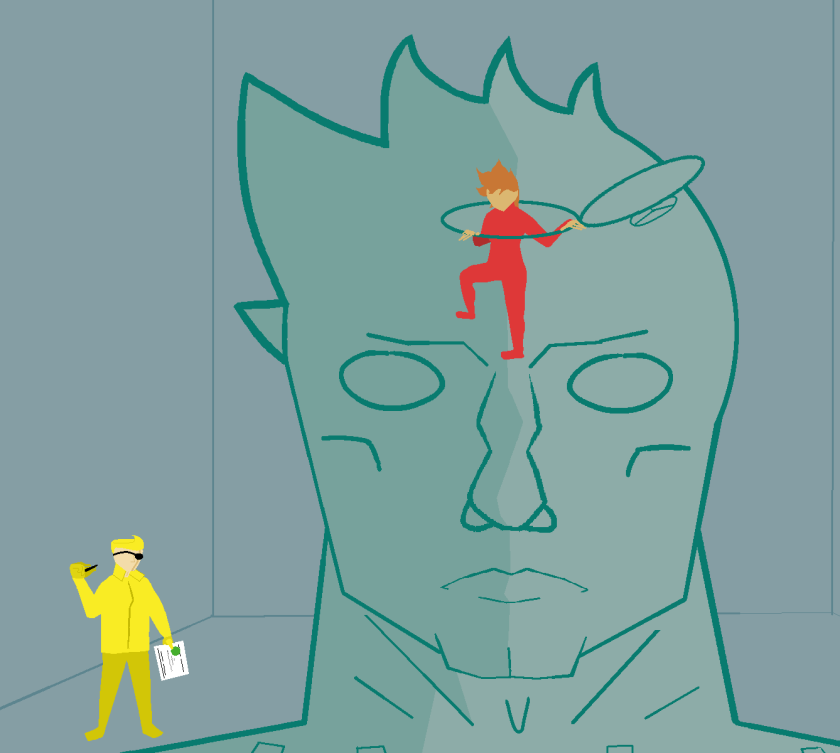
…I’m trying to reference Dante’s vision of The Old Man of Crete. In Dante’s Inferno, the rivers of Hell are the tears from a statue. Says University of Texas’ Dante-worlds,

Dante invents the story of the large statue of an old man–located in Mount Ida on the Island of Crete–for both practical and symbolic purposes ( Inf. 14.94-120). Constructed of a descending hierarchy of materials–gold head, silver arms and chest, brass midsection, iron for the rest (except one clay foot)–the statue recalls the various ages of humankind (from the golden age to the iron age: Ovid, Met. 1.89-150) in a pessimistic view of history and civilization devolving from best to worst.

…Although the statue is not itself found in hell, the tears that flow down the crack in its body (only the golden head is whole) represent all the suffering of humanity and thus become the river in hell that goes by different names according to region: Acheron, Styx, Phlegethon, Cocytus (Inf.14.112-20).

To me, this statue totally sounds like a giant anime robot. It’s a giant human whose parts are different-colored metals and materials; it’s perfect!

Lucille’s Galaxy Zephyr re-contextualizes the image: rather than crying tears which flood Hell, the robot bleeds gold which seals its wounds. Humanity’s suffering is not hellish oppression; our ability to feel remorse is humanity’s redeeming feature which emboldens our future efforts.

Next Chapter
Table of Contents