Inspirations

In Homer VS the Dwarf Aria brings her minotaur to the market to sell him, but he proves a force to be reckoned with in a game of table-war.

In this commentary I want to talk about my inspirations for this story, and what I hope it becomes.

Although the idea of a minotaur following “twine” is obviously related to greek myth, and I feature my own twists on the typical gamut of fantasy races (elves, dwarfs), the biggest inspiration for The Minotaur’s Board-Game is the anime YuGiOh. I enjoyed the show as a kid, and while it becomes more ridiculous every time I remember it, I still look back fondly on the series with a campy nostalgia.

In YuGiOh, a boy with improbable hair is possessed by an ancient Egyptian pharaoh who’s great at card-games. He wins every card-game he comes across and saves the world with the luck of the draw. The audience is rarely worried about whether the pharaoh will win, and more eager to see how he wins.

I already spoiled this in the last commentary: Homer the minotaur will win all his table-war matches. He’s not possessed by a pharaoh or anything, but his outsider’s perspective will let him surprise his opponents. I don’t think there are so many table-war games in this story that the reader to get bored of seeing Homer win; I hope the reader will be eager to see how Homer turns the tables, and yet still be surprised when he does.

One major joke regarding YuGiOh, among people in the know, is that the characters basically ignore the card-game’s rules. Occasionally YuGi’s catapult-turtle launches Gaia the dragon-champion at his own swords of revealing light, or whatever, warping the rules to give our protagonist a win. I hope to sidestep this by making up my own game, table-war.

Table-war has few, if any, explicit rules. The gnomes, impeccable machine-creatures, arbitrate each match with their own undisclosed guidelines meant to recreate real life. This way I get to focus on the back-and-forth of combat instead of worrying about a concrete set of rules and whether my characters are following them. The structure of the game is based less on YuGiOh’s hand of trading cards, and more on Warhammer 40k’s table of miniatures; I’ve never played 40k, but its tiny warzones are a striking image.

Another inspiration is The Turk, a book about a 1700’s clockwork machine which played chess. Spoiler alert, it was a hoax: someone hid under the table and directed the machine’s movement. Today we’ve got Deep Blue and other powerful computers which can whup humanity’s ass at chess and basically any other board-game, but a clockwork machine is a still great symbol.

My original conception of this story would have Homer, the minotaur, forced into a box to operate a Turk-style table-war machine. Sort of a Pixar’s Ratatouille thing. I still like this idea, and maybe I’ll return to it, but I’ve decided to have Homer fight against a machine in the final chapters; he’ll face a The Turk/Deep Blue style robot to prove that his unique, creative perspective is more valuable than pure computational power.

Another inspiration is modern warfare. Long-gone are the days of trenches; today we have drones and satellites which abstract war, and the internet delivers propaganda at light-speed. Likewise, in my fictional world, there is no actual war, just table-war. No one dies in battle; their game-pieces die, and the real person they represent probably doesn’t know or care. Rather than diminishing the effects of war, I hope table-war lets my fantasy setting comment on the nature of leadership in our modern era. How do you command people? How do you relate to people you could send to die in your name?

Still, in terms of what I want the story to achieve, I mostly want to have fun writing, because I enjoy writing and I think it’s neat.

But besides myself, who am I aiming the story toward? Honestly, I’m not sure. I hope the story is appealing to all age-groups, but I think I’m writing for people not much younger than me (24) of any gender. I’m minimizing the swearing and adult themes, so maybe I could claim it’s for young adults and teens.

Anyway, thanks for reading. If you’d like to read more, check out the table of contents or follow my site to receive emails whenever I update.

Next Chapter
Table of Contents

Aria VS the Elf

When Aria woke, she was frigid. Her wood cabin’s interior was frosted with frozen dew. Her blankets’ edges dangled icicles. “Uuugh.” She pulled herself from bed. “Scales! Scales, get out of here!”

She quickly donned overalls, thick wool socks, and boots and finally stopped shivering. She pulled two heavy leather gloves over her hands and knelt to peer under her bed.

“Scales! I said get out!”

AriaVStheElfA.png

A chill wind blew through her hair. There was a dragon under her bed, four feet long and covered in silver scales. Its white muzzle puffed icy flakes from two slim nostrils. When it stretched, the icy armor it accumulated overnight cracked and slid to the floor. Its stubby legs made Scales look like a salamander, but no ordinary lizard had talons quite so much like jagged icebergs.

“Come on. You belong outside.” Aria reached with her heavy leather gloves, but Scales slipped from her grasp. “You’re lucky I’m in a good mood this morning, Scales.” She stood again. “Hungry?”

She returned to the bed waving a long carrot and Scales stopped slithering to watch. Aria offered the carrot, but when Scales bit its tip, she nabbed the dragon by its neck and plucked it into the air.

“Gotcha.” A smile trickled across her face as she pushed open the cabin’s door with her shoulder. “You’re getting new fodder today, Scales. Soon you’ll be too big to sneak indoors.”

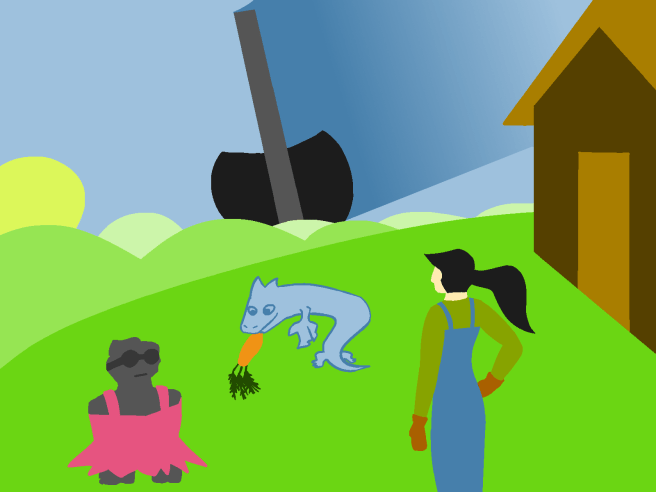
The cabin’s interior was twenty degrees colder than the summer morning air outside. The sun’s first beams rolled over grassy hills. The light was split by the shadow of a colossal black ax lodged in a forest near the horizon. The ax’s handle towered a mile tall, dividing clouds just like its head scarred the glade.

Aria released Scales. She threw the carrot and the dragon scampered after it. Its footsteps strangled grass with frost tendrils. Aria knew it wouldn’t roam too far, because it could hardly leave her alone.

“You’re early, Mr. Gnome, sir.”
AriaVStheElfB.png

The gnome stood between three and four feet tall. His rocky skin seemed to have gravel embedded in it. He wore a frilly little pink dress and dark goggles. “Good morning, Ms. Twine. I’m here on behalf of the elves buying your imps.”

“You don’t need to wear a dress just because elves tell you to. I’ve got wee overalls you could borrow.”

The gnome shrugged. “Novelties like wardrobe mean little to me. Dresses and overalls are equivalent.”

“Then change into overalls.” Aria tossed him a pair. “This is a monster farm. Dress like it.”

“Of course, Ms. Twine.” The gnome removed and folded his dress before donning the overalls. His skin was rough and gravelly all over.

“Follow me, the imps are in their enclosure. And call me Aria. What should I call you?”

“I am Septem Decim. Please show me your identification.”

“Right here.” As they walked she gave him a slim brass card about the size of her palm.

Septem felt the card with his stubby fingers. Engraved in the brass was a grid of tiny holes; the gnome’s fingertips detected their varying depths with perfect accuracy. “…This says you are deceased.”

“In the game, yeah. Ten years ago.”

“Ah, I see…”

“Hey, you speak great English for a gnome. Have you ever refereed?”

“I am a diplomat. I have only refereed unofficially in table-war hobby-shops.” Septem returned Aria’s brass.

“Oh really?” She gave him a slim wooden card. “How much would this be worth?”

Septem manually inspected the card. “This is a reproduction of your old brass for table-war hobbyists, isn’t it?”

“It’s me at my prime. Do the geeks use it often anymore? Do fans win matches in my honor?”

Septem didn’t sugarcoat it as he returned her card. “Perhaps it would have some value to historians, but I’ve never seen it used in competitive play.”

AriaVStheElfC

Aria sighed and tucked both cards in her overall pockets. “Let’s change the subject.”

“Another gnome was found decapitated by the dwarven border.”

“Sorry to hear it.” They approached an apple-tree covered by translucent mosquito-netting. Aria untied a rope to open the net. “Breakfast! Piknik, Togdag, Gumdrop, get your milk.”

A tinny voice like a squeaking rat called from under the apple-tree’s roots. “We saw! Don’t think we didn’t see!”

“What did you see, Togdag?” Aria pulled the cork from a jug and poured milk into a shallow saucer.

A different voice, like a chirping bird, called from the upper boughs. “You fed Scales!”

“Why was he fed before us?” called a voice in a knothole.

“Tell you what.” Aria dropped three cherries in the milk saucer. “I’ll add cream today. Will that make up for it?”

“Barely!” called Piknik.

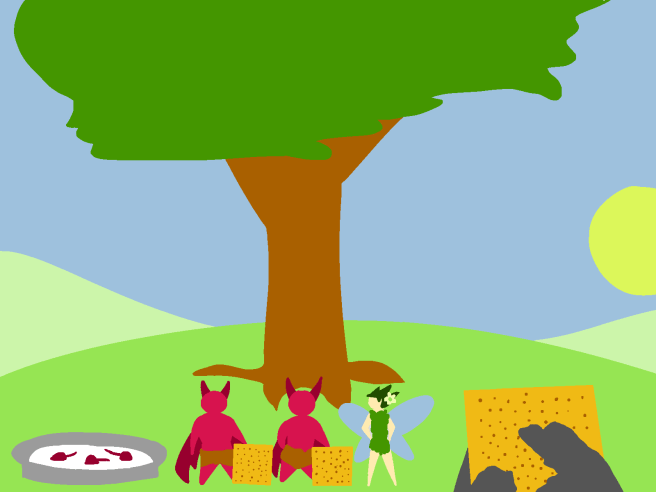
“But you all have to line up for Mr. Decim, here,” said Aria. “Bring your brass! Chop chop!” While Aria measured cream from a smaller jug, Septem Decim watched the imps emerge from hiding. Two were red, bat-winged creatures in loincloths of weeds and bark. The third was a fairy in a dress of leaves with an apple-blossom tied in her wild green hair. They all fluttered to the ground, barely a foot tall apiece, carrying brass cards almost too large for them to hold.
AriaVStheElfD.png

The gnome scanned each brass card with his fingertips. “If it’s any consolation, to a table-war hobbyist, your imps would each be worth ten of you.”

“Thanks, I guess,” said Aria. The fairy-like Gumdrop giggled, revealing teeth longer and sharper than her pretty face suggested. “You three, come eat breakfast.” The imps swarmed her. “Ow! Gumdrop!”

“A parting gift!” giggled Gumdrop. Aria held her finger. The imp had drawn blood even through heavy leather gloves. “We’ll miss you, Twine!”

“What’re you trading us for?” asked Piknik. “You’d better not give us back to the dwarfs. You’ll never see imps like us again!”

“Ah, shoo. I’m glad to be rid of you,” she joked. “I’m trading you to the elves for dragon fodder.”

“It is not my place to speak of such things,” said Septem, “but the elven queen is procuring many powerful game-pieces. Tensions on the elvish/dwarven borders have heated. The pressure will only escalate. Ms. Twine, would you like me to brass your dragon, just in case?”

“No, not yet.” Aria cast her gaze around her farm.”Where are your elves, anyway? I thought they’d arrive with you.”

“We came across a distraction.” When the gnome left the net, the two red imps tried to sneak out with him. “Perhaps you could assist?”

Aria shoved the cork back in the milk jug. “What’s wrong?”

“You are a monster tamer, correct?”

She smiled. “Or so I’ve heard.” The gnome tilted its head, confused. “Sorry. Yes. I’m a monster tamer.”

“A minotaur escaped its labyrinth near the Great Ax’s fracture. The elves sent me ahead while they captured it.”

“A minotaur?” Aria scowled and adjusted her gloves. “Let’s go.”


The Great Ax had stood there for as long as Aria could remember. Its double-bladed dwarven design was hungry for war. Its massive head was buried in the forest as if some giant had tried to cleave the earth in half, creating a clearing ten yards wide and hundreds long.

“Ugh.” Aria groaned. “The Demons’ weapons have always freaked me out.”

“You are too young.” Septem adjusted the hem of his pretty pink dress. “What is ‘freaky’ are the monsters which forged them.”

“What?” Aria adjusted the straps of her backpack. “The Demons didn’t make those weapons, the dwarfs did.”

“I stand by my statement.”

“Oh. Harsh.”

“Not harsh enough,” said Septem. “Even the dwarfs agreed to a peace treaty to escape the war they started. You can’t imagine how awful it was, for even dwarfs to regret it.”

Aria held her tongue. Dwarfs and gnomes could live long enough to remember the war against Demons centuries ago, but humans didn’t have that luxury.

When they entered the thin clearing, Aria saw a few figures near the narrow crevasse carved by the Great Ax. She squinted to count three elves, two gnomes in dresses, and one big brown minotaur. “Septem, hurry!” Septem’s tiny legs carried him as quickly as they could while Aria sprinted ahead rummaging in her backpack.

The minotaur stood ten feet tall and was covered in fur like dead brown grass. Its twisted horns sprouted from its forehead like dead trees clinging to a mountaintop. The two shorter elves pinned the minotaur to the cold metal ax with spears. The spears made deep gashes across the minotaur’s torso when it struggled with the strength of ten men.

“You’re hurting it!” said Aria.

The tallest of the three elves scoffed. “Who cares? Look what it did to my cute little gnome!”

One of the gnomes lay on the grass with his head split open. A green, rocky brain rest coldly in its skull. The second gnome held the brain in place with one hand while gesturing to Septem with the other.

Septem reached into his dress for gnomish surgical implements. “All will be well, Octoginta Tres. Merely a cranial fracture.” Septem sat to tend to the fallen gnome’s exposed brain.

“See? He’s fine,” said Aria. “Get off that minotaur, these are human lands!”

The tallest elf’s eyes glittered like emeralds, and her skin sparkled; so-called “high elves” bathed in gold dust if they could afford it. Her beehive hairdo added a foot to her height. She wore a long dress which no doubt concealed platform shoes, and lace wings which made her seem to float. Nonetheless she stood five-foot-eight, about seven inches shorter than Aria. “Gosh, if it’s not Aria Twine! It’s me, Stephanie! Are you the farmer trading us imps?”

AriaVStheElfE.png

“Not traded yet, Steph.” Aria dropped her backpack on the grass. “Tell your shorties to let the minotaur go.”

“Hmm, I don’t know, Aria,” said Stephanie, “under what jurisdiction?”

“You can’t steal game-pieces from human land,” said Aria. “He belongs to us. And you’re hurting him!”

Stephanie stroked her tall hairdo. “Hm… Shorties, let the beast go.”

The shorter elves—almost four feet tall—lowered their spears.

The minotaur’s gasps filled lungs the size of barrels. Its arms, packed with muscles like stacked melons, lifted three-fingered hands to rub the wounds on its chest and stomach.

“Let’s get something on those cuts,” said Aria.

Its ox-head turned on her. “Raaugh!”

“Hey! Easy, now! I’m here to—”

Its hooves stomped the grass.

It fled into the forest.

“Oh, what a shame,” said Stephanie. “We’ll have to go after it.”

Aria scowled. “You’ve done enough damage here.” The shorties looked to Stephanie, who shook her sleeves to the trees. The shorties took off after the beast, spears at the ready. “You’re out of line, Steph!”

Stephanie covered her mouth with her sleeve to hide a fake laugh. “Perhaps the gnomes have a different idea?”

Octoginta Tres was only distinguishable by his bandaged head-wound, and Septem Dicem by his goggles. Otherwise the gnomes were identical. “The high elf is correct,” said Septem. “An escaped game-piece belongs to no one. As you allowed the minotaur to flee, Aria, you relinquished humanity’s jurisdiction. The elves have the right to chase it and claim it.”

Stephanie giggled. “There you go, Twine. Perhaps you’ve forgotten the finer points of table-war?”

Aria picked up her backpack. “I challenge you for the minotaur.”

“The minotaur is already mine, dear. And besides,” smirked the elf, “your own game-piece is dead, isn’t it? That means you can’t command!” Aria grit her teeth. Stephanie coyly held her chin. “Who killed you, again? I can’t seem to remember.”

“You did,” Aria admitted, “but our match doesn’t need to be official. And I have something you want. I’m not ordering dragon fodder for nothing. I’ll wager my dragonling for the minotaur.”

Stephanie beamed. “Why, Aria, you just had to ask politely! Gnomes, would you care to referee?”

The three gnomes stood. After joining hands in a triangle, their fingers tapped messages in the same gnomish language written on brass cards. Septem nodded. “That is acceptable.”

Stephanie clapped. “Let’s set up a board!”


Stephenie’s tower of brass cards threatened to topple. Octoginta ran his fingers over each card apparently oblivious to his bandaged head-wound.

Aria had only a few brass cards. After Septem inspected them, he helped the third gnome prepare the table.

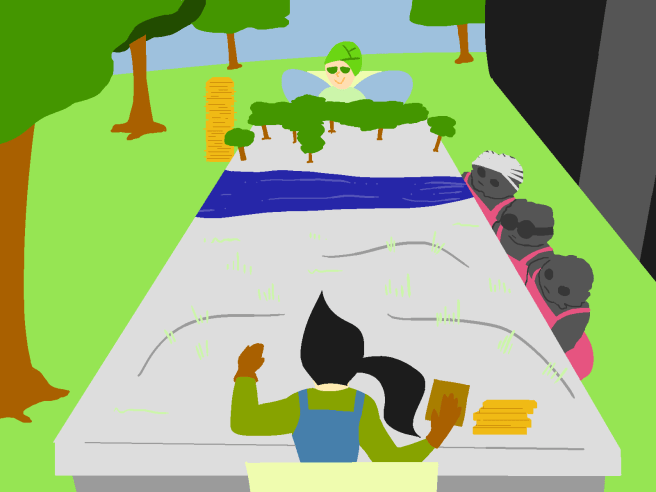
The table the elves had brought with them was sub-standard size, only five feet across and ten feet long. Stephanie demanded they construct the elven capital, but that required a full board. Aria and the gnomes talked her down to a smaller map.

Aria had played on this map before; it was popular among hobbyists. Stephanie’s side featured a thick forest. Aria’s side held rolling hills. The two sides were divided by a wide river. Even for an unofficial battle, the gnomes detailed the table intricately and effortlessly. Special gnomish clay built up the features of the terrain. The gnomes’ precise fingers carved trees and even grass. Beads in shades of blue painted the river’s speed, separating rapids from gentle banks.
AriaVStheElfF.png

“It’s hardly a match if it doesn’t represent a real area.” Stephanie arranged silver figurines on her half of the table. Each one represented an elven soldier described by a brass card. “Do you have game-pieces, Aria?”

“Sure do.” She poured the contents of her backpack onto the grass. Besides medical supplies she brought for the minotaur, she carried five wooden figurines. “Whittled ‘em myself.”

“Aww, how rustic!” As the sun rose, the Great Ax’s shadow shortened. Stephanie cooled her delicate features with a broad fan. The fan must have cost a fortune, because it was decorated with seashells. Seafolk always charged exorbitantly. “I suppose when I killed you, your official figurines were confiscated? My figurines were made by the elven queen’s own smiths.”

Stephanie smirked when her gnomes brought another metal figurine: a giant squid, pulled from the depths of the ocean. “You must’ve made general,” said Aria, refusing Stephanie the satisfaction of seeing her expression sour. “That’s a powerful beast. Buy it from seafolk?”

“Commander, darling! I’m a commander. I have much more powerful monsters, but they don’t fit on this tiny board.”

“The elf-queen must be pretty desperate if you made commander.”

Stephanie blinked. “She’s a better judge of talent, perhaps, than you are. The dwarfs are preparing for war; we elves must protect ourselves.”

AriaVStheElfG.png

“Septem.” The gnome turned to Aria. “Can you make me a brass for my dragonling, Scales?”

“I have not inspected it, ma’am. You must use the generic ice-dragon brass instead of one customized to your creature.”

“Fine.” Aria gathered her five wooden figurines from the grass. First she placed the wooden figurine representing herself—or, the version of herself described by the wooden hobby card, as her official brass claimed she was dead. Her figurine, accurately tall and lanky, stood behind three wooden imps.

“Are you just using any old units lying around your farm?” Stephanie hid her mouth with her sleeves to snicker.

“Plus one.” Aria placed a wooden cockatrice on the front lines. Aria remembered wearing dark glasses for two years raising the creature from an egg. “When I sold this monster to the human military, they said it was too volatile for table-war. I got to keep its brass. You can read on the card, I keep the cockatrice blindfolded for safety.”

The elf had perhaps a hundred game-pieces, while Aria’s side of the table felt more barren with each figurine she set on the field.

“Here,” said Aria, “we’ll use this roll of medical tape for the dragonling.” She placed it atop a grassy hill.

AriaVStheElfH

Octoginta tugged Stephanie’s lace wing. “Hey! This is elven silk, gnome.”

Septem hopped off the board to hold hands with his wounded companion. “He says your army can’t fit on this map. You can use the giant squid or the army of elves, but using both would pack units too densely.”

“Fine.” The elf waved her hand over the board. “Aria, as you’re clearly outmatched, I leave the option to you.”

“Keep both.” Aria straightened her wooden figurines. “You’ll need them.”

Stephanie’s lower lip wavered. “You pompous—”

“I’m ready. Hurry up.”

“Is that really all you’ve got?” asked Stephanie. “Your biggest monster is a dragon barely months old! Your cockatrice has to be blindfolded or it petrifies its allies! You’ve even put your own game-piece on the board! Embarrassing.” Aria swallowed as Stephanie arranged the enormous squid-figurine’s horrible tentacles to infest the forest canopy; internal mechanisms allowed the figurine to be realistically puppeted. Hidden buttons controlled the squid’s beak and eyes. “It’s a tad one-sided, isn’t it?”

“I agree.” Aria brushed hair from her face. “You go first, to even the odds.”

Stephanie hid a grimace with a smirk. “All my elvish units march forward. My archers ready their bows.”

The three gnomes linked hands to communicate and calculate. Then they scrambled over the board. “Elves are not hindered by forest terrain,” said Septem. “They move unimpeded. Say when.”

The gnomes made the metal elf figurines march halfway to the river. In the dappled shade of the model trees, Aria saw the features of the figurines’ faces. These were no mass-produced generic figurines, but actual models of real elves down to their freckles and pointed ears. “Stop there,” said Stephanie. The gnomes halted the elves.

“My dragonling allows the imps and cockatrice to mount it,” said Aria.

Gnome fingers clacked together. “The dragonling is strong enough, and the cockatrice and imps are small and light enough, to perform the action requested. Because your own figurine is present on the table, Ms. Twine, your expertise in taming monsters keeps them from fighting each other.”

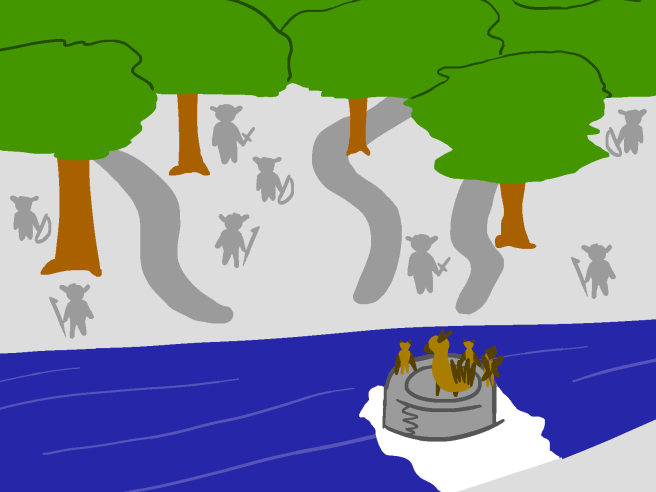
“My dragonling runs across the river.” She pointed to a specific spot on the board. The gnomes used white beads to show how the river froze under the dragon’s footsteps, forming a path. “Perfect,” said Aria.
AriaVStheElfI.png

Stephanie covered her mouth. “Your dragon is too young to use ice-breath, isn’t it?”

“Maybe.”

Stephanie looked at the roll of bandages. “Better safe than sorry, right? My army retreats to the forest.”

The gnomes moved the elven figurines. “Is that all?”

“Not yet.” Stephanie leaned over the table. “Have you ever fought a giant squid, Ms. Twine?”

“Nope.”

“Then you might not know, being born in the arctic deep, they’re impervious to the cold! My squid engulfs my men with its tentacles, protecting them from the dragon’s breath.” She moved the tentacles herself. “There.”

Aria nodded. “Of course I knew that.”

“Ah, a guest!” Stephanie clapped. Her shorties dragged a net behind them. The minotaur pushed his three-fingered hands against the net, grunting with animal pain. The shorties pinned the beast with their spears. Aria noticed blood trickling from the minotaur’s closed eye. “Put it aside. This game ends soon. My archers will use Ms. Twine’s beasts as target practice.”

“It’s my move.” Aria pointed to the imps. “My imps remove the cockatrice’s blindfold, and Scales leaps face-to-face with the squid.”

“…My squid shuts its eyes!” Stephanie pressed hidden buttons to make the squid’s figurine blink.

“That kind of squid doesn’t have eyelids,” said Aria. “Too bad whoever made your figurine didn’t know that.”

The gnomes conferred. “The squid has turned to stone.”

Stephanie frowned.

“My imps fly through the stone tentacles.”

“My archers fire! The rest defend themselves from the imps with knives!”

As the gnomes held hands in deliberation, Aria left her chair to inspect the minotaur. “Let it out of the net. It’s calmed down.”

“No! Keep it restrained,” said Stephanie.

“Then put away the spears. You’re hurting it.”

Septem cleared his throat. “The stone tentacles are wrapped too tightly to draw a bowstring or swing a knife. Only the imps may move freely.”

Stephanie bit her lip. Gnomes showed how the imp figurines massacred her army. “…I forfeit.” Stephanie flicked over an elvish archer. “Why would I want a smelly, brainless beast, anyway?”


“Hold still.” Aria stroked the minotaur’s dense, prickly hair. “Shh, shh, shh.”

“It can’t understand you, you know.” Stephanie admired Aria’s imps in their tiny wooden cage. “Shorties, bring me their brass.” The cages were cramped even for imps. The devilish Togdag and Piknik pulled the metal bars with crimson claws. Gumdrop looked forlornly at their netted apple tree. “Are we sure this one’s an imp?” Stephanie stuck a finger into the cage to prod Gumdrop’s dragonfly wings. “It looks more like a fairy—Aaaugh!”

Gumdrop snickered as Stephanie clutched her chipped fingernail. “We’ll miss you, Twine!”

“Keep out of trouble, Gumdrop.” As the minotaur slept, Aria wrapped an eye-patch around its head. The shorties had injured its right eye; it would never see properly again. “Shh, shh, shh. It’s okay.” She poured clear liquid over the minotaur’s wounded chest. The sleeping beast grumbled at its stinging cuts. “You must be scared, so far from home. You’ll make plenty of friends when I sell you to the army.”

AriaVStheElfK

The shorties rolled barrels from the elven wagon. There were twenty barrels in all. “Your dragon fodder is ready,” said Stephanie. “You know, Aria, if you knew what was best for you, you could live in elven lands. You could help tame that giant squid. You could even be royalty.”

“I wanna be royalty because I’m awesome, not because I’m taller than you.”

Stephanie bared pearly teeth. “Come, shorties.” One shorty pushed the wagon from behind while the other pulled it from the front. “We’ll be back in elven lands within a week if you trudge fast enough.”

“Take care, dear,” said Aria.

Next Chapter
Commentary

And More

In Chapter Z. The End Professor Akayama delivers a last diss to the Enemy Hurricane before returning to Earth and dissolving into Earth’s population.

Thanks for reading Akayama DanJay. I enjoy writing in my free time, and I feel more fulfilled having done it in an area where people can pop in and check it out, and read commentary where I try explaining what I’m on about. It’s also nice to say, “Hey, visit AkayamaDanJay.com!” and have people say, “huh?” and then I spell it out and maybe they check my website later, if they remember.

I’ve learned a lot in the last year and a half or so, and it’s time to move onto new projects. I hope you can join me in breaking new ground. Here’s my plan:

I’ve made a new website called Ted-Writes.com. This will be easier to tell people about than AkayamaDanJay.com, because I won’t have to say, “well, it’s two characters’ names, except it’s really sort of two-and-a-half characters’ names, see…” The new site will be a hub for all my stories and whatever other projects I assign myself. I’ve moved Akayama DanJay onto the new site, in the new order I mentioned before, but I’ve already planned out the next novel-length-work I want to write:

The Minotaur’s Board Game will be a fantasy adventure about a minotaur who escapes his labyrinth only to be embroiled in political conflict. He’ll prove naturally talented at the tabletop-war-game which has replaced actual war, but this only secures his position as a pawn to his superiors. I mentioned this story ages ago because I wrote the first draft before the first draft of Akayama DanJay, and it’s been sitting in my mind ever since. I think I’ll enjoy returning to my weird takes on fantasy races like elves and dwarfs, and the twists and turns of each board-game the minotaur must win.

I’ll be sad to leave Akayama DanJay behind. I’ll admit, sometimes I’ve felt like a Dan agonizing over a Beatrice, but today I feel more like a Jay content with his Faith. Now that I’ve written it out and gotten it all off my chest, I feel connected to the world in a broader sense. Professor Akayama taught me what I needed to know, and now I can move on to prose which is more commercially viable, maybe.

Which isn’t to say I’m leaving Akayama DanJay behind for good. I think I’ve got a totally enjoyable story here, it’s just difficult to imagine marketing my novel about drug-addled hipsters who merge with an anime robot. Maybe I’ll redo the art and compile the whole thing into an e-book people can download off Amazon. Or whatever. Stories are never finished, the writer just decides to let them go.

Thanks again for joining me. I’ll probably have the first sections of The Minotaur’s Board Game ready to read by the end of September. I hope to see you there!

Table of Contents

The End

Professor Akayama unfurled both wings and blasted steam from her lab-coat to sail light-years from the Galaxy Zephyr. As she flew, she siphoned the Zephyr’s mass until it was merely its original robots, and her wingspan could have enveloped the observable universe. On her wings she grew eye-spots which signaled a final message to the Enemy Hurricane’s scattered humanoid particulates.

Z picta.png

“I’m sorry,” she signaled. “I wouldn’t wish this on anyone. But did you really think this could end any other way?”

The Enemy Hurricane’s particles signaled back, “What did you do?”

“Space-time is expanding,” signaled Akayama. “Soon it will expand so quickly that nothing will ever travel faster than the speed of light in vacuum. You’ll drift farther and farther, faster and faster, until after billions of years, your images will be Doppler-shifted beyond ultra-violet, and there’s no trace of your existence. By then, maybe even our memory of you will fade.”

“We’ll recombine,” signaled the Enemy Hurricane. “We’ll join together once more, and then—”

“No you won’t,” signaled Akayama. “Just as you drift away from us, you drift away from each other. Soon your individual bodies with be sheared apart.” As she signaled this, the Enemy Hurricane felt the shearing force. Expanding space-time smeared their humanoid forms into snakes and salamanders. Stretching opened wounds which bled teeth. “Eons hence, your subatomic particles will be torn asunder.”

“The same will happen to you and your people!”

“Nope. We’ll die long before then. It was your desire to be permanent, not ours. Be careful what you wish for. Although…” Akayama scratched under her beak. “When you obliterated Lucille’s generous suicide-pill, you probably absorbed its self-destruct sequence wirelessly. You can cast off this mortal coil any time you like.”

The Enemy Hurricane just squealed in pain. Akayama sighed.

“Tell me,” she signaled, “do you fear God?” She received no answer. “If there ever comes a time you could be called dead, Lucifer will drag you to his darkest pit. You might shout to God for mercy—and I will look down in pity and remind you, you had your chance.” Akayama shrugged. “Oh, I almost forgot.”

She shook one wing and a tiny green speck fell from her sleeve onto her longest feather.

“Although you’re suffering, o Hurricane, understand that your hundred pilots are safe and sound. I included them in the algorithm reducing Earth to its most basic forms. I’ve met humans whose compassion extended to every sentient being. Anihilato’s complicated form reached every corner of humanity’s most vile crevices. But you?”

She raised the tiny green speck. It was a frog. It was almost cute.

“You ain’t shit.”

The Enemy Hurricane didn’t respond. Maybe it was too far away, or maybe its mind was clouded with agony.

Z pictb.png

Charlie pointed to his main monitor. “Look! The professor’s coming back!”

Lucille folded her arms and tssk’d. “She didn’t even ask before she stole my robot’s mass. We’re barely a kilometer tall.”

“She gave you that mass,” chided Daisuke, “and she knows what she’s doing.”

The ten thousand pilots watched Professor Akayama shrink as she left galaxy-clusters in her wake. She popped off her wings and they decomposed into dark matter. Her compound eyes disintegrated and every facet became a gargantuan star.

“Beautiful,” fawned Fumiko. “There are stars everywhere!”

“Better than that!” Eisu scrolled through historical-records on his monitors. “The stars are back where they used to be a century ago!”

The whole crew gasped as Akayama shed her robe and it condensed into the Milky Way’s celestial belt. She expelled the sun and moon from her chest. The combined Zephyr landed gently on the moon, beside the lunar base.

Akayama’s body shrank and shrank, leaving each planet of the solar system behind her. She deposited Earth last. Lucille stared agape at Earth’s gleaming oceans. She eventually regained composure and pulled her monitors close. “Zoom in! Start scanning! Are there any signs of life?”

Z pictc.png

ZAB responded in its computerized monotone. “Only one. Akayama.” The monitor magnified the image of Earth and zoomed in on the fertile crescent. Buildings, roads, and infrastructure were present, but no humans were to be seen. Only Akayama herself stood tall over the landscape, almost six hundred billion tons of colossal bird-thing.

“She’s—” Fumiko covered her mouth. “Is this appropriate to watch?”

Akayama deflated to a tiny fraction of her volume laying an enormous egg. “It’s hatching!” said Eisu.

Gas streamed from the egg’s cracks and spread over Earth in seconds. “Those are all Earth’s single-celled organisms,” said ZAB. The cracks widened and dark rivers poured. “The insects and small creatures.” The cracks widened and torrents surged. Lucille didn’t need ZAB to tell her these were the larger species. Elephants, tigers, wolves, and every other manner of animal ran for their habitats. Even sea-creatures rolled across the deserts, and she understood that Akayama had scientifically bolstered these specimens to make their journeys home.

Z pictd.png

“Where are the people?” asked Daisuke.

“Look!” Charlie made the combined Zephyr’s right arm point to Akayama. Her feathers fell one by one, and each became a human being. The feathers drifted and tumbled with the wind to deposit each person where they belonged. With each lost feather, the bird-thing’s body shrank.

ZAB clicked through thousands of calculations. “They’re all there,” it said. “Everyone—no, everything is accounted for, down to the last microbe.”

Lucille leaned away from her monitor’s camera so her crew couldn’t see her wipe tears from her face. “Yappari sou da. Akayama Hakase.

“Wait.” ZAB’s monitors flickered. “There are two Akayamas.”

“Huh?”

The monitor zoomed in. Professor Akayama’s human body lay nude and unconscious in the sand before the body of the bird-thing, about twelve feet tall. It loomed motionless above her.

The crew of the combined Zephyr watched breathlessly as Akayama’s human form stirred awake. She felt her own body before standing and noticing the bird-thing before her. She cringed in fear, then reached out to touch its featherless flesh.

Z picte.png

At a touch, it disintegrated. It just blew away in the breeze. It left only a fresh white lab-coat on the sand. Akayama put it on. She pat her pockets and found a bug-stick and a lighter. She indulged in a good smoke.

“It’s over,” said Lucille. “It can start again.”

Commentary

Apotheosis

In Chapter T: Wings we see Beatrice’s soul combined with the Galaxy Zephyr. She’s a giant ball of wings; now the Galaxy Zephyr has sixteen wings with jet-turbines for feathers, like a sci-fi seraph.

We can see why Dan was obsessed with Beatrice. She’s the first principal component of Earth’s life, a pure, shining example of undiluted sentience. Akayama says she’s not even just a component of humanity, but mostly of bacteria, arthropods, and reptiles. (Birds are adjacent to reptiles, right? That’s my reasoning for the feathers.) Akayama isn’t recreating humanity; she’s set her sights higher than that, endeavoring to restore Earth’s total population all the way down to single-celled organisms. Her god-like perspective has transcended anthropocentrism.

But the Galaxy Zephyr lets its guard down, and Faith gets lightning-bolted. Bummer.

I don’t have anything in particular to comment on for this section, so I’ll just talk about how everything’s wrapping up. In fancy-talk, “apotheosis” refers to a culmination or climax. Coincidentally, it can also mean elevation to the status of deity, which is sort of what happened to Beatrice.

I’ve heard that a video-game’s final boss shouldn’t just be the game’s most exciting moment. It should also test the player by confronting them with every challenge the game has to offer. At the end of each kingdom in the original Mario, the player confronts Bowser. The Bowser-fight combines platforming challenges with an enemy encounter. At the end of a Pokemon game the player fights the Elite Four, who are supposed to push the hero’s team to the limit while demanding understanding of the mechanics the player has learned throughout the game.

I think a book’s climax should do the same. The final confrontation should demand the main characters apply every lesson they’ve learned.

In Akayama DanJay‘s case this is a little difficult, since the weirdo narrative structure means there’s not really a main character. Lucille hardly learns a lesson, thriving because of her appropriately-directed lust for vengeance; Akayama and DanJay learn more, and are more deserving of the title ‘main character,’ but neither of them have much agency in piloting the giant robot.

Still, Akayama couldn’t preside over the afterlife if she hadn’t made Sheridan. That was her training-ground for godhood. DanJay failed to defeat Anihilato as Dan, but as Jay, he’ll have another shot. Lucille’s discovery of her parents’ fate pushes her to be merciless in battle.

Really, the ‘main character’ who’s learned the most lessons is the reader. Throughout Akayama DanJay the reader has come to understand (a fictional) reality as a temporary projection. They’ve learned the secrets behind the afterlife, and therefore they’ve conquered life and death. They know centipedes aren’t just a hallucinogenic drug, nor just transport to the afterlife, but a connection to the Hurricane, the presiding mind of the universe.

So the climax should wrap all these lessons in a nice package. Pulling Beatrice from the mortal plane to the afterlife and into the Galaxy Zephyr ties everything together.

If I reorganize Akayama DanJay like I’ve considered, I’d lose some of the surprise. Soon after the reader sees Beatrice hit by a bus, they’d watch chapter T as an episode of anime. This wouldn’t delay all the apotheosis to the end, but it would clarify to the reader exactly how the Galaxy Zephyr works. I think that would be for the best. Besides, there’s more to come.

The character DanJay is sort of a stand-in for the reader. As I’ve written it, DanJay’s stream of conscious is totally unbroken from beginning to end. So when DanJay finally joins the Galaxy Zephyr, all the lessons the reader has learned from his perspective will pay off at once.

There’s still a ways to go, and I have all the time in the world to rearrange sections as I see fit. We’ll see how everything turns out.

Keep eating your worms!

Next Section
Table of Contents

The Snowflake

Howdy!

I’ve decided to publicly outline the plot of my story far in advance, because I enjoy trying to explain/excuse my creative process. I’m not worried about spoilers; in fact, I’ll tell you how my story ends in this commentary, right now. I think a story should be enjoyable even if you know how it ends. Call it a challenge.

If you scour writing-advice websites, you’ll find the snowflake method of crafting a novel. The idea is you start small—with a one-sentence description—and snowball your way up to a paragraph, a page, ten pages, and eventually a whole novel. (The description in the link has some extra steps, like making character charts, but personally I feel like that’s a bit extraneous. But I’m not the published author, so what do I know?)

I added a step: I wrote the entire book ahead of time. My first draft—my “exploratory” draft—is 206 pages of double-spaced playfulness titled The Minotaur. I knew I wanted a story about a minotaur who’s great at board-games, and I wrote it without much planning. Narrative conflicts arose because conflicts are neat to write; characters had arcs because I winged ’em. My goal was to have fun. If you can have fun writing a first draft, I’d wager you can fix it up into a final draft which is fun to read.

Now, to follow the snowflake method, I’ve taken the best aspects of those 206 pages and made a several-sentence description:

War is impossible because impartial clockwork gnomes would summon demons to destroy the aggressor. Only a war-like board-game is allowed, for which civilizations of fantasy races take census of their populations to use as game-pieces.

Aria Twine used to be humanity’s champion at this war-game until her own game-piece was killed, so she’s no longer allowed to play. Aria took to raising dangerous beasts for humanity to register as game-pieces.

When she meets a minotaur with a talent for the game, she jumps on the opportunity to regain political relevance. She makes Homer, the minotaur, prove himself in a tournament against war-game champions from among humans, elves, and even monsters from the wild wastes and seas, before he’s able to combat the dwarfs who plan to claim the war-ending demons as their own and conquer the world by force. The dwarfs have a war-game-playing machine made of gnome-brains; Homer will defeat it with his flexibility.

Next, I wrote a quick description of each character’s desires and arcs.

Aria Twine desires the political power she wielded in her youth. To achieve this she’ll drive Homer the minotaur to the breaking point, using him as she would a pawn in a board-game. Eventually she’ll realize this isn’t the right way to lead, and thereafter become a worthy queen of humanity.

Homer the minotaur desires a place to belong. He initially follows Aria’s demand to become a champion war-gamer because it’s all he knows of the surface-world outside his labyrinth. He’ll even try to propose to her in marriage. He’ll eventually learn to fight for himself and for the sake of other fantasy creatures to whom he relates. His increasing understanding of the surface will be reflected in his increasing vocabulary.

The dwarfs want to conquer the world. By the end, the reader will learn that gnomes and dwarfs used to be the same underground-dwelling race before the demons split them apart. Dwarfs believe this robbed them of the right to world supremacy.

The gnomes claim to have no desires or emotions, which is why only they can control the demons. Nevertheless, they detest dwarfs. They hide it well.

Elves are like bees: their queen’s goal is to protect the forests from the dwarfs, and she mind-controls all her subjects with pheromones. There’s a class of drones, “shorties,” who only follow orders, and a taller class of “high-elves” who follow orders but secretly relish the chance to leave the forests and escape their queen’s mind-control. We’ll mostly see one particular high-elf, the one who killed Aria’s game-piece, as she learns to respect Homer as a person.

Sea-Creatures are a varied collection of different watery races who are largely mysterious to surface-dwellers. They frequently take unconventional, roundabout routes to accomplish goals landlubbers can’t even comprehend. They’re incredibly rich because they have access to all material wealth in the ocean. From their diversity, Homer will realize humans should accept him instead of treating him like a pawn.

The wild wastes are home to mostly-uncivilized fantasy monsters. A small cadre of these creatures will demand to compete in the tournament so they can prove themselves politically relevant. They’re terrible at war-games, but that’s beside the point. Homer will eventually consider himself aligned with these creatures, even if he fights under humanity’s banner.

Humanity is ruled by Queen Anthrapas, who’s old and near death. Anthrapas needs an heir, and knows Aria is suitable, but must teach her how to treat her subjects as people instead of pawns before she considers her worthy. We won’t meet many other humans, but they’ll mostly serve as antagonists for Homer and Aria.

For each chapter I’ve written something like this quick set of notes for the first chapter:

Aria vs the Elf:

Introduce Aria by having her reprimand her adolescent dragon, Scales. Scales the ice dragon shows how stressed animals warp their surroundings into their own habitat, presenting the work’s central theme about how we shape our world and, in turn, the world shapes us.

Introduce a gnome and remember gnomes have numbers for names. Show how brass cards represent a person or monster for use in the war-game by having Aria present her brass to the gnome. Remember the gnomes are rocky, machine-like, and mostly emotionless. Also have Aria see the giant ax embedded in the earth in the distance; the conversation with the gnome should tell the reader about the Demon War a thousand years ago and explain why war is now board-games. The gnome should foreshadow the evil dwarfs.

Aria should find the minotaur being assaulted by the elf who killed her game-piece. Aria will challenge her for the minotaur, and the game they play should teach the reader how the game works and how gnomes referee.

I hope you notice my emphasis on teaching. Mystery is a powerful tool, but more important, I think, is to let readers know how the world works. The first chapter of a book is like a video-game’s tutorial which teaches its player how the game is played. If I pull this off right, reading the first chapter will feel fun and new and interesting, and the reader will hardly realize it’s just the tutorial for the rest of the story.

See you next week! If you’ve enjoyed my commentary or you just want to know how Homer the minotaur becomes a war-game champ, consider following my blog. You’ll get an email whenever I make a post!

Next Chapter
Table of Contents

Wrapping Up

In Y4. The Dance on the Hurricane the Galaxy Zephyr cuts the Enemy Hurricane into a bajillion tiny little specks, then brushes those specks away. This is the penultimate section. Next week is the last update! It’s been a long time coming.

In this penultimate section, I want to wrap up some longstanding images and themes. Let’s talk about it.

The Galaxy Zephyr is still humanoid. It’s got four arms and legs in a sort of Vitruvian-Man design, but it’s still humanoid. It’s also got horns, because Lucille is a stand-in for Lucifer; the split-open heads on its horns are a direct reference to Dante’s vision of Satan with three faces.

Modern Satanism is, uh, interesting. It’s not really a religion as much as a secular social movement. On one hand, it denounces religion’s interference with government and promotes rationalism, which is neat. On the other hand, that wikipedia page says it emphasizes social darwinism and anti-egalitarianism, which is a recipe for “our slaves should thank us, they’d never make it on their own” and “don’t blame us, those minorities brought that genocide on themselves.” Plus, one satanic “rule of the Earth” is to abstain from sharing opinions unless asked, but one “satanic commandment” is to indulge rather than abstain, so it’s really just a hodgepodge. What can you expect from a group which self-identifies as intentionally provocative?

But Lucille is a Lucifer who’s not cast away from the godhead. Her Galaxy Zephyr’s version of Satan is more like Shiva the destroyer than any western interpretation of the devil. Lucille probably gets this from DanJay, who’s spent the whole book transcending duals, being masculine and feminine while straddling the mortal plane and the afterlife.

Meanwhile the Enemy Hurricane devolves from a human, to a scorpion, to a snake, to toads, to powder. It forms humanoids again, but soon the expansion of space-time will smear them into snake-shapes once more, as in the ending of Paradise Lost. I want this decay to contrast the Galaxy Zephyr’s growth: the Enemy Hurricane will do anything to achieve power, even discard its humanity; the Galaxy Zephyr achieves power by retaining its humanity, and as a result, its power is leagues beyond what the Enemy Hurricane even imagined possible.

A rationalist who uses physical determinism as a dogmatic excuse to be a self-interested dickhead will have only physical determinism to blame for their failure to compete against rationalists who work together for mutual benefit. The Enemy Hurricane discards morals because Might Makes Right, but the Galaxy Zephyr grows mightier by upholding its morals and fighting for Earth. The Galaxy Zephyr recreates Earth from dust and harvests power from it; the Enemy Hurricane is demoted to dust by its hubris.

This leads to Akayama DanJay‘s principle theme on identity. The Enemy Hurricane calls itself the sky-bearer, demanding respect for the position it pilfered and the identity it assigned itself. When it asks “who the hell do you think you are” (echoing Gurren Lagann and, interestingly, the penultimate episode of Full Metal Alchemist Brotherhood, when an evil scientist demands answers from the God called Truth), Lucille answers with a line which I’ve repeated a few times elsewhere in the text: “call me what you want.” True power isn’t controlling what other people think, say, or do; true power is being yourself regardless of what other people think, say, or do. At the end of the day, all we can chose in this life is which hill we die on.

As much as the Enemy Hurricane would like to imagine it controls itself, it only ever morphs its shape in response to the Galaxy Zephyr. The Galaxy Zephyr’s self-determination dictates the flow of battle. Now the Enemy Hurricane can be, think, say, and do whatever it likes—far, far away from everyone else.

In light of all this, the Dance on the Hurricane is modeled after the Nataraja, an iconic Hindu sculpture of Shiva dancing on the demonic dwarf which represents ignorance. Not every aspect of the sculpture is accounted for, but some have shown up in previous sections: the mandala of flames is here, for example.

Anyway, I hope you’ve enjoyed my explanation of whatever pretentious bullshit I’m on about this time. I’ll see you next week for the final chapter of Akayama DanJay!

Next Chapter
Table of Contents

The Rule of Threes and Fours

In Y3. The Final Form Lucille pulls the chain three more times, swelling the Galaxy Zephyr to twice the size of the observable universe, and making it all scary and stuff. Now that they’ve collected all the data they need to reconstruct Earth’s exploded population, there’s nothing to hold them back.

There are some numbers which keep coming up in fiction. The obvious number is three: there are three little pigs, three billy goats gruff, and Goldilocks eats three bears (right?). We’ll come back to three, but let’s talk about some other nice numbers.

I’ve heard that the number twelve comes up a lot in screenwriting for a very interesting reason: in English, it’s the highest number which is one syllable. This makes it attractive for anyone making a tight script. It’s also an appropriately biblical number: there are twelve apostles, for example.

Forty is another biblical number. Noah and Jesus both undertake trials for forty days and forty nights. Akayama DanJay has a few forties, like Anihilato’s forty limbs, or Akayama’s 3*40 = 120 years of age at the beginning, and her 140 years of age at the end. I like the number forty, because (to me) it feels nicer to say than twelve even if it’s an extra syllable. Same with twenty.

This list from Listverse explains why these numbers are important: they represent completion, or wholeness. Certainly 39 doesn’t feel as full as 40.

Different religions have different favorite numbers: Buddhism has lots of fives, representing the five senses, capped off with the sixth sense, consciousness. Check out this story about a man fighting a sticky monster. He smites the monster with five weapons, but each weapon gets stuck. He bashes the monster with his four limbs, then his head, and each limb and his head get stuck. Then something interesting happens: the man accepts his death, but warns the monster that inside his belly is a sharp object which will kill the monster if he’s eaten. There was a secret sixth.

I enjoy that approach to numbers. If the number five feels full, then the number six represents transcendence. The Galaxy Zephyr has five important pilots, plus a transcendent sixth: Lucille, Charlie, Daisuke, Eisu, and Feito, plus Akayama in the heart. There are ten thousand more pilots, but they’re mostly window-dressing, though 10,000 is a nice number as well.

Back to the number three. If you’re telling a joke, you might repeat the setup twice to establish a pattern, then put the punchline in the third repetition. In a fairy-tale, two characters can fail a task in opposite directions, and the third character can take the middle road to victory. It shouldn’t surprise us that threes pop up a lot.

Akayama DanJay has its share of threes, and I try to cap them with transcendent fourths. There are three islands of Sheridan, each larger than the last, but none as large as the Mountain in the next eternity. Beatrice, Faith, and Dan make a trio, joined by Jay. Dan visits the afterlife twice, once because he smoked centipede, then because he dies; Jay visits the afterlife a third time by smoking centipede, then a fourth time by dying to confront Anihilato. Anihilato appears once to Danonce to Faith, and once to Jay. In this section Anihilato appears a fourth time, as a skeleton.

Lucille pulls the chain four times. The first time, Beatrice joins the Galaxy Zephyr. Then Faith, then DanJay, then Anihilato.

I think these threes and fours just contribute closure. I could pretend I intentionally constructed everything to feel poignant and profound, but I’d be lying. I just wanted to write something about giant robots, and when I needed numbers, it felt best to use numbers everyone enjoys, like three, four, five, twenty, forty, and ten thousand. Those are some nice numbers.

Next Section
Table of Contents

Tulpas

In Y2. The House of Eyes Professor Akayama and Jay smoke Anihilato like a cigar, and then Akayama eats Jay. With all Earth’s data accounted for, they return to the Mountain.

A long time ago, I compared Stands in JoJo’s Bizarre Adventure to something called Tulpas. In Tibetan Buddhism, Tulpas are theoretical beings or objects created with the mind or spirit. In modern internet parlance, a Tulpa is a theoretical autonomous sentient being coexisting with the consciousness of its creator, a Tulpamancer. Various internet communities share guides, tips, and advice for creating and managing Tulpas.

At first glance, it’s easy to look down on this sort of thing. What kind of grown adult has an imaginary friend? It doesn’t help that many Tulpamancers choose to make Tulpas based on anime characters or My Little Ponies. Even if it’s true that Tulpas are autonomous, and not just imaginary friends whose actions are consciously directed, isn’t that just self-induced schizophrenia, or dissociative identity disorder?

But think about it this way: you can’t help but predict how your closest friend will react to events. You can even finish their sentences, or make them laugh with a knowing glance. In this sense, even if your predictions aren’t always correct, you mentally simulate your friend as a natural aspect of social interaction.

Likewise, in his book I am a Strange Loop, Douglas Hofstadter (author of Godel Escher Bach) discusses how his late wife, Carol, lives on in his mind:

Friends kept on saying to me (oddly enough, in a well-meaning attempt to comfort me), “You can’t feel sorry for her! She’s dead! There’s no one to feel sorry for any more!” How utterly, totally wrong this felt to me.

…I realized then that although Carol had died, that core piece of her had not died at all, but that it lived on very determinedly in my brain.

Douglas Hofstadter even describes moments where he is Carol, which coincides with the modern Tulpamancer’s notion of ‘switching’ so their Tulpa possesses the Ego, the ‘I’ of their consciousness:

For brief periods of time in conversations, or even in nonverbal moments of intense feeling, I was Carol, just as, at times, she was Doug… I shared so many of her memories, both from our joint times and from times before we ever met, I knew so many of the people who had formed her, I loved so many of the same pieces of music, movies, books, friends, jokes, I shared so many of her most intimate desires and hopes. So her point of view, her interiority, her self, which had originally been instantiated in just one brain, came to have a second instantiation, although that one was far less complete and intricate than the original one.

(In the case of the Tulpamancer with an ‘original character’ as a Tulpa, the Tulpa’s instantiation of consciousness can only be the primary one because it’s not gleaned from another person. For a Tulpa based on a cartoon character, the voice actor’s or animator’s mental conception of the character could be called the primary instantiation, but in that case I’d argue that the Tulpa’s total consciousness is so spread-out across its creators and its audience that there is no proper primary instantiation. Everyone’s idea of Mickey Mouse or Twilight Sparkle is uniquely their own.)

As a writer, I’m used to setting aside part of my consciousness and claiming it’s someone else. I can say Dan is allegorically Dante, or Jay is Jesus, but ultimately, all their words are mine. In that regard, writing a book is like playing with sock-puppets. Fictional characters tread the line between narrative tools and autonomous actors; spend long enough on any writing forum and you’ll hear people claim their characters have spontaneously diverged from the plot they’ve planned.

There’s no way around it: the fundamental structure of consciousness is built to house autonomous sentient beings. The most obvious example is the self. After all, if you’re not an autonomous sentient being, what are you?

If we accept that the brain can generate one autonomous consciousness, why not two? Or hundreds? When thoughts arise from the mind, we naturally label them as being from the self. A Tulpamancer chooses to label some thoughts as being from their Tulpa, ‘creating’ a second sentience which must be as real as the self, as both originate from the mind. One might argue the Tulpa is illusory, but I’d argue the self is illusory to begin with, so it’s a moot point.

To me, the concept is enlightening. Any aspect of phenomenology can be called a Tulpa. Take a look at this post from Tumblr-user “Emphasis on the Homo”:

Oh hay so, nifty tip for dealing w/ invasive irrational thoughts.

Pretend Spock is standing by your shoulder telling you it’s “illogical” or some shit.

Getting invasive thoughts that everyone you know secretly hates you? Spock is there to be all “That is statistically improbable Captain, several of your friends have told you many times that they enjoy your company.”

Paranoid that you’re going to get hit by a car every time you walk by a road? Spock is walking beside you, calmly explaining that “You are mostly like not going to be hit by a car. You’re walking on the sidewalk, and there are no cars in sight.”

Is someone not messaging you back right away, and part of you is terrified that they’re dead in a ditch somewhere? Spock is there to be all “Captain, your friend is currently at work. They’re probably helping a customer, not dead.”

Seriously, I spend a lot of time pretending that Spock is bluntly telling me why all of my irrational, invasive, and paranoid thoughts probably aren’t true. “Spock, someone’s watching me.” “Captain, you are alone in your apartment. Everything is fine.”

In this case it’s explicitly stated that the Spock is “pretend,” but we can imagine someone thinking Spock’s lines and labeling those thoughts as being from a separate, but contained, entity. In this context, not only can Tulpas be advantageous for mental wellness, but it’s not even a terribly outlandish concept.

Or, a Tulpa might be the symptom of mental sickness. It’s possible to convince yourself that aliens are beaming thoughts into your brain, or your dentist implanted a microchip in your teeth to track you. A cynic might delight in saying that particularly religious people, who claim to hear God’s voice, have just made a God-Tulpa without realizing it. If that’s the case, Tulpas are dirt-common.

Taking inspiration from Tulpas, Akayama DanJay treats consciousness as modular. Characters can be merged together or pulled apart. Characters can influence one-another, and that influence leaves an imprint. Anihilato is just a bunch of souls blended Hurricane-style. When Akayama is inside the Mountain, she says her pronoun is “they” because she’s connected to thousands of other sentient minds. Individual worms, representing dabs of psychic data, combine into people, separate, and recombine.

Now’s as good a time as any to talk about whatever the hell was happening in chapter I. Dan smokes centipede and turns into an amoeba. After panicking and turning into teeth, he dissolves into his component worms in a puddle. Faith takes those worms to Anihilato, but the puddle itself turns into Dan. Dan emerges as a man without worms. Perhaps that’s why he feels useless; he’s no longer contributing to the machine-learning algorithm conjuring Earth’s population. It’s like he’s sterile. Maybe that’s why he’s able to combine with Jillian. Or maybe I’m making stuff up as I go along.

Anyway, thanks for reading. I spend a lot of time thinking about consciousness and reality or whatever. It’s nice to have an outlet where I can talk about disparate authors like Douglas Hofstadter and tumblr-user “Emphasis on the Homo.”

Keep eating your worms.

Next Section
Table of Contents

Kaiji, the Ultimate Survivor

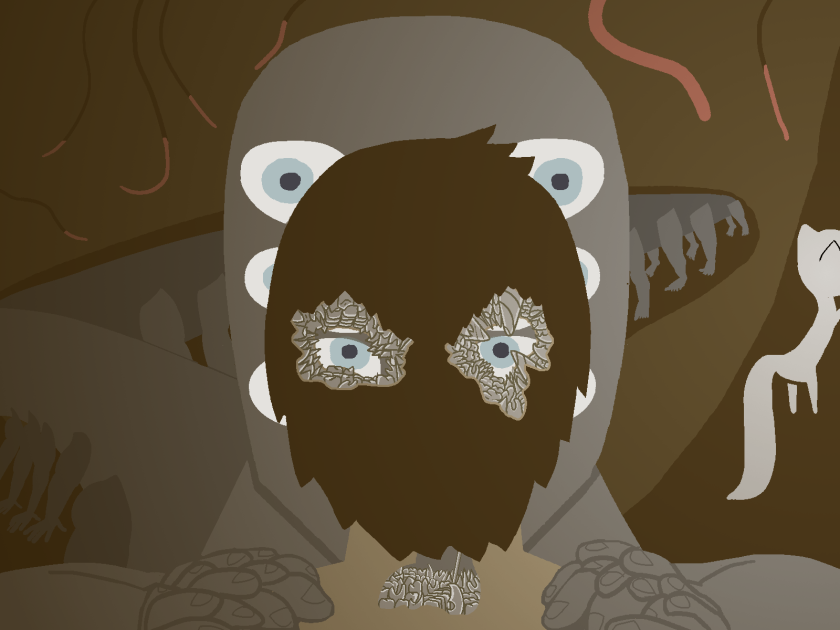
In Y1. The Staring Contest at the End of Time DanJay finally confronts Anihilato again. Last time Dan met the King of Dust, Dan’s soul was stuck in an egg until Jillian’s soul happened to free it, creating Jay. Now DanJay knows exactly what’s at stake in his staring contest. If Jay blinks, not only will his soul be devoured, but Anihilato will escape from the Biggest Bird, Akayama. As a result, Lucille’s Wheel of Reincarnation won’t be able to reconstruct Earth’s life. Even if the Galaxy Zephyr managed to defeat the Enemy Hurricane, it would be a Pyrrhic victory. Worse yet, DanJay can’t possibly win the staring contest: Anihilato has six eyes and closes them in pairs to keep constant vigilance. Even when Anihilato blinks, it faces no consequences.

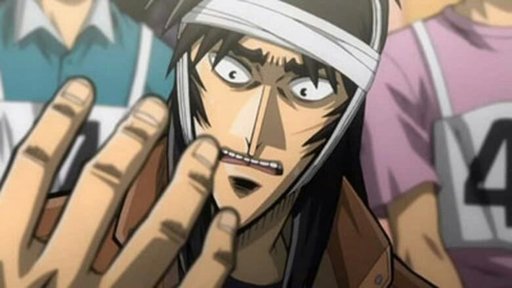
Overcoming hopeless situations by understanding them is a narrative element executed beautifully in a manga/anime called Kaiji: The Ultimate Survivor. You can watch it for free on Crunchyroll, but be warned: it’s not for the squeamish.

Itou Kaiji is a gambling addict conned into betting his life. To survive and crawl out of debt, Kaiji must defeat opponents in card games, dice games, and even mahjong. But he doesn’t always win, and when he loses, it’s painful. Literally painful, as he sometimes wagers body-parts. (Remember to read manga right-to-left.)

Image result for kaiji crying

I can’t recommend this anime enough. I’ve never before had a panic attack over a fictional character trying to win the jackpot at a pachinko machine. There are TV shows about superheroes, ninjas, and superhero-ninjas which can’t match the nail-biting intensity of Kaiji playing rock-paper-scissors.

The intensity of Kaiji’s gambling is something I’d like to reflect in Akayama DanJay. While Lucille has a traditionally climactic fight in a giant robot, Dan and Jay have staring contests for the fate of mankind. So what makes Kaiji intense? Spoilers incoming.

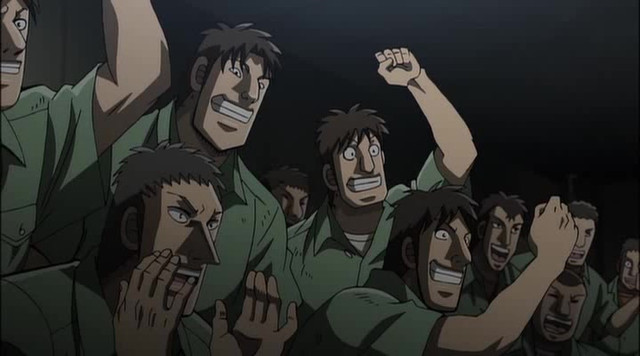
First, Kaiji can lose. If you’ve watched a lot of anime, you might roll your eyes whenever a powerful enemy appears because you know the hero is just going to power up and beat them next episode. But by the end of the first season, Kaiji loses all his money, all his friends, an ear, and four fingers. Holy shit.

Image result for kaiji fingers

Likewise, Dan loses his staring contest with Anihilato. I hadn’t seen any Kaiji when I wrote that first chapter, but I think I did well enough: Dan eked out a small victory against a bird before his teeth-splitting defeat to Anihilato. Jay isn’t going to lose—it’s the end of the book, after all—but Dan’s failure shows the reader DanJay isn’t an invulnerable protagonist, making tension possible.

A4 pictb

Second, Kaiji’s gambles usually have simple rules. Kaiji’s first gambles are literally rock-paper-scissors. Mahjong isn’t so simple, but the version Kaiji plays is theoretically simple if you actually know how to play mahjong to begin with. Explicit and unbending rules let Kaiji pull off jaw-dropping wins which always feel deserved.

Image result for forty fivers kaiji

DanJay challenges Anihilato to staring contests. Everyone knows how those work; blink and you lose. It’s pretty one-sided, because Anihilato can blink with impunity; only DanJay would turn into teeth.

Third, Kaiji’s gambles have life-altering stakes. Maybe he’ll pay off his debt, or maybe he’ll be subjected to a lifetime of slavery. Maybe he’ll make millions of yen, or maybe he’ll lose his fingers. The incredible and escalating stakes make every episode nail-biting, even when Kaiji just rolls some dice. Often, it’s not just his own fate on the line; other gamblers stake their lives on Kaiji’s. This serves double-duty by raising the stakes while making Kaiji a ‘good guy’ the audience can root for.

Image result for forty fivers kaiji

Dan is already dead when he challenges Anihilato. What’s at stake is his soul, which I’d argue is a step above gambling his life. Dan gambles his soul for the sake of Faith, then for the sake of Beatrice. Even though Beatrice doesn’t need to be saved, these bets let Dan ‘save the cat,’ a screenwriting concept stating that a story’s protagonist should demonstrate very early they’re worth rooting for by performing a kind, selfless act. Dan trying to save Beatrice is arguably a selfish act, because he’s trying to curry her favor, but Dan ups his bet to saving all the souls in Anihilato’s box. Dan loses, so his soul is chewed up and he’s shoved into an egg.

When Dan returns as Jay, Jay understands the REAL stakes. If he loses, it’s not just that his soul will be eaten for good; all sentient life in the universe rests in the balance. However, Jay declares he’s not fighting for anything:

“I am the inevitable,” said Jay, “and so are you. What happens happens. I’m subject to reality, just as you are.”


“This doesn’t mean anything,” said Anihilato. “You’ve failed. You and that frigid rat!”

“You’re half right,” said Jay. “This doesn’t mean anything.”

The progression of stakes—from Beatrice, to all souls, to all sentient life, to nothing at all—shows DanJay’s progression from self-centered to selfless. The only reason Jay is worthy of winning a gamble for the sake of the universe is because he doesn’t make it about himself.

Fourth, Kaiji’s gambles take twists and turns. Some people think Kaiji playing the pachinko machine drags on too long, and I agree, but I still love it because from moment-to-moment Kaiji can seem to have no way to win, or no way to lose. The back-and-forth, with upset after upset, renews the anxiety every episode. Kaiji usually begins at a disadvantage he must overcome; in the first season, he’s immediately tricked and loses most of the resources he has to gamble with.

Dan barely beats a bird, then is quickly bested by Anihilato. When Dan closes one eye, then opens it and closes the other, it barely buys him seconds. The delay makes his inevitable loss more painful, I think.

Jay begins at a disadvantage when Anihilato throws sand in his face. Then tears, sunlight, shadows, and sweat shift the tide of battle. My goal is to make the reader clutch their hair and scream, “all sentient life in the universe is doomed because Jay gets sweat in his eyes? Aaaugh!”

Fifth, Kaiji and his opponents cheat. Kaiji’s victory often depends on understanding how the opponent is cheating and using that knowledge to parry. When he learns an opponent is monitoring his biorhythms from his ear, he cuts off his ear for a slim advantage.

Image result for kaiji ear

Dan doesn’t cheat, unless you count closing one eye at a time. Anihilato cheats against Jay by throwing sand. Jay sort of cheats: he knows Akayama will arrive eventually, and he let the staring contest commence just to keep Anihilato in place until then. Jay will win by exploiting his knowledge of the secrets behind reality.

Sixth, and most importantly, Kaiji’s gambles are often thematically relevant. The most obvious example is a card game with three kinds of cards: emperors, citizens, and slaves. Emperors beat citizens, citizens beat slaves, but slaves beat emperors because slaves have nothing to lose. In this game Kaiji manages a few decisive victories against an evil company by cutting off his own ear. Just like the slave against the emperor, Kaiji wins because he has nothing to lose. Kaiji’s first gambles, over rock-paper-scissors, echo the theme song’s insistence that “the future is in our hands.” Kaiji plays mahjong, a four-player game, against only one opponent; the empty spaces at the table remind us of his two friends helping him cheat.

I hope a staring contest seems thematically relevant for Akayama DanJay. Eyes are important: Akayama grows compound eyes to demonstrate her godly perspective; the Hurricane Planets communicate with their eyes; Leo always wears suspicious sunglasses. In my art characters rarely have eyes at all, except to represent penetrating understanding.

So when Dan and Jay stare at Anihilato, it’s not just a staring contest. Thematically speaking, satan-allegory Anihilato is administering judgmental glares. Dan withers under that glare. Jay knows the gaze is powerless compared to that of Akayama, who has compound eyes Anihilato could never hope to cope with. Jay’s gaze is not divine judgement, but divine acceptance. He knows Anihilato is necessary to Akayama in the same way it’s necessary to remember horrifying historical events. To stop staring at Anihilato would be like trying to ignore Leo. We’d like to ignore people like Leo, but we mustn’t. We must stare them down and not let them escape.

Jay begins his contest with an explosive entrance. I want Jay emerging from the egg to reflect Christ’s harrowing of Hell, in which Jesus crushes a demon under a door on his way to salvage the damned. Jay’s death last section was a thinly-veiled crucifixion. I try to dilute the Jesus-imagery with Faith’s protective tail, which echoes the Buddha’s shelter under a cobra as it rained during his meditation.

The concept of a staring contest against all humanity’s foulness also reflects this line from The Once and Future King, a book about King Arthur’s childhood and rule:

I should pray to God to let me encounter all the evil in the world in my own person, so that if I conquered there would be none left, and, if I were defeated, I would be the one to suffer for it.

Dan, the mortal everyman with self-destructive compulsions, takes on Anihilato and fails, but it’s this failure which turns him into Jay, who can defeat Anihilato for good. Attacking all of humanity’s ills at once might seem to be a reckless, impossible task, but the first step is trying. Just as Merlin propels Arthur to greatness by preparing him for the horrors of the future (Merlin, who lives backwards, warns Arthur of World War II and Adolf Hitler), all the Blue Virgils residing in Anihilato keep the monster intact for Jay to properly challenge.

I hope all these elements combine to make a thrilling emotional climax for DanJay. What Dan could never do, he’s learned to accomplish as Jay.

Go watch Kaiji.

Next Section
Table of Contents