
Mystery Boxes

In L4. The Magic Circle Jango instructs Jay to eat a hallucinogenic centipede, in continuation of all the phallic imagery we’ve seen so far. Back when Jay smoked powdered centipede he woke up in the afterlife. Now he’ll experience the centipede’s full potency, but that’s a reveal for next week.

In this section Jango reveals that the mysterious masked figure, Virgil Blue, is just a pile of robes around a centipede bush. The real Virgil Blue retired decades ago in the same manner as every person to take the mantle of Blue: walking above the Sheridanian clouds never to return.

This explains why Virgil Blue never speaks or moves. It doesn’t explain why their silent speeches are so engrossing, or how they spoke to Jay, but I’m happy to chalk it up to magical realism. (Alternatively, maybe just smelling centipedes can give you a contact-high. Jay was in an enclosed space with the Virgil for an extended period before he heard the mask speak.)

J. J. Abrams, the mind behind LOST and the Cloverfield franchise, has a narrative idea called a mystery-box. A story keeping a secret can engross its audience; just owning a box with a question-mark on it “represents infinite possibility,” says Abrams. “It represents hope. It represents potential.”

Compare this to the idea of “the magic circle.” Says Dutch historian Johan Huizinga, quoted from this Wikipedia article,

All play moves and has its being within a play-ground marked off beforehand either materially or ideally, deliberately or as a matter of course. Just as there is no formal difference between play and ritual, so the ‘consecrated spot’ cannot be formally distinguished from the play-ground. The arena, the card-table, the magic circle, the temple, the stage, the screen, the tennis court, the court of justice, etc, are all in form and function play-grounds, i.e. forbidden spots, isolated, hedged round, hallowed, within which special rules obtain. All are temporary worlds within the ordinary world, dedicated to the performance of an act apart.

Fiction is a space where literally anything can happen. Many fictional worlds follow certain rules for the sake of narrative consistency, but these rules are largely self-enforced by the storyteller and often disagree with the rules of our reality. When we engage with a story, we cross into a magic circle and accept an alternate mode of existence.

In this context, a mystery-box is a rule in a narrative reality which is hidden from the audience, but which impacts the story. The audience is left to speculate at the hidden aspect of the narrative reality until the eventual reveal.

An unfortunate drawback is that if the reveal of a mystery-box’s contents contradicts the established rules of the fictional universe, the audience might retroactively judge the earlier parts of the story. They’ll say, “you didn’t actually have a plan at all—you just enticed us with the idea of a satisfactory answer.” Perhaps worse is a mystery-box whose contents don’t live up to the expectations. I don’t mean to pick on J. J. Abrams, but I recall people being disappointed with the ending of LOST for technically explaining everything but with a narrative “meh.”

So when I reveal something, I hope it answers the reader’s questions in a way which makes them more engaged with the story, not less.

This section of Akayama DanJay opens a mystery-box with the removal of Virgil Blue’s mask. Virgil Blue being a centipede bush answers some questions (why are they immobile? why are they silent?) while raising others (why is the mask so engrossing? why did Jay hear the story of Nemo?), which I hope encourages readers to come up with their own answers and imbue the imagery with thematic meaning.

If Virgil Blue’s silver mask represents Truth as solid as the moon, then the reveal of centipedes implies that Jay’s hallucinations will reveal the Truth of Akayama DanJay. We’ve seen Dan. We’ve seen Jay. Now that’s see Akayama’s side of things.
Next Chapter
Table of Contents

Christ Imagery

In L3. The Last Meal Jango extends an invitation to the group: he had prepared an initiation ceremony for Faith, but since she’s dead, he’ll allow them to experience the ritual for themselves. In this section Jay has his last meal before leaving to visit Jango, and he helps Dan take off his shoes.

Christ imagery walks a fine line between ‘neat literary device’ and ‘eye-rolling, cringe-worthy self-masturbatory style.’ Remember how in Man of Steel Superman would occasionally float around with his arms out? It was visually striking, sure, but maybe a little on-the-nose. In the third Alien film, Ripley falls into molten metal with her arms out to save humanity from the xenomorph-queen inside her. The symbolism is pretty obvious.

On the other hand, Harry Potter‘s Christ imagery is veiled enough that most people read about the boy who lived, died, and lived again without considering the Crucifixion. Some Christians say J. K. Rowling intentionally mirrored Christianity; simultaneously a few Christians say Harry Potter exposes children to witchcraft and the dark arts of black magic, so the true narrative intent remains ambiguous. I don’t personally know if J. K. Rowling wanted Harry to evoke Christ, but I’m sure she at least realized the implications of Harry’s resurrection and wrote with them in the back of her mind.

The double-character DanJay has already been reborn. Dan died in a furnace and was reincarnated as Jay. His first life was plagued by anxiety, guilt, and low self-esteem. His second life, who transcends death, has a more laid-back worldview because of his experience.

Dan, who echoes Dante from the Divine Comedy, represents a mortal every-man. When he met the Master of Nihilism Dan gambled his soul for the sake of all sentient beings, but for selfish reasons: he wanted to be with Beatrice and naively assumed he had to save her. Dan wasn’t ready yet, and he was obliterated. Like a phoenix rising from the ashes of nothing, he was reborn as Jay.

Jay is pretty mundane for a Christ figure; he performs no miracles (unless you count being born as Jillian and transitioning to assert a masculine identity as an act of transmutation) and he manifests no divinity. But he does buy Dan a bunch of fish sandwiches and pints of stout, and he helps Dan come to terms with the death of Faith and Beatrice. I occasionally specify where Jay appears in a line-up from left to right when he’s sitting at a table, like we’re looking at The Last Supper. In this section he takes off Dan’s shoes, like Christ washing his disciples’ feet. Dainty Dan, who hates to touch dirt, cannot remove his grass-stained shoes on his own. Jay is selfless enough to help him. After all, a lifetime ago, Jay was Dan himself.

If Dan is the mortal every-man, the implication that mortals need Jesus to cleanse them of sin is pretty obvious and too generic a message for Akayama DanJay. The fact that Dan and Jay are the same person takes the Christ imagery in a surreal, but mundanely humanist direction. Dan judges himself to be guilty; he’s always dirty. After ‘killing’ Beatrice and Faith, the only person who can really cleanse him—the only person who can convince him of his worth—is himself, Jay.

Humans carry faith wherever we go. Worthiness is internal. Now that Jay understands this, he’s free to cross the magic circle.

Next Section
Table of Contents

Asceticism

In L2. The Interview with Virgil Blue Jay sits alone with the mysterious Virgil. Virgil Blue’s engrossing silver mask resembles the moon, and like the moon, Virgil Blue represents the ultimate truth, silent but solid. Blue refuses to speak to Jay, even after Jay asks a question three times, until Jay writes “”. This seems to provoke the Virgil, who tells Jay to drop the pen. When Jay promises not to speak or listen, Virgil Blue tells him the story of Nemo, the first man in the religion of Sheridan.

Nemo, the first man, received the title Virgil Blue directly from the Biggest Bird who created the world. Granted immortality, Nemo gradually grew crazed and began to demand harsh asceticism from his students, even eating their frostbitten fingers and toes. Nemo realizes he’s not in proper mental condition to teach anymore, and agrees to retire. He declares the next Virgil Blue and walks above the Sheridanian clouds, never to return.

Asceticism is severe self-discipline often applied in a religious context. Practitioners avoid pleasure to seek spirituality, whether that spirituality is flavored as Christian, Judaic, Islamic, Buddhist, Hindu, or something else.

The term ‘austerity’ can refer to strenuous tasks an ascetic might impose on themselves. The word might conjure the image of a guru lying on a bed of nails, or a monk self-flagellating, but the prevalence of some of these practices has probably been overblown and sensationalized by popular culture. Nevertheless, the mere fact that these ideas have influenced popular culture shows their power to command a viewer’s attention. Self-destructive religious fervor strikes a strange chord.

Nemo eats his students’ fingers. There are a few religions (mostly cults) where amputations are included in rituals. For obvious reasons, these cults don’t exactly have new applicants knocking down the door. (Compare this with religions popular in the West whose histories had to overcome the somewhat imposing hurdle of circumcision.) Nemo realizes that his immortal mind has drifted so far from normality that his very presence threatens his religious institution. He retires above the permanent cloud-cover on the Main Island of Sheridan.

Religions change over time. If Nemo had demanded total control of his congregation, he would soon have no congregation. The Sheridanian religion outlives its immortal patriarch’s reign. But Nemo still remains: every generation, he returns to the dreams of the Blue Virgil, and he eats their dream-bodies to force them into retirement. Even if Nemo spares the junior pupils severe austerities, he demands each Virgil Blue maintains this strict protocol.

When religions remove difficult aspects of worship in order to expand their congregation, those difficult aspects can remain. Religions have splintered between groups who accept lax interpretations of scriptures, and groups who demand stringent orthodoxy and authenticity. When Nemo’s doctrines grew too beastly to follow, those doctrines were not totally abandoned. He merely carried them above the clouds, where ordinary folks would not be subjected to them. His practice remains in the cultural subconscious and the literal subconscious of Virgil Blue, the only mortal capable of withstanding the brutal rituals.

At the same time, Dan chews his fingers when he’s anxious. This mundane action relates to Nemo’s ritualistic amputation. The highest religious practices are extensions of the most human habits.

Maybe we’ll see what’s beyond the clouds. Not for a while, though.

Next Section
Table of Contents

Anticlimax

In L1. The Expected Visitors Dan, Jay, and Bob visit Sheridan Cliff-Side College to learn about the Virgils—only to find the Virgils waiting for them. As Jango says, there are no coincidences: Virgil Skyy and Blue have come to see Faith, who has visited Jango on three notable occasions. The gang must tell them that Faith died only days ago when she was struck by lightning.

An anticlimax is the opposite of a climax. Instead of an impressive capstone, as in a climax, an anticlimax has a series of events concluded by an unexpected and often disappointing ending. Perhaps a problem which seemed imposing is solved in a trivial manner. (Think War of the Worlds, where the horrible aliens are totally weak against the common cold, you guys.) Maybe an obviously upcoming event is averted, or a mystery has a lackluster twist ending.

Anticlimaxes can pull the rug out from under an audience, so they power some nice jokes. Listen:

A traveling salesman is caught in a storm and must stop at a farmer’s house. The farmer says, “you can stay in the guest room—but so help me God, if you touch my daughter, I’ll string you up and let the hogs eat you!”

So, naturally, during the night, the salesman gets curious and knocks on the door to the daughter’s bedroom. He opens the door to see that she’s in bed with another traveling salesman. The first salesmen shuts the door and says, “gosh, I must be in the wrong joke!”

A traditional set-up, which begins many classic jokes, is suddenly sunk by a fourth-wall break. An anticlimax can make people groan or laugh, or even reconsider the structure of a narrative.

Akayama DanJay is no stranger to anticlimax. Recall Faith’s obliteration at the hands of Anihilato; in the next section, Dan saved her in a staring contest. Then Dan was obliterated, too, but he just woke up as someone else. On one hand, letting my characters off the hook this easily might wreck any sense of conflict or danger in my story. On the other hand, these anticlimaxes present the ineffectiveness of death and even obliteration in the story’s setting while (hopefully) intriguing the reader. It also warns the reader to fear bigger threats, like The Teeth that Shriek.

This week we see another anticlimax: just before they arrive at the college, Jay gets a phone call regarding visitors he did not expect. This primes the reader for a surprise, which I fulfill when Virgil Jango Skyy greets Jay in the hallway. Then Jango further delays the anticipated gratification by telling the group a story with no obvious importance, and then reminding the reader of Faith’s three visits.

Then all is revealed: Jango is impressed with Faith’s peculiar appearances, and wants to take her as a student. Dan, Jay, and Bob have to tell him Faith died days ago. Jango came all this way for nothing. The moment fizzles.

But why? What does an anticlimax accomplish in this case?

Well, first, I hope it’s a little funny in a macabre sort of way.

Second, storytelling coincidences which help the protagonists are often considered “cheating,” while coincidences which get the protagonists into trouble are fair game. If Jango had appeared just to help Dan and Jay and Bob, it would be flimsy storytelling. Instead Jango appears to look for Faith, and Dan and Jay and Bob have to break the bad news. I hope that this anticlimax gets me off the hook for my “there are no coincidences” style of bringing characters together.

Third, because I get to bring characters together on a dime like this, I get to accelerate the plot and catch the reader by surprise. Next week, Jay interviews Virgil Blue.

Next Section
Table of Contents

Masculine and Feminine

In K4. The Return Faith demands an explanation from the Biggest Bird, the creature who rules the afterlife. The Biggest Bird lets Faith visit reality, where she meets Jay, bringing us up to speed with the previous chapter.

Again, I’m running out of topics for commentary. I can’t spoil too much about the afterlife, and there’s only so much to be said about non-linear storytelling. So this week, I thought I’d talk about the distribution of male and female characters in Akayama DanJay.

In ‘reality’ most of the characters are male. DanJay, Jango, Michael, Bob, and Leo have more narrative importance and screen-time than Faith, Beatrice, Eva, and Lilly. Meanwhile the afterlife is ruled by a giant bird who seems more maternal than masculine, while worms—thinly veiled phallic imagery—struggle to become worthy of joining that bird. The story-within-a-story, LuLu’s Space-Time Acceleration, has primarily female leads in Princess Lucia and her daughter Lucille. Akayama DanJay‘s mortal plane is generally masculine and its alternate realities are more feminine. If you believe The Da Vinci Code, ancient Christianity featured divine femininity; certainly The Divine Comedy where Dante seeks Beatrice can be read this way.

The double-character DanJay bridges genders and dimensions. When Dan was obliterated, he was reborn as a two-year-old girl named Jillian; Jillian reasserted a masculine identity when they took the name Jay. Jay straddles mortality and death by visiting the afterlife and meeting the dead.

Jay watches Dan’s struggle with death, anxiety, and femininity. After his father’s suicide, Dan obsesses over his fantasy of ideal love, Beatrice, who has barely a passing interest in him. When he accidentally smokes centipede and goes to the afterlife, Dan is a gnashing pile of teeth which decomposes into ten thousand worms. A tangled pile of worms is an obvious image of frustrated masculinity. It’s this frustration and anxiety which keeps Dan from the Mountain.

Faith and Beatrice immediately enter the Mountain after their deaths, as symbols of femininity. In fact, Beatrice is barely more than a symbol (which I guess is somewhat fitting in a Divine Comedy allegory). If Beatrice is the purest, most unattainable vision of love possible, then Faith, who returns from death to tell the tale, is mankind’s only chance to unite with that vision of love. Through Faith, the unattainable is attained.

But also lurking in the afterlife is the largest worm, Anihilato, a massive, overgrown phallic tumor. Anihilato refuses to join the Mountain and in fact claims to own all sentient beings. The Biggest Bird seems to accept Anihilato’s existence and even integrates it into their cosmology: they say, “When I find worms I cannot swallow, I know Anihilato will eat them for me.” In an otherworldly sense, the Biggest Bird keeps Anihilato because the concentrated masculine energy is sometimes necessary to open stuck jars.

In another section I said that fundamentally speaking, gender is just a thing humans made up. The only reason I can talk about masculine energy and feminine energy is because people know those words and understand what I mean. I can say Anihilato is masculine despite calling it an ‘it’ because it’s phallic and muscular and aggressive. I can say the Biggest Bird (or the Heart of the Mountain, or Bug-Bird) is feminine despite calling them ‘they’ because they encompass maternal aspects, having birthed the Islands of Sheridan and the matriarchal birds who live there.

The afterlife in this story is therefore divided by the Biggest Bird and Anihilato along generally engendered traits. Only DanJay, whose dual life has shown him a little bit of everything, has the potential to integrate those opposites.

Next Chapter
Table of Contents

Cut the Turtle, Write like an Egg

In K3: The Antlion Faith ventures into the desert and steps on Anihilato, the forty-limbed centipede-person. Back when we met Faith for the first time, she mentioned this meeting! The afterlife’s timeline is an unconventional one.

Once again, I find myself running out of topics for commentary. There’s not a lot in this section I haven’t already discussed. So, I thought I’d discuss something I cut when I wrote this new draft.

In the exploratory draft I wasn’t sure what should happen to Faith in the afterlife. To compensate, I added another character to take up narrative space: a turtle who dispensed fortune-cookie wisdom. He didn’t do anything, or mean anything, and he only appeared because I wanted to fluff up the word-count. But including the turtle did make these sections easier to write, so even though I removed him, he was an integral part of my writing process. Like a bay-leaf added to soup, the turtle was intended for removal before serving.

I notice writing-crutches like that turtle in my first drafts fairly often. If I haven’t planned what should happen next in a story, I might introduce a new plot element just to keep me writing until I figure out where I’m going. When I write the second draft, I should know roughly where the story ends up, so I can omit characters and events which I know to be extraneous. The turtle helped me write Faith’s introduction to the afterlife and her confrontation with Anihilato; once those events were more fleshed out, the turtle was no longer necessary. Anything not necessary to a story should probably be removed.

That writing principle is what I call “writing like a salty egg.” Let me explain:

How do you balance an egg upright on just a few grains of salt, as few grains of salt as possible? You might try to stick two grains of salt under the egg and hope they support its weight, but you won’t have much luck.

But, you can easily balance an egg upright in a small pile of salt. Then you can blow the salt away, and the only remaining grains are those needed to hold the egg. This is the preferred way to balance an egg on a few grains of salt, if you ever find the need.

In writing like a salty egg, I try to overwrite until I know my narrative game-plan. Then I remove everything which serves no purpose. The turtle’s wisdom was given to another character, the Heart of the Mountain. The companionship Faith once found from the turtle, she now finds from the white wing. Hopefully my story will still stand after being pared down to its most important elements.

Another example of this comes from Dan Wakes Up. In that section, Dan awakens as a toddler named Jillian after his soul is eaten by the Master of Nihilism, Anihilato. Jillian’s parents tell Dan his name is Jillian and tuck him back into bed. That’s complicated enough for one section.

But in my first draft, I didn’t know that. I thought Dan/Jillian needed to see something important, to start a story-line involving Jillian’s family. As I rewrote chapter B I realized Akayama DanJay didn’t need that extra story-line, and I removed it. But at the time, writing that story-line gave me narrative momentum and kept me writing words on the page. It wasn’t a waste, even if I later decided it was unnecessary.

Anyway, thanks for reading my rant about turtles and eggs and all that.

Next Section
Table of Contents

The Shape of a Story

In K2: Outside Reality Faith follows the Biggest Bird into the Mountain. The Biggest Bird escorts Faith beyond the bounds of reality as we know it and tells her to jump into a specific moment. When Faith enters reality, Jay explains he’s already heard this part of the story.

To recap, Jay entered the monastery of Sheridan to hear a story from Virgil Jango Skyy. In the story Faith appears from smoke to learn about Jango’s brother Jun, then returns whence she came. The first time we read these sections we read them from Jay’s perspective. Now we reconsider those sections with Faith’s perspective in mind, and we see the intersection of strange timelines.

One of my goals with Akayama DanJay is to write a story which feigns linearity, but cannot be understood linearly. When the reader realizes they cannot depend on chronological order, they must consider the whole story at once as a simultaneous object.

If the reader can hold the whole book in their mind at once, and consider its beginning and ending to be concurrent with every other part, they become like the aliens in Kurt Vonnegut’s Slaughterhouse-FiveSL5 features aliens called Tralfamadorians (who appear in different forms throughout Vonnegut’s works) who can see every point in space-time simultaneously. The Tralfamadorians describe the end of the universe as if it had already happened, and they keep humans in a zoo to speculate about the nature of our limited minds.

SL5 follows one human, Billy Pilgrim, as they struggle with Post Traumatic Stress Disorder after WWII. The disorder is likened to being “unstuck in time” as Billy perceives events in an unconventional order; the reader is whisked from past to future to present and back. In this manner Vonnegut enforces upon the reader a feeling of disconnection with reality. Vonnegut’s Post-Modernist story-shape induces a symptom of PTSD within the reader, temporarily, in order to convey the senselessness of war and the meaninglessness of life. “So it goes,” says Vonnegut.

Akayama DanJay is less bleak but no more straightforward. The dual character DanJay begins the narrative by immolating himself in a furnace as Dan, led by an obsessive desire for spiritual cleansing. He is reincarnated as Jay alongside his previous life, and the vantage point allows Jay to come to terms with his destiny. Dan feels incomplete without his fantasy of idealized love in Beatrice; Jay knows he contains everything he needs.

And Faith connects them all. In life, she brought Dan to Beatrice. In death, she visits Jango and Jay. Now the Heart of the Mountain requests Faith to wrap the Wheel with the white wing—Faith literally binds reality together.

The white wing belongs to Beatrice, who appeared as the wing-thing in the afterlife after she was hit by a bus. Beatrice’s compassion and spiritual purity manifest as indestructible wings of infinite length. My vision of reality as a spinning circle, maintained by Faith’s application of compassion, is generally optimistic. Faith is even reunited with her lost love, even if she hasn’t caught on yet.

Kurt Vonnegut described the “shape of a story” in a delightfully mathematical way: graph the protagonist’s state over time. From the beginning of a book to the end we can draw a line which dips when the hero struggles and spikes when the hero overcomes. I especially like this description of a story’s shape because Vonnegut’s own books can be difficult to graph: should Slaughterhouse-Five be graphed using time in the traditional sense, or using the non-chronological order presented to the reader?

When writing SL5, Vonnegut planned the story by unrolling toilet paper and drawing each character’s “lifeline” across its length. When a character died, their line stopped. I imagine Vonnegut felt like a Tralfamadorian as he reviewed his toilet paper plotting: he could see the beginning and the end and everything in between at once, if only in a fictional universe of his own creation. Maybe he drew a line which curved back on itself, or disappeared and reappeared elsewhere, representing Billy Pilgrim or the reader themselves, who journey through time in the unconventional order presented in the text.

Whatever timeline we use to “graph” SL5, flattening out a book gives readers a “god’s eye view” of the narrative. In Akayama DanJay, I describe the whole of reality as a spinning circle which the characters can observe. I hope viewing the universe from the outside—even within a story—is an intriguing experience.

At the same time, the reincarnation of Dan as Jay presents a circular story-shape. DanJay lives as Dan, then simultaneously as Jay, walking the same path again. In an abstract sense, DanJay’s reality really is a spinning circle, as I depict it. Or maybe I’m just being pretentious.

So it goes.

Next Section
Table of Contents

How Many Gods

In K1: Instinct Faith wakes in the afterlife and she hopes she’s hallucinating. She meets the Heart of the Mountain, the twenty-foot-tall bird with tentacles and human hands hidden in its robes. Faith asks the Heart of the Mountain about the Zephyrs. The Heart’s talk of Zephyrs confuses Faith more than it enlightens her.

Faith asks the Heart of the Mountain how many Zephyrs there are. The Heart says there are uncountably many. Faith presses the Heart until it admits that in a fundamental sense, there is only one Zephyr.

I mean this to mirror a story from the Vedas. Says a website called “hinduwebsite,”

In the Brihadaranyaka Upanishad, when Vidadgha Sakalya asked Yajnavalkya, how many gods were there, he began the answer saying, “As many as mentioned in the offerings made to the gods of the universe, namely three hundred and three, three thousand and three.” On being queried further, he reduced the number gradually from three thousand three to thirty three, then to six, then to three, then to two, then to one and half and finally to one.

When I first heard this story I wanted to know what would have happened if the pesky mortal asked the sage Yajnavalkya just one more time, “How many gods are there.” Could the sage say there are zero gods? Would he use another fraction? Would he start ascending back up to thousands?

As I understand it, Yajnavalkya’s answers reflect the modus operandi of Hindu deities. One singular god, Brahman, is the ultimate transcendental reality and the supreme cosmic being. Brahman never changes, yet causes all change. The three gods Shiva, Vishnu, and Brahma are said to have emerged from Brahman. From these gods emerge countless subordinate deities. However many millions of gods are mentioned in texts related to Hinduism, they are manifestations of a singular identity.

Compare this to the Christian idea of a three-pronged God in the Father, Son, and Spirit—or, in fact, to any number of theoretical absolutes.

In Akayama DanJay Faith asks the Heart one more time, “How many Zephyrs are there,” and the Heart responds, “I’m done playing this game.”

Faith, who appears in the afterlife as a fox, is mischievous. She keeps asking how many Zephyrs there are because she thinks it’s funny the Heart keeps changing its answer. The Heart continues to answer until it catches on that Faith is merely playing. But the act of asking once more, even in jest, after the Heart claims there is only one Zephyr, advances Akayama DanJay‘s goal of transgressing boundaries to observe sheer absolute reality.

So whatever a Zephyr is, and whatever a god is, there seem to be exactly as many as you need at the time. The All, The Absolute, The Everything, or whatever you’d like to call it, is an infinite well-spring of diversity. In it, you will find anything you’re looking for.

In the same way, we often say there are seven continents: Africa, North and South America, Antarctica, Asia, Australia, and Europe. But there’s no single consistent definition of a continent, except to point at that list of seven of them. If continents were determined solely by contiguous landmasses, Europe and Asia would be combined. If mountain ranges separated continents, then the Rockies and Andes would define East and West Americas. If we based continents on tectonic plates, there would be thousands. A more holistic approach might call planet Earth one big continent just to get it over with.

In the next section Faith will ask the Heart of the Mountain what gender they identify as. How many genders are there? Same bucket of worms. Chromosomal abnormalities and the various mating practices of different species make any single definition of gender untenable. There are two genders, and there are ten thousand genders, because fundamentally speaking, there are zero genders. We made them up, like I made up Zephyrs.

See you next week.

Next Section
Table of Contents

Hallucinatory Ordinariness

In J4: The Magritte Jay realizes he’s a little too high and steps out for some fresh air. While he’s outside a cloud shaped like a fox steps from the sky to talk to him. This is Faith, who was struck by lightning and died.

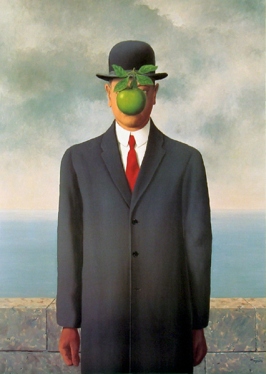
She steps from the sky with the “misunderstanding of a Magritte.” Rene Magritte was a Belgian surrealist painter born in 1898. You’ve probably seen his apple-face-guy, the Son of Man:

Ren? Magritte, The Son of Man, 1964, Restored by Shimon D. Yanowitz, 2009  øðä îàâøéè, áðå ùì àãí, 1964, øñèåøöéä ò"é ùîòåï éðåáéõ, 2009

Magritte’s brand of experimental modernism is entrancing. His impeccable symbolic style influenced Pop Art of the 1950s. I’m not an artist (just check any section of Akayama DanJay) or an art historian or anything like that, but I do have art-critic Robert Hughes’ introduction to The Portable Magritte to vouch for me in Magritte’s applicability to the story I’m trying to tell.

Says Hughes,

Magritte’s turning point was 1927, when he went to live in Paris. There, immersed in the Surrealist movement, he was no longer a provincial spectator. And he quickly realized where his contribution to it might lie… in hallucinatory ordinariness. …Magritte’s combinations [of ordinary objects] were another thing entirely. His poetry was inconceivable without the banality it worked on and worked through: it subverted ordinary naming.

Magritte’s paintings have a knack for pointing to the illusory nature of reality. His painting The Human Condition is my favorite:

renc3a9_magritte_the_human_condition

Says Hughes,

The canvas on the easel bears a picture of the view through the window, and this picture exactly overlaps the view, so that the play between “image” and “reality” inside the fiction of Magritte’s image asserts that the real world is merely a construction of the mind.

When I look at that painting, my first question is “does the picture on the canvas accurately reflect the real view through the window?” This is precisely the trap Magritte has laid: there is no real view through the window. It’s a painting. In the same way, we might try to “peek around” our sensory perceptions to glimpse reality as it truly is, but that glimpse would necessarily be filtered through sensory perception. No matter how hard we try, we cannot wrangle objective reality. These words on your screen are filtered through your mind, which lies to you every night when you dream. If there exists something called an “I” it is a bubble of lies which pops when self-observed.

Akayama DanJay begins with Dan dying and touring the afterlife. When he is obliterated, he returns as Jay. Is Jay’s memory of being Dan a dream? Is Dan’s experience as Jay illusory? The continuity of DanJay’s consciousness across the afterlife and back is my attempt to reproduce, in writing, the effect of Magritte’s The Human Condition. Which parts of DanJay’s experience are real? Are his hallucinations a greater reality than his perceptions of waking life? Of course not! Akayama DanJay is fiction. None of it is real! Our mind betrays us by imagining reality when there can be no such thing.

Not everything in Akayama DanJay is ordinary. Crickets grow like grass from the ground.  A bird-monster scours the afterlife. But the characters don’t treat crickets as unordinary, and the bird-monster appears only in hallucinogenic stupors. I hope to blend the normal and the weird so thoroughly that the reader never knows what to expect. When the characters are supposedly sober, they see congregations of monks worship a pink penguin. When the characters hallucinate, anything goes, yet their visions have internal consistency.

Anyway, that’s why I mentioned Magritte. Even my crude artwork sometimes echoes his composition and themes.

D3 pict

I hope this was interesting, because I’m grasping for ideas to write about as commentary. I don’t have much writing advice, because I mostly wing it. Maybe I’ll just talk about one of my inspirations every week!

See you next Friday. Keep eating your worms!

Next Chapter
Table of Contents

Fighting Dirty

In Chapter U. Spokes Lucille distracts the Enemy Hurricane while her Galaxy Zephyr’s Wheel is repaired. Long-time readers know Faith is wrapping the Wheel with Beatrice’s wing to subdue the bulge. This means the lightning bolt which killed Faith also caused the bulge which Faith mends. The bolt caused two problems, one of which solves the other. With Faith, every problem is its own solution. Closing doors opens windows.

In the same way, the Enemy Hurricane birthed the tools of its own destruction. Besides frightening Akayama’s Hurricane Planet into following the professor’s every order, it caused the perfect storm to generate its executioner, Commander Lucille, by killing her parents.

Admittedly, the Hurricane Planet which killed Lucille’s parents eventually pledged allegiance to Akayama, but since all Hurricane Planets used to be identical, it’s not a stretch to blame the Hurricane in general. Also admittedly, that Hurricane Planet didn’t actually kill Lucille’s parents: Commander Bojack self-detonated to protect his crew, and Princess Lucia died as a result of over-exertion.

Yet Lucille blames the Enemy Hurricane for the death of her parents, and she’s not totally wrong. The Hurricane created a universe in which robot-pilots had to put themselves in danger to protect the galaxy. In this sense, just like the lightning bolt killed Faith and caused the bulge which Faith repairs, the Hurricane threatened humanity in a way which generated its greatest enemy, Commander Lucille. She doesn’t care about technicalities. She doesn’t even care about Earth. She has nothing to lose or gain by fighting; fighting is its own reward and she relishes every instant.

Lucille demonstrates this by fighting dirty. The Enemy Hurricane fights dirty, too, so really, it had this coming.

When Lucille asks the Enemy Hurricane about her parents, she’s leading it on. She knows it’s lying. She’s playing dumb to invite foul play. She insists only that the Enemy Hurricane return her parents as ‘ordinary, breathing humans’ so she may inspect them.

The Enemy Hurricane makes facsimiles of Bojack and Lucia to lure Lucille close. Both replicas are traps meant to kill Lucille in front of her crew. Lucille preempts the favor by tearing out her parents’ throats, exploiting her insistence that they be ‘breathing.’ The situation is really her own trap. If her parents’ facsimiles were really copies of the Enemy Hurricane, then she kills it in front of itself three times (she kills Bojack in front of the Enemy Hurricane AND Lucia, then kills Lucia in front of the Enemy Hurricane). By baiting the Enemy Hurricane she delivers poetic justice, perhaps to a degree which could be considered overkill.

Is it really fighting dirty if you match your opponent tit-for-tat by predicting their deception? One might argue turnabout is fair play. Lucille, the stand-in for Lucifer, has a knack for exploiting her opponent’s attempted treachery. It’s common to say that super-heroes shouldn’t kill super-villains because then “they’d be just as bad,” but Lucille doesn’t seem to mind being bad as she wipes blood off her jaw.

Lucille also points out “It’s just us and the Hurricane. Legality falls with the chips.” It’s hard to justify, say, adhering to the Geneva Convention after Geneva Switzerland has been vaporized. As the only two entities remaining in the entire universe, the positions of the Enemy Hurricane and the Galaxy Zephyr can only be stated relative to one-another, speaking both physically and morally. Lucille is the equal and opposite reaction to the reality-devouring entity which produced her.

Also notice, the Galaxy Zephyr would have no hope if the Enemy Hurricane didn’t destroy Earth. Without Earth’s destruction the Galaxy Zephyr would have no Wheel. It wouldn’t have Beatrice’s wings or Faith’s assistance. Every step of the way, the Enemy Hurricane’s displays of power only manage to doom itself. It lacks Lucille’s satanic charisma, the quality which allows her to violate battle-decorum.

Keep eating your worms.

Next Section
Table of Contents