End of an Arc

G4: Riding the River is the end of a story arc. Jay has finished his tour through Sheridan, and next Chapter he’ll be back in LA. I’ve done my best handling loose story threads: the Chinese couple, Eva, and Lilly share a moment of closure, while Leo/’Henry’ will appear again; I’ve dangled him on purpose. Let’s examine this ending to see how I try to wrap things up and provide a satisfying conclusion.

First, ‘Craig,’ ‘Suzy,’ Eva, and Lilly share their last moments ‘on-screen.’ Conjoining the endings means I only needed to write one effective scene. If I wanted to address ‘Craig’ and ‘Suzy’ and Eva and Lilly separately, I’d have to write and balance multiple scenes and that sounds hard. It’s more expedient to roll these characters together and finish them all off at once.

Second, ‘Craig’ and ‘Suzy’ tell Eva and Lilly their real names, Zhang and Li Ying. This rounds out the message conveyed in sections E4 and F1. People associate themselves with names and symbols based on how they want to be perceived and how they interpret their surroundings; ‘Craig’ and ‘Suzy’ gave English names because ‘Henry’ kept asking Michael to translate their Chinese. Now that ‘Henry’ is gone, Zhang and Li Ying can reveal themselves.

Third, I use the bird statue to bring closure to Michael’s arc. In previous sections Jay was told the statue was a shrine, but Jango told him it was a mailbox. Jay tells Michael what he learned, and Michael admits he made up the shrine story years ago because tourists didn’t care about mailboxes. Even the locals started to believe it, and they lit incense and candles in the box. This means no mail gets to the monastery, so Michael needed Jay to deliver his letter. Michael’s lackadaisical treatment of religious icons separates him from his lost nieces and nephews. Maybe he doesn’t even realize this.

So that’s all our minor characters wrapped up. When Jay returns to LA, the reader won’t expect Zheng and Li Ying to reappear. Eva and Lilly have had their time to tell the reader a story, and now we move on.

To further signify the closing of an arc, the last imagery of the chapter suggests the end of a journey. Readers have followed Jay from island to island, over hills and up mountains, all the way to the monastery; now Jay reverses direction by riding down the river in an inner-tube. In comparison to the long hike up, the return is effortless. He speaks with the other tourists, but the river separates their inner-tubes and he finds himself alone for the first time since E3. Fish swim under him while he floats under bridges. The river becomes timeless, the ocean becomes infinite. For a little while, Jay is at peace with the universe.

Of course, Akayama DanJay isn’t over, so that peace must be short-lived. Next week Jay’s world must be shaken. Let’s hope the lessons he’s learned in Sheridan help him out in Los Angeles.

Keep eating your worms!

Next Chapter
Table of Contents

Miscellaneous Motifs

A lot happens in G3: The Great Stand so I had trouble choosing something to comment on. We’ve already talked about giant robot animeJapanese, and non-linear storytelling. I eventually decided to just review some of the motifs I’ve used so far, and explain why I’ve included them. A motif is a “distinctive feature or dominant idea in an artistic or literary composition,” says Google, and noticing them is key to understanding a writer’s intentions for their work.

I didn’t start writing with motifs in mind. I wrote what I wanted, and noticed motifs later. There were a lot of mountains and a lot of worms. Now that I’m rewriting Akayama DanJay for publishing online, I can put intention behind the imagery.

In Akayama DanJay, height represents spiritual knowledge. The first paragraph of the first section shows Jango on a mountaintop looking down on two small islands, while contemplating an even larger mountain, THE Mountain, in the next eternity.  The main island of Sheridan, the holiest place on earth, is shrouded by clouds so mere mortals aren’t overwhelmed by the height of its peak. Monks in Sheridan must acclimate to the holiness of the main island by practicing on the hill of the smaller second island. Faith meets Virgil Jango Skyy in the Bighorn Mountains. Jay travels to Sheridan via airplane, like he’s being carried by a bird.

Jango says he was born in Kansas. Kansas isn’t actually the flattest U.S. State, but it’s often thought to be, so this represents the spiritual barrenness Jango felt before coming to Sheridan. His brother Jun has lived in Kansas all his life. Now Jun lives in a basement, rejecting spirituality and elevation.

But Jun has a spotlight, and lighting in Akayama DanJay has been used to represent realization or clarity of mind. In the first picture Jango’s head is framed by the sun, giving him a halo. Anihilato lives in the deep, dark underground. Leo wears sunglasses even at night. We discussed fireflies in the commentary for section G1. So even though Jun rejects spiritual influence, he sees to the heart of things.

Worms are gross. No one wants to be a worm. But Faith says in section A2 that she “usually reign[s] in regular old lost souls, like earthworms and stuff. The Zephyrs meet people like [Dan] themselves.” It seems most people turn into worms in the afterlife. In my mind, death forces humans to be humble. Turning people into worms expresses that. Some worms are larger than others, and Anihilato is the largest. Anihilato rejects humbleness; if he’s to be a worm, he’s gonna be the biggest worm.

Meanwhile, birds eat worms. The Biggest Bird gathers worm-souls and brings them to the Mountain. Beatrice is a thing with wings when she enters the afterlife, so she must be special. In particular, Beatrice has wings with no beak or claws, so she expresses only a bird’s romantic qualities and none of the dangerous or harming aspects.

How about eggs? An egg represents the potential for life. The Sheridanian Big Birds hatch from fist-sized eggs tended and laid by an enormous matriarch. Anihilato has eggs, as well, but he uses them for warmth and for battle. The Sheridanians have slightly egg-shaped heads. The first time we see Faith made of snow, she balls up into an egg-shape to keep her cold surface from the hot sand.

Faith herself is an odd case. She’s a human in life, but in the afterlife she’s a fox made of snow who can turn into a cloud. Clouds are important in Akayama DanJay, representing that which cannot be grasped, and cannot be destroyed. I think that fits ‘idyllic spiritual faith’ to a tee. Foxes are often tricksters in folklore, and Faith certainly has a mischievous playfulness. Foxes also eat birds, so Faith is naturally attracted to the bird-girl, Beatrice.

Finally, let’s look at giant robots. I’ve already waxed quite a bit on the subject, and Jango explains his own interpretation to Jun in this section. Fighting robots represent places and people, so to combine robots requires those places and people to be in harmony. As a metaphor for the power of societal change, giant robots are perfect.

Anyway, next week I’ll have some notes on writing endings and conclusions. Keep eating your worms!

Next Section
Table of Contents

Folklore and Non-Linear Stories

In G2: The Kid from Kansas Jay meets Virgil Jango Skyy, an old monk with an odd disposition. Jango tells Jay he met Faith Featherway not just in Section C2 but also ten years prior to that, and under strange circumstances. Akayama DanJay has a non-linear story meant to drip-feed information to the reader.

Telling a linear story is difficult enough: a writer must choose which scenes to show, from whose perspective, and at what pace, in a whole parallel universe they made up. If you allow yourself non-linearity, the gloves come off. You’ve got the whole time-space continuum to edit, and you have to tease out some one-dimensional string of text. For inspiration let’s read some notes in American Indian Myths and Legends.

The introduction to Erdoes’ and Ortiz’s collection of American folk lore tells us,

To those used to the patterns of European fairy tales and folktales, Indian legends often seem chaotic, inconsistent, or incomplete. Plots seem to travel at their own speed, defying convention and at times doing away completely with recognizable beginnings and endings.

But this is a feature, not a bug. The efficient style is a product of the reason these people tell stories, and the manner in which they tell them:

Spinning out a single image or episode may be the salient feature of—indeed, the whole reason for—telling a tale, and tales are often told in chains, one word, character, or idea bringing to mind a related one, prompting another storyteller to offer a contribution… Rather then being self-contained units, they are often incomplete episodes in a progression that goes back deep into a tribe’s traditions.

I don’t want to post whole stories from the book, but take as an example this opening from the Maidu:

20170918_115113.jpg

I imagine a group of people sharing stories over a fire, and one mentions a butterfly. Another person is reminded of Tolowim Woman and Butterfly Man and tells it afterward, like an ancient version of queuing songs in a playlist. To make these story-weaving sessions possible, ‘modern’ story structure is eschewed for a sense of timelessness. Each story stars an iconic cast like Coyote, Gray-Fox, Mole, Turkey, Deer Hunter, and other such immediately-identifiable names and animals whose personalities would be well-known to the audience. Protagonists are often said to be “out walking one day” when some inciting event presents itself, so the story can be imagined to have taken place at any time. The place of a story in the timeline of creation mythology may be unclear until the end, when characters are suddenly revealed to have been the Sun and Moon, or constellations, or famous landmarks, or plants. More often a concrete time-period is undisclosed, so the stories can be told in any order.

Akayama DanJay isn’t as non-linear as barely-connected stories told over a campfire. The character DanJay provides a near-continuous through-line for readers to follow. Sections lead fairly directly into one another, and Chapters represent contiguous story-arcs mostly in one setting.

But the breaks in between might bring Dan back in time and make him Jillian, or throw him into the afterlife as Jay. Time-travel and alternate universes are a lot for readers to swallow. Even with DanJay’s almost unbroken plot-thread, I need to make stylistic choices which help readers cope with the shape of my story. That’s why I’m taking notes from American Indian folklore; I hope the lessons in timelessness will help me soften the transitions from timeline to timeline.

I hope to teach readers to recognize my character’s names like American Indians recognize their folk heroes. Seeing the name Dan or Jay or Faith at the start of a section should immediately ground the reader in the world of the book, just like saying “Coyote was walking along” might prime an audience for a classic tale. Most of my character names are five letters or less, and longer names like Beatrice have meaning which might make them memorable.

Although I start each section by introducing the setting and relevant characters, I try to do so quickly with only a paragraph or two. Then I introduce tension. I hope this propels readers from section to section because they want to see what the next conflict will be, just like American Indians might begin with a single line of action before an inciting event, to get to the good stuff.

I also try to revisit the same images in new contexts, as discussed in the commentary to Section D2, to make events echo and reverberate across time. Jango tells Jay the story of finding a monk smoking in a mailbox, and Jango tells the monk he once smoked a cricket in the monastery furnace. These both echo Dan’s immolation. Even Lucille climbing into her giant robot is reminiscent of the furnace scene. No matter how strange Akayama DanJay might get, it consistently circles the same ideas.

When we make the choice to present a story in a non-linear way, we should do so with purpose. For the rebellious non-linearity of Akayama DanJay, doubly so. So why did the American Indians adopt this form of storytelling?

Tellingly, many tales tell of heroes braving the land of the dead and returning with boons. Stories with such elements assert control over the world around us. It unites families with their ancestors and their progeny. Death is permanent, but timeless stories will be applicable and strengthening for generations. They can never become dated and irrelevant.

In Akayama DanJay that sense of unity with the people who came before us, and the people who came after us, and the people alongside us, will manifest into a giant fighting space-robot. That’s not so different from Coyote turning wolves and bears into the Big Dipper, in a cosmic sense.

Thanks for reading. Keep eating your worms!

Next Section
Table of Contents

Pulling Punches

In G1. Fireflies Leo joins Jay on the path to the monastery of Sheridan. Leo is abrasive as always, but he finally leaves to wander the mountainside alone. I’d like to talk about Leo in this section, as I’ve given a lot of thought to his portrayal. (This is probably the commentary I edit most, because I’m still not completely sure what Leo’s deal is. I think it’s difficult for him to represent anything in particular because he has no values at all, but he’s willing to pretend to have any value when it’s convenient.)

If I’m doing my job as a writer, I can make people believe anything. I’ve already thrown my protagonist into the afterlife using hallucinogenic centipedes, and that’s pretty fantastical and surreal, but ultimately harmless. That’s the kind of journey which makes it worth building a magic circle and inviting people inside. But over-indulging in the vileness of an enemy is propaganda. Leo gets to restrain himself (for now).

As outlined in the commentary to E4, Leo represents the recent swell of ultra-toxic ‘politics’ in the American cultural subconscious. He’s a coward who hides his intentions behind feigned obliviousness, but shows his true colors when he thinks he’s among like-minded company. In this section he’s astounded that Jay is actually visiting monks and not just using the monastery as an excuse to steal drugs to sell back in America. Leo argues his drug-smuggling is an extension of a family tradition of smart business decisions, and sets off to steal centipedes even though Sheridan has made quite clear that centipedes are of vital cultural and religious importance. He swears using language too colorful to print.

Allowing Leo to hide his intentions from the audience as well as Jay is a courtesy. Eventually Leo will have another chance to explain himself, and then he may show more of his unsavory side. Until then, I’ll try not to look like a bad political cartoon.

Leo claims to be a self-made man because he climbed the mountain without a lantern. Perhaps he says this to deride Jay for his friendship with Michael the tour guide, as Michael gave Jay his lantern in return for his friendliness in comparison to Leo. But Leo’s claim of being a self-made man doesn’t ring true: he had a jar of fireflies to light his way, and he didn’t even collect the fireflies himself. He even expects Jay to help him carry his luggage up the final ledge, and still claims to be self-sufficient. Despite the claim, he’s quick to blame others for his life’s difficulties, as he bemoans the trouble he’ll have finding centipedes after Jay frees his fireflies. (Remember, he blamed his wife for dragging him to Sheridan. He can’t even be responsible for his own alibi.)

Speaking of fireflies, the image of jarred bugs flailing for air is a disturbing one. People aren’t normally so squeamish about dying bugs, but fireflies have a romantic connotation. Also, crickets and centipedes are associated with religion in Akayama DanJay, so trapping fireflies for light seems like abusing religious doctrine for personal gain. Freed fireflies lighting the trail to the monastery signifies the power of natural religious illumination to guide humanity to knowledge. Trapping fireflies to steal centipedes signifies the potential for religious power to be perverted by those who wish to warp the natural order to suit their whim.

I censor Leo’s final swears for three reasons. First, it lets the reader imagine what cultural boundaries Leo is transgressing. Second, it keeps Leo from being too much of a straw-man; I’m not pinning an egregious phrase on his character just to decry him for it. Third, it shows that Jay has stopped caring about what Leo says.

Anyway, I hope this commentary speaks to my writing process. I think everything in a book should line up. Next week I’ll share some inspirations for the lecture Jay will hear in the monastery of Sheridan. Keep eating your worms!

Next Section
Table of Contents

Penguin Pilgrims

In F4: The Main Island of Sheridan the tour hikes around the mountainous main island. In the end Jay continues hiking to the monastery of Virgil Blue, joining only the oldest birds still climbing through their life’s journey. In this commentary I’d like to talk briefly about the birds, their life-cycle, and the religion I built around them.

Real-world birds migrate. They have wings and eat bugs, so they’d might as well live anywhere they want. And somehow they know exactly where to go! Seeing migration through the lens of religion, birds are pilgrims who travel long distances guided by their faith.

At the same time, some birds have cultural significance. Owls are called wise even though they barf up bones. Eagles and hawks are honorable and patriotic. The Sheridanian Big Birds aren’t really so dignified, as they look like plump penguins, but penguins have good press lately. People like penguins because they’re devoted parents who protect their eggs at all costs, trudging miles across Antarctic ice. Wizened old tropical penguins would be the perfect pilgrims. The Sheridanian Big Birds spend their whole lives on their feet, starting from birth.

As far as I know no bird requires religious adoration to lay fertile eggs, as Michael describes, but it’s convenient from an allegorical standpoint. Taking successive islands of Sheridan to represent gradations of spiritual truth, the birds are so pure they can only be born on the second island. There the fledglings enjoy a lengthy, cherubic adolescence. When they grow large enough they swim to the main island to lounge on the beaches, mating.

They’re the only birds who mate for pleasure, joining humans, bonobos, dolphins, and I think elephants. (As an aside, how do people tell whether animals mate for pleasure? Every time I ask a wolverine I just get bit.) When the birds mate they begin with spread tail-feathers and a coy, knowing glance. They also pair off “mate to mate” and “egg-layer to egg-layer,” without concern for reproductive capability, and in a squawking heap, without shame.

I hope this reflects Paradise Lost, John Milton’s vision of humanity’s first sin; before temptation, Adam and Eve mate in a ‘pure’ and ‘innocent’ way. Here’s a passage from book four:

…So spake our general Mother, and with eyes
Of conjugal attraction unreprov’d,
And meek surrender, half imbracing leand
On our first Father, half her swelling Breast [ 495 ]
Naked met his under the flowing Gold
Of her loose tresses hid: he in delight
Both of her Beauty and submissive Charms
Smil’d with superior Love, as Jupiter
On Juno smiles, when he impregns the Clouds [ 500 ]
That shed May Flowers; and press’d her Matron lip
With kisses pure: aside the Devil turnd
For envie, yet with jealous leer maligne
Ey’d them askance, and to himself thus plaind…

Here’s a little more, where Milton explains why he thinks Adam and Eve had sex in Eden:

Strait side by side were laid, nor turnd I weene
Adam from his fair Spouse, nor Eve the Rites
Mysterious of connubial Love refus’d:
Whatever Hypocrites austerely talk
Of puritie and place and innocence, [ 745 ]
Defaming as impure what God declares
Pure, and commands to som, leaves free to all.
Our Maker bids increase, who bids abstain
But our Destroyer, foe to God and Man?
Haile wedded Love, mysterious Law, true source [ 750 ]
Of human ofspring, sole propriety,
In Paradise of all things common else.
By thee adulterous lust was driv’n from men
Among the bestial herds to raunge, by thee
Founded in Reason, Loyal, Just, and Pure, [ 755 ]
Relations dear, and all the Charities
Of Father, Son, and Brother first were known.

The birds are meant to echo the purity of sex in paradise. Until the birds give up their days of frolicking, they mount each other as they please and lay infertile eggs.

(The spread tail-feathers of the mates are “like a flaming curtain.” This is like a mandala, a pattern often placed behind Hindu and Buddhist icons. The more pseudo-religious imagery surrounding these birds, the better.)

When the elder birds tire of mating and decide to climb the mountain, their real pilgrimage begins. They hike until they die, the lifelong pilgrimage marked by a porcelain egg beside the trail. When a tour passes by, the birds hide behind trees, which strikes me as a humbleness in their devotion. Above the treeline the surviving birds can’t hide like this, so they must be fearless and unabashed in their conviction.

I think that just about covers it for birds. I’ve got one final note on pilgrims: one of the first instances of the English novel is The Pilgrim’s Progress, detailing a man named Christian on his way to the Celestial City. It’s an excellent instance of allegory, even with its heavy-handedness: Christian (get it?) meets characters like “Evangelist,” “Pliable” and “Obstinate,” “Legality” and “Civility,” “Ignorance,” and my personal favorite, “Mr. Worldly Wiseman.” Compared to these, “Faith Featherway” isn’t so ridiculous, is it?

Next Chapter
Table of Contents

Power Dynamics

In F3: Ferryman the tour buys seashells from a ferryman to gain passage to the main island. Aside from alluding to the river Styx (the Greek river bordering the afterlife, for whose crossing the ferryman Charon would demand two coins), this is a chance for characters to show their position in the group’s power structure. On the ferry we see those power dynamics come to a head. Subtle power dynamics can make conversations as tense as action scenes. (Have you seen the new Spider-Man movie, Homecoming? You know what I’m talking about.)

Characters are driven by their desires. In this section the ferryman wants captive tourists to buy his shells. Henry doesn’t want to pay, while the others are willing to buy souvenirs to achieve their desire, boarding the ferry. Michael wants his tour to continue without incident, aligning himself with the ferryman with snide remarks toward Henry. Eventually Henry pretends his wife bought him two sand-dollars, and the ferryman lets him through. Jay already bought two high-priced shells (partly to show up Henry), so the ferryman decides he’d made enough money to cut some slack to the man-child. His final remark to Michael shows how Henry passes at the ferryman’s mercy. Michael concurs, “Oran dora.”

But Henry thinks he won. He thinks he outsmarted the ferryman. His sense of his position in the tour group’s power structure is inflated by the concessions afforded to him by his immaturity and bull-headed ego. His confidence is so puffed up, Henry goes to break bread with Jay, his perceived comrade-in-drug-smuggling. Henry steals Jay’s passport from his backpack to return it as he sleeps, a sociopathic tactic to make Jay begin the conversation indebted to him. Henry isn’t bright but what intelligence he has is sinister.

For Jay to be locked in conversation with a drug-smuggler fond of swastikas is not a position of power, even when it’s a bumbling one like Henry. Henry doesn’t even seem to realize the aura of danger he exudes, but a trans person of mixed race probably doesn’t feel too comfortable with someone like Henry being all buddy-buddy in the middle of the night.

Jay deflects Henry’s statements (and avoids provoking him) by merely asking for clarification and making non-committal grunts. Jay lets Henry dig his own hole hoping he’ll eventually leave. But no—Henry gives his real name ‘Leo’ to make Jay reciprocate. (Of course, Leo already knows Jay’s real name, he just won’t accept it.) Then Leo mentions Faith’s cricket, which he shouldn’t know about. Saying “you only got one cricket” is like saying “you smell different when you’re awake,” in the sense that Leo accidentally reveals more information than he had intended.

In response Jay threatens to shout, reminding Leo of his low position on the totem pole. With the rest of the tour in the room, including his wife and step-daughter, Leo can’t give Jay a reason to call in the cavalry; he knows he’d be shouted at, or beaten half to death. Leo calls Jay a gaylord and walks way.

I hope this commentary demonstrates how I’m trying to make interesting interactions. Each character has a different impression of the power dynamics of the group. In each scene, the balance of power shifts.

Notice most of the tourists gave false names. Leo said his name was Henry. The Chinese couple Zhang and Li Ying gave their names as Craig and Suzy. Jay said his name was Jadie, adopting the misnomer Michael greeted him with. These are subtle power-plays. Craig and Suzy deferred to ‘Henry’ by taking names he could pronounce, and did so ahead of time signifying they knew ‘Henry’ would make a fuss and they wanted to avoid a scene. Leo usurped the power of self-introduction from the women in his family because he’s an asshole, and also so he could frame his visit to the islands as he wanted. He pretended his wife dragged him on these drug-smuggling getaways.

Why did Jay name himself Jadie? It’s an act of surly disobedience; Jay’s fake name proves to himself that he’s not playing by Leo’s rules. This connects the idea of names and titles to the concept presented with the swastika in E4: what names do people choose for themselves, and why?

Dan had his name taken from him when he was made into Jillian. Jillian discarded her name to become Jay. Jay set aside his name to become Jadie. Each of those events represents Jay’s refinement as a person. He exceeded Dan. He attained knowledge from being Jillian. The fake name ‘Jadie’ prevents his real name from being tarnished by association with Leo.

So, Jay exerts power in social situations by making friends with anyone amicable, and through malicious compliance with everyone else. Whenever Leo takes center stage as a power-play, Jay makes his own power-play by relenting that stage: Jay lets Leo dig himself into situations and curry disfavor with the tour guide.

The different ways characters assert power will result in different types of conflict. Jay is happy to subtly deride Leo for his childishness, while Leo stumbles into trouble head-on, often intentionally, but always feigning innocence to see how far he can get before someone stops him. In this section Jay has to draw the line.

That’s it for today. Keep eating your worms!

Next Section
Table of Contents

Stepping on Toes

In F2: Religious Ceremony Michael leads Jay and the others on a tour of the second island. Since this section includes parallels to real religious activities, let’s take the chance to discuss borrowing from other cultures appropriately.

It’s said that good artists write but great artists steal. Sometimes this is true, but stealing elements of a culture wholesale without careful consideration is just appropriation. Of course, it’s possible to write great stories in foreign countries, using real cultures—but such stories require planning, and you can bet their writers were conscious of the concept of cultural appropriation. To see what happens when the writer is lackadaisical, let’s look at my own first draft.

In the first draft of Akayama DanJay, Jay didn’t go to the Islands of Sheridan. He went to Tibet. Instead of witnessing a nest of eggs surrounded by bird-worshipers, Jay visited a temple where monks contemplated a statue of the Buddha. Virgil Blue’s monastery was in the foothills of Mount Everest. These are well-known images, and I could have convinced myself to keep them. I could have decided making a new area was too difficult, or using Tibet’s status as a religious site would lend the story authenticity. I could have kept the Buddha statue, pretending it’d make my story resonate with Buddhists.

But I drew the line at Mount Everest. Mount Everest has hugely religious connotations in Tibetan culture. If Akayama DanJay sidestepped religion, or if Jay visited a variety of holy areas, that might be fine, but since I’m relating religion to giant anime space-robots, I decided not to lean on Tibet. Using Everest in the context I’d planned might be offensive, and referencing figures like the Buddha just complicates the messages I’m sending. To tell my story, I needed to build a proprietary location from scratch.

To make Sheridan I considered two things: what do I need in a location, and how many different cultures can I draw from?

Akayama DanJay requires hills, mountains, and clouds. Sheridan must be mysterious, so its remoteness was a matter of course. I also need the whole tour group to be stuck together. I moved Sheridan from Tibet to fictional islands at Point Nemo, the most remote region on earth, in the middle of the ocean.

I knew I would still reference real-world religions, as there’s hardly a way around that. To prevent inappropriate appropriation I decided to mix so many cultures Sheridan could hardly be seen as disparaging any one of them in particular.

Sheridan’s first island echoes real tropical tourist traps with its commercialization of culture. They package their religion and sell it to tourists in the bazaar; you can’t take pictures of birds, but you can buy facsimiles. Michael and his brothers Gabriel and Raphael are named after Archangels. Michael’s wife Anaita is named after an ancient Middle Eastern goddess, because I couldn’t find any girl Archangels. Michael’s populous, highly structured, and economically empowered family leads the charge in profiting off tourism—supporting the commercialization of their religion. They are like a massive church which has lost its bearing, maintaining only meaningless structure and rules. Meanwhile the fourth archangel Lucifer is represented by Lucille in LLHST.

Dante’s Inferno is obviously present, as the tour takes a ferry from one island to the next and we’ve heard from Anaita there is a second ferry, paralleling Dante’s trips across the rivers of Hell. I don’t think anyone is offended by allusions to Dante’s Inferno; it’s omnipresent in culture.

The islands themselves are clearly the Gardens of Eden. SherIDAN is a tropical paradise-on-earth allegedly created by the Almighty Biggest Bird, who gave some very specific commandments. We know there used to be snakes here, as well. By combining Dantean structure with Eden-like imagery, I hope to convey gradations of religious meaning. If Eden represents God’s ideal for humanity perverted by sin, then Sheridan shows how the superficial elements of God’s message can be packaged and sold to the masses while maintaining a beacon of real, sacred truth (atop the mountain, protected by clouds). To get from the superficial truth to the real ultimate truth, one must undergo training with Virgil Green on the second island. But dare to sneak a peek at the peak, representing the holy light of the ultimate knowledge of the LORD, and you and your possessions will be utterly annihilated—a reminder to be humble. I doubt people will mind allusions to Eden, and I think my Dantaen take is rather fresh.

To transition the reader from the commercialized religion of the first island to the real but surreal religion of the second, masked dancers appear in the forests. The dancers may remind the reader of all sorts of groups: Native American, African, and Australian aboriginals all maintain masked dancing festivals. This might be a touchier practice to borrow, but as long as I don’t specifically reference any particular group, I think it’s a great way to relate Sheridan to primal and powerful imagery.

The Tibetan monks sitting in stereotypical solemnity before the Buddha are replaced by students who sometimes sit around a bird and who sometimes walk in a circle. Supplementing real religious practices (like seated and walking meditations and chanting) with surreal imagery (like an eight-foot pink tropical penguin) ensures my monks are identifiable as spiritual, but simultaneously inoffensively generic and strikingly unique.

The students are led by Virgil Green, a black man with a white beard in a green robe who chased the snakes off the islands. A recognizable and undiluted splash of Ireland distinguishes Sheridanian monastic culture from any other. It also meshes with what we know about the Sheridanians: they worship birds, they must hate snakes. I considered naming him Virgil O’Sean, like Virgil Ocean, but Virgil Green will work for now.

The inclusion of hallucinogens could potentially be problematic. I wouldn’t write a story about people tripping on Ayahuasca, for instance, because that’s a real plant with real religious connotations. I think bugs are the perfect substitute: putting bugs in your mouth is gross, and smoking them just seems worse, so they should instill within the reader a sense of religious taboo without directly referencing existing religions. In America anti-smoking campaigns are so drilled into us as children that cigarettes and bugs can be thought of as occupying the same level of our abstract mental hierarchy of do’s and don’t’s. Plus, birds eat bugs. I’ll bet the Sheridanian Big Birds could swallow a centipede.

The islands we’re exploring are meant to convey meaning without stepping on anyone’s toes. Rather, I step on so many toes that the pressure is dispersed between them. I hope my use of other cultures allows my story to tap into universal themes, rather than alienate readers.

The red card-stock pamphlet suggested featherprints from the Biggest Bird’s act of creation could be seen in all cultures and religions; therefore Akayama DanJay’s end-goal is to re-contextualize the concept of religion as a lingering memory of epic cosmic events featuring giant anime space robots and giant birds. I think universe-sized anime robots are the perfect vehicle for such galactic battles as those in Paradise Lost and the Bhagavad Gita. We’ll talk about those when the time comes!

Next Section
Table of Contents

Real-World Economics

In F1: Local Cuisine Jay and his tour group eat at a restaurant owned by Michael’s family of 28. This family wields some economic clout, which makes Jay consider the cultural on-goings of the island.

When we read the red card-stock pamphlet, my commentary explained my views on world-building. I noted that if a fictional world is too far removed from feasibility the reader may be taken out of the story. On the other hand, if a fictional world borrows too much or handles borrowed topics without cultural tact, the work can come across as offensive or derivative. Today let’s talk about making a realistic society; we’ll leave cultural sensitivity for next week when Jay meets Virgil Green.

Real places have certain concerns which fictional places should address for authenticity. These concerns include basic things like food, currency, and transportation infrastructure. Including these details in fiction makes cultures seem like they continue when the reader is not present, instead of being backdrops which readers can ignore. There are lots of other things along those lines to consider (like housing. Where do people live? and sewage systems. Where do people do what bears do in the woods?) but a little bit well-conveyed goes a long way.

Think about Harry Potter. The characters interact with magic food, golden coinage, and awesome means of transport. A reader never need ask what Harry eats or how he affords his schoolbooks or how he gets to Hogwarts. These worldly details are woven into the story. These are the elements which truly capture us when we read J.K. Rowling; train station 9 3/4 and Ron’s Dad’s flying car are some of the most memorable modes of transport in any medium. It would be possible to write a story about a magic school without these details, but including living candy and a lunch hall where food mysteriously appears on tables, prepared by house-elves, conveys a broad and interconnected world behind the scenes.

In this section of Akayama DanJay, Jay photographed a crescent-shaped Sheridanian pastry with lettuce, carrots, grains, coconut, and goat meat. This serves many purposes: it tells the reader what kinds of food are available on the islands; it reemphasizes Jay’s journalistic goals; and the pastry’s crescent shape kicks off a series of moon images which will signify increasing religious importance. Multilayered meaning is invaluable for making every scene count. Now readers understand this is an island culture with goats rather than pigs or cows. They are primed for Jay to take more pictures. Those looking for symbolism are ready to find more moons.

Currencies morph to suit their context. Native Sheridanians use sand-dollars while accepting foreign currencies. This combines real-world seashell currencies (like cowry and bead-necklaces) with a foreigner-friendly system of exchange, perfect for a tourist trap. The airport, restaurant, and bazaar expertly separate travelers from their money; when shoppers receive change, they can only spend that change in Sheridan, like theme-park fun-money. It’s a sad fact that many tropical paradises are packaged and commodified for tourists; on Sheridan even the religion is auctioned off bird by bird, feather by feather. The first island is a glorified gift-shop.

Michael’s family seems to lead the charge against unspent cash. While Michael and six of his brothers make a killing running continuous tours, his other seven brothers are chefs. Their fourteen wives are waitresses and landlords, catering not just to tourists but also to airline workers, pilots, and bazaar merchants. The island economy’s gears mesh tooth-to-tooth with the arrival of airplanes, and Michael’s family of 28 is at its head. I hope this provides an acceptable explanation for the island’s economic workings, and conveys a cynical but practical view of nepotism.

But where do all these people live? Some live in Michael’s restaurant’s apartment, but it couldn’t hold a whole bustling bazaar. We’ll see that most of them live on the main island. Merchants arrive by ferry to work in the bazaar, then return the same way. Some merchants might commute every day to peddle their wares to tourists arriving and departing. Some merchants might come only once a week to sell the goods they’d made in the intervening time. I won’t spell out the whole ordeal; I’ll let the reader follow Jay on one of these ferries and the rest of the island’s transport infrastructure will be implied.

In this way, Sheridan insulates itself from the tourism which turns its economy. The commercialization is minimized by outsourcing it to the smallest island, so the embarrassing bazaar of prepackaged culture does not spread. The tourists themselves will visit the other islands, but Sheridan has clearly pushed its false face up to the airport to practice genuinely in relative privacy.

I hope the world-building so far seems realistic. We know what Sheridanians eat, what money they use, and how they get from island to island; that’s a good starting point for understanding any anthropological group. Moreover, the operation of the first island’s economy reinforces some of Akayama DanJay’s religious themes.

Thanks for reading! Next week we’ll see how I try to mix cultures to make something original. Keep eating your worms!

Next Section
Table of Contents

Playing with Fire

In E4: Touchdown Jay arrives in Sheridan. The loud man from the plane keeps up the volume waiting in customs, interrupting Jay’s conversation with two well-traveled Chinese-speakers. The loud man, in his dark sunglasses and Hawaiian shirt, notices that their Chinese Atlas uses swastikas to represent temples. Let’s look at how I try to treat controversial imagery with tact to emphasize my theme. (And if you don’t like how I handled it, yell at me in the comments, or whatever.)

First, a little history from the United States Holocaust Memorial Museum. The swastika is at least 5,000 years old, dating back to the invention of writing itself. The word ‘swastika’ stems from Sanskrit, and the image was a mainstay of symbolism in Hinduism, Buddhism, Jainism, and Odinism (the religion of the ancient Norse). The symbol was common throughout pre-Christian Europe.

In the late 1800’s archaeologist Heinrich Schliemann noticed the symbol in the ancient city of Troy, near modern Turkey. He compared it to similar markings on German pottery, and thus was found an icon for German ultra-nationalism. It was swept up by the Nazi party, who believed Germans were the descendants of the Aryans.

(In the time between the swastika’s rediscovery and its use by the Nazis, the symbol enjoyed some mainstream use as a good luck charm. The French Lafayette Escadrille used one in the insignia for their WWI flight squad.)

The USHMM ends their brief history by noting that “despite its origins, the swastika has become so widely associated with Nazi Germany that contemporary uses frequently incite controversy.” As a symbol for the atrocities committed by one of Earth’s most legendarily cruel regimes, even mentioning it in Akayama DanJay might make the story taboo in Germany, where displaying the swastika is illegal. (Allowances are made for education and satire of the Nazis, but in general such imagery is taken quite seriously.)

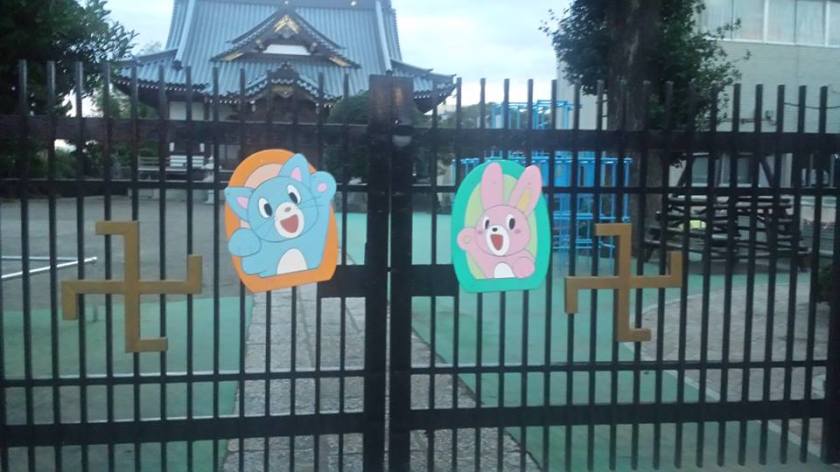
So you can understand why I was caught off-guard by this temple for toddlers in Japan:
10986672_1145829992097104_733232371050964146_n

In recent years Japan has started to limit the number of swastikas in public places, particularly on maps where unknowing tourists might take umbridge. I’d seen the symbol on maps before, but I’d never seen it displayed so prominently and so near Tokyo. It left me shaken, and amused by my shaking. The cartoon characters between the swastikas produced a cognitive dissonance which made me reconsider the psychological foundations of symbols and meaning.

In Akayama DanJay, the loud man with sunglasses asks the Chinese-speaking tourists why there are swastikas in their Atlas. They give several traditional answers. The loud man—whom we will learn is named Henry—turns to his wife and tries to press one of their points onto her. She ignores him, and Jay takes the first opportunity to leave.

By comparing how multiple characters interpret the symbol, and how they try to explain it to others, I hope to use the swastika appropriately to express an idea. On one side of the spectrum is the Chinese couple with the Atlas. Li Ying doesn’t even realize that a cultural miscommunication has taken place when Henry observes the swastikas. Zhang realizes and tries to clarify the use of the symbol. Jay, sitting literally and culturally between the groups, immediately sucks air through his teeth. He sees to the heart of the situation right away, beyond even Zhang’s understanding. Jay knows Henry is feigning ignorance of the swastika. Henry is quite quick to defend the symbol to his wife, who ignores him like she’s heard it a hundred times before.

The Chinese couple clearly represent the old, traditional understanding of the swastika, while Henry represents the modern bastardization eclipsing tradition. What else do we know about Henry? We’ve actually known him since B2: he’s the student in dark sunglasses, and the boy who sold Faith a cricket. In his first spoken line he tells his teacher he could make money selling crickets because they “get you totally bug-eyed.” By D3, now in his late twenties, he’s become the kind of person we’ve all had to sit next to on an airplane whose obnoxiousness made the flight feel twice the length. He dismisses his wife with the phrase “Chicks, am I right?” and seems creepily interested when Jay mentions drugs. He says “guys like us, gotta stick together,” presumably referring to those drugs. And in this section, he’s awfully amused by swastikas.

Henry represents the recent swell of ultra-toxicity in American politics. I’m not talking about Republicans, or conservatives, or Libertarians, or whatever (I’d argue calling him any of those things is falling for his con). I’m talking about edge-lords who might call themselves basically anything to disguise their scorn for human decency and diversity. (EDIT: I wrote this before the white supremacist rally in Charlottesville, VA, but it shows the cultural timeliness of Henry as a character.)

Henry is a misogynistic drug-smuggler who doesn’t know when to shut up. He is enamored by the swastika for its mere power to upset people, and anything he could learn about the symbol’s humble history would only make him more proud of his tattoo. Call him a straw-man if you like, but I’d call him a caricature. He’s an effigy, an object made to be sacrificed.

In Dante’s Inferno, Dante meets real-life political figures from Florence. Through their conversations, Dante scathingly criticizes them, their parties, and their religious beliefs. Dante uses this to present his views on contemporary political drama. He even meets someone who was still alive at the time of writing, claiming their sin was so heinous a demon took over their mortal form and their soul was dragged to hell before they died.

Although I’m trying to avoid naming real-world figures, you can’t write an Inferno allegory without punishing a sinner really condescendingly. Just as Dante criticized ancient Italian politics, so must I tear into today’s. At least I’ve had the courtesy to limit myself to one amalgamated straw-man instead of pointing fingers.

So, while Jay and the Chinese couple understand the multifaceted meaning of the swastika as a symbol which must be handled carefully depending on the circumstance, Henry is proud to see the swastika in this ‘appropriate’ context because it validates a symbol he venerates in other contexts. He immediately tells his wife Eva how popular the symbol is, but she keeps reading to their daughter. Eva has undoubtedly heard him prattle on about this for years, and she’s decided to inoculate her daughter with literacy.

How does Jay react to the situation? When Henry first points out the swastika, Jay inhales sharply through his teeth. It’s like he’s reacting alongside the reader as I play with fire: “Is this really the direction we’re going?” He says nothing during the discussion and leaves as soon as he is able. Remember, in the last section, Jay put on headphones and hummed to avoid talking to Henry. How long can he keep up this up?

Not so long, if his dream sequence is to be believed. In his dream, Jay began at rest atop a dune. Rather than descend either side, he ran away along its crest. But doing so caused the dune to collapse.

In this section, Jay finds himself caught between the Chinese couple and Henry, and chooses to abscond when the conversation turns for the worse. Now the world must collapse around him, leading to metaphorical free-fall.

In his dream, how did Jay escape this situation? By realizing he was dreaming, of course. To resolve the perceived issue of interpreting the swastika, Jay must mentally free himself from the epistemological chains binding meaning to symbols. Then no force will hold power over him and he can change the game.

In terms of overall theme, this should remind readers that the Nazis were not horrible because they appropriated the swastika. They were horrible because they committed atrocities. Nevertheless, Henry’s feigned ignorance of the swastika reflects poorly on him. To Jay, who sees through that feigned ignorance, the tactic makes Henry appear immature, insufferable, and maybe dangerous. In this manner we see the value of symbols despite the subjectivity of the meanings attributed to them: as humans, we choose which symbols to associate ourselves with and which symbols to distance ourselves from. Those decisions align us into groups. To feign ignorance of a widely known, controversial symbol might align one with the unsavory group it represents in the eyes of all who know better.

Next Chapter
Table of Contents

Things Not Shown

A common phrase in writing is “show, don’t tell.” Sometimes “not showing” can be even more powerful than “showing” OR “telling.” Withholding information from the audience is a tactic famous in the horror genre but effective for storytelling in general.

In E2. To the Airport we don’t see any mourning for Beatrice. She was hit by a bus in C4, but Jay and Faith didn’t notice because they were in another dimension. When they returned, Dan didn’t tell them what happened to Beatrice. He finally broke the news by cutting a cupcake into thirds instead of fourths. We didn’t get to see Faith or Jay’s reaction.

Instead, E2 begins with Jay telling his mother about Faith staying indoors and bawling for weeks. Then Faith drives Jay to the airport, showing the reader how she’s recovered. She’s feeling better, but Beatrice’s death still weighs heavily on her and Dan.

There are three reasons I decided not to show Faith’s full reaction to Beatrice’s death:

First, it moves the plot at a brisk pace. I couldn’t describe weeks of depression and recovery without slowing down the story and boring the audience. I instead ramp up the tension by killing Beatrice in B4 and drawing out the reveal until E1, and even then making the character’s reactions a cliffhanger. I then make Jay allude to weeks of depression and recovery, and have his mother react sympathetically. The storm brewed and passed, and the heroes continue their journeys in its aftermath.

Second, withholding that information from the reader forces them to imagine Faith’s reaction for themselves. We know how distraught she must have been at the death of her girlfriend, but without the details, we must imagine her emotional state for ourselves. This is a staple of great horror movies: what the viewer can see isn’t nearly as scary as what they can’t. I hope it works for tragedy as well; by withholding the reaction, I force the reader to react instead.

Third, Faith is meant to be a perky, happy character fueled by inexhaustible childlike curiosity. This doesn’t mean she can’t be sad or angry (in fact, her even temper means her scenes of sadness and anger stand out). But readers understand characters through their actions; if I showed Faith’s period of loss and mourning, a reader might get the wrong impression of her. They might remember her as “the one who was crying,” or “the one whose story is about missing her girlfriend.” She chose to stay indoors, in privacy, so her friends would not see her moments of weakness; likewise, the reader cannot see her either. Faith won’t allow herself to be pigeonholed by one scene of tragedy. We’ll let the tragedy be implied.

With these points in mind, refraining from revealing information to the reader has two almost contradictory results: Faith’s period of mourning is amplified by the reader’s imagination, while simultaneously she escapes being labeled as a tragic character. The reader understands that Faith has been dealt a blow, but also that she can recover. I hope I’ve handled the restriction of information well enough that the technique is effective.

As she drives Jay to the airport, we learn Faith has been painting. Creating art is a good way to deal with emotions in a healthy manner, and Faith has been associated with art before (like in B2and B3), but because of Beatrice’s death Faith’s artistic inclination suddenly seems more earnest. Without Beatrice, Faith falls back on art. It is her solid foundation. Art is the grandchild of God, says Virgil in Dante’s Inferno.

Also notice that Faith helps Jay. Not only does she drive him to the airport, but she also offers him hygiene products if he needs them. (He doesn’t, but this is another chance to remind the reader Jay is trans. I don’t want to focus on that aspect of his identity too much, but I think this moment humanizes both characters.) Faith is always looking for ways to help. She guided Dan in the afterlife until he decided to gamble his soul away. She taught Jillian how to smoke. She put up with her uncle when he was rambling about some conspiracy theory. She even came early to the centipede-smoking-party to ask Dan to keep his distance from Beatrice. She is the glue that holds the group together.

Finally, she gives Jay an envelope containing a card with her art and an original sketch. There are a lot of papers passed around in this story: Dan gets his Eternity Card from Anihilato. Jillian gets a flier from her teacher and studies a map in a pamphlet at the museum. Faith first sees the Sheridanian birds in a brochure in her uncle’s truck, and then receives a red card-stock pamphlet from Jango. Now Faith passes Jay an envelope. Why?

Well, the card in the envelope features art she made after Beatrice’s death. By giving away the fruits of her grief, she shows how she has overcome that grief—or, at least, that she’s on the way. Her struggle made her stronger.

She also says not to open the envelope until after customs, which suggests there are drugs inside. In A1, Dan got a cricket from Jango and then went to the afterlife. In B3, Jillian got a cricket from Faith and then watched an episode of anime. In C4, Dan teaches Faith and Jay to smoke centipede and they spend a whole chapter in the great beyond. The passage of drugs from one party to another leads them into a new world. Here, Faith is ushering Jay towards Sheridan with a gift. More parallels, a la D2’s commentary. And, it offers another perspective on the transaction of papers and pamphlets already discussed.

Next week Jay entertains himself on a plane flight, and I’ll tell you nice folks about JoJo’s Bizarre Adventure. See you there! Keep eating your worms!

Next Section
Table of Contents