Arms Race

Nemo followed the arm up the island for hours. Its coiling movement unsettled him, but he vowed to keep watch lest the arm hurt his children. The arm’s eyeball occasionally stared at the sun, which watched back with its own eyes. All the eyeballs vibrated to communicate so the arm could navigate by the sun’s aerial view.

They left the pines behind and clambered over boulders. The only plants at this elevation were black bushes which Nemo had never seen, with slim leaves and sharp thorns.

“This is the stuff.” The arm crawled to a black bush. It tried harvesting the fruits inside, but with just one eye on the back of its hand, it caught thorns between the teeth in its palm. “Ouch! I could blame the professor for giving this plant thorns, but I really should’ve planned this body better. Nemo, help me out.”

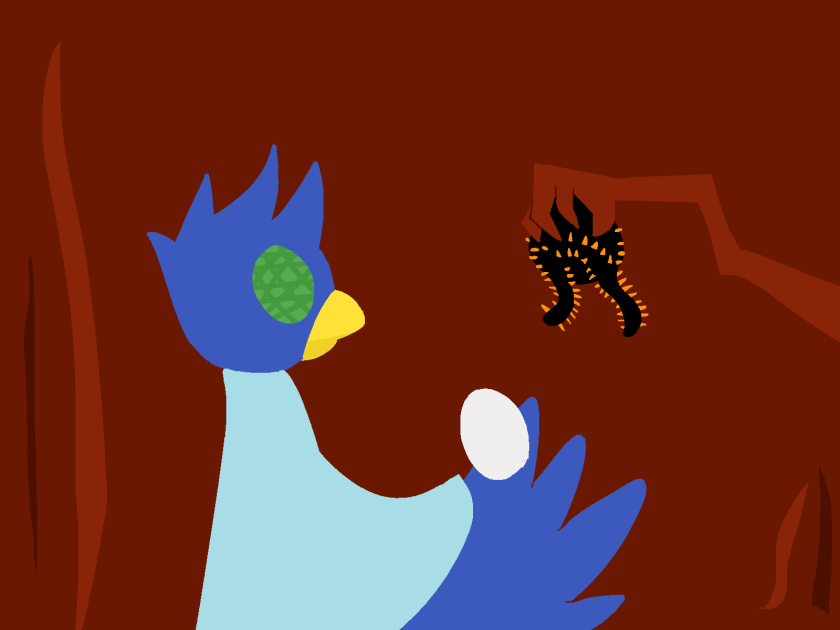
Nemo just inspected the bush. The thorns were inches long and barely distinguishable from the slender leaves. The thorns protected a black ball of long, tangled fruits. The fruits had tiny orange legs.

“Reach in,” said the arm. Nemo folded his arms defiantly. “Come on!” The palm’s mouth licked its lips. “Yum! Centipedes! Gotta eat centipedes! Akayama made these just for you!”

“Akayama?” Nemo recalled the giant bird making those sounds. He pointed to the sun.

The arm nodded by flapping its wrist. “Yep! That’s me up there! I’m the Hurricane Planet! I’m piloting this arm remotely.” The arm’s eyeball jiggled at the sun to transmit sensory data, and the sun’s eyes wiggled back instructions.

If the arm and the bird were both from the sun, then the arm must be another mentor. Nemo huffed and squinted at the centipedes in the bush. He clenched a fist.

“Yes! Do it!”

Nemo thrust his hand into the bush and squealed as thorns ripped agonizing streaks in his forearm. He tore out the centipede-ball and dropped it.

“Hey! Take it easy! Don’t cry!” The arm pried a centipede from the ball. “Eat this. You’ll love it.” The hand’s mouth nibbled the bug like a parent urging a child to eat off a spoon. Nemo wiped his tears and rubbed his tender wounds. “Come on!” Nemo finally brought the centipede to his mouth. “My immortality is yours,” said the hand, “but your humanity is mine!”

Nemo bit off the centipede’s head. It was so bitter his face twisted, but he made himself chew. By the end, he was sobbing—but when he swallowed the last inch, his expression evaporated and his eyes unfocused.

The arm giggled and looked at the sun to transmit the image of their success. “The centipede is linking your mind to my planet. As I speak, your biology is warped into my brand of undying flesh.”

Nemo said nothing.

“Now I’m loading a pilot into your skull.” The arm’s eye watched Nemo’s mouth curl up at the corners. “Are you there, compatriot? Is our mission accomplished?”

Nemo nodded.

“Here, take this. You’re better built to carry stuff.” The arm rolled the centipede-ball to Nemo’s knee. “Let’s make the other humans eat centipedes, too.” Nemo ignored the centipedes and picked up the arm. “Hey—leggo!” The arm flailed both double-jointed elbows. Nemo pulled the arm taught. “No! Stop! Are you a pilot or are you still Nemo? Either way, I’m your friend! I’m the Hurricane! I’m the sun! I’m—oh, God, please, no!”

Nemo bit off its thumb. Blood poured and he crunched bones. The hand’s four fingers scratched his face, so he munched its tail-end next.

“Aaaaugh! Why! It hurts! I’m begging! Please!”

Nemo yanked out a long bone, snapped it in half, and slurped up its marrow. He ate floppy boneless skin as easily as he’d eat a peach with no pit. When he reached an elbow he slurped its tendons, yanked out the next bone, and snapped it to drink its marrow, too. Soon only the hand remained.

The palm shouted. “You motherfucker! You motherfucker!”

“Yuu maddafagga,” mimicked Nemo with his mouth full. “Name Nemo.”

Nemo swallowed the fingers whole, then chomped the palm. The eyeball burst in his teeth as it transmitted distress to the sun.

Nemo licked blood off his body until Nakayama approached from behind. “Oh no. Nemo!” She gasped at the blood around his mouth. “Did you eat a centipede? Please, tell me you didn’t!”

Nemo rolled the ball of centipedes toward her.

“No, no!” Nakayama took the centipedes. “I hid centipedes up here so you wouldn’t have one until I knew you were ready!”

Nemo showed her the snapped arm-bones. He pointed to the sun.

Nakayama’s beak became hooked like a hawk’s. “That cosmic scum! The Hurricane Planet went behind my back to give you immortality! Instead of just… usurping your body… as I advised…” Nakayama tilted her eyes with regret. “I’m sorry, Nemo. I should’ve been assimilated twenty years ago. I would’ve doomed just one Earth instead of building a whole new Earth to ruin.”

Nemo pat her lab-coat with sympathy.

“But how did you keep your mind? Why aren’t you possessed?” Nakayama stared at the furious sun. “To make you immortal, they probably stabilized your brain-matter. They couldn’t kick you out because they reinforced you first. Their fear of death preserved you.”

Nemo shrugged. He didn’t understand anything Nakayama said, but shrugging seemed appropriate.

“I must return to the Hurricane. I don’t belong here—but you do, and I need you to promise: keep centipedes from the other islanders. The next person mind-linked to the Hurricane might not be so lucky as you.” She held the centipedes toward the capes and crossed her wings in an X. “Buu.” Nemo nodded. Nakayama extended the white point of one feather. “I’m bestowing a title upon you. When I built the Zephyrs, I meant to build many more, in many colors. When they agreed in intention they’d work together to grow stronger. I started with the leader, Zephyr-Blue.”

She marked Nemo’s forehead with her feather’s point.

“I christen you Virgil Blue, the island’s immutable backbone. You alone know the Hurricane’s treachery.”

“Virgil Blue?” Nemo felt his forehead. Embossed between his brows was a four-pronged Hurricane symbol—a swastika. “Virgil Blue.” He nodded.

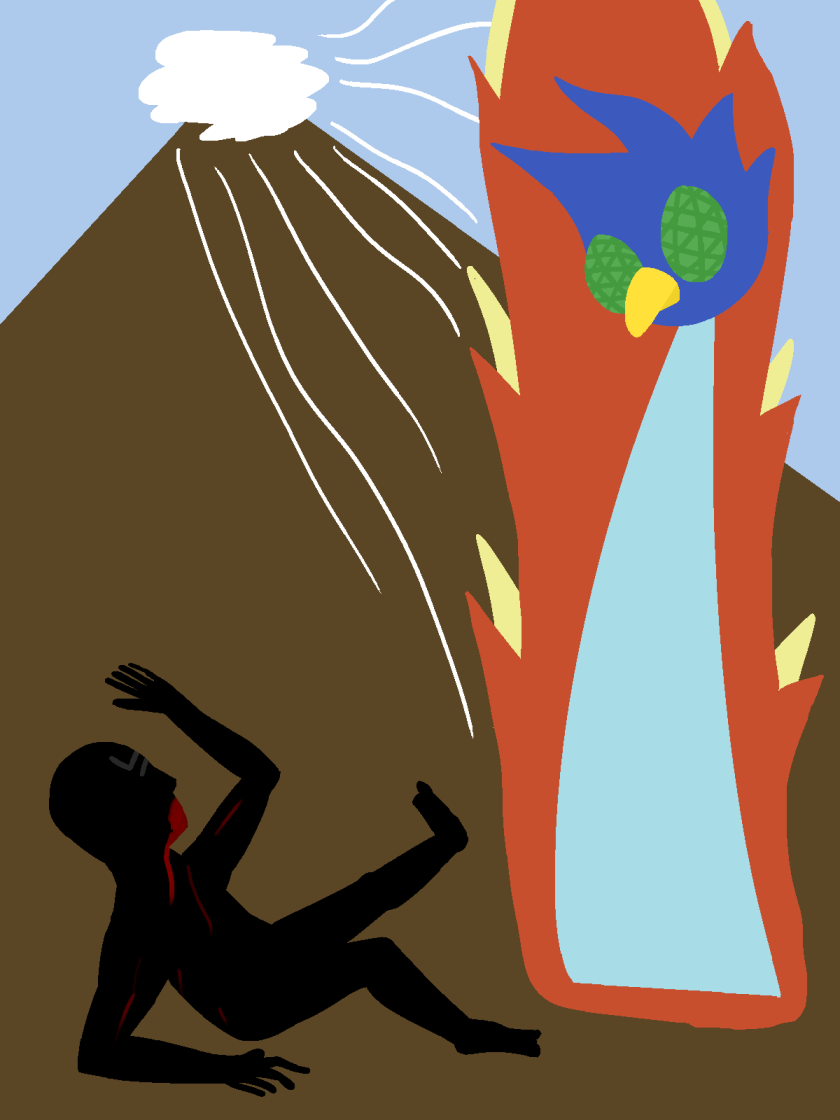
“I don’t mean to send mixed messages, but this is my quickest way back.” Nakayama swallowed the ball of centipedes. “I couldn’t protect myself from the Hurricane, but I hope I can protect you.”

She spontaneously combusted. In an instant, only smoke remained. Nemo watched wind carry smoke to the island’s peak, where it lingered.
O3 pictb

Next Section
Commentary

Dynasty

It took a while for Nakayama to explain exactly what she wanted Nemo to do to the egg. When he finally got the idea, he stepped behind a bush and she obligingly turned away. Nakayama knew the new humans would need more space, so she made her wings razor-sharp and cut down trees to make a clearing atop the island.

She heard Nemo scream, first in pleasure, then in terror. Nakayama hurried to his side.

Grown adults spilled from the egg. Nemo covered his horrified face. “Congratulations!” Nakayama made her left wing into a blowtorch and lit a cricket for Nemo to smoke, but he was distracted by the emerging men and women. “You’re a father now. Omedetou!

Soon a nude crowd filled the clearing. They were varied as Earth’s humans, but seemed at least superficially healthy. Nakayama lifted them to check for defects in their ears, eyes, noses, and throats. Nemo shook hands with each person as Nakayama put them down.

Still more people spilled from the egg. Eventually Nemo just let his children crowd around him for their handshake. “Name Nemo,” he said to them, “Nemo name.” Then he gave them their own names. His children shook hands with each other and introduced themselves.

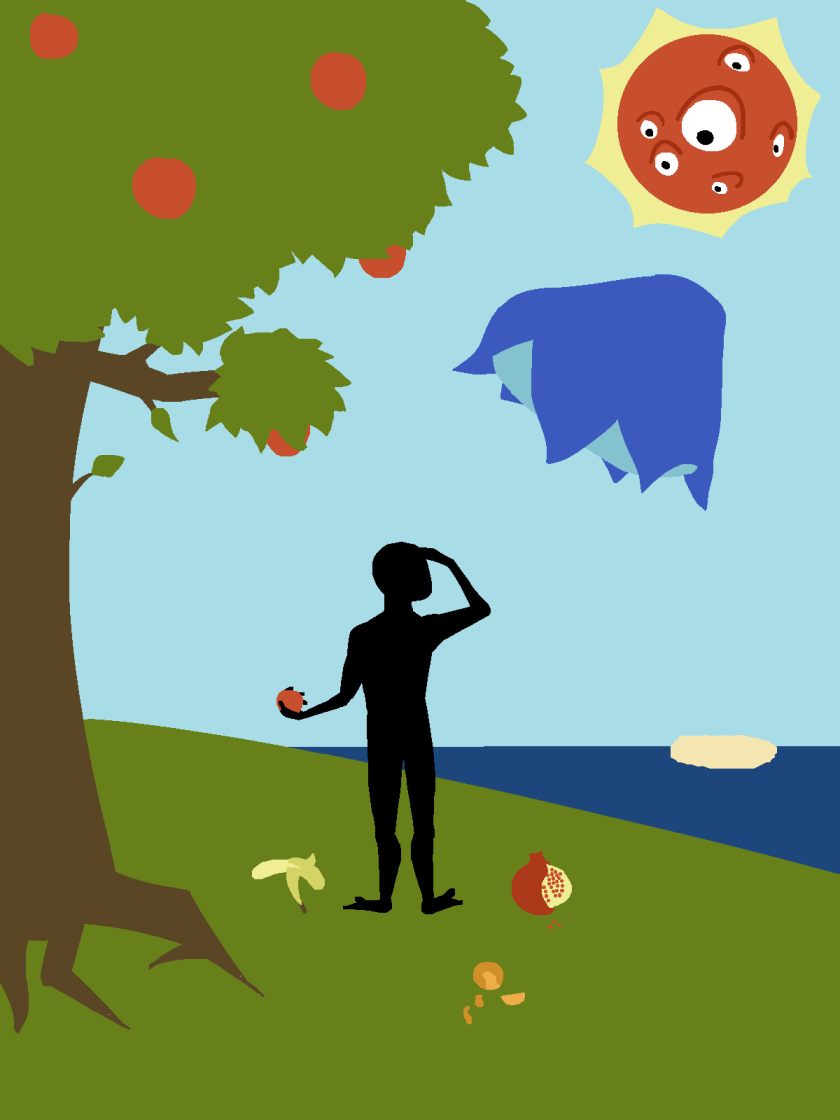
When the crowd was so thick Nemo couldn’t find hands to shake, he pushed his way out and climbed a tree. He yawped for attention: “Ora, ora, ora!” He bit an apple and showed his children the interior flesh. He licked sweet juice from his chin. He tossed the apple and a woman caught it in her teeth. She smiled and shared the apple with the man beside her. Nemo sat on a branch and demonstrated how to peel bananas and oranges.

Nakayama hefted a man from the crowd to check his health. The man screamed. Nakayama dropped him in surprise and barely caught his ankle before he hit the ground. “It’s alright, it’s alright!” she promised, but the man kept screaming. The crowd turned to watch Nakayama try calming him. “I understand—the first humans saw me alongside them, so I was ordinary. Now the crowds are thick enough you’ve only ever seen your own kind. You’ve established your sense of normalcy and now you’re meeting… me…”

Nakayama set the man down and examined herself. She was a giant, peculiar bird-creature. How could she convince anyone her presence was acceptable?

Ora ora!” Nemo waved his hands. The crowd turned to him. He pointed skyward and the crowd squinted at the sun. Nemo whistled like a falling object as he pointed to Nakayama. Then Nemo mimed shaking hands.

The crowd oohed and aahed. The screaming man mutely shook Nakayama’s wingtip and opened his mouth to show his throat. Nakayama covered her beak in disbelief. “Thank you, Nemo.” Before she inspected more islanders, she quickly counted heads. Fifty islanders were already present and the egg only spewed more. The clearing wasn’t large enough. “Nemo! Come here!” She gestured for his approach and the crowd parted for him to pass.

Nakayama showed Nemo the trees she’d cut from the clearing. She flattened her wings into scoops and carved logs into rough canoes. She made oars from branches.

“You have more children coming,” she told Nemo. “Gather a group and row to that island over there.” She pointed to the mountainous island. “I’ll send the rest boat-by-boat as I inspect them.”

Nemo didn’t understand, so Nakayama pushed the canoe down the slope and it splashed into the ocean. “Ahh!” Nemo understood. He chased the canoe and called for others to follow. “Ora ora ora!


Nakayama carved canoes so quickly there was always a boat voyaging from the fruity island to the mountainous one. Nemo stood cape-side to welcome each load of islanders to the coast.

This island had no fruit-trees, but birds like penguins larger than ostriches lounged on the beach laying eggs which islanders cracked open to drink.

“Nemo! Nemo!”

Nemo turned. Three of his children approached, panting with their hands on their knees. “Oran dora,” greeted Nemo.

“Nemo,” they urged. They led him a mile up the island to point at a pine’s branches. They cupped their hands around their ears to tell him to listen.

Nemo heard a creature in the canopy. “Aaaugh, how does she land? This was an awful idea.” Now Nemo noticed a hanging vine. It was four feet long and the width of his arm. In fact, it seemed to be an arm with two double-jointed elbows. Its fingers clutched a branch.

Oran dora,” said Nemo.

The arm flopped in the tree. “Is someone down there? I can’t see you. Can you catch me?”

“Name Nemo,” said Nemo.

“Oh, Nemo! Nakayama told me about you. I’m your God now! Catch!” The hand released the branch. The arm crashed on the dirt. “Ow! Dammit!”

O2 pictb

Nemo squatted to inspect the convulsing limb. The other islanders backed away.

“Not your fault, kid,” said the arm. Its skin was pink and its palm held a mouth. The back of the hand held an eyeball with a pupil but no iris. “You’re not smart like I am yet. Here, follow me. I gotta show you something.”

Nemo watched the arm bend its elbows to squirm. He walked after it and the three islanders followed him, but Nemo shook his head and pointed them back to the coast.

Next Section
Commentary

The Egg with 100 Yolks

Akayama glided through space toward her Hurricane Planet. She propelled herself with new organs she’d invented which threw clouds behind her. These organs worked like the engines in her Zephyrs, which she’d perfected after cracking the secrets of Jupiter’s spot. The efficiency and compactness of these engines were why her new robots were Zephyrs, gentle breezes in comparison to the Hurricane.

As she fell into the planet’s gravitational pull, the red mountain which had jettisoned her now caught her in a caldera. Soft sand at the core of the planet grasped her like a rescue net.

The planet rumbled around her. “Have we made progress?”

“I didn’t expect these results so soon.” Akayama made a blue tentacle and stuck it in the dark wall to transmit images to the planet. “Look, there was a man under the sand. Did you put him there? I named him Nemo. I also found an awkward insect you probably made from my cockroach. I turned it into stable plant-matter which I’m calling a cricket. Here’s its genome. The fruit-trees are healthy.”

“Only one man?” The planet’s core contracted in disappointment. “How long until each of my pilots has a private person to possess?”

“Look at this.” Her tentacle uploaded Nemo’s genome. “You contain my copy, correct? I’m sure with her knowledge and your massive form, you have the resources to give Nemo countless children.” She retracted her tentacle. “Give your Akayama more control. Put her knowledge to use.”

“Do I have to?” asked the planet. “I let her beam radiation and genetic material over the oceans, and I even let you control your own body. Now you want to control my form as well?”

“I can’t obey if you won’t let me.”

“Fine.” The planet rumbled. “But don’t expect this to happen again.”

“The vessels should represent both sexes evenly,” Akayama said, pacing in the dark, “and contain the full spectrum of heights and skin-colors. Then your pilots can experience the gamut of humanity. I’m sure my duplicate can produce such subjects.”

“Done,” said the planet. “Take this.”

An egg rolled from the darkness. It was larger than Nemo’s head and white like milk. Akayama focused her eyes to magnify her vision. Her compound ocular lenses glinted like jewels. “I see. This shell protects a hundred human ova. I’ll have them fertilized.”

“Take this, too.” An arm from the wall offered a black ball of long bugs.

Akayama reared back. “What is it?”

“My copy of Akayama built them from your insect-plant, the cricket,” said the planet. “These have lots of legs, so we’ll call them centipedes. Feed them to the human vessels. This will connect their minds to me wirelessly. Then I can make them immortal and put my pilots in them.”

“What? No!” Akayama crossed her wings in an X. “We’re not making them immortal, remember? If your vessels are indestructible, you’ll never understand death. Can’t you hear Akayama inside you, saying you’re misguided?”

“Not anymore,” said the planet. “I let her delete herself in return for making centipedes.”

Akayama’s lower lip trembled. She made her mouth into a hard beak so she couldn’t cry. “Why?”

O1 pictb

“I need neither her knowledge nor quaint morality.” The wall opened an eye to squint at her. “Didn’t you say death is necessary? You should rejoice. Now there’s only one of you. Speaking of which,” said the planet, “you’re getting uppity because you’re separate. You need to understand you’re just a drone under my control. Since I fire you from a mountain on my surface, your new name is Nakayama.”

“Inside the Mountain,” translated Nakayama. “I see.”

“Make me men and feed them centipedes.” The sandy floor shot upward. Nakayama approached escape-velocity. “I’ll be watching you.”

“I should make sure the vessels are healthy before feeding them centipedes,” said Nakayama. “I’ll plant them at altitude so no one stumbles on them accidentally.”

Nakayama rocketed from the red mountain. She tossed the ball of centipedes atop the largest island.


Nemo sat under a mango tree, slurping fallen fruit. He licked juice from his skin wherever it dripped. He was flexible enough to lick his elbows and the far sides of his ankles and knees.

When he finished all the fallen fruit, he looked up the mango tree. The trunk stood forty meters tall and the lowest branches were halfway up. Each branch was heavy with mangoes.

He tried climbing the trunk, fruitlessly. The bark chaffed and scratched, and falling hurt his feet.

He stepped to a nearby tree with no fruit but low branches and climbed this tree easily. When the branches became too slim to support him, the mangoes were almost in reach. He’d have to jump for them.

He shuddered when he looked down. If he slipped, he’d break the branches below and hit the ground.

The mangoes looked good enough to jump for.

He leapt and grabbed a mango-branch with both hands. He clung shakily but finally pulled himself up.

He climbed to the top collecting mangoes. He ate them while enjoying the view. He saw the sandy island of his birth on one side and a giant, mountainous island on the other.

He noticed a thin cloud elongating.

He blinked. At the head of the cloud, Nakayama was shooting right toward him at incredible velocity.

“Aaaugh!” Nemo dropped his mangoes and scrambled down the tree, but not fast enough.

A sonic boom followed as they both crashed through branches to the ground. Nakayama cushioned Nemo with wings of fluffy feathers. “Sorry if I startled you.” She produced the egg from the sleeve of her lab-coat. “I need you to ejaculate on this.”

Next Section
Commentary


Recombination

“Great work, Eisu! Keep it up, Fumiko!” Lucille stood at the window of her lunar command-tower with her hands on her hips. Outside, two enormous legs hopped toward each other across the moon’s dusty surface. Each leg was 500 meters tall, and each muscle group was a different color like an anatomical diagram. Squinting, Lucille saw each color was made of robotic limbs and torsos guided by accompanying heads. Thousands of robot-pilots approximated human gait to guide the giant legs together. “Now!”

The thighs conjoined along the groin. The pilots readjusted and the legs stood strong. In the command-tower, Charlie ashed his cockroach. “Lucille, we’ve never combined so many robots at once. I’m impressed.”

Daisuke sighed and wheeled back from the window. “It’s an impressive training-exercise—nothing more. The fully-combined Zephyr is a glorified org-chart, a cute mnemonic to help pilots find their superiors during a crisis.”

“Daisuke, you know my pilots have no superior.” Lucille spoke into her microphone: “Alright, everyone, keep steady while we put ourselves together!”

“Put… ourselves together?” Daisuke soured. “You mean you’re not stopping at the legs?”

Charlie bit the scar in his lip. “Lucille, Zephyr-Purple doesn’t have a head-pilot yet. Purple is the core of our org-chart. You need it to relay your command.”

“I’ll pilot ZAP.” Lucille ushered Charlie and Daisuke into the elevator down to the hangars. “You both pilot two robots at once. Why can’t I?”

“I sit in Zephyr-Blue’s right arm, but I’m actually pilot of Zephyr-Yellow’s head.” Charlie tousled his golden hair. “My dual-pilot status lets me convey your command to the right arm of the moon-base quickly and accurately. Same with Daisuke and the left arm.”

“Just trust me,” said Lucille. The elevator opened into Zephyr-Blue’s hangar. They boarded their respective cockpits. From surrounding hangers launched hundreds of roaring robots. Lucille activated her own robot’s chest-engines and the Blue Zephyr shot into space on a column of steam.

Lucille, Charlie, and Daisuke floated kilometers above the moon. Below them, hundreds of robots maneuvered to build a giant human chest. Lucille drifted to align the Blue Zephyr’s hips over the combined robot’s muscular neck. Zephyr-Blue contorted to become a crude head.

N4 pictb

When Daisuke pulled a lever, the combined chest brushed lunar dust with its left arm. “Left arm, check.”

Charlie turned a dial to clench the combined chest’s right hand. “Right arm, check. Where are our abdominals? Where’s Zephyr-Purple?”

“On its way.” Lucille’s largest monitor displayed the view from Zephyr-Alpha-Purple. The purple robot bounded over craters to stand between the enormous legs and chest. Zephyr-Purple alone stood as tall as the conglomerations. The purple pilots appeared at attention on Lucille’s monitors. “Just like we planned, everyone. Charlie, Daisuke, fold our arms!”

The combined chest folded its arms. Zephyr-Purple squatted and gripped the chest’s rib-cage with both hands, then hefted the chest a kilometer into the sky. Zephyr-Purple raised its arms and the chest fell over it like a T-shirt. This completed the torso, which walked with tiny purple legs.

N4 pictc

“Eisu, Fumiko! About-face and take a knee.” The combined legs turned their calves and glutes to the torso. The left knee bent to the ground. They wobbled but slid their right foot to steady themselves. “Charlie, Daisuke, help Z-Purple jump on my mark!”

The combined chest knuckle-walked like a gorilla.

“Jump!”

They tried to leap into the legs like pants, but only knocked them over. Thousands of robots fell onto the moon. Just before impact, pilots disengaged their robots from the combination to brace themselves as individual arms and legs.

“Damage report!” shouted Lucille. Zephyr-Blue was still connected to the combined chest’s right arm, but Lucille was upside-down and suspended by her seat-belts. “Shit.”

“Cut the comms when you cuss,” said Charlie, “it saves Daisuke the trouble of writing formal reprimands. Everyone’s fine, Commander. Safety-tech has come a long way.”

“We warned you ZAP needed a pilot!” lambasted Daisuke. “Your feet aren’t hearing you when your hands do!”

“Nah, nah. We’ll just do it in zero-g next time!” Lucille beamed at the camera on her main monitor and made a V for Victory. “Great job, everyone! Hit the showers and take the afternoon off.”

Robotic limbs collected into humanoids of solid color and meandered back to base.

“Hold on.” A red light blinked on Lucille’s control-panel. “There’s a distress signal. Are we sure no one’s hurt? Has someone had their comms cut?”

“Commander, look!” The robots pointed to the sky. From black space spun a blue shape. “Is it debris?”

Lucille magnified her main monitor. The blue shape had one eye and half a mouth. “Debris doesn’t send distress signals. That’s one of our own.”

“But everyone’s accounted for,” said Daisuke.

“Not everyone.” Lucille gripped her steering-wheel. “Charlie, tear off Zephyr-Blue and throw us at the newcomer!”

N4 pictd

The combined chest’s right arm tore Zephyr-Blue from its neck and hurled it. Zephyr-Blue caught the falling object mid-flight. “No way,” said Charlie. “It’s ZAB’s right half! The original right half!”

Lucille eased their descent with steam. She held the half-face eye-to-eye with ZAB. “Repair-bay! Double-time!”


Charlie and Daisuke prepared a live-feed so every Earthly news-station could witness Lucille’s debriefing of ZAB’s lost half.

Twenty mechanics repaired the half-face while another twenty mechanics cut ZAB into two. Lucille paced before the head-halves, hands folded behind her. “You mean Professor Akayama lived on the Hurricane for twenty years?”

“Or so I estimate,” said the half-face. “I can’t imagine she survived the fall back to the planet.”

“What a hero. Even if she was indirectly responsible for the Hurricane’s creation, as you suggest, her ceaseless struggle to salvage even humanity’s most despicable portions is inspiration for us all.” Lucille motioned for the mechanics to fuse ZAB’s original halves back together. “The moon’s changed since you left,” she said. “Hurricane Planets invade more frequently than ever, stealing stars from the edges of the Milky Way. We’ve built hundreds of robots based on Akayama’s designs and expanded the lunar crew to ten thousand. We can combine into a single mech a kilometer tall.”

When the mechanics wired its halves together, ZAB consolidated the knowledge of both portions. “We’re still not strong enough,” it said. “I know our power and the Hurricane’s. There are far more Hurricane Planets than we anticipated, and their organization is primitive but powerful.”

“So you know how the Hurricane is organized, huh? Anything we haven’t guessed?”

ZAB thought. “The highest concentration of Hurricane Planets is called the Dance of the Spheres. This is where Hurricane Planets meet to exchange information and ensure homogeneity. It’s so far from us that light from the Dance will not arrive in the Milky Way for eons.”

“So they’ve got a weak-point?”

“No. I would call the Dance of the Spheres the Hurricane’s strongest point because it is the densest—”

“But if we destroy it or infect it with a virus, the Hurricane will chaotically tear itself apart.”

“Perhaps.”

“Perhaps nothing.” Lucille posed for the cameras. “Grit those teeth, humanity! We’ve got our battle-plan.”

Next Chapter
Commentary

Captain Nemo

As she swam the oceans of the watery world, Akayama wondered if she was alone in her skull. Maybe the Hurricane sanctioned her actions from inside her own brain. She hoped only to accomplish the task she’d assigned herself: opening undersea magma-vents to create landmass.

Since the Hurricane had warped her biology, she found herself capable of conscious change at the cellular level. Currently she was thirty meters long and skinny like a snake. She’d flattened her feathers into scales like an aquatic anaconda. Her lab-coat clung to her narrow shoulders while her stretched arms pried stones to expose molten magma.

She spent days underwater before deciding to rest. She became buoyant and floated to the surface. She massaged her gills flush against her neck. Her lungs reopened. She fought for breath.

In the west was a faux sunset. The impostor sun was her Hurricane Planet irradiating the oceans. Akayama felt its thin chemical rain seeding the seas with genetic material. She wondered how the copy of her mind left aboard the planet was faring.

Akayama slept and melted into an acre of filmy liquid buffeted by waves.

In the morning she collected in her lab-coat. She filled her sleeves with pseudopods which became arms. She tread water with new legs.

Her magma-vents had spawned three islands. She swam to the closest, the smallest, and shambled ashore like an octopus. The island was sandy and barren. Surely nothing could live here.

She heard a chirp.

She enlarged her eyeballs to inspect the sand and saw a small hopping insect. She flattened her left arm to scoop it up. “What are you supposed to be?”

The insect chirped by shuffling its wings.

“You look like a skinny cockroach,” said Akayama. “How disgusting. The Hurricane is cutting corners to generate animal life. I’ll call you a cricket.” She slipped the insect and sand up her sleeve. She shook her other sleeve, and out fell fertile soil with the insect planted eyes-down. “I’ve made you a radially symmetrical plant. Now you’re far more stable.”

She ambled about the island planting copies of the cricket she had made. When she needed more soil, she scooped sand into her sleeves and converted it to loam with nuclear processes.

This worked until she uncovered a human body. “Augh!”

“Aaaugh!” The nude man hiding in the sand was more afraid than she was. He kicked and clawed and scrambled away. “Aaaugh!”

“Hey! It’s okay!” Akayama bounded after him. The man had dark skin, darker than black. His bony build would stand six feet tall if he weren’t crawling in terror. “I’m here for you! I’m here for you!”

“Aaaugh!” He was cornered on the coast. The man flipped on his back and raised his arms to protect himself. “Aaaugh!”

“Hold on, hold on.” She frayed her scales back into feathers and molded her arms roughly humanoid. “Um.” She couldn’t recall how many fingers humans had. “Show me your hands.”

The man recoiled when she took his arm as if to read his palm.

“Only five? I have too many! No wonder you were scared.” She ate her extra fingers like soft cake. “There we go. Shake.” She shook the man’s hand. “Yoroshiku ne. Akayama dawa. Do you have a name?”

“Name?” repeated the man. He had wide-set eyes with black irises. “Name?”

Akayama thought. “To make these islands, I spent days at the bottom of the sea. Taking this as inspiration, I name you Nemo.”

“Nemo name?” asked Nemo. “Name Nemo?”

“Precisely.” Akayama pulled Nemo to his feet. “Are you alone?” Nemo didn’t understand, so she combed the island. “Why did the Hurricane make you after I specifically said we’d work our way up to advanced lifeforms? I can’t imagine what awful things it did to its Akayama to coerce your creation.” The island was combed and she found no more men. “This island is too small to house a human comfortably. Let me take you to that larger one with the trees.”

Akayama folded herself into a boat. Nemo stepped shakily aboard her back, and after she crossed the harsh surf, he was glad to disembark on the second island. Nemo walked through the trees staring up at their canopies in awe.

“You have food, at least.” Akayama stretched her whole body to pull fruit from the treetops. Bananas, apples, oranges, pomegranates, and peaches grew side-by-side. She gave their fruits to Nemo. “Not all these trees can survive in this climate. Enjoy them while they last.”

Nemo couldn’t hold all the fruits at once. He bit a banana through its peel. When he saw soft flesh underneath, he understood the nature of the fruit and peeled it. He experimented with each fruit while Akayama surveyed the island for dangerous species. The only animals she found were tiny flightless birds in a variety of colors.

“…Hey!” She knocked a tiny flightless bird out of Nemo’s hands before he ate it alive. “Don’t eat these! These aren’t fruit.” Nemo stared blankly, so she sketched the bird in the sand. “Buu.” She crossed her arms in an X. “Buu.” She swept the bird-sketch away. “Got it?”

Nemo nodded.

Akayama led him back to the coast to show him the Hurricane Planet shining like the sun. “That object and I are separate but of the same form. You come from there as well. I must go but I will return. Let me sample your DNA.”

She speared him in the ribs with the white point of a feather. Nemo shouted, but the feather left no wound. Its point was thinner than a syringe.

“Stay safe.”

With that, her body flattened so wide, tall, and thin that the wind lifted her. Nemo watched her float away like a jellyfish.

N3 pictb

Next Section
Commentary

Water World

Akayama’s sun-sized Hurricane Planet scanned the skies with eyes large as oceans. It saw a space-rock and thought to itself, “how about that one? It has cool craters.”

“No.” This thought had Akayama’s accent. “Too small. Its core is probably solid throughout and not conducive to complicated life.”

The planet digested the space-rock like an amoeba. “How about that one over there?”

“Too near the Milky Way. We’d attract attention.” They avoided it. Akayama took control of the planet’s eyes and focused on the black distance. Her knowledge of optics had increased their vision’s acuity a hundred-fold. “Maybe one of those.” She generated engines to thrust them across space.

The planet’s engines were even less sophisticated than the engines of the original Hurricane spaceship Akayama had built almost a century ago. The Hurricane’s only tactic was recreating, in massive scale and quantity, technology and biology it had already absorbed. She had always assumed the Hurricane’s transmutation of the universe into its own flesh was directed by sinister intelligence. Now she was merged with it and knew she had only been half right.

Being assimilated took getting used to, but Akayama had invented mind-merging and knew how it worked, in theory. The planet had a single train of thought which was like a high-speed conversation between every mind Akayama was merged with. The result was the sum of the constituents’ knowledge and the average of their intent. Akayama’s input was currently prioritized as the planet demanded she create life to dominate.

“None of these celestial objects are acceptable,” thought Akayama. The conjoined mind didn’t doubt her because their united subconsciousness made lying impossible. “The Hurricane should regret eating most of the universe. We have nowhere to call our new Earth.”

“No problem,” thought the planet. It accelerated into a sparse volume of space on the border of the galaxy. “We’ll build one. We’ve got the know-how.”

The Hurricane Planet opened enormous organs in its interior. One organ flooded with salt-water, one organ inflated with nitrogen and oxygen, and one organ 3D-printed a lithosphere with an iron core spinning in molten magma. The planet ejected these components so they orbited ninety-million miles away. Gravity pulled the components together with a great fluid splash. It was a watery world with a breathable atmosphere.

“I’m confident I can grow life here,” thought Akayama. “We will be this world’s sun, providing radiation and genetic material. But I need to be back in my body. I’ll work on this world in person.”

“I agree,” thought the rest of the Hurricane Planet, “but even if you’re leaving, you’re not leaving.”

Akayama managed only an instant of confusion before she opened her original body’s eyes and tore away the flesh-mask which connected her to the Hurricane Planet. She sat on a rock in the dark at the core. She clenched her fists to ensure she really controlled herself. She still had feathers from the fall.

She heard a voice from the Hurricane Planet. To her surprise, it was her own voice: “Did you just copy me?”

“Oh, gosh,” said the Akayama in her own body. “This is confusing.”

“Nothing to it,” said the planet. “You’re still Akayama and I’m still the Hurricane Planet, even though the professor is present in both vessels.”

Akayama didn’t appreciate her body being called a vessel. She felt like a file on a computer which could be duplicated or deleted. “Send me to the water-world. My first task is generating landmass with sub-aqueous extrusion—that is, I’ll open underwater magma-vents.”

“I know what sub-aqueous extrusion is,” said the planet. “I know everything you know.”

“Of course, of course.” Akayama felt the floor rise from the planet’s core. “What life-forms are we aiming to generate first? We eventually need organisms with a nervous-system if we want to transfer minds into them.”

“We’ve got the genomes for squids, birds, and people.”

Akayama pat her lab-coat pocket. “I’ve got a cockroach.”

“Gimme.”

She tossed the roach. The wall opened to catch it. “You also have the genomes for earthworms. They were my first animal test-subjects when I developed mind-merging because they’re segmented and almost radially symmetrical. They’re in the legacy-files alongside the fruit-trees.”

“I’m not putting my minds into worms.”

“You don’t have to, but I’ve never made life before, so let’s start with worms.” Akayama felt violent vibrations as awful acceleration pressed her against the floor. “We’ll work our way up to humans.”

“Can we make them immortal? I won’t put an aspect of my being into something which might die.”

Akayama humphed. “We’re reclaiming your humanity, remember? Immortality isn’t the human condition.”

“Look into it anyway. You might change your mind.”

“Is that a threat?”

Akayama was fired from the planet’s surface and shot through space like a bullet. She thought the firing-mechanism resembled a colossal volcano, but with distance, the volcano looked like a tiny pimple.

N2 pictb.png

Next Section
Commentary

The Twist

Akayama’s Zephyr tracked time with great accuracy: seven years and three months passed before Akayama trusted her light-speed engines. She typed to her Zephyr on its control-panel’s keyboard so the planet couldn’t eavesdrop. The Zephyr replied with text on its only monitor: ‘Professor, shall we check the engines again?’

‘We’ve checked a hundred times,’ typed Akayama. ‘Today’s the day.’

She left her cockpit and stepped on her Hurricane Planet’s dusty surface. Getting the planet’s attention was a chore; it never left ears or eyes around (unless it did so secretly to spy), and its flesh was too insensitive to detect an elderly woman jumping and stomping. For this reason, she’d dug a hole in the sandy skin-flakes. Under the red sand, the Hurricane’s flesh was smooth and pink. She reached into the hole and stabbed the flesh with her screwdriver.

Instead of blood, the wound gushed pearly pulp.

Akayama covered her ears. The pulp congealed into teeth which cracked each other in high-pitched cacophony. The teeth made a hard sheet sealing the wound, but not before the whole hole filled with white goop.

As the cracking of teeth subsided, the hole became a mouth and screamed. “Akayama! I told you I hate that!”

“It’s not my fault your immune-system overreacts to minor stimuli.” Akayama strode to her Zephyr. “Today you reclaim your humanity. Do you remember how I taught you to make synaptic-cable?”

“Oh! Oh, yes!” A red tentacle popped from the sand. Its tip split into two, and each of those tips split into two, and so on, until the tentacle ended with a fibrous braid. “Like this, right?”

Akayama pulled the braid to the Zephyr’s torn-open neck. “I’m plugging you into the spinal-input-port. In the past, this connected to the Heart of the Zephyr so pilots could work in tandem.”

“Like me?”

“No, not like you. The Zephyrs’ pilots are united by their goal and by the direction of their commander.” Akayama inserted the braid deep into an exposed rubber tube. “You’ll feel an electrical tingling.”

“I do! I do!” The tentacle wriggled with anticipation.

“Recall the identities constituting your being. Choose one for the first excursion into relative normalcy.” Akayama climbed into the cockpit and hit return on her keyboard. The Zephyr began copying the Hurricane Planet in its entirety. “Have you chosen?”

The planet rumbled under her. “We’ll go alphabetically,” it decided.

Sou desu ka.” Akayama pretended to type. On the monitor, the Zephyr signaled that the duplication was complete. “Okay, just relax and let my machine do what it needs to do.”

“You’re not giving me another virus, are you? I won’t fall for that again.”

“Of course not. Are you ready to cast off the yoke of the hive-mind?”

“I am.”

“Engage.”

The Zephyr deleted the Hurricane Planet.

Everything was quiet.

Akayama had had recurring nightmares: the moment her planet’s consciousness was deleted, the sand collapsed under her, or a mouth opened and swallowed her, or the planet deflated like a balloon. Nothing happened. Everything was quiet.

“Is it done?”

“Yes,” the Zephyr said aloud. “I’ve copied the whole Hurricane Planet into my memory-banks and deleted the original. Shall I disconnect my memory to quarantine the Hurricane from my systems?”

“Let them access the monitor so we can communicate. Warm the engines and let’s take off.” Akayama sealed her torn cockpit with her lab-coat so the cabin could fill with air; she’d soaked the lab-coat in extra slobber just for this. The Zephyr’s monitor displayed a speaker-icon indicating the Hurricane Planet could hear her. She let it listen to the engines spinning to life. “I’m sorry. This is the only way to get you home.”

The neck spilled white steam and the Zephyr ascended.

“Can you hear me?” asked Akayama.

“How could you?” asked the Hurricane Planet through the monitor’s speakers. “I trusted you.”

“I know, but on the moon I’ll have the tools to separate all of you at once. You don’t have to be this cosmic horror. I can save the pilots of the Hurricane.”

“Save me from what?”

“This.” Akayama pulled her lab-coat aside an inch. The monitor’s camera showed the Hurricane its own red planet retreating. “Is that what humanity looks like?”

“Yes!” said the Hurricane. “I’m humanity and I’m that! Let me go!”

“No!” They kept accelerating. “I’ll never reclaim the stars you swallowed, but I will bring you home!”

“No! I’m bringing you home!”

The monitor flickered red. “Professor,” said the Zephyr, “the Hurricane has seized my monitor-controls.”

“Disconnect it! Quarantine it!” Akayama squinted at her red monitor as black circles in white circles appeared upon it. By the time she realized what she was looking at, her gaze was fixed on a hundred electric eyes. Akayama felt her own optic nerves vibrating in response to their movements.

M4 pictc

“Professor, what’s happening?”

She barely managed to speak. “The Dance of the Spheres.” One by one, the eyes onscreen winked shut. Akayama’s eyes lost their luster. “It’s jumping into me.”

The last eye winked away. The monitor went black. “Professor, the Hurricane is no longer in my memory-banks. Can you hear me?”

Akayama said nothing.

“Professor?”

The corners of her mouth fought to say different words. Her arms swept across the control-panel. Her legs turned her chair to face the lab-coat separating her from space. She tried to kick herself from the cockpit, but seat-belts held her back. “My mind—I’m losing my mind—”

“You’re not losing your mind,” she said back to herself, “I’m gaining one!”

“Stop,” she begged, “please!” Her left hand fought her right hand over the seat-belt buttons. Akayama wasn’t sure which hand was hers and which was the Hurricane’s as they swapped sides repeatedly to wrestle. Then both hands were hers and both hands were the Hurricane’s. They had merged. Akayama gasped at the insights provided to her. “Bunjiro is dead. This planet killed him.”

“Wrong,” she said to herself, “Bunjiro self-destructed. I saw it with my own eyes.”

“And now I see it with mine.” Akayama was helpless to wipe tears from her face.

“Professor, what should I do?” asked the Zephyr.

“Leave me to die. Fly to the moon and tell them what happened.”

Her unruly hands unbuckled her seat-belts and tore her lab-coat from the cockpit’s gaping side. Vacuum sucked Akayama from the cockpit and she spun toward the Hurricane Planet a thousand miles below.

As she fell, she donned her lab-coat. It didn’t flutter in space. She struggled for breath with nothing to breathe, but she didn’t suffocate. The Hurricane inside her was already morphing her biology to survive.

Boney spines poked from her skin. The spines grew blue hairs to become fluffy feathers.

M4 pictb

Her lab-coat now fluttered as she entered the atmosphere. Her limbs lengthened and flattened into wings. Feathers matured and aligned themselves to catch the wind. Her body no longer spun but dove in a spiral like a bird of prey.

“Akayama,” said her own mouth, “you were really holding out on me. You have more scientific knowledge than all my other pilots put together. If you hadn’t lied and did what you’d promised, you would’ve finished years ago.” The dunes approached. “I could make you undo your virus, but I don’t want to divide anymore. I’d rather keep you to myself. When we’re uploaded back into our planet, we’ve got a new mission. We’ll make a whole world of human bodies, one for each pilot. Then we’ll see what being human is all about.”

They only realized they didn’t know how to land an instant before impact. Akayama’s feathery body smashed against the sand, barely contained in her lab-coat. Pearly pulp poured from her injuries and turned into teeth whose roots knit her body back together. Through the agony, Akayama found control of her voice. “You can’t learn to fly from a caged bird,” she said, “and you can’t learn humanity from your own hand-puppets.”

Next Chapter
Commentary

The Escape Plan

Akayama woke before the artificial sunrise and wrapped her old, tattered lab-coat around her shoulders. She stepped from her half-cockpit onto her Hurricane Planet’s sandy surface and strode over dunes to a small stone. She carried the stone over more dunes to a line of stacked stones. She counted the stacks: ten. Each stack was ten stones high except the last, stacked nine stones high.

She capped the tenth stack with its tenth stone. Another hundred artificial days had passed. Stacking stones was a dull chore, but it kept her sharp and in shape. She could not recall how many times she’d counted a hundred days, but the futility of the task did not dissuade her: the artificial day surely differed from 24 hours, so tracking Earth time was a lost cause. If she had to guess, she’d estimate she fell to the Hurricane twelve years ago.

She crossed her legs to sit facing the stone stacks in the direction she called east. She closed her eyes and waited for sunrise.

“How come you always move these rocks?” The Hurricane Planet spoke from a mouth in the sand the size of a manhole. “Why do I bother orbiting a star if you wake before dawn?”

Akayama straightened and inhaled. “Despite your biological trappings, you are more machine than man. You’ve forgotten the importance of morning rituals.”

“I have memories of my pilots brushing their teeth each morning,” said the Hurricane, “but they’re too boring to review. There’s nothing meaningful there.”

“That’s exactly the attitude I seek to cure,” said Akayama. “Everyday mundanity is vital to the human condition. Do you know the notion of wabi-sabi?

“Of course. It’s like green horseradish.”

Akayama clenched her closed eyes. “I must cope with solitude as consequence for my crimes. Only the transience of the human experience sustains me. You’d do well to accept impermanence.” She saw the artificial sunrise through her eyelids. She stood and kicked over her stacks of stones. “My last screwdriver snapped. Do you remember how I taught you to make them?”

“Hold on.” The mouth’s tongue bounced around its teeth. It spat a stone screwdriver. “Is that all you need?”

“Eeuugh.” Akayama used her lab-coat’s pocket like a glove to pick up the screwdriver. Over the years, saliva had stained her lab-coat bluish. “You must learn manners. When you return to Earth, will you greet Princess Lucia with a slobbery maw?”

“We can’t go to Earth. Your moon-base would attack and I’d have to kill or absorb everyone.”

“That’s what you’d do if they didn’t attack. That’s why they attack.” Akayama began the walk back to her Zephyr-half. The mouth followed along the ground. “I need more food. Do you remember how I taught you to prepare mixed fruits and tako-yaki-tori?

“Yeah, yeah.” The Hurricane struck a stone spear from the sand. The spear skewered seared meats. “You’re lucky I assimilated that bird and that squid, or you’d have no meat to eat but human flesh. How do I make fruit, again?”

“When I developed mind-merging, I tested it by grafting fruit-trees without them physically interacting. The data from those tests is still—”

“I didn’t ask for your life story, I asked how to make fruit.”

Akayama sighed. “There’s a collection of fruit-tree genomes in your legacy-files.”

“Oh, right.” The Hurricane struck another spear from the sand. It skewered apples, peaches, and pomegranates. “Anyway, you’ll need to hide underground. I’m syncing my databases in the Dance of the Spheres. If my copies see you, they’ll make me share you.” A nearby dune opened like an eyelid, unleashing a colossal eyeball. Akayama heard eyeballs enormous as oceans blooming in the distance, watching the sky.

She groaned as she pulled the spears of food into her cockpit. The Dance of the Spheres took place so far from the Milky Way that no human had ever witnessed it. It was a never-ending swirl of Hurricane Planets sharing information via eye-signals. She speculated their eye-communication was derived from ordinary human REM sleep. “I’ll need light,” she said. “Do you remember how to make luminescence?”

“No.” The mouth regurgitated graphite and slimy, fibrous paper. “Remind me?”

The professor wrote chemical formulas and tossed the paper and graphite back into the Hurricane’s mouth. The mouth salivated glowing slime. Akayama smeared the slime on the ceiling of her cockpit. “That will be all.”

The planet swallowed her ship. She landed in a subterranean organ like a lung. Then she felt strange forces as the planet accelerated to many times light-speed.

By the slime’s glow, Akayama unscrewed the Zephyr’s control-panel to access circuitry underneath. For twelve years (she estimated) she had repaired everything which required only tools as basic as a soldering-gun. The only uncracked monitor functioned flickeringly. The life-support worked, but she wouldn’t let her Hurricane Planet know that. She could even use the nuclear reactors to synthesize chemicals from subatomic particles.

Now she twisted wires together and screwed the casing back onto the control-panel. She turned the key in the ignition. The life-support pumped oxygen into the torn cockpit. So far so good. Akayama addressed the Zephyr: “Can you hear me?”

“Yes.”

Masaka!” She collapsed sobbing on the steering-wheel. “Thank God! Thank God!”

“I’m damaged.” The Zephyr spoke through the monitor’s speakers. “How long was I offline?”

“I wish I knew.” Akayama wiped her face with the sleeve of her lab-coat. “We’re trapped on the sun-sized Hurricane Planet. Our virus half-worked: the planet cannot divide, but it still functions. I’m lucky to remain distinct from it and lucky it’s allowed me to repair you.”

“The sun-sized Hurricane Planet…” The Zephyr’s only monitor displayed an image of the planet from Akayama’s confession. “Can it hear us?”

“I don’t think so.” Akayama draped her lab-coat across the torn cockpit like a curtain, just in case. “Its attention is diverted as it syncs with its copies. Also, the Hurricane generates only rudimentary sense-organs.”

M3 pictb

“Then I have video you may wish to review. When I was torn in half, my left half continued recording. It transmitted the recording to me until we were out of range.”

Akayama’s blood ran cold. “Play the recording. Wait! Don’t!” She already saw stars spinning while she begged to die. “Just tell me what happened.”

“Bunjiro, Charlie, Daisuke, and Princess Lucia arrived mere moments after the tentacles ripped me apart,” said the Zephyr. “Bunjiro was piloting the gray test-head. They punched the planet at above light-speed.”

“They made the wound which saved me.” Akayama covered her heart. “I knew Bunjiro couldn’t be kept in a stretcher for long.”

“Tentacles wrapped around them, but Princess Lucia fired her Super Heart Beam and shredded their bonds. She also disintegrated a sizable portion of this planet.”

“She did? Oh, Princess!” The professor beamed with pride. “No one’s ever fired the Super Heart Beam twice in one day!”

“Team Zephyr rescued my left half. The last frames show them accelerating above light-speed with tentacles in slow pursuit.”

“They escaped with my confession.” Enormous weight lifted from her shoulders. “Everyone knows the Hurricane’s weakness to short-range communication. Earth is surely safe with Bunjiro, Charlie, Daisuke, and Princess Lucia. I would trust no one else.”

“I’m glad you’re in good spirits, but my engines are offline. I doubt we can escape in this condition.”

“Don’t worry. I’ve got a plan,” she whispered. “I told the planet I’m repairing you to use your circuits as a timeshare for its pilots’ consciousnesses. Really we’re going to immobilize the planet by transferring the whole thing into your memory-banks all at once. I’m sure your spinal-input-port can handle the load. Then we’ll escape to the moon without interference, and take our time separating the Hurricane’s pilots.”

“I see. But still, my engines are offline.”

“Now you’re here to help. We should have them repaired within a few years.”

“Very well.”

Akayama grit her teeth. “Show me the princess’s Super Heart Beam.”

Next Section
Commentary

Belly of the Beast

As the Hurricane Planet swallowed her, Professor Akayama sat in her mutilated half-Zephyr. The cockpit’s adjustable chair was the only operational object in the spaceship. Every monitor was cracked but one. The circuits were scorched. Hoping beyond hope, she turned her key in the ignition. “Can you hear me?” The Zephyr was silent.

Akayama popped the glove-compartment to find three days of rations and a cockroach. She had craved smoking, but now felt nauseated by claustrophobia. She stowed the roach in her lab-coat and drank water from her rations.

Because the torn Zephyr had no left side, subterranean rocks rushed upward as Akayama descended. An eyeball bigger than a grapefruit opened on the rock wall. It slid down the wall alongside her, keeping watch. Akayama spun her chair to watch it back. “Hisashiburi,” she said. “Kill me already!”

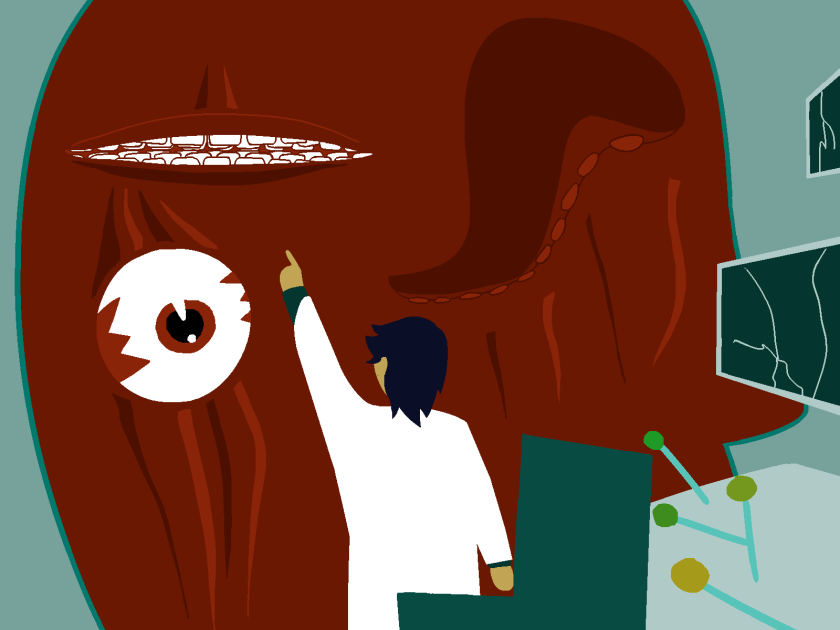
A mouth opened above the eyeball. “I’m not killing you. I’m absorbing you.” It had three rows of blunt teeth and a massive flopping tongue. “Unlike the other humans I’ve encountered, you seem useful.”

Akayama’s heart dropped. “The two hundred and seven who trespassed on forbidden space? Some brought their children? One child brought a pet bird? You killed them all?”

“Not all of them. I absorbed the bird.” The mouth bared teeth. “What did you do to me?”

“I did everything,” said Akayama. “I built the Hurricane. I failed to prevent its launch. The fiery fate of the universe is my fault.”

“I mean, what did you do just recently?” The eyeball squinted. “You fired a laser at me, and when I smacked you from the sky, you transmitted data! I was about to divide into a million copies, and now I can’t.”

Akayama put a hand over her heart. “My virus affected you. Humanity may have a chance.”

“Undo it.”

“You misinterpret my intent,” Akayama explained to the eye and mouth. “That virus proves there’s hope to salvage the pilots of the Hurricane.”

“Salvage? Pfft.” The mouth blew a raspberry which speckled her with spit. “My pilots are safely fused with my eternal form. If you really built me, you know my duty is to humanity’s preservation.”

“What do you remember of humanity?” asked Akayama. “Decades have passed since the Hurricane’s pilots were merged. Don’t you have their memories? Can’t you see their grieving widows and orphaned children?”

“I can,” said the Hurricane, “which is why I must divide. My quintillions of backup-copies ensure my memories will last forever. At the core of this planet, your consciousness will join mine. Then I’ll disable your virus myself.” The mouth licked its lips. “Your consciousness will be divided, too, and accompany my every copy. I’ll share you with my copies across the universe until your knowledge is safely stored in my omnipresent mass. Humanity’s best must last for all time.”

Akayama shuddered. “Life isn’t about fearing death. You contain people, but you’ve lost what made them people.”

“Ha! I’m a hundred times the human you are, because I can see a hundred lifetimes at once.”

“You ended a hundred lifetimes at once! Your pilots run in parallel wearing their yoke like a crown!” Akayama didn’t feel brave, but she pointed accusingly at the eye. “How can you claim to be human when you can’t appreciate anything without absorbing it?”

“I’ve got fingers too, you know.” The Hurricane poked at her with an arm from the rock wall. It had two elbows bending in opposite directions and only three fingers with no thumb. “I know the fingerprints of every person I’ve assimilated. Don’t fear merging with me. I’ll preserve you in perfect detail.”

The thought made her knees knock. “When you were born, why did you leave earth?”

“I didn’t. Not right away.” The arm morphed into a slimy tentacle. “First I dove into the ocean and assimilated a giant squid, just to see if I could.”

“And then why did you flee?”

“I wasn’t fleeing.” The Hurricane retracted its tentacle. “I wanted to explore the cosmos.”

“You didn’t just explore the cosmos, you consumed it! But at least you were exploring, a marginally human activity.” Akayama folded her arms. “When you decided protecting humanity meant homogenizing it, everything humane in you died! You don’t even know how many fingers you’re supposed to have.”

The eye tried counting Akayama’s fingers, but she hid her hands in her sleeves. “I’m the most humane being possible!”

“Then grant me my individuality!” She stood from her chair to shout. “And grant it to yourself! You vowed to share me with Hurricane Planets across the universe. If you share me with your copies, nothing will separate you from them!”

The eye blinked audibly.

“You need me.” Akayama pointed to her nose. “You need my mind unmolested. Aren’t you special? Aren’t you the `I’ of the Hurricane? What could elevate you above countless copies like uniquely accommodating your creator?”

“Hmm.” The mouth bit its lower lip. “What utility can you provide if you’re separate?”

“I could help you reclaim your humanity! I’m the universe’s leading expert on consciousness.” Akayama turned the Zephyr’s broken steering-wheel. “I could load just one of your pilots at a time into my Zephyr’s circuitry. Imagine: each of your aspects can have personal-space to recoup their lost perspective!”

“I could absorb your knowledge and do that myself.”

“No.” Akayama stood her ground. “You lack the necessary motor-skills and sense-organs. How could I operate the Zephyr’s control-panel with tentacles stretching from your bulk? I’ll need to live on your surface, near a star. Otherwise it will be too dark for me to work.”

She felt heavier. The peristalsis reversed direction to vomit her up the planet’s throat. Akayama sighed in relief.

“You can’t live on my surface forever,” said the Hurricane. “I’ll have to hide you when we meet my copies. If they see you, they’ll ask why you weren’t assimilated.”

“Can we stay far from the others?”

“Periodically I sync databases with my compatriots in the Dance of the Spheres. I’ll give you ample warning.”

M2 pictb

Next Section
Commentary

The Fall

20 years prior, Professor Akayama didn’t have time to scream when the Hurricane ripped her spaceship in half. Both halves of her Zephyr’s head spun into space while she lost consciousness. Each time she woke, she saw the sun-sized Hurricane Planet grow larger as she fell toward it. She prayed to die before she woke again and had to see the Hurricane once more.

She wasn’t so lucky. She splashed in an ocean of warm, pearly pulp.

Akayama had no strength to swim, but her lab-coat kept her afloat. She languished in half-awareness for what felt like days. She had to guess the duration because only red Hurricane Planets speckled the black sky. She would starve to death without the familiar sight of the Milky Way.

She couldn’t move an inch. Whenever she guessed a day had passed, she tested her broken bones and found a greater range of motion. She knew these oceans of pearly pulp accumulated on wounded Hurricane Planets to repair their injuries. She’d seen similar seas flood and drain while studying the Hurricane through powerful telescopes. She considered it cruel irony that the pearly pulp sustained her. Her death would not come so easily.

On the ninth day (she guessed) even her arthritis was gone. She flipped to float on her belly and shed her lab-coat. Inside the lab-coat were buoyant plastic air-pockets which inflated during the fall. If she’d left without her lab-coat, she could’ve just drowned, and this would all be over. Now she wore the lab-coat back-to-front so the buoyancy was suitable for swimming. She tread water (well, not water, but she didn’t want to think about it) and surveyed the horizon. She finally saw a thin plume of dark smoke against the black sky’s red speckling of Hurricane Planets.

She’d never seen a Hurricane Planet expel dark smoke. Was this her crash-landed Zephyr? She had no other guess, and her stomach rumbled at the thought of rations stored aboard. She wasn’t hungry—the Hurricane’s wound-goo sustained her—but the wound would soon heal and the sustaining pulp would be absorbed. Besides, she kept a cockroach in the Zephyr’s glove-compartment, and she craved a good smoke.

After swimming thirteen hours (she guessed) she grazed a gritty shoreline. She pulled herself onto the painful beach and slept on her lab-coat. As she slept, the tide of pearly pulp grew shallow, and she woke to see the shore was paved with human teeth. She shuddered, stood, and pulled her lab-coat around her shoulders. She limped over the teeth toward the dark smoke-plume in the distance.

M1 pictb

About seven decades ago, when Akayama experimented with human mind-mergers, her failed test-subjects bristled with painful teeth. She surgically rectified her subjects and recorded the incompatibilities so the mistakes were never repeated. Today her largest failure, the Hurricane, cordoned its injuries with densely impacted chompers.

Beyond the teeth, Akayama walked on fresh pink flesh. Walking further, the Hurricane’s flesh reddened and shed dead skin rough as sand. Her feet sank six inches in the desert-like dust.

The plume of dark smoke drew closer every hour. She crested a final dune and saw the right half of her Zephyr in a deep, sandy crater. It had just one eye, one ear, and half a nose and mouth, but its unflappable expression filled Akayama with confidence. Maybe the engines worked and she could escape.

She slid down the crater’s slope.

The soft sand rippled under her like a trampoline. When the ripples reached the crater’s walls, the crater’s walls grew higher. Akayama scrambled back up the steepening slope, but the walls became vertical and caved overhead like a tidal wave. She tumbled into the crater and rolled next to her Zephyr as the horizon sealed shut above her.

Akayama heard rumbling subterranean hydraulics. After days of trekking, she now considered that it was statistically improbable for her and her Zephyr to land within even a year’s travel of one-another on the sun-sized cosmic object. This had been a trap.

The Hurricane Planet swallowed her and her spaceship, and rushed them to the core with churning peristalsis.

M1 pictc

Next Section
Commentary