Race Map

Jonas is behind the horse again. Bummer.

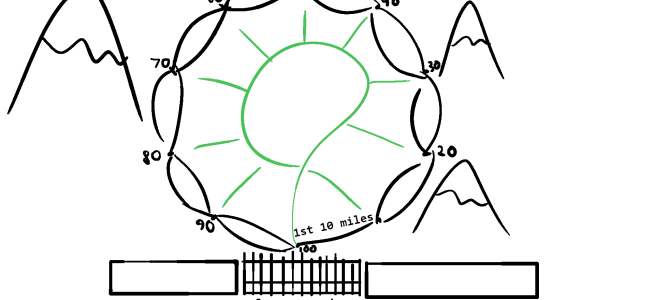
I made a little map of Alphonse’s estate. By my reckoning the Bronson Estate must be about a million acres—the size of Rhode Island—which is ridiculous, but not too ridiculous.

The race started and will end at the front gate, where Kevin, Whitney, and Hermes were held up. Then every ten miles, there’s a fork in the trail. Whoever gets to the fork first gets to choose which direction the race goes. There’s are mountains around mile 10-20, 25-30, and 60-70.

The green inner wheel is the service road Kevin and Hermes are driving on, which meets the trails every ten miles.

I hesitate to make this more detailed. I think a map of a fictional setting is only helpful insomuch as it empowers the story. Being too precise would just limit my ability to hand-wave inconsistencies away (or change things later, if I have cool ideas). There’s no canonical map, just this sorta abstract one.

See you next time!

Next 10 Miles
Table of Contents

To Mile 60

(This is part six of a story about an ultra-marathon-runner who bets his legs he can beat a horse in a hundred mile race. For now, Jonas is ahead of the horse.)

cropped-cardfront2-4.png

2019

BEEP. Mile 51: 11:52 / 6:48:51.

Hermes’ compression-sleeve was a lifesaver for my left knee. The knee ached without a sleeve ever since I broke my leg cross-country skiing as a Wisconsin teen, but I hadn’t worn a sleeve this morning because the only one I owned was cotton. After just twenty miles it would’ve rubbed my knee red-raw. Hermes’ compression sleeve was silky nylon. The man knew how to live.

“Drink.” Whitney gave me the hose to her water-backpack. My mouth was still dry from twenty miles with hardly any liquid. As I chugged, Whitney put something in my palm. “Swallow these.”

It wasn’t my place to ask what she’d given me. I just swallowed them.

“That’s two ibuprofen and a salt tab,” she said. “You’ll thank me for the painkillers, and hyponatremia is a death-null. You’re already acting confused.”

BEEP. Mile 52: 8:11 / 6:57:51.

“Can’t too many meds cause kidney-failure?” I asked.

“If you win a million bucks tonight, you can buy as many kidneys as you want from the Bronsons,” said Whitney. “If you lose, you’ve got bigger problems than your kidneys.”

I gulped. As we ran into the shade of trees, a chill ran down my spine. “Change the topic, squire.”

“You just finished two marathons in under seven hours. Nice job.”

“I don’t want to think about running.”

“What have you explained so far to Thog, the caveman?”

“Just cars and crosswalk-signals.”

“Airplanes are usually good for a few miles,” said Whitney. “Explain airplanes.”

“Well, Thog, do you know about birds?”

Whitney smiled. “Thog know bird. Thog eat bird.”

“Have you ever wanted to fly like a bird, Thog?”

“Why Thog want that?”

“You could fly up high to see where all the animals were hiding. You could drop rocks on enemy tribes. You could spy women from afar to take back to your cave—I’m sure flying would be a hit with the ladies.”

“Ooh. Thog want that,” said Whitney. “Tell Thog about airplane.”

BEEP. Mile 53: 8:03 / 7:05:05.

I felt the ibuprofen kicking in. It didn’t help my aching legs much, but it helped. Whitney was right to worry about hyponatremia, too; low salt-levels could make me cramp or even hallucinate. “Well, Thog, I already explained cars, remember? An airplane is like a car that can fly like a bird.”

“How Thog get one?”

“Ooh.” I bit my tongue. “It’s harder to get an airplane than a car. Airplanes are expensive.”

“Eckspensif?” asked Whitney. “What that?”

“You know, you have to trade a lot of berries and animal skins and stuff for an airplane.”

“Oh. Thog have many berry and animal skin. Thog trade for airplane. Bring many woman back to cave.”

“The tricky thing is, though, piloting a plane is a lot harder than driving a car. You’ll probably have to get a license, or something.”

“Lie…sense?”

“I mean, you gotta prove you can fly without crashing and killing everyone aboard.”

“Ooh. Scary. Thog reconsider.”

Whitney and I laughed. My cheeks were red. “I missed running with you, Thog.”

“I’m glad to see you again, Jonas.” Whitney pointed up through the branches above. “You should tell Thog about helicopters next.”

I looked up. I’d prayed the helicopter flying overhead was a hallucination. “Alphonse.”

BEEP. Mile 54: 8:09 / 7:13:14.


Kevin paced around his car, smoking a cigarette and swearing. Hermes napped across the back seat. The sixty-mile flag fluttered in light breeze.

“…Finally!” Kevin waved both hands in the air.

Hermes opened his eyes at the buzz of an approaching aircraft. “What’s that?” A plastic craft the size and shape of a bird of prey hovered before Kevin and gently set a pizza-box on the dirt.

“I’m friends with a guy who runs a start-up delivering stuff by drone. I figured we couldn’t get Jonas’ pizza into the estate any other way, considering the hassle we had at the gate.” Kevin opened the pizza-box to check its toppings, then gave a thumbs-up to the drone’s camera. “Pineapple-olive, just like Jonas ordered. Eeugh. Well, it’s his shitty pizza.” Kevin showed the drone’s camera both sides of his credit-card. “Christ, who orders a cheeseless pizza? Pretentious pricks, that’s who.”

Hermes watched Kevin inhale the last of his cigarette and blow the smoke at the drone as it took off. Hermes pursed his lips. “You don’t seem to like Jonas very much, huh, Kev? Why’d you want to come here and help him?”

“Jonas and I go way back, back to high-school cross-country. But he was always a pretentious prick. Always ragging on about skiing and the Wisconsin countryside and crap like that.” Keven sat in his car’s driver’s seat with the pizza-box in his lap. He used his smartphone to add a tip onto the delivery. “If he wins a million bucks today, Jonas better pay me for the pizza. It costs two hundred bucks to deliver like this. And he got it cheeseless, the pretentious prick!” Kevin lit another cigarette and puffed.

“Why do you smoke, man?” asked Hermes.

“Calms me down,” said Kevin, apparently unsarcastically. “Don’t tell me you’ve never smoked anything, hippie-beard.”

“Nothing legal,” said Hermes. “I just mean, as a cross-country runner, I figured you’d worry more about your lungs.”

Kevin reclined his seat. “Spare me the speech, dude. I’ve heard it all before.”

“Bet you have,” said Hermes. “I heard it all the time when I was drinking myself to death.” Kevin tapped ash from his cigarette. “When I was Jonas’ age, all I did was drink and run, but I only really learned to love running after I quit drinking. Got better at it, too.”

“I’m not like you weirdos,” said Kevin. “I don’t run ultras. I run on a treadmill in my air-conditioned basement, three miles at a time, three times a week. The treadmill doesn’t care if I smoke.”

“Running is running. Don’t Run to Live, man, Live to Run.”

“If that kinda thinking got Jonas into this situation, he should’ve just settled for living.” Kevin puffed his cigarette. “Should’ve just left the Bronsons alone.”

“I’m just saying, you could really… Uh…” Hermes pointed skyward. “Hey. Look.”

Kevin shaded his eyes from the sun. A helicopter was flying toward them. “Huh,” said Kevin. “Must be Alphonse.”

“Do you think it’s coming clos—” Hermes’ words were blown away by the helicopter landing abruptly before them.

“Good afternoon, gentlemen!” Alphonse Bronson stepped from the cockpit. “I suppose this is yours?” He tossed the drone onto the dirt. It was mangled and torn.

“Whoa!” said Kevin, “Did you fucking shoot it?

“No, I didn’t. My helicopter-pilot shot it.” Alphonse saluted back to the helicopter as the blades spun down. “Your drone was in my private airspace, and my pilot has an itchy trigger-finger regarding invasion of my privacy.”

“It’s not a government spy, crackpot! It’s a pizza-delivery bot!

“I see. Please, forgive me.” Alphonse bowed, sweepingly. “I’ll pay for the drone, but I hope you understand I don’t want any unauthorized visitors on my property, flying or otherwise. If you’re hungry, please, call me and I’ll have a trusted estate-agent bring you something more sophisticated than a pizza.” He passed Hermes a business card.

“The pizza’s not for us,” said Hermes. “Jonas asked for it specifically.”

Alphonse blinked. “Oh.” He pat his gaudy military jacket’s pockets for a minty metal toothpick. “May I see it?”

“Excuse me?” Kevin pulled back the pizza-box. “Hell no.”

“Please excuse my abruptness. I’m fascinated by athlete nutrition,” said Alphonse. “What pizza-toppings does an ultra-runner order? Maybe my horses could learn a lesson from Jonas.”

Kevin raised an eyebrow.

“There’s really no need for suspicion,” said Alphonse. “I assure you, I’m not nearly nefarious as the media portrays me. The Bronsons aren’t a photogenic family, but we’re much more personable in person.”

“It’s pineapple and black olive,” said Hermes, “and cheeseless.”

“Cheeseless!” Alphonse clapped. “How intriguing!”

“Yeah, I’ve met lots of runners who say cheese makes them nauseous,” said Hermes. “They don’t do dairy on a run.”

“You know, when I was young, my father took me to Italy. I learned that cheeseless pizza is perhaps the most historically authentic,” said Alphonse, “and definitely delicious!” Kevin rolled his eyes. Pretentious prick. “But how might a runner eat a whole pizza mid-stride?”

“Jonas is hungry enough to eat a horse,” said Hermes. “It won’t take him long to finish this. Maybe he’ll walk for a few steps to scarf it down.”

“Is the pizza cut into squares,” asked Alphonse, “or are slices more convenient?”

Hermes shrugged. “It doesn’t matter.”

“The things you perceive not to matter might matter most!” said Alphonse. “My father always taught me—”

“Fine you pretentious prick!” Kevin opened the box. “It’s cut into slices, okay?”

Alphonse kicked the bottom of the box. The pizza flopped onto the dirt. Alphonse stepped on it and smeared it with the heel of his boot.

Kevin stared at the pizza. “You asshole!” He rolled up his sleeve and approached Alphonse. Alphonse just smiled and pulled a pistol from his jacket. It was silver and had horses engraved on the handle. “What the fuck.”

“You visit my property at my mercy. I don’t approve of flying-machines intruding to deliver mysterious pizzas—especially flying-machines with cameras.”

“We don’t want any trouble,” said Hermes, with his hands up. “Mr. Bronson, sir, would you please send us a pizza with pineapple and black olives but no cheese? For Jonas.”

Alphonse put the gun back in his jacket. “I’ll see what I can do.”

“You’re a dickhead!” said Kevin. “Aren’t you supposed to be riding a horse right now?”

“My best jockey’s on the job.” Alphonse climbed back into his helicopter. “You’ll see her soon enough, as she streaks by.”


BEEP. Mile 55: 7:59 / 7:21:13.

“Anyway, Thog, that’s what helicopters are all about,” I puffed. Whitney’s pace was demanding but manageable.

“There it is again.” Whitney pointed up at Alphonse’s helicopter. “Maybe he’s spying on us.”

“I wouldn’t doubt it.”

“I can’t believe he switched out for a jockey,” said Whitney. “I read all about the Bronsons when I was researching Georgie Masawa. Alphonse seemed like the kinda guy who’d wanna do things himself, if only to gloat.”

“He flipped me off,” I said. “He said he was injured when his horse brushed against a branch, and he was eager to show me the band-aid on his middle finger.”

“Pathetic,” said Whitney. “He can’t even give the bird himself. He has to blame his horse.”

“Yeah.” I chuckled. “I don’t need any help to flip someone off.” I raised my middle-finger at the helicopter. “Take that, Alphonse.”

“Careful,” said Whitney. “If he’s really spying on us, he might take that personally.”

“You think he’s that petty?”

“From what I’ve read, no one is more petty than Alphonse Bronson.” Whitney passed me the hose to her water-backpack. “You know that better than anyone.”

I sure did. I grit my teeth.

BEEP. Mile 56: 8:02 / 7:29:15.

“Let me talk to Thog.”

“Thog here.”

“I told my friend Whitney that racing the horse was a corny attempt at romance,” I said, “but that’s not it. I have a grudge against Alphonse I couldn’t put off any longer.”

“You’ve told this story to Thog a hundred times,” said Whitney, “but Thog is happy to hear it again. You’re good at telling it.”

“I broke my leg cross-country skiing when I was fifteen,” I said. “If I ever wanted to ski again, I needed surgery my family couldn’t afford.”

“Mm-hm, mm-hm.”

“We heard about a big charity event in Colorado,” I said, “sponsored by the Bronsons. The Bronsons had an awful reputation, but if they were funding a charity event, maybe they weren’t so bad. So I went, and they gave me a crutch for free. I just had to run in a charity race.”

“How’d that go?”

“Alphonse offered free medical-care for life to every kid in that race except last place. As the kid on a crutch, it came down to me and the girl in a wheelchair.” I took a deep breath. “I would’ve been nothing but thankful if I’d just gotten the crutch, but taunting me with the possibility of getting my knee back, good as new—it wrecked me. I still see the girl in the wheelchair when I close my eyes. She beat me by meters.”

BEEP. Mile 57: 7:48 / 7:37:03.

“Thog understands,” said Whitney. “The Bronsons have hurt a lot of folks. You’re among an elite crowd, including Georgie Masawa.”

“I know.”

Hoy, hoy! Outta the way!”

Whitney and I heard galloping hoof-beats. Champ streaked by us, full-tilt.

Yah! Yah!” shouted the jockey. The hoof-beats became quiet in the distance ahead.

“Oh my god.” My knees quaked.

“It’s okay,” said Whitney. “Don’t panic. The horse won’t always be behind us, or ahead. Races are about change.”

“No, it’s not the horse.” I held my head in my hands. “The jockey was her, Whitney. The girl in the wheelchair.”

“You’re hallucinating, Jonas. She could have been anyone.”

“I’d know the back of her head anywhere.” Now I led the pace.

BEEP. Mile 58: 7:32 / 7:44:35.

Whitney sped a few steps ahead to slow me down. “Drink.” I drank from her water-backpack. “Swallow.” She ripped open a silver packet of running glop. I slurped it down: peanut-butter. “Drink.” I drank from her hose. “We’re closing in on that mountain.”

“Yep.”

“Is there another flag at mile sixty, to choose which way we run at the fork?”

“Yep.”

“Have you looked at maps of this place?”

“Yep.”

“Does either way, left or right, avoid that mountain?”

I puffed. “Nope.”

“Then save your gas, Jonas. The fork’s the jockey’s. Let her choose. You’ll choose at mile eighty, I promise.”

BEEP. Mile 59: 7:15 / 7:51:50.

I let myself slow down. “Thanks, squire.”

“Think about your pizza.”

“Ooh.” I salivated. “Kevin’s such a snob about pineapple on pizza, but I can’t get enough.”

“The combination of savory and sweet is old as cooking,” Whitney concurred, “and you never know what tastes good after sixty miles until you get there.”

“Nah. I’ve been praying for that pizza since mile five,” I said. “I hope they could get it into the estate.”

“I hadn’t thought about that.” Whitney put a hand over her mouth. “I should’ve asked for your pizza-order before we came in.”

“I need that pizza, Whitney.”

“There they are.” Whitney pointed ahead. Beyond the trees, beside the flag at mile sixty, Kevin and Hermes waited in the car.

BEEP. Mile 60: 8:04 / 7:59:54.

Hermes made a gesture for Whitney I couldn’t see. “Jonas, do some stretches and check where the jockey tossed the flag,” said Whitney.


“It’s not good, Whitney.” Hermes brought Whitney behind Kevin’s car.

“What? What’s wrong?”

“Alphonse stopped by.” Hermes opened the pizza-box in the back-seat. The pizza was mushed and dirty.

“Ah. Shit.” Whitney put her hands on her hips and breathed through her teeth.

“That ain’t half of it, sister.” Kevin tossed the destroyed drone before her. It was still smoldering. “Alphonse is packing heat. We called the police, but they said Alphonse is legally justified shooting down drones in his private airspace. Who’da thunk.”

“Okay. Okay.” Whitney covered her mouth. “I’ll handle this. Get another pizza to mile seventy. It’s uphill the whole way, so it’ll take us a few hours.”


The jockey had tossed the flag left, and I was glad. The trail right was steeper.

“I’ve got bad news,” said Whitney.

“I’ve got good news, so lemme go first.” I pointed left. “The jockey chose the shallower path. Champ must be getting tired.” I grinned. “She was just galloping past to freak us out.”

“There’s no pizza,” said Whitney.

I looked at her dumbly. “Huh?”

“Alphonse stole your pizza and gave it to the jockey. She ate one slice, and the horse ate the rest.”

My blood boiled.


2014

Sandra knocked on the door. “You sent for me, sir?” There was no response. The door was ajar, so Sandra peeked into Alphonse’s bedroom. Alphonse was bundled up in blankets in the fetal position. He waved a finger to tell Sandra to come closer. Sandra rolled her wheelchair to his bedside.

“My father died this morning,” said Alphonse.

“I’m sorry to hear that,” said Sandra.

“He said I hadn’t made anything of myself.” Alphonse coiled into a tighter ball. “He still thought himself a bigger man than me.”

Sandra tutted. “Well, he raised you. If he considers you a failure, he must’ve failed as a father.”

Alphonse considered. He sat up, still wrapped in blankets. “Yeah. That’s right!” He turned to Sandra. “The apple doesn’t fall far from the tree. If he calls my aspirations twisted, he has only himself to blame. And now, without him holding me back, I can be a real Bronson!”

“Exactly, sir!” Sandra clapped. “Let’s celebrate! Do you have any jockey-juice? If I can stand, we’ll tango!”

“Yes, lets!” Alphonse opened a drawer on his nightstand. He passed Sandra a syringe which she injected into her thigh. Then she stood from her wheelchair as if she never needed it. “Come here!”

Sandra had practiced dancing ever since she first tried jockey-juice. She and Alphonse danced around his bed. “What’s the first thing you want to do, now that your old man isn’t around?”

“The same thing I’ve done all my life,” said Alphonse, “dwarf my father’s legacy! My father made millions, I’ve made billions. My father raced glue-horses, I breed champions.” They wheeled around the room. “Anything he did, I’ll do with ten-fold the grace!”

“Yeah! That’s the spirit!” Sandra let Alphonse dip her. “Show your daddy who’s daddy!”

Alphonse kissed her on the lips.

Sandra grunted and pushed him away. “Whoa! Hey! I didn’t mean it like that!”

“I’m sorry, I’m sorry.” Alphonse adjusted the cuffs of his gaudy military jacket. “I just thought—My father… was a father, and I thought you meant—I thought you were volunteering to make me a father, too.”

“No, no, no.” Sandra sat back in her wheelchair; Alphonse had diluted the jockey-juice, and she felt it wearing off. “I’m sure you’ll find the right woman to carry the Bronson genes.”

Alphonse looked out a window over the estate, and, sighing, shook his head. “I think I’m the last of my lineage. I can’t imagine meeting a suitable receptacle for my seed.”

Sandra breathed in relief. Some lucky lady dodged a bullet.

“No, I know exactly how to put my father’s memory in its place.” Alphonse smiled at the sun. “I’ll follow in his footsteps and beat a modern Georgie Masawa. Maybe I’ll run him to death, too.”

Sandra bit her lip. “With all due respect, sir, if you follow in your father’s footsteps, you’ll always be a step behind.”

Alphonse paused and turned to her. “I understand what you mean, but there’s a little more to Georgie Masawa than the history books tell. There’s room to improve on my father’s ambition.”

Next 10 Miles
Commentary
Table of Contents

To Mile 50

(This is part five of a story about an ultramarathon-runner who bets his legs that he can beat a horse in a 100-mile race.)

cropped-cardfront2-4.png

2019

BEEP. Mile 41: 7:45 / 5:27:51.

I drank the last of the water Alphonse had tossed me. I threw the empty bottle over my shoulder.

Did Alphonse really mean to take my legs? Was that… legal? It couldn’t be, but knowing the Bronsons, legality wouldn’t stop him. I shuddered. I had to beat the horse.

If Whitney and Kevin and Hermes could meet me with supplies, maybe I had a chance. If I won, it wouldn’t matter what I’d bet.

Whitney. God. How could she be here, after what I did?

Or, what she thinks I did.

BEEP. Mile 42: 7:33 / 5:35:24.

I recognized my pessimism rising, but I couldn’t change my mind. I was bonking again and my brain took off without me. I settled into harsh memories in exchange for a healthy downhill pace.

By the time I turned 26, Whitney and I had run more ultra-marathons than I could recall. Most were a hundred miles or more; we had a knack for hundos. We’d even won a few of the less popular ones, so when I signed up for The Great Race, I intended to finish first. But Whitney wouldn’t pace me: she was running against. “I won’t go easy on you,” she’d said. “I plan to win The Great Race, too.”

“After I get my gold medal, I’ll fix you a veggie-smoothie for when you finally finish.”

“The Great Race is the most popular ultra in North America,” Whitney warned me. “The best of the best will be there.”

“We certainly will,” I’d said. She laughed. “It’s okay if I come second by a hair. I’ll forgive myself.”

“That wouldn’t be a bad twist for the book we’re writing together,” she’d said. “I plan to title it Live to Run.”

“Lemme spoil the ending: I’m gonna win.”

BEEP. Mile 43: 7:19 / 5:42:43.

The Great Race was as strenuous as it was infamous. Three quarters of it were uphill over rough, narrow trails. For the last thirty miles Hermes would pace me, and another race volunteer would pace Whitney.

After seventy miles I met Hermes at an aid station. “Lemme take that.” He filled my water-backpack and put it on himself. “How’s your knee?” I gave him a thumb-up and swallowed a fistful of pretzels smeared with peanut-butter. “Ready?”

I shook my head. “Uh-uh,” I mumbled through stuck-together teeth. I pointed to my left shoe.

“Want me to take it off?”

“Uh-huh.”

He removed my left shoe. “Oh, Jesus, Jonas.” Hermes pulled off my bloody sock. Two toenails were loose. “I’ll count to three, okay?” I nodded. “Three.” Hermes tore off the loose toenails.

“Mmmnn,” I groaned.

“Good job, soldier.” Hermes wrapped bandages around my foot, put on a new sock, and retied my shoe. “Let’s go.” We ran. “You’re not far behind the runner in fifth.”

“Who’s first?” I’d asked. “How many miles ahead?”

“Whitney is first, but don’t worry about first, Jonas. There are mountains between you and first.”

“I’m king of the mountain.”

BEEP. Mile 44: 7:36 / 5:50:19.

And I was. By mile 90, I was in second-place with Whitney just a mile ahead.

Even Hermes had trouble keeping up with me. At the last aid station, he gasped for breath. “You go on, Jonas. As a pacer, I’m just holding you back.”

“Uh-huh, uh-huh.” I pulled my water-backpack from his shoulders. It took all my brain-power to remember to say “thanks” before I kept running.

At mile 97 there was a fork in the trail. A pink ribbon tied to a tree-trunk told me I was on the correct path, but I wasn’t sure whether to go left or right. I had to choose fast: Whitney wasn’t far ahead.

I heard voices. Cheers. At first I thought I was hallucinating again, but no, it was real: I heard onlookers at the finish line, and the voices were louder when I looked left. So I ran left.

Biggest mistake of my life.

I finished first—I broke the tape—but I never saw Whitney and her pacer along the way. I thought maybe I’d just missed them when I passed. I didn’t see whoever put a gold medal around my neck, either; my vision was foggy. Hermes was there, having taken a shortcut.

BEEP. Mile 45: 7:29 / 5:57:48.

When Whitney finished a few minutes later, she accused me of taking a shortcut, too. “How’d you get ahead of me, Jonas?” she panted, glaring.

“I’m not sure.” I massaged my bandaged foot. “Didn’t you see me pass?”

“No,” she seethed, “I didn’t.” Her volunteer pacer shook his head and shrugged.

Kevin hadn’t seen me, either. Kevin was race photographer, in charge of snapping each runner at the 99-mile-mark, and he didn’t have a picture of me. Race officiators skeptically eyed my gold medal. “At the last fork, were we supposed to go left or right?” I asked. “I went left.”

Whitney groaned. “You cut two miles off the end! We studied the maps, Jonas, we’d prepared for this!”

“I’m sorry! My mind was cloudy, you know how it is.”

“Uh-huh, sure,” she said.

“Look, I’ll run back to the fork and do it legit! I’ll bet I can still finish second or third.” I prepared to take off, but Hermes put his hand on my shoulder. He took my gold medal and gave it to the race officiators, who passed it to Whitney. She still glared a hole in my head. “I didn’t mean to,” I said. “Honest. Just give me a DNF—‘Did Not Finish.’ I don’t mind. It’s fine.”

BEEP. Mile 46: 7:32 / 6:05:20.

I slurped my last silver packet of running glop. This one was lime-kiwi. I gagged. Without water to wash it down, my mouth tasted like runoff from Willy Wonka’s chocolate factory.

The Great Race didn’t let me DNF; they just ejected me from the competition. That’s a black mark.

Whitney never believed me that it was just a mistake. She was so bitter that she finished our book alone: Don’t Run to Live, Live to Run. Contractually, she was obligated to put my name on the cover, but the story was all about the first woman to win The Great Race. Sold like hotcakes.

I sipped from the hose of my three-liter water-backpack, then spat. I forgot the river was bitter. I dumped water from the backpack mid-run. That saved me about seven pounds.

The water trickled down a ditch into a cactus-patch. The trail was so rough and steep I had to slide down on my butt. I chuckled, wondering how Champ would deal with the path I’d chosen for us. This was hard enough for a human. It would be agony for a horse.

Then I remembered Alphonse’s spurs, and the dark red spots they left on Champ’s ribs. This was already agony for a horse.

And it was approaching agony for me. My bum left knee had started to tingle. Soon my patella would slide around like a hockey-puck.

BEEP. Mile 47: 7:41 / 6:13:01.

The bottom of the mountain gave me a much-needed gift: flats were less brutal on my joints than downhill, and I finally saw a car driving toward the trail. Kevin, Whitney, and Hermes were just a few miles away.

I watched the car chug along the slim service-road. To preserve attractive sight-lines, the roads were far from the trail, but the car drove off the asphalt and crushed a topiary on the way toward the 50-mile flag. Kevin must’ve been behind the wheel.

I really couldn’t imagine why these people had come all this way for me. I was sure, from their perspective, I was a blight on their lives—a cheater who cared more for himself than anyone else, who would betray for personal gain—not even money, or fame, or power, but sheer ego. I wouldn’t have driven here for me, except maybe to watch Alphonse chop off my legs.

As soon as the car stopped at the 50-mile flag, the shotgun-door opened.

Whitney stepped out and hit the ground running toward me. I tried squeezing out all my tears before she was close enough to see them.

BEEP. Mile 48: 8:03 / 6:21:04.

I waved. She didn’t wave back; her focus was on her form, and so was mine. For a quarter-mile my eyes soaked up the sight of her ponytail bouncing with her stride. Suddenly the tension in my muscles evaporated.

When she was close, I waved again. “Whitney!”

“Jonas, you idiot!”

“I know!”

She turned on a dime to run by my side. “Give me your backpack.”

“Okay.” I slipped it off my shoulders.

“It’s empty,” she said.

“The water in this place is toxic. I haven’t had a drink in eight miles.”

“Here.” She gave me the hose from her own backpack. The water was ice-cold. “I see the horse a few miles behind. Nice work.”

BEEP. Mile 49: 7:54 / 6:28:58.

“Thanks.”

“What’s that thing?” She pointed to the collar of my shirt.

“Oh, right.” I showed her Alphonse’s silver toothpick with ruby handle. “Alphonse says it’s worth ten-thousand bucks. You want it? He says it tastes like mint.”

“No way. I’ve read enough about Alphonse’s drug-habits to know not to take anything from him. It’s probably expensive because it’s spiked with something exotic.”

“Oh. Good, I didn’t use it.” I tucked it back through my shirt-collar.

“This is a really… interesting decision you’ve made, Jonas. Win or lose, I’ll have to write another book about you.”

“I’m sorry.”

“Why are you racing the horse, Jonas?”

“I don’t even know,” I admitted. “I think I thought you’d think it was a romantic gesture.”

“Standing outside my window with a boombox would have been more traditional.”

“I know, I’m sorry.”

“The Bronsons charge good money to let people onto the estate. How’d you get in?”

“I made a million-dollar bet.”

“That must’ve been most of your cut from the book-profit.”

“It would’ve been, but I spent all that on gambling and booze, so I anted up my legs.”

“Holy shit, Jonas.”

“I know, I’m sorry. Don’t tell the others, I don’t want them to worry.”

BEEP. Mile 50: 8:01 / 6:36:59.

“Jonas!” said Hermes.

“You idiot!” said Kevin.

Whitney tossed Kevin my empty water-backpack. “Jonas, sit down.”

“I don’t know if I can. I don’t think I’m physically capable of sitting.”

“Then lie on your back.” Whitney and Hermes helped me collapse onto the dirt.

“We’ve got your favorite flavors of running glop.” Hermes held up some silver packets. “Chocolate and peanut-butter.”

Whitney wiped sweat from my brow with a towel wrapped around an ice-pack. “It’s getting warm today.”

“I noticed,” I said.

“Warm is good,” said Whitney. “Humans handle heat better than horses.”

“Need any footwork?” asked Hermes.

“Please. I need new socks.”

“Okay.” Hermes pulled off my shoes. “Hoo boy, Jonas.” My right sock was wet and bloody. “Blister?”

“Blister.”

He peeled off my socks. “Uh… Whoa” I wiggled my toes. I’d removed all the nails weeks ago. “No loose toe-nails this time, huh?”

“Not making that mistake again.”

“Okay, moron,” said Kevin, “if we’re getting you through this, we’ll have to meet up every chance we get. The service-roads only meet the trails every ten miles, so we’ll see you at mile 60. What should I have ready for you there?”

I pawed at the zipper of my water-backpack he held. I retrieved my second banana and the rest of my peanut butter. I ate it all like a slovenly pig. “Pizza,” I said. “I want a pizza. Large. Pineapple. Black olives. No cheese, it nauseates me on a run.”

Kevin raised an eyebrow and looked to Whitney. “Is pizza, uh, kosher, on a race like this?”

“There’s no diet after sixty miles,” said Whitney. “The body wants what it wants.”

Hermes slipped a compression-sleeve over my left knee and retied my shoes. “You’re good to go, Jonas.”

I lay spread-eagle for another half-minute. Finally I pulled myself to my feet with help from my pit-crew. “I’m sorry, guys.”

“Come on.” Whitney took off in front of me. At the trail’s fork, she asked, “Which way are we going?”

I plucked the flag at mile 50. The trail to the right ran through an expansive clearing of tall grass. The trail to the left ran through a shadowy wood. I tossed the flag to the left. “It’s warm. Let’s enjoy the shade.”


2013

Alphonse left his father’s deathbed, leaving Father Bronson alone with his doctors, nurses, and attendants. In the hallway of the Bronson manor, Alphonse impotently sucked a minty metal toothpick while clutching a syringe.

“He didn’t want the jockey-juice?” asked his best jockey.

“No.” Alphonse gave the syringe to his jockey, who waited in her wheelchair. “He still thinks it’s abominable.”

“His loss.” The jockey injected the syringe into her leg. Instantly she stood from her wheelchair as if she never needed it. “Who was this one?” she asked, returning the empty syringe.

Alphonse shrugged. “Some loser.”

“Oof.” The jockey smoothed wrinkles from her pants. “Do you know the names of any of the jockeys in your races?”

“Nah.”

“What’s my name?”

“Why would I care?” Alphonse petulantly picked his teeth.

“My name’s Sandra.”

“I’ll forget it soon.” Alphonse walked away from his father’s room.

Sandra pushed her empty wheelchair behind him. “Do you even know your father’s name?”

Alphonse shrugged again. “What a loser.”

“I’ve heard he was something to behold, back in his day.”

“His day is done.”

“You mean—” Sandra covered her mouth. “You mean he’s dead?”

“Might as well be, already.”

Sandra released her breath. “Don’t you have any fond memories of your father?”

Alphonse paused. He opened the curtains over an ornate window overlooking the estate. “One, at least.”

“Yeah?”

“I must have been seven, or eight, or nine.” He wiped his toothpick on the curtain and put it back in the pocket of his gaudy military jacket. “My father challenged the best human runner on the planet to a race against a horse. He let me ride in the saddle with him.”

“A human has no chance against a horse.”

“Around a race-track, no, but across a hundred miles, a human might have a shot.” Alphonse smiled. “Gosh, what was the runner’s name? His name was… was…”

Sandra watched Alphonse wrack his brain. She wondered what it meant that Alphonse hadn’t even bothered trying to remember her name, or the name of his father, but seemed to recall a man he’d met decades ago, as a child.

“Georgie,” said Alphonse. “Georgie Masawa. A little Mexican kid, about 5′ 6”. Mid-twenties.”

“How’d the race turn out?”

“Georgie lost. He didn’t make it seventy miles.” Alphonse surveyed the estate. “He tried keeping pace with our horse from the get-go, and my father tired him out. You know, I don’t think we ever did find his body.”

“His body?”

“My father ran Georgie to death. Poor guy. What a shame.” Alphonse reconsidered. “I mean, if he weren’t such a loser.”

Next 10 Miles
Commentary
Table of Contents
 

To Mile 40

(This is part 4 of a story about an ultra-marathon-runner who makes a million-dollar bet that he can beat a billionaire on horseback in a hundred-mile-race. The ultra-marathoner will soon learn that without a million dollars to lose, the billionaire will demand his legs.)

cardFront

2019

BEEP. BEEP. BEEP. BEEP.

Kevin turned off his alarm-clock. It was ten in the morning. He slumped out of bed and started a pot of coffee.

As the coffee dribbled, Kevin checked his Facebook, his Instagram, and his Twitter. He smiled; he’d doubled his followers since Jonas’ book came out. What was the title? Live to Run? Kevin would never bother reading it, but apparently he came across quite well. He’d have to thank Whitney for the publicity.

Kevin checked his texts and almost dropped his phone. “Jonas! You idiot!” He dialed a number and put the phone to his ear. “Whitney! Your ex is making an ass of himself again! Call your Uncle Hermes, I’ll pick you up.”


BEEP. Mile 31: 8:04 / 4:10:22.

The maps said there was a river running down this side of the mountain, and technically, there was, but I hesitated to fill my three-liter water-backpack. The water flowed crystal clear from a rusty industrial pipe. It never occurred to me that this river might be man-made, and chlorinated, or worse.

Anyway, I filled up my three-liter backpack and tossed in a water-purification tablet. The backpack sloshed every step. After half an hour bouncing on my back, the water might be drinkable. I crossed my fingers; I couldn’t run seventy more miles without water.

On a typical ultra-marathon there’d be regular stations where runners could load up on supplies, or seek medical attention, or even quit the race. Some ultras over hundreds of miles were just lots of loops around small courses, so runners passed one aid-station over and over. A runner might even have a partner, a ‘pacer,’ who could carry things like a squire for a knight.

I was Whitney’s first squire.

BEEP. Mile 32: 7:32 / 4:17:54.

She’d signed up for a fifty-miler by the beach. We’d planned it for months. I’d be at each aid-station every ten kilometers. After thirty miles I’d be allowed to run beside her and pace her for the rest of the race.

Her Uncle Hermes taught me the rigmarole of race-staffing. He was an old hand at ultras. “Here, Jonas, hydro those guys.” At a marathon I might hold out a paper cup of water for the racers every mile. At the ultra I filled up a guy’s water-backpack while he puked into a bush. His stomach-capacity impressed me; he was skinny like a skeleton, but hurled up whole pints. Hermes pat him on the back and offered him some pretzels. “Whitney should be here soon,” Hermes told me. I wondered if she’d be as gaunt as most of the people who’d already passed.

“Hoy!” Whitney waved as she came around a cape. She was exhausted but jubilant. She tossed me her water-backpack. “Fill ‘er up and put ‘er on!”

Hermes untied Whitney’s shoes while I filled her water-backpack. I turned the backpack upside-down so the air-bubble floated to the top, where I could suck it out the hose. That’d keep the backpack from sloshing every step. “You’re the seventh woman overall,” I said, “and fourth in your age-group.”

“Am I on pace?”

“Perfectly.” I donned Whitney’s water-backpack to carry it for her while Hermes finished retying her shoes. If Whitney had crouched to tie them herself, she risked cramping and collapsing. “Let’s go.”

BEEP. Mile 33: 7:27 / 4:25:21.

It was fun to work pit-stops for Whitney, and I treasured running beside her when she was already fatigued. After she’d run thirty miles I could actually keep up with her, and I felt useful pacing her to the finish-line in ten hours. She ran the last mile in eight minutes, then kicked off her shoes. Her toenails were black and bleeding. We collapsed together near the ocean and let waves lap at our legs.

Then she asked, “when are you doing one?”

So I was obligated to let Whitney pace me on a 50-miler. And let me tell you, she looked different after I’d run thirty miles.

She was like peanut-butter: on a long run, I couldn’t get enough. When Whitney ran beside me, my body demanded her. She was salt and sugar and oil.

That’s why I signed up for a 100-miler. I was eager to speedball my girlfriend when my body was battered and bruised. “Are you sure?” she’d asked. “My Uncle Hermes ran few hundos back in the day. He says it’s a whole new world of pain.”

“Running is all about suffering,” I’d said. “The one who suffers best is the one who wins.” And boy, did I suffer. I ran from sunrise, to sunset, to sunrise, and Whitney was an irresistible siren luring me on when I wobbled.

BEEP. Mile 34: 7:44 / 4:33:05.

That hundred-miler was at a national park in the Midwest. About twenty-two hours in, I saw a bird I didn’t recognize. “Whitney?”

“Need water?” She offered me the hose from her water-backpack.

“No, the bird.” I pointed at the sky, near the sun. “Look. A big red bird.”

“There’s no bird, Jonas.” Whitney shook her head. “You’re hallucinating. Hermes warned you this would happen eventually.”

“Huh?” I couldn’t believe it. The bird looked real as anything I’d ever seen. “It’s right there, though. You must see it, it’s huge. It’s got a wing-span like a semi-truck.”

“Does that really sound real to you?”

“I guess not.” The bird dissolved into clouds. “Maybe I should quit now and take the DNF—‘Did Not Finish.’ Hallucinating doesn’t seem healthy.”

Whitney puffed as we jogged uphill. “You can stop at the next aid-station if you want, but you’re just a few hours from the finish. Hallucinations can’t hurt you, Jonas.”

“I… I don’t know.” I wondered which rocks and trees were real or not. “I don’t know.”

“Look. Jonas. Look at me.” Whitney pulled off her sports-bra. “These are real. These are right in front of you.” I drooled. “Keep running.” I could only obey.

BEEP. Mile 35: 7:21 / 4:40:26.


Kevin rolled down the driver’s-side window. “Hey! You! Open up the gate.”

A security-guard sitting in a booth crossed his arms. He wore a leather jacket and sunglasses. “No one gets onto the Bronson Estate without permission.”

“Call Alphonse. He’s gotta be expecting us.”

“Lemme see your ID.” Kevin gave the guard his driver’s license. “All of you.” Whitney gave the guard her license, too.

“I don’t have an ID, man,” said Whitney’s uncle Hermes. “I try to stay off the grid.”

“Then look at the cameras, sir.” Hermes noticed a security camera on each side of the wrought-iron gate into the Bronson Estate. The security guard returned their IDs. “I’ll tell Mister Bronson you came, and you can schedule an appointment. Mister Bronson doesn’t want to be disturbed today. He’s on important business.”

“So are we,” said Whitney. She sucked the air-bubble out of a water-backpack. “Could you please contact Alphonse? I think he’ll want to let us in.”

“No dice.”


BEEP. Mile 36: 7:51 / 4:48:17.

I sucked water from the hose of my three-liter backpack, then spat it out. It tasted bitter. The water Alphonse pumped up the mountain was chemically treated to look pretty. No wonder there was barely any wildlife in the Bronson Estate besides rodents, lizards, bugs, and birds. Fish weren’t welcome. A deer stranded here would die of thirst.

And so would I. I hadn’t had a drop of water in six miles. My mouth was dry. I couldn’t keep this up. I didn’t stand a chance.

My phone rang.

I pulled it out of my backpack. “Hello?”

“Jonas, you idiot!”

“Hi, Kevin. I guess you got my text. I’m racing the horse as we speak.”

“Jonas, I’m here too.” It was Whitney. “We’re outside the Bronson Estate.”

“Oh… I’m sorry you came all this way for me.” I wiped tears off my cheek and licked them off my palm to conserve water. “I need supplies, guys.”

“We’ve got all you need, Jonas,” said Uncle Hermes. “We’re gonna get you through this. But there’s something you’ve gotta do.”

“Okay. What?”

BEEP. Mile 37: 7:43 / 4:56:00.

“I just heard your GPS-watch beep,” said Whitney. “Are you using the running app I introduced to you? Do you have a premium membership?”

“No. I’m still bumming off your premium membership.”

“Perfect. I’m logging in on my own watch,” said Whitney. “Alright, I’m monitoring your run live. We can track your GPS-location and meet. I see you’ve got an eight-minute-mile average so far. Not bad. You might actually do this.”

“Jonas, they’re not letting us onto the estate without permission,” said Hermes, “but they won’t call Alphonse to ask if we can come in. Can you make him open the gate?”

“Uh…” I looked at the horizon. “I don’t know. He must be miles and miles ahead.”

“Catch that horse, Jonas,” said Whitney. “We can’t help until then.”

Kevin hung up. I tucked the phone back into my backpack.

BEEP. Mile 38: 7:21 / 5:03:21.

Whitney’s voice rejuvenated me. I felt her assessing my form from afar.

This was possible. I had a chance. I just had to catch the horse.

My blister was bigger than a half-dollar. Each step, I stomped my right foot until the blister popped and soaked my sock with warm fluid. It hurt—it burned like a salted wound—but now it wouldn’t mar my stride.

Whitney, Kevin, and Hermes. What a nice reunion. I’d texted only Kevin about racing the horse because I didn’t think Whitney cared for me anymore, but I suppose texting anyone about my dumb decision was just a cry for help. “Help, I’m going bankrupt staring at a horse’s ass!”

But what an ass.

And there it was.

Champ and Alphonse were stopped by the side of the trail halfway down the mountain. No wonder I hadn’t seen them from above—I’d assumed they were twenty miles passed, not waiting for me just ahead.

“Jonas! Good to see you.”

“Alphonse,” I panted, “What are you doing here?”

“You’ve got the advantage now!” Alphonse cheekily displayed a band-aid wrapped around his middle finger. “I endured an injury a few miles ago, when Champ brought me too close to a tree branch. I hoped to hold out until mile forty, but I fear I must throw in the towel here.”

BEEP. Mile 39: 7:32 / 5:10:53.

I slowed to linger beside him. “You mean… you give up?”

“No, no—My best jockey is tapping in! She’s arriving here by helicopter. She’ll ride Champ in my stead. Thirsty, Jonas? Catch!”

He tossed me a plastic bottle of water. I walked a few steps to drink two-thirds of it. “You can’t switch out. This race is between you and me.”

“Actually, if you read the contract you signed, you’re racing the horse, not me. The jockey is irrelevant.”

I locked eyes with Champ. The horse flared its nostrils. Alphonse’s spurs had bloodied Champ’s ribs. “My crew needs your permission to enter the estate, Alphonse. Can you let them in?”

“I’ll see what I can do,” said Alphonse, “but we have something to discuss. It’s come to my attention that you lack funds for our wager. If you lose, you can’t afford to pay up.”

“Really? Gosh.” I feigned surprise and jogged away. “I’m sure your people can talk this over with my people, once you let them in.”

Alphonse jogged after me. His spurs clattered every step. “I’d rather talk to you directly. I want to propose a deal.”

“What kind of deal?”

“Let’s call it…” Alphonse laughed. “Charity! If Champ wins, you’ll make a donation within your price-range and we’ll call it even.”

I tried running faster to leave him behind, but while I followed the trail around back-to-back switchbacks, Alphonse cut corners to keep up. “A donation? To who? How much?”

“Nothing you can’t afford, and for a noble cause. You might know that the Bronsons have significant holdings with wings of the medical industry.”

“Horse medicine, or human?”

“Both! If you lose, I’d just ask you to provide a sample for the labs. I’m sure they could learn from your impressive physique.”

“What do you want? Like, a spit sample? Blood?”

“No, no, Jonas.” Alphonse covered his mouth to hide giggles. “Jonas, I want your legs.”

“…Huh?”

“Your legs, Jonas. I value your legs at one million dollars, and accept them as your ante. If you lose, in lieu of one million dollars, I will take ownership of your legs.”

“Like… cut them off?”

“For medical purposes! And remember, only if you lose.”

“I can’t accept that. No one could.”

“Jonas, Jonas. If you win this race, you expect me to pay up, right? It’s only fair you keep your end of the bargain and put something at stake. You must restore the bet to make up for your deception. I can’t forgive you otherwise.”

“No deal.”

“You should really consider my generous offer. Remember, you’ve run almost 40 miles on my private property; at my standard rate of $10,000 a mile, you already owe me about half a million! You’ll ante both legs, or we stop the race here and now and I’ll settle for just one of your legs, or both legs below the knee.”

I was about to say I’d shove a leg, or both legs below the knee, right where the sun didn’t shine, but then I heard distant whirring helicopter blades. I was ahead of the horse, and would be at least until the new jockey arrived. For the first time in this whole race, I had the advantage. I couldn’t physically bring myself to turn down the wager. “Okay,” I whimpered. “I’ll take the bet.”

“You mean it?” Alphonse laughed and clapped. “I’ll call the front gate and let your crew into the estate. Oh, what fun!” He finally stopped following me. I left him and Champ behind.

BEEP. Mile 40: 9:13 / 5:20:06.

I plucked the red flag at the fork and tossed it toward the trail to the right. That trail was rocky and narrow, and I hoped a horse would have trouble with it.


2012

“And the winner is…”

Father Bronson’s coughing drowned out the announcements. He sounded like he’d hack up his last lung. Alphonse pointed to the stadium’s sparse spectators. “Look at all those winners, Dad!” Men in expensive suits cheered or tore up bad bets.

“Where did—” Father Bronson coughed again. He gripped the wheels of his wheelchair to hork up phlegm. “Where did you find these people?”

“They’re colleagues, and colleagues of colleagues,” said Alphonse. “None of them is worth less than a billion bucks, and they relish the thrill of putting millions on the line. I truly have the people’s support!”

The gates at the finish-line slammed shut before the last horse. Their jockey howled and shook the reins until a dart shot him in the neck. The jockey fell from the saddle, unconscious.

Six men in leather jackets led the horse into a big metal box, and tossed the jockey in afterward.

“Son, what’s happening?” Alphonse shushed his father.

The six men turned a heavy iron crank. Horse-glue poured from a spout into a bucket. The spectators cheered.

A woman in a white lab-coat and rubber gloves led two men carrying a white cooler to the big metal box. She opened a drawer on the box, where her two men retrieved another cooler full of eerie lumps. “Organs!” said Alphonse. “Even a losing jockey’s organs are economically valuable. Think of how many lives we can save with transplants, and how much we can charge!” While her two men loaded the box’s drawer with the empty cooler for the next race, the woman with the lab-coat withdrew a syringe from a panel on the box. She brought the syringe to Alphonse. “Look, dad!”

“What is that?” asked Father Bronson. “Hey, don’t!”

Alphonse relented and didn’t yet inject his father with the syringe. “Once we’ve extracted every organ with medical value, there’s chaff leftover. Our labs have perfected a technique to turn that chaff into a nutrient-paste. It’s a cure-all! Don’t you want to walk again, Dad? You could even ride a horse!”

Father Bronson blanched, then rolled the wheels of his wheelchair to turn away. “Son, I don’t think you’ve understood the finer points of my advice. My enemies in the media may disagree, but even have standards, and what you’re describing is beneath me.”

Alphonse struggled for words. “Oh. I get it. This is the jockey that came last. I can’t inject you with a loser. Your blood is too royal for that.”

Father Bronson opened his mouth, but decided against the rebuke he had in mind. “I’m leaving, son. Contact me when you’ve made something of yourself.”

As his father wheeled away, Alphonse shook. He took a minty metal toothpick from the breast pocket of his gaudy military jacket and suckled it. “You, Doctor,” he said to the woman in the lab-coat, “bring me the jockey who won that race.”

“In a syringe, you mean?”

“No, just send them over.”

The doctor walked to the finish-line and addressed the winning jockey. The winning jockey didn’t get off her horse; she rode it to Alphonse’s track-side seats. “Howdy, boss.”

“Congratulations.” Alphonse tossed her the syringe. She cringed, but caught it carefully. “That’s a month of medical care in a hypodermic needle. Good for what ails you.”

The jockey smiled. “I appreciate it, sir, but you already pay all my medical expenses.”

Alphonse cocked his head. “Huh?”

“When I was a kid, I came second-to-last in a charity race, and since then you’ve funded my healthcare. Thanks to you, I’ve got the best wheelchair on the market.” She pat her horse.

“Oh.” Alphonse shrugged. “Well, with that injection, you won’t even need a wheelchair for a while. You’ll be able to walk. I’ve seen lab-rats with terminal illnesses get a new lease on life.”

The jockey inspected her new syringe. “If I come first again, will you give me another?”

Alphonse laughed. “Let’s make a deal.”

Next 10 Miles
Commentary
Table of Contents
To Mile 30

(This is part three of a story about an ultramarathon-runner who makes a million-dollar bet he can beat a billionaire on horseback in a 100-mile-race. Our runner Jonas is far behind the horse, but just crested a mountain—only to see another mountain he’ll have to summit soon.)

cardFront

2019

BEEP. Mile 21: 6:51 / 2:45:35.

Running downhill is easy. Running downhill well is hard. Anyone can jump off a cliff. Only mountain-goats survive.

In high-school, each week of Fall, all the local cross-country teams competed on some rough trails. I was proud of my personal record: I could run three hard miles in just under 16 minutes. I could even keep up with the best varsity runner, Kevin, for the first two miles.

But in the last mile, he’d leave me behind, because the last mile was downhill, and Kevin knew how to handle downhill. Lord, Kevin could sprint. He always finished at least two minutes ahead of me. After each meet I was exhausted, but standing. Kevin usually collapsed and puked. That’s how the coach knew Kevin had done his best and I’d slacked.

On this hundred-mile run, I’d puke eventually. It was just a matter of time.

BEEP. Mile 22: 6:21 / 2:51:56.

Kevin had taught me how to run downhill, but Whitney taught me again.

“What are you thinking?” she’d asked me on a twenty-mile run. We were training for our first marathon. We’d promised to run that marathon together, and beat four hours. “Slow down!”

“It’s downhill,” I’d said. “Downhill is easy, so we should sprint every step.”

“No, no,” Whitney’d said. She easily matched my pace. “Did Kevin teach you that? You can sprint downhill at a three-mile cross-country meet, but you’ve gotta be more careful on a marathon. Didn’t you once break your leg skiing? You’ve gotta take care of your body! Think about your knees!”

Runners often thought about their knees. Knees are important. Knees tell us a lot.

BEEP. Mile 23: 6:13 / 2:58:09.

My knees could tell the downhill slope I’d enjoyed was starting to level out. I looked at the mountain a few miles ahead; Alphonse and Champ had probably climbed most of it, if they hadn’t already started descending the other side.

Even though the scenery was idyllic—the valley between mountains was lightly forested, and birds chirped in the trees—I knew I had to keep my mind off my dismal situation. I focused.

Whitney. We wanted to run a marathon together.

Well, she wanted to run a marathon. I was initially on-board, but after that twenty-mile training-run, I shuddered at the thought of more. “No, no,” I’d panted, “I don’t think I could take another step.”

“You hit the wall,” she’d said. “Hitting the wall means you’ve trained hard. Each time you hit the wall, you push it back—if we keep this up, we’ll push the wall beyond marathon-length and finish just fine.”

“You know a lot about this,” I’d wheezed.

“I want to write a book about running,” she’d said. “Maybe it’ll star us, and this marathon.”

BEEP. Mile 24: 7:02 / 3:05:11.

Kevin wanted to join. He asked me on the high-school track: “How long is that marathon you signed up for?”

“Marathons are officially 26.2 miles,” I’d said. “I think it’s historical. Whitney could tell you.”

“I could run 26 miles,” he’d said.

“26.2. Whitney says every step counts. She also says the last six miles are harder than the first twenty.”

“How fast are you gonna run?” asked Kevin.

“Whitney wants to finish in four hours. That’s about nine minutes per mile.”

“I can run better than nine-minute miles,” said Kevin.

And boy, did he. Kevin signed up for our marathon and crossed the starting line alongside Whitney and me, and 20,000 other people. Like Champ, Alphonse’s horse, Kevin initially begged to run faster than Whitney would allow. “Wow, they give out water every mile?” Kevin took a paper cup from a volunteer. He drank mid-run, while Whitney and I walked a few paces to swallow efficiently.

BEEP. Mile 25: 6:58 / 3:12:09.

“They’d better,” said Whitney, starting to run again.  “Even the fastest marathon-runners take at least two hours, and exerting yourself like that, you’ve gotta drink.”

“I wouldn’t mind being thirsty for four hours,” said Kevin, “and if I’m not weighed down by water, I bet I can finish faster than that!”

“Go ahead,” said Whitney. I recognized the dismissive roll of her eyes. “Do what you want.”

So Kevin ran ahead.

We caught up with him at mile 16. He didn’t look happy; his features were gaunt and sweat had dried in salty streams down his arms. “Hey guys—” He almost asked us to wait, but he didn’t. “Take off without me,” he said. “I’ll be right behind.”

BEEP. Mile 26: 7:11 / 3:19:20.

Back in the Bronson Estate, the trail began to grow steeper. While I sipped water from my three-liter backpack, I ‘beeped’ in my head: 26.2, 3 hours 22 minutes. It didn’t quite qualify me for the Boston marathon, but after the Boston marathon, you get to stop. I still had almost three more marathons to go today—and they’d all be slower than 3:22.

Whitney and I didn’t finish our first marathon in four hours. We took an extra 45 minutes. We started walking at mile 22; that was our ‘wall.’ We barely managed a photogenic jog for the cameras at the finish-line.

To his credit, Kevin finished, too. It took him five and a half hours. He confided in me that he’d never, ever run a marathon again, or any distance over ten miles. He’d hit the wall, and it hit him back.

The wall. What a quaint idea.

You could push the wall beyond marathon-distance. But a hundred miles, no.

BEEP. Mile 27: 7:43 / 3:27:03.

When Whitney and I trained for longer distances, we learned not to call it ‘the wall.’ It’s not an insurmountable obstacle; it’s a temporary circumstance to make peace with, like a surfer diving under harsh waves. Ultra-runners call it ‘bonking,’ because it’s like a sledgehammer smashing your skull.

Instead of training to push back the wall, you train to run through the bonk. All the bonks. Over a hundred miles, I’d bonk at least a few times. The first one would come soon.

The trail became steep and demanded every atom of my effort.

I tore open another silver packet of running glop. I aimed to slurp one down every hour or so. I’d finished off the flavors I liked; no more chocolate or peanut-butter. This one was orange-creamsicle.

I washed it down with a sip from my three-liter water-backpack. There wasn’t much left.

Maps of the Bronson Estate showed a river at the top of this mountain. I could refill my backpack there, if the water was palatable. If it wasn’t, I carried some purification tablets.

Racing the horse was the most well-researched stupid-ass decision I’d ever made.

BEEP. Mile 28: 9:39 / 3:36:42.

The scrapes on my hand and knee still trickled blood, but they didn’t hurt anymore. I actually almost forgot about them. But the blister on my foot had grown to the size of a quarter, and I felt it every step. Eventually I’d have to stop and lance it with something from the little first-aid kit I kept in my backpack.

I sniffed. I smelled horse poop. A pile of round, brown droppings waited in the trail ahead. It looked fresh. Alphonse and Champ must have passed less than an hour ago.

This was possible. I could do it. I almost smiled.

Then I got bonked.

BEEP. Mile 29: 10:44 / 3:47:26.

“Oh, old friend,” I said to myself. “Here we go again.” Pain wandered up and down my legs, but worse was the cold wash of pessimism and self-loathing. I started walking. It’s not shameful to walk uphill. Soon I’d hit the top of the mountain. Then I could recover.

While I walked, I opened my backpack. I carried a plastic baggie of peanut-butter and two bananas. I peeled a banana and used it to scoop peanut-butter into my mouth.

Running does weird things to your taste buds. When I’m not running, I don’t care for peanut-butter. After twenty miles or so, I can hardly think of anything else. Whitney likes vegetable-smoothies after running seven hours, not a step before.

When I finished the banana and half the peanut-butter, I sealed the baggie and put it back in my backpack. I tossed the banana peel off the trail; I never liked litterers, but banana skins decompose, and anyway, this was Alphonse’s estate, and I hated that son-of-a-bitch. I wouldn’t mind if he slipped on my banana peel. I wouldn’t mind if he choked on it.

BEEP. Mile 30: 14:52 / 4:02:18.

Alphonse had plucked the flag at 30 miles and tossed it toward the trail to the right. That trail was broader and smoother, all the better for Champ to sprint.

As the slope leveled out, I started running again. I sipped the last of my three-liter water-backpack to swish peanut-butter from between my teeth. The bonk would be back, but so far so good.

On the horizon, there was another mountain—a third, looming incline still veiled by the distance. In maps of the Bronson Estate, every trail eventually went up that mountain, but somehow I was less daunted by that final foe. With any luck, Whitney was right, and Champ would be more fatigued than me by then. I’d be king of the mountain.

How did Alphonse know I didn’t have the funds to pay up if he won? Could he see my empty bank-account? I could only hope to finish first, or, if not, hope that Alphonse Bronson was a reasonable man. I swallowed.


2011

Alphonse Bronson gripped his father’s shoulders. “Dad, are you watching?”

“I’m watching an empty stadium.” Father Bronson pulled the wheels of his wheelchair like he wanted to roll away, but Alphonse kept him there. “Fill the stands with spectators before you bother showing me.”

“But father, look!” Alphonse pointed to the starting line, where ten horses stamped the ground behind their gates. “I know you’ll be proud! I’ve invented a new, efficient kind of racing!”

“Racing is already efficient,” said Father Bronson. “The winner wins. The loser loses. The difference is efficiency. The most efficient finishes first.”

“…And the least efficient loses!” Alphonse waved his hand and the gates opened. Jockeys bounced on the horses’ backs. “And what do we do to the losers?”

“Glue, son,” said Father Bronson. “The most efficient use of an inefficient horse is glue.”

“Right!” said Alphonse. “So look!” He pointed to the end of the track, where nine gates waited open. “Ten horses, nine gates. Think of musical chairs.”

The gates swung shut behind the first nine horses. The tenth horse whinnied and threatened to throw their jockey from the saddle. “Son—”

“Watch,” said Alphonse. The tenth jockey dismounted to help some men in leather jackets lead the tenth horse into a big metal box in the center of the track. The jockey shut the box’s iron door while the men climbed onto the box to lay hands on an iron crank. When they turned the crank, white goo oozed out of the box’s spout into a bucket. “Glue! The last horse is processed into paste with corporate efficiency, as God intended!”

“Hmm.” Father Bronson stroked his beard. “Hmm.”

Alphonse stopped grinning. “What’s the matter, Dad?”

“Horses are one thing. Humans are harder. However many horses you have, you need humans on your side.” Father Bronson cast his gaze over the empty stadium. “If you can’t get the people’s support, you’d might as well be paste yourself.”

Alphonse misunderstood. His father was dismayed with the empty stands, befitting such a grotesque scene, but Alphonse kept watching the tenth jockey. “I’ll impress you, Dad. I’m sure I will. I’ve got a tournament planned.”

“A tournament?”

“Yes! A whole tournament, where the last in each race will be turned into their…” Alphonse rubbed his chin. “Their useful components.”

Next 10 miles
Commentary
Table of Contents


Trip’s Trap

(This story won the Most Excellent Prose award from the College of Creative Studies at UC Santa Barbara!.)


My colleagues at the lab said my nightly vomiting was a symptom of alcohol poisoning. I would share the hypothesis, except I vomited eyeballs.

I don’t recall swallowing eyeballs, mind you. With optic nerves dangling like spaghetti.

And twitching! I typically vomited into the toilet and flushed the eyes before the horror set in, but after a midnight joust with a bottle of gin, I heaved into the orange, plastic bucket in my closet, where the eyeballs struggled like fish flopping for the water. I slammed the closet shut, and when I regained consciousness in the morning, I saw the eyeballs had died trying to escape under the door.

I elected not to take them to the lab (my reputation already strained), so I turned to the meager equipment of my apartment. According to my bathroom scale, the weight of the eyeballs exceeded one kilogram, yet I’d lost little mass myself last night. I must have conjured the eyes from my stomach.

For a while, I could not even look at liquor without imagining the eyeballs I should surely vomit. Then a spontaneous rendezvous with a handle of whiskey forced my hand. I puked six eyes and a pair of lips into the bucket. The lips squirmed like drowned worms into the shape of a mouth.

“We gotta talk, Arnold.”

I slammed the closet.

After staging a coup on a few more shots, I mindlessly retreated to the bucket. Two more eyeballs, six more lips. My throat’s last spasm threw an ear onto the pile.

“Can I call you Arnie?” asked the lips in unison.

“Please, don’t talk.”

“Your universe ain’t well-developed, so this might be hard to understand. Trust me, the eyeballs were the quickest way to reach you. Hey, it’s not polite to stare, Arnie, don’t give me that look.”

I slumped onto my ass. “Oh god, I’m smashed.”

“Hey, lucky guess. Our universes are on a collision course.” I moved to slam the closet, but the lips interrupted. “Pick up my ear, Arnie, it’s hard to hear ya.”

“Please, no.”

“Into the ear, Arnie. C’mon.”

I leaned into the bucket. “Go away. I don’t want this.”

“You need my help, Arnie. I can’t get into details; it involves trans-dimensional mathematics, and you Stage One universes aren’t hot on that. Can you even make Quantum Foam?”

“What?”

“Okay, time for a crash course. Not literally, I hope,” murmured the lips. “Universes are like bubbles. Our bubbles are about to bash. This ain’t my first rodeo, but you guys are gonna pop.”

“Who are you?”

“Look, you’re bright enough, Arnie, I’ll level with you. I’m not a person, I’m a reality, the whole thing. Consciousness is inevitable, so lots of realities develop self-awareness. We call that Stage Two. Whole ecosystem out here, Arnie.”

“Uh…”

“Yeah, trippy, huh? There we go: call me Trip.”

“Trip.”

“You’re a quick learner, Arnie. Anyway, your universe won’t survive Stage One if you pop now, okay? Gotta work with me here, alright?”

“This is too much.” I sprawled across the carpet. The world blurred in my vision.

“I’m not as mobile as I used to be, but your reality is pretty spry. If you pass me the reins to your universe for a bit, I can jettison some of your space-vacuum. Push you guys out of harm’s way. Dig?”

“How do I… What do you mean?”

“I’ll need your universe’s address. Know it off the top of your head?”

I shook my whiskey. Only a tablespoon remained in the bottle. I drank it. “…Can’t say I do.”

“You know Physics, Arnie?”

“Well… Some. I’m a chemist. I… I mostly study alcohols.”

“Find a Physicist. They’ll know if anyone does.”


The next morning, I fumbled my way to the physics department.

“Arnold? Are you drunk?”

“Not yet, I just…” I pushed my wire glasses up the bridge of my nose. “You don’t happen to know the universe’s address, do you?”

“…What?” They squinted from behind their desks. “Little early to be hittin’ the sauce, Arnie.”


The night’s bourbon made me consider gifting Trip a fresh load of facial features. “Sorry, no one knows what you mean.”

“No prob, it was a long shot. I didn’t know my address in Stage One either.” Trip somehow bit his lips at the bottom of the bucket. “There’s an equation for it, but you can only really solve it at Stage Two or Three…”

“…I can do equations.” I felt bile rising in my throat. “What’s the equation?”

“Nah, nah, it’s too complicated. You guys don’t even have Quantum Foam, no way you’ve got the computing power. Hey, you’re lookin’ a little green, Arnie, you gonna chunder?”

“I can hold it down.”

“Then have another drink. I can’t calculate your address from here. I gotta send you a Neuron Pod. Be careful with this, Arnie, I’ve only got about eighty-six billion. These are Stage Three tech, Arnie.”

The brown bottle’s last drops trickled from its neck to mine. I gagged on the odor. “What’s a Neuron Pod?”

Trip surprised me by licking his lips with a tongue emerging from under the pile of eyeballs. “Ever study biology? Get to mitochondria?”

“Yeah.” I doubled over the bucket and opened my mouth, retching, but nothing came out. Saliva dribbled between my teeth.

“Neuron Pods are like mitochondria. Sub-realities, within me but distinct from me. Gotta delegate, that’s Stage Three. Outsource your computation. I found some Stage Zero podunk realities and converted the mass into brain matter. One Neuron Pod is like a septendecillion human brains. Smart brains, too, like yours, Arnie. Alright, here it comes!”

Huge, like a cantaloupe. It shouldn’t have fit in my throat, and it didn’t fit in my mouth. Trip’s eyeballs watched it flop into the bucket. Trip’s lips smiled.

A Neuron Pod was like a brain with a hagfish mouth and chattering needle-teeth. “Trip—What do I do with this?”

“It’s looking for your address. Just keep it safe.”


Friday night. Party night. In a dark alleyway, I popped the cork off two-dollar wine. Grape foam spilled onto the dirt.

I put the Neuron Pod on a trash-can lid. The needle-teeth were the worst part, like a sex toy from hell. “Can you talk?”

The needle teeth chattered.

“Answer questions?”

More chattering.

“What’s Quantum Foam?”

The Neuron Pod’s needle-teeth shifted and clattered, filling the alley with heinous clicking. Almost… speech. After a quick drink of wine—like fermented olive oil—I held the Neuron Pod to my ear. “Tiny… universes.” The queer, snapping voice had a thick accent from somewhere eldritch.

“Can you elaborate?”

“Quantum Foam is the primal fabric of the multiverse… Each bubble is a universe at Stage Zero, absent of conscious thought…”

When I put down the wine, the bottle was two-thirds empty. “I’m not drunk enough. All this stuff about our universes colliding, it’s all real? We’re going to pop?”

“…My master leaves you with an ultimatum: be annihilated by the ballistic force of a careening reality, or entrust my master with your universe.”

I didn’t like the way the Neuron Pod said ‘master.’ “Well… You’ve known him for a while. Is Trip… trustworthy?”

“My master is… Stage Four.”

“Four? What does that mean?”

The Neuron Pod squirmed on the trash-can lid. “…Stage One universes contain sentient beings. Stage Two universes are sentient themselves… Stage Three is utilization of Stage Zero universes. Stage Four is… enslavement of Stage Three universes.” The hagfish mouth went silent.

“Enslaving universes? Sentient universes?” I looked at the Neuron Pod. “When Trip said you were ‘Stage Three tech,’ he meant—You’re saying Trip enslaved eighty-six billion sentient realities, and you’re one of them?”

“Yes…” The Neuron Pod flopped off the trash-can. When it hit the ground it almost burst, brain-folds expanding with juices. The hagfish mouth puckered. “Kill me.”

I poured the rest of the wine down my neck.

“Please…”

I smashed the bottle against a wall.

“Kill me…”

I threatened the Neuron Pod with the broken bottle.

“Please…”

“I… I can’t.” I dropped the bottle. “If I kill you, Trip will just enslave my reality instead. I need your help.”

The hagfish mouth took a deep breath. The brain’s folds inflated.

“We need to make Quantum Foam.”


I poured a shot of Scotch. “Need a drink?” The Neuron Pod twisted, which I interpreted as a ‘no.’ I downed the drink. “Okay. Okay.”

When I opened the closet, lips, ears, and eyes spilled out. Trip’s twitching eyeballs had toppled the bucket. “Hey, hey, Arnie! What’s the good word? That old Neuron Pod got your address yet? Might take a while depending on the cosmological constants in your reality.”

I put the Neuron Pod on the floor. “What next?”

“Well, ordinarily you’d hafta swallow that thing to send it back to me, but our universes are close enough I can toss you a Synapse Cable. You feel like hurling, Arnie?”

“I’m pretty sober right now.”

“Well, either you hafta swallow that Pod, or you hafta start drinking so I can throw you this Cable.”

Ignoring the shot glass, I drank from the Scotch-bottle. The nausea set in instantly. With one animal-like retch, I felt a thin strand jump up my throat and stick to my teeth. I pulled the strand from my mouth like a circus-clown conjuring a line of handkerchiefs. The strand expanded until a whole rope of meat and fat dangled from my jaw. The Synapse Cable was two inches thick, plugging my esophagus.

“Put it in,” said Trip.

I waggled the meat-rope near the Neuron Pod. The hagfish mouth slurped the frayed ends and locked on with needle-teeth.

“Ah, perfect. I’m getting your address now…”

For a few seconds I choked on the Synapse Cable. The Neuron Pod contorted and flexed in concentration.

“Hey, you’ve got a cool little reality… No wonder you’re still Stage One, with quantum particles like these. These photons are trash… And your Planck Temperature! How do you get anything done?

I nodded. It was all I could do.

“You did good, Arnie. Your universe was almost a splat on my windshield. Just gotta get you outta the way…”

Trip paused.

“You…” The eyeballs turned to me. “Hey, did you give me the wrong addreeeeeaaaugh!”

The lips flopped on the floor. Eyeballs burst into spurts of blood.

“Aaaaaaugh! God, no, what did youuuuooooaaaaaugh!”

The Synapse Cable retracted down my throat. The Neuron Pod detached from it, letting the meat-rope whip through my esophagus like measuring-tape.

“Are you trying to kill me?! What did you do?!”

“Sorry, Trip.”

“Aaaugh! I can’t—”

“We made Quantum Foam, Trip.” I massaged my neck. “We made new universes.”

“We found, in the innumerable realities… one whose cosmological constants were a perfect snare,” clicked the Neuron Pod. “This is how you entrapped me, isn’t it, master?”

“Now that universe is slurping you up like noodle soup,” I muttered, lying on the carpet.

“Of course… if you merely jettisoned space-vacuum… your connection to the snare would be harmless… Your pain indicates, as we suspected, you intended to subsume this universe into your own… or perhaps enslave it, like me and my compatriots…”

Eyeballs, lips, and ears shredded as if stuck in a storm of razor blades. Without lips, Trip’s voice echoed from my throat like shouts from a deep cave. “Arnie, Arnie, c’mon, I’m sorruuughhh make it stop Arnie please I’m begging you—”

I covered my ears. “I can’t, I can’t—”

“Your address! Give me your address, Arnie, let me escape, before it’s too late!”

“Not even if I could.”

“Then—then—”

Nausea pumped my guts.

Fingers from my throat pried my teeth open.

An arm stretched out of my mouth, fist-first.

“If you yak me up, I’ll survive! Vomit harder than ever, Arnie, right now!” The arm grabbed the Scotch. “I’m close, Arnie, I can escape to your universe, but it has to be right now, now, now—”

The arm sank back into my stomach. Before I realized why, it stuck the bottleneck down my throat, pouring liquor into me. I tried to scream.

“Now, Arnie! Now now now!” I couldn’t take the bottle away from the hand in my throat. I flipped onto my belly so the bottle didn’t pour down my neck. “No!”

Two arms opened my jaws wide. One flipped me onto my back and kept my mouth open. The other grabbed the bottle and spilled it on my face.

I groped the floor for something, anything.

A glass beaker.

I smashed the bottle with the beaker. Scotch soaked the carpet.

“No no no no!”

The arms in my mouth pat the damp floor.

“No, no, no…”

The arms slid down my throat until the fingertips brushed along my tongue.

“No…”

I struggled to my knees, teeth clenched, salivating, holding myself.


For twenty minutes, I puked. No eyeballs, no limbs, just ordinary stomach contents. I spent the night cleaning vomit and broken glass. “Hey. How are you holding up?”

The Neuron Pod deflated. “I am well… Thank you.”

“You sure?”

“My torment is at an end… Enslaved realities have been released. It is over.”

I tossed vomit and glass into the trash. “And our Quantum Foam…”

I opened my desk drawer.

Milky sand so fine and smooth it could have been liquid, like cream for coffee. Each speck was a universe. One speck had swelled like a pearl. “That’s Trip’s trap, huh?”

“My old master used the technique quite often.” The Neuron Pod observed the foam with its eyeless gaze. “I am impressed with your ability to synthesize Quantum Foam. You have a knack for it.”

“It wasn’t that hard,” I said, “since you gave me the recipe. It’s just chemistry.”

The hagfish mouth made a toothy smile. “Proper chemistry is vital for an up-and-coming Stage Two universe.”

Back

To Mile 20

(This is part two of an ongoing story about an ultra-marathon-runner in a 100-mile race against a horse. The runner might win a million bucks, but doesn’t yet know he stands to lose his legs.)


2019

BEEP. Mile 11: 9:45 / 1:13:14.

Alphonse immediately galloped far ahead. Champ didn’t seem to notice the steepening trail. Already the horse and rider were a dot navigating the switchbacks above me.

After that 4:22 mile, I was in no condition to catch up. I walked a quarter-mile to catch my breath. As if to help me slow down, the incline gradually made each footstep harder than the last, forcing me to trudge.

When this was over, what would I tell my ghostwriter? “That horse, Champ, he’s a beaut. I mostly saw its rear-end, but what a rear-end!”

Why’d I ever think I could beat the horse?

Oh, right. My ghostwriter.

Whitney.

BEEP. Mile 12: 10:15 / 1:23:29.

I met Whitney through my cross-country-running team in high-school. Well, she wasn’t actually on the team, but that’s how we met.

I’d grown up cross-country-skiing in Wisconsin. When my family moved to Colorado, I figured the closest sport would be cross-country-running, but it wasn’t my jam. I could ski for hours and hours over miles and miles of countryside. The running team sprinted across city streets like they couldn’t wait to stop. Every morning during training, they’d say, “six miles!” and finish fast as possible, then collapse.

They left me in the dust every time, but I didn’t mind. Kevin, the quickest varsity runner, didn’t mind lazing in the back of the pack with me until the coach found him slacking and chewed him out. No matter how much Kevin lingered to keep me company, he was always first to finish every run.

Once, when I was left behind during off-season training in the Summer, I met Whitney.

BEEP. Mile 13: 9:44 / 1:33:13.

We both stopped at the same crosswalk signal. She was obviously in the middle of a run; she wore a headband soaked with sweat. I asked if she was on the girl’s cross-country team, because I’d seen her in the hallways at high-school. What was her response? I tried to remember, it was priceless.

“Nope,” she’d said. “I’m a real runner.”

Wow. That ego sparked my interest. “The guys on the team are way better runners than I am. They’re a mile ahead, and probably always will be.”

“Nah,” she’d said. The crosswalk signal changed and we ran across the street together. “After enough distance, the tortoise beats the hare. If you guys were running a marathon, their jackrabbit start would tire them out and you’d pass them up. Over a hundred miles, a human could beat a racehorse.”

God, Whitney, I hope you were right.

BEEP. Mile 14: 9:13 / 1:42:26.

Before the train of thought turned pessimistic, I decided to change my mind. The mental struggle was half the battle. I’m sure every runner has a dumb game they play to pass the time. Mine was talking to Thog.

“Crosswalk signals,” I said aloud. “How would I explain crosswalk signals to a caveman? Well, first I’d explain cars. They’re like fast animals you can climb inside and control.”

The air wasn’t quite cold enough anymore to see my own breath.

“Cars are useful, because they can travel very far very quickly. But if a car hits someone, it would hurt. Imagine a mammoth trampling you—you know about mammoths, right, Thog, mister caveman? So we have crosswalk signals. They’re clever little boxes which put up a hand when it’s not safe because cars are coming.”

I held up a hand for Thog to see as an example—just in time to catch myself, because my foot slipped on a rock and I fell.

BEEP. Mile 15: 9:23 / 1:51:49.

My grunt of pain sounded like Thog: “Ugh!” My left knee and right hand were bleeding. I scrambled to my feet and kept running. From another pocket of my three-liter water-backpack, I withdrew some alcohol wipes and cleaned my injuries as I went. The sanitizer stung.

I could cry later.

I tore open another silver packet of running glop and slurped it down. This one was flavored like peanut-butter, a close competitor to chocolate. I washed it down with a sip from the hose of my three-liter water-backpack, which was almost half-empty. I’d be left thirsty by mile thirty.

My bleeding hand wasn’t a huge issue. It hurt, but lots of things hurt, and in a hundred-mile run, eventually everything would hurt.

My bleeding knee was more concerning. The impact threatened to reignite an old skiing injury.

I also felt a blister growing on my right foot ever since my 4:22 mile. It was about the size of a dime.

But so far so good. This pain was surface level.

Eventually hell would seep into my bones.

BEEP. Mile 16: 9:41 / 2:01:30.

I plugged my left nostril and fired a snot-rocket from the right. It landed in a neatly trimmed rosebush.

I had to hand it to Alphonse, the Bronson Estate was a sight to behold. With territory overlapping Wyoming, Colorado, and Utah, the Bronsons owned a million acres of precisely cultivated wilderness. Alphonse brought business-partners here to ride horses and talk about whatever multi-billionaires talked about. It was the perfect place to luxuriate in richness. The view from the top of the mountain would be glorious.

Once I got there.

I couldn’t even see Alphonse and Champ anymore. They’d passed over the peak. Alphonse had probably made mile 20 and tossed the next flag to choose left or right at the fork. I knew he’d chose whichever trail was helpful for horses and harder for humans.

BEEP. Mile 17: 9:37 / 2:11:07.

The pain in my knee reminded me to watch my step along the trail. I didn’t want to slip again or stumble on a gopher hole.

I narrowly avoided another kind of obstacle: a stinkbug. Stepping on stinkbugs wasn’t the worst, but I’d rather not.

A lizard skittered across the path. A chipmunk or squirrel chattered near a tree.

A cool, low-flying cloud brushed by me on the switchbacks. In the last eight miles, I’d climbed at least 2,000 feet. I turned my head to see the trails stretching behind and below me. The morning sun cast long shadows of hills and trees.

I smiled. This connection to my surroundings was why I enjoyed endurance sports to begin with.

BEEP. Mile 18: 10:13 / 2:21:20.

Then I recalled the severity of my circumstances.

What would Alphonse do if he beat me to the finish line? His lawyers could claim my every possession and it wouldn’t come close to a million bucks.

I hadn’t lied when I said my bestselling book made me a millionaire, but money doesn’t last long when you have a habit of drinking, or gambling, and especially both at once. But that was behind me, and about 81 more miles were ahead. I had to win. I literally couldn’t afford to lose.

Of course, if I won, Alphonse could cut me a check and not even notice a million bucks missing from his bank account. He could blow his nose with a million bucks. He could wipe his butt with it.

BEEP. Mile 19: 9:52 / 2:31:12.

Finally the incline shallowed out and my pace naturally quickened. Within minutes I passed the peak and the landscape opened below me.

I almost cried.

Another mountain stood a few miles away, just as tall and twice as steep. At mile twenty, the trial forked; Alphonse had already tossed the flag toward the right, the quickest path to Mount Doom. I would only have a few easy miles to recover before climbing again.

I refrained from swearing and just ran. On the downhill slope, my strides were long and easy. If I really barreled, maybe I had a chance of passing the horse down the line.

BEEP. Mile 20: 7:32 / 2:38:44.

As I passed the flag, I noticed a note taped to a trashcan. I took the note and walked briskly with it.

“Hello, Jonas,” wrote Alphonse. “I hope you’re enjoying the view. Unfortunately, my accountant has bad news—he says he’s investigated your expenses and calculates that you might not have the funds to pay me back if you lose.

“Don’t worry, Jonas. If it comes to that, I’m sure we can work out an alternative arrangement. If you catch up, we can discuss this in person!”


2009

“And the winner is…”

Alphonse Bronson politely clapped for a cadre of school-children crossing the finish line. He knew he had to clap no matter how bored he really was when the cameras were on him and displayed him on the stadium’s jumbo-tron.

“Isn’t this fun?” A teacher bumped elbows with Alphonse. Alphonse dusted off his sleeve. “What a great experience for these kids, and for such a good cause! Thank you again for your generous donation to our organization.”

Alphonse smiled and nodded. His marketers said donating to charity would help his family’s public-image problems, but he’d have donated elsewhere if he knew this charity would make him waste an afternoon watching kids with medical problems run around a track. “Thank you for inviting me. It’s a pleasure to be here.”

As the next group of kids lined up for the next race, the jumbo-tron displayed a celebrity in a tuxedo. The celebrity threw up peace-signs while an announcement played over the loudspeakers. Alphonse couldn’t hear, but the crowds of spectators cheered.

“What’s happened?” Alphonse asked the school-teacher beside him.

“He’s just made a donation,” she said. “From the cheers, it must have been a big one.”

Good, thought Alphonse. The cameras were off him. He took out a metal toothpick and sucked it. The minty flavoring was an appetite suppressant that kept him slim.

The teacher conferred with a woman beside her. “Really? Oh. Oh, dear. That’s… macabre.”

“What?” asked Alphonse.

“The donation,” the teacher relayed. “People normally donate to the charity itself, but that man in the tuxedo wants to fund medical care for the winner of the next race.”

Alphonse dropped the toothpick when he gaped. “Is that… legal?”

“I guess. And we are a charity—we couldn’t just turn down such a generous offer.” The teacher crossed her arms and shook her head. “Oh, look—that boy has a crutch, and that girl’s in a wheelchair. Those poor kids. It seems cruel to dangle that prize at the finish line.”

Alphonse swallowed. Here he was, bored out of his mind, and he hadn’t even thought to gamble. This changed everything. Suddenly the children looked like racehorses. “I know exactly what you mean,” he said. “The disabled kids were put in the race just for publicity. Neither could possibly win. They’re battling for second-to-last.”

“Well, maybe one of them will win. You never know. It’d be a good underdog story. And surely this will inspire more donations.”

“No, no.” Alphonse took out his wallet—crocodile skin—and withdrew a blank check. He waved it for the cameras. “We shan’t rely on fate. I’ll even the playing-field.”

“Oh! Mr. Bronson!” As Alphonse appeared on the jumbo-tron, the school-teacher kissed him on the cheek. “You’re so selfless!”

“I’ll pay every medical-bill for every kid on the track—for life—except,” he said, smiling wide, “last place. That’ll make this a race worth remembering.”

The school-teacher blinked. Alphonse pressed the blank check into her hands. The crowds cheered, at first, but the teacher’s draining expression on the jumbo-tron made them hush. “That’s… awful. We can’t do that…”

“Could you really turn down such a generous offer?” asked Alphonse. “The little girl’s got the advantage of a wheelchair, but the boy with the crutch is a few years older, taller, and leaner. Maybe he’s a high-school student, and she’s a middle-schooler? It’s really a toss-up.”

“You—you’re a monster!” She slapped his face. The crowds oohed.

“You’ll keep those kids from excellent medical care, just because you think I’m a monster?” Alphonse felt his cheek as he bent over the railing to admire the racers. “Monster-money is legal tender.”

The teacher gasped, then walked away sobbing.

The stadium was otherwise silent as the loudspeakers explained the grim donation. The girl in the wheelchair and the boy with a crutch shared a worried glance.

Alphonse almost drooled when the starting gun went off. All but two kids crossed the finish-line within a minute. Then the crowd watched the last two kids race neck-and-neck, and heard their panting, and the squeak of her wheelchair, and the plod of his crutch.

Next 10 Miles
Commentary
Table of Contents
Story Structure

A race has a beginning and an end. A story has a beginning and an end. But races are linear—you go step by step. Stories might loop around and have flashbacks and other chronological anomalies.

My first idea for Man VS Horse would have been more like a race. We’d start at the starting line and end at the finish. We’d learn about our characters’ backstories through dialog or narration during the race. I even wanted the length of the text for each mile of the race to reflect the protagonist’s mile-times: a ten-minute mile would take a page, while a five-minute mile would take half a page, and a twenty-minute mile would take two pages. I still like this idea. I know movies bother me when a character says, “the bomb’s going off in ten seconds!” and you count to thirty before they defuse it with a second left.

But while restrictions can breed creativity, those rules produced something subpar. I’m glad I tried it, but this time I’ll allow myself some more creative liberty.

Longer miles will still take up more text, I hope; I think that should have an effect on the reader, making them exhausted alongside our protagonist.

But I’ll allow myself some flashbacks at the end of every ten miles. If our billionaire is going to claim the protagonist’s legs, we gotta explore his history and figure out why he thinks that’s a remotely reasonable option.

You’ll notice in commentaries I’ll often call the characters ‘the billionare’ or ‘the protagonist.’ I haven’t settled on names for the characters yet. I just chose ‘Alphonse’ and ‘Jonas’ because they came to mind. Maybe I’ll get attached to those names and decide to keep them, or change them to something more thematic. This is a living document; I reread and make edits every so often.

I hope you have fun reading!

Next 10 miles
Table of Contents

The first ten miles

2019

BEEP. Mile 1: 7:17 / 7:17.

I’d ran hundreds of first miles faster than that. This morning, I paced myself.

The horse had no trouble keeping up. Alphonse tugged the reins to stay alongside me, but his horse Champ begged to pull ahead. “Regretting this, Jonas?”

“Not yet,” I puffed. This was an easy pace; I could speak aloud, coherently, at this pace. “Just ninety-nine more to go.”

“That’s the spirit.” Alphonse Bronson stroked Champ’s mane and brushed dust from the horse’s leather saddle. The Bronson Estate’s million acres were landscaped with artisan dirt for rustic authenticity. “With a million dollars on the line, you can’t let your head get away from you.”

“Uh huh, uh huh.”

“A million dollars. A hundred miles. That’s ten-thousand dollars per mile!” Alphonse laughed. “To some people, that’s real money.” I pretended not to see his grin, focusing on my feet slapping the trail. “You’re sure you’re good for it, Jonas?”

“Uh huh, uh huh.” I sipped water from the hose of my three-liter backpack. I took a sip every mile. I could do it by muscle-memory, even without my GPS watch beeping.

BEEP. Mile 2: 6:33 / 13:50.

“Let’s call that mile a tie,” said Alphonse. “We’re neck and neck entering mile three. How exciting!”

“The only mile that matters is the last one,” I puffed.

“Every step matters,” said Alphonse. “You wrote that in your book.”

Did I? I’d never read the darn thing.

“We tied on mile one and mile two! Allow me to treat you to a tasty morsel.” Alphonse unbuttoned the breast-pocket of his gaudy military jacket.

“I’m not hungry.”

Alphonse took out two toothpicks and picked his teeth with one. He held out the other toothpick for me; his horse was so tall that I had to reach far above my head to take it.

“What’s this for?” I puffed. The toothpick felt oddly smooth, and after steadying my eyes to focus as I ran, I saw the toothpick wasn’t wooden, but metal, like a needle.

“Suck it,” he said. “That’s a ten-thousand dollar custom-order toothpick. It’s made of silver, and the handle is a ruby. I mean it, suck it, it’s mint-flavored! Zero-calorie snacks like this are how I keep my figure.”

BEEP. Mile 3: 6:59 / 20:49.

“I’ll save it for later.” I stuck the toothpick through my shirt-collar. This was my favorite shirt, a prize for finishing my first ultra-marathon, a fifty-miler. I didn’t win that race, but even last-place got a shirt, and it was a good shirt. Its light mesh material never rubbed my nipples bloody like cotton did.

With my hands free, I corrected my form. Form was vital. Sure, the only mile that mattered was the last one, but that last mile was built on every step up to then. I guess my ghostwriter knew what she was talking about.

Champ, the horse, seemed to understand, too. His form was impeccable. His ropy muscles wrapped his legs and shoulders and buttocks. Champ’s breathing was strained not by effort but by desire to run faster than Alphonse would allow.

“I don’t know how the view is down there,” said Alphonse, “but here in the saddle I can see the first flag at mile 10.”

I saw it too. At the base of a mountain, the first flag flapped in the breeze.

BEEP. Mile 4: 6:54 / 27:43.

I let Alphonse explain again while I sipped from the hose of my water-backpack: “Don’t forget, the first of us to that flag chooses if we go left or right at the first fork.”

I knew. I knew. I’d obsessed over maps of the Bronson Estate; I saw the race’s possible paths and elevation profiles when I closed my eyes. With scenic environs and a variety of terrain, it would be a fun place to run under better circumstances.

If we went left at the fork, we’d go through a valley and skip most of a mountain. If we went right, we’d go right over it.

I was no stranger to running up mountains. In fact, I’d won some ultras over mountains. I was king of the mountain. But I reckoned Champ would be the mountain’s champion and leave me in the dust. I had to be first to the fork, and I had to choose left… or, if Alphonse was first to the fork, I had to cross my fingers and pray he’d prefer flatter terrain.

I puffed and puffed. The air was just barely cold enough to see my breath.

BEEP. Mile 5: 6:46 / 34:29.

The weather was perfect for a run. Not too sunny; I hated sun in my eyes almost as much as I hated wearing hats and sunglasses. Buttermilk clouds dappled the sky. I could enjoy a long run on a day like this, but today was not that day.

“Tell me, Jonas. Do you want to go around the mountain, or over it?”

The question caught me off-guard, and I considered lying. Maybe I could use reverse-psychology to make Alphonse choose the flat terrain. “Over,” I said. “Your horse doesn’t know there’s a million bucks at stake. When Champ’s terrain gets tough, I bet he’ll stall and slow down. A man’s more nimble than a horse on rocky mountain trails.”

“Ha! Maybe he’ll fall and break his legs.” Alphonse pat the saddle. “Don’t worry about my horse. Champ could jump over the mountain. What would you prefer, personally, over or around?”

I grimaced. “Over. I’m king of the mountain.”

He laughed again. “Jonas, leave reverse-psychology to businessmen. I’d like to go over, too—I’m calling your bluff!”

BEEP. Mile 6: 6:52 / 41:21.

When I was younger, I imagined an average person trying to keep up with me as I ran. It pumped up my pride: “oh, Jonas, have mercy! Slow down! Six miles is too much!”

“Six miles is a warm-up,” I’d say to my shadow. “Don’t give up now—let’s sprint the next block!”

But today I felt like the shadow. Alphonse allowed Champ to pull ahead a few yards. “You should know, Champ can run a bit faster than this. He’s descended from my father’s race-horses.”

“Believe me, I know.” Alphonse had told me many times before.

“My father’s horses never lost a race,” said Alphonse, “because if his horse ever lost a race, it turned out it wasn’t my father’s horse after all. It was retroactively disbarred to preserve my father’s spotless record.”

“Must be nice to be able to do that.”

BEEP. Mile 7: 6:03 / 47:24.

The horse was leading the pace, faster than I would’ve liked to maintain. “So Jonas, where did you get the money for this little wager?”

“Book-money,” I said. “I’m a national best-seller.”

“I’ve read your book, but could you remind me of the title?” Alphonse put a finger over his smile. I knew he was testing me, and delighted that it took me a moment to remember.

I stalled by panting, but finally recalled: “Don’t Run to Live, Live to Run.”

Alphonse chuckled. “If we live to run, surely Champ here is better at living than you. Wouldn’t you agree?”

BEEP. Mile 8: 5:55 / 53:19.

“He’s a beaut,” I said, not lying. Champ’s pure black coat was intimidatingly sleek. “What does he eat?”

“Nothing that isn’t hand-picked by my professional equine-dietitians,” said Alphonse. “My father founded his own company to produce acceptable foodstuffs for his racers.”

I took a silver plastic packet from the pockets of my three-liter backpack. I tore the packet’s top and squeezed the contents into my mouth.

“What’s that?” asked Alphonse.

“I don’t have any dietitians, but companies make foodstuffs for human racers, too.” I crumpled the packet and tucked it into my backpack. “That one’s chocolate-flavored. One of the only flavors I can stand.”

Beep. Mile 9: 5:48 / 59:07.

The flag was so close. It would be embarrassing to choose the left trail, around the mountain, after I pretended I wanted to go over—my reverse-psychology would be laid out for humiliation, and I knew Alphonse would relish the opportunity—but I could take the shame, and I wasn’t sure if my legs could take the mountain better than Champ’s.

I put on the gas.

I shot ahead of Champ, each stride Olympian.

“Oh ho!” Alphonse let the reins go slack and kicked his spurs into Champ’s ribs. Champ effortlessly kept pace with me. “You’re really not so slow, are you?”

I didn’t have breath to respond.

“But we’re pretty quick, too,” said Alphonse. Champ pulled forward. The horse’s hooves tossed rocks at me, but I ran faster and faster.

BEEP. Mile 10: 4:22 / 1:03:29.

Alphonse plucked the flag from the dirt right in front of me. “Photo-finish! Ten miles, still neck-and-neck, but Champ pulls through in the end!” The sarcasm dripped; Champ wasn’t even winded.

I barely resisted collapsing on my knees. I couldn’t speak for panting, but Alphonse filled the dialog:

“Jonas, I was joking about reverse-psychology,” he said. “I know this is just a friendly wager, so I’ll indulge you by choosing what’s best for both of us in the interest of sportsmanship.”

Through my panting, I managed to smile. “Really?”

“The view of the estate from the top of this mountain is breathtaking, especially this early in the morning. I think we’ll both appreciate it.” He tossed the flag toward the trail to the right. “Let’s go!”


1987

“And the winner is…”

On his eighth birthday, on his father’s lap, Alphonse Bronson cheered for another horse-race. “Daddy, was the winner one of yours again?”

“No, no, I didn’t have a horse in that race.” Father Bronson stroked his beard. “But I’ve got another horse in the next race. Look close, guess which one it is.”

“It’s the one that wins, right?”

His father chewed his beard. “You know, son… in every race, there’s a horse who comes last.”

“Yeah!” Alphonse punched his own palm. “What losers!”

“The Bronsons didn’t build their fortune by racing horses. We began with glue-factories.” His father looked away. “I bought those losing horses for cheap, and made them into glue. So at least they were useful in the end, right?”

“Yeah!”

“I still own those glue-factories and sometimes the horses get mixed up.” His father pointed to the starting gates. “I think the horse racing now might have been destined for paste. You’ll see what I mean.”

The starting gun. The horses raced.

His father’s horse was last.

“What a loser,” said Alphonse.

“Exactly,” said his father. “Sometimes a glue-horse pretends to be a racer. It’s a good thing we Bronsons can tell the difference.” His father’s men led that horse into a white van. His father ripped up some betting slips. Good riddance, thought Alphonse.

Next 10 miles
Commentary
Table of Contents

The End

(This is the final and shortest chapter of a fantasy series starting here. Homer saved the world by winning a board-game against a drawven robot. In the process, Homer’s game-piece was killed, and he can no longer play table-war, but Aria won the Mountain Swallower’s rocky brain.)


After the Mountain Swallower encephalectomized them-self, Queen Aria considered putting the brain in a glass box to commemorate Homer’s victory over the dwarfs.

However, the behavior of the remaining dwarfs—even those a continent away—immediately changed after their leader’s death. Their voices were still gravely and they still smelled of carrion, but without the Mountain Swallower commanding them, the dwarfs defaulted to almost gnome-like behavior. They walked aimlessly, and could respond to questions, but had nothing interesting to say. They could be bossed around a little, but without gnomish intelligence, all they could do reliably was carry things, and not even heavy things.

pict1.png

With dwarfs demure, Aria decided displaying the Mountain Swallower’s brain would be poor taste. She had to keep taste in mind, now, being queen. She asked gnomes what they’d recommend doing to the brain, but of course, the gnomes didn’t care. “What happened to the rest of the Mountain Swallower’s body?” she asked. “Did you eat it?”

“Goodness no. We threw it into lava.”

“Seems fitting to me,” said Aria. “Would that be appropriate, Jameson?”

Sir Jameson saluted. “I could burn the brain now, in your royal magma pit.”

“Nah. That’d look conceited in history books.” Aria stood from her throne. “Solemn and dignified-like is the way. In the wild wastes.”

“In the wastes?” Jameson moved as if to press Aria back into her seat. “Queen Anthrapas died in the wastes! It’s simply too dangerous.”

“Shove it. I’m not a nonagenarian, or a spindly elf-queen.” Aria gestured for Jameson to follow, and he had to jog to keep up. “A human queen’s gotta do politics in person. And I traveled through the wastes when I was just a kid!”


Homer lived not far away, just on the other side of the border. Jameson hadn’t even realized they’d entered the wastes. “Wasn’t there a wall where we had to present our brass?”

“The centaurs took it down,” said Aria. “I think it was a metaphor anyway.”

She knocked on Homer’s door and heard him finding the right hallway to greet her. Homer’s house was a little unconventional in layout, but he’d designed it himself, and the sphinx had helped him build it. “Arra!”

“Hey, Homer!” Homer and Aria hugged. Sir Jameson waited until they released each other. “In the mood for a funeral? You’ve never seen one before, have you?” Homer shrugged; he still didn’t understand some spoken language. “Is there a gnomish lava-pit around here?”

Homer led Aria and Jameson over a hill to an openly bubbling pit of molten rock.

“Care to do the honors?” Aria gave Homer the Mountain Swallower’s brain. “You won it for me, so it’s only right.”

Homer tossed the brain in the lava. It sank slowly, and when it was totally submerged, a bubble popped where it had been.

pict3.png

“Hey, look! Aria—I mean, your majesty!” Jameson pointed to the sky. “Isn’t that your dragon? Is it escaping?”

“Scales!” Aria waved both arms. “I forgot, I arranged for the royal beast-master to release him today. His game-piece is dead, so there’s no reason to keep him. A lot of game-pieces died in the match against the Mountain Swallower, and I’ve made sure the corresponding beasties were released.” Scales disappeared behind some snowy mountains. “I wish I’d seen him take off, but I don’t think he needs my support anymore.”

“Pity, I’d have liked to try riding him,” said Jameson. “Maybe he’ll come back someday?”

Aria smiled. Years ago she, too, had left the human capital when her game-piece died, but sure enough, she’d come right back. Maybe the dragon would come back, too, better for its time away from the table.

THE END


(Like I said, this probably isn’t the final version of this story. I’ll eventually come back and change stuff. Until then, I’m still happy enough to host it online. There’s a nice story here about board-games which determine the fate of fantasy nations, and that’s pretty neat. I like how, since living creatures change their environment in this story, it sort of seems like Aria’s presence caused Homer to appear. Aria feels stuck, and a labyrinth represents an inescapable problem. An ax symbolizing primordial war lets Homer escape his labyrinth, and, at the end of the story Homer and Aria end war’s lingering effect on mankind.

To totally read meaning into this retroactively (and be conscious of that meaning when I change stuff) the wild wastes represent man’s thoughts in the same way dwarfs and gnomes are expressions of the earth, or like the movie Forbidden Planet in which sci-fi protagonists are attacked by monsters of the id. Homer bridges the gap between animals and man, and through him man’s animal nature is resolved. The seafolk are mysterious forces pulling the strings, like wisdom which quiets the mind.

Sorry for the shorter section and commentary this week. I’m devoting more of my time to graduate school and video-editing. I’ll still post on this website, but I’m not sure how often.

My YouTube channel, Thinkster, is lots of fun. I mostly talk about anime. If Kaiji: The Ultimate Survivor sounds a little extreme to you, I made one about One Punch Man’s surprising depth. I even have a vr-ready 360 video of a bird landing on your head!)

Table of Contents