Notes to the future (plus a video about Black Mirror)

This chapter is a little short; I just started graduate school, and on top of that I’m having fun experimenting with video-editing, so I’m beginning to move on from this project.

But I’ve had a lot of fun with The Minotaur’s Board-Game, and I don’t think I’ll be done even after I post the last chapter two Fridays from now. I like the world I’ve made, but I think my exploration of it leaves something to be desired. Maybe a year later I’ll revisit this project and spruce it up a bit.

That’s the good thing about having a website instead of publishing a book. I can always change stuff. It’s a living document. It’s only public because I enjoy sharing my stories with anyone who wants to read them.

So let’s leave some notes for myself in the future. What needs to be spruced up in The Minotaur’s Board-Game?

The beginning needs expansion. I’m in such a rush to introduce core concepts, and just get on with the story, that Homer wins his first table-war the day after meeting Aria. I can convey my world to the reader in a clearer, more compelling, but still compact way. What if Aria put Homer to work on her farm, and they bonded a little over board-games?  Aria could explain table-war to Homer and the reader. Then Homer’s first victory is more plausible, and the bond between Homer and Aria presented in this chapter is more convincing.

Also, I think Homer should get along more with the sphinx. Minotaurs haunt labyrinths; sphinxs propose riddles; they gotta buddy up. In the current draft Homer beats the sphinx at table-war and that’s that. Maybe Homer should run into the desert to console the sphinx on her loss.

I like Homer the minotaur proposing to Aria the human in marriage. The reader has watched Homer’s whole existence on the surface, so obviously he doesn’t know much about marriage. He can’t know that humans don’t marry beasts. But this book has a theme of accepting beasts; is Aria just closed-minded? Their platonic relationship is probably more fitting.

I started this project focusing on the snowflake method, in which a story is built up in phases. It only makes sense to return later to fill in the gaps, and it bodes well that I’m eager to do so. If I have fun writing it, maybe someone will like reading it.

But that’ll have to wait. After The Minotaur’s Board-Game, I’ll be focusing on graduate school and occasional YouTube videos. I’m having a lot of fun making videos about my favorite shows like Kaiji the Ultimate Survivor. It’s a new kind of content I’d like to practice on; I figure people are more willing to watch a ten-minute YouTube video than read ten-thousand words on my website.

Speaking of, here’s my latest video on Thinskter! Karl Pilkington describes Black Mirror episodes. Maybe next time I’ll discuss a dataset I’m studying about witch trials?

Final Chapter
Table of Contents


I made a YouTube video!

I figure nobody reads anymore, so I’d might as well board a sinking ship and make videos about anime on YouTube. I embedded the video below, but first I’d might as well talk a little about the chapter of The Minotaur’s Board-Game I posted today.

When Aria breaks Homer’s heart, Homer runs into the wild wastes and finds an entrance to (exit from?) a labyrinth. We’ve been warned minotaurs get homesick, but Homer’s commitment to stay on the surface and defeat the dwarfs redoubles when he sees that dwarfs have killed some minotaurs for their heads.

Homer wins a table-war against the dwarven machine, but loses the next round. For the first time ever, gnomes award a commander more than five points when the dwarven machine’s victory earns nine.

Awarding points is a great knob for me to twist, as a writer. What I mean is, it’s easy to replace nine points with eight points, if I decide I need to. I strongly believe no how much planning a writer does, the act of writing is just making things up as you go; if I notice something doesn’t make sense, I can go back and change it. Nothing is written in stone, and having gnomes award points makes the story quite pliable.

I also like the reveal that gnomes and dwarfs used to be the same race. There’s a lot of baggage in using classic creatures like elves, dwarfs, gnomes, and all that, because in many fantasy stories, these races are essentially copy-pasted, but I’ve tried to shake things up. Giving dwarfs and gnomes a peculiar, entwined history makes them stand out in a world of Lord-of-the-Rings knockoffs.

So anyway, here’s that video. It’s about Kaiji: The Ultimate Survivor, an anime about a guy who gambles his limbs. Spoilers!


Next Chapter
Table of Contents

Stories about politics

In Homer Vs the Sphinx everyone’s favorite minotaur beats a sphinx at the board-game which shapes nations, table-war. The sphinx can’t help but present her own weakness with a riddle, and Homer, the perfect protagonist, solves it on his third try.

What does it mean for a story to contain politics? As a tabletop RPG-player, to me a story with ‘politics’ is one which focuses on feuds between competing factions. Since The Minotaur’s Board-Game is inspired by tabletop war-games like Warhammer 40K, it’s natural to have themed groups in constant conflict.

I don’t write a lot of these ‘political’ stories. The Minotaur’s Board-Game is sort of my first try. But, hey, write what you don’t know! Let me retroactively justify my thought process focusing on Aria Twine, the character at the center of our wheel of virtue.

Aria Twine starts as a homeless orphan child and becomes queen of humanity. On the face of it, this is an inspirational tale, sort of a rags-to-riches story. In reality, Aria’s been exploited for her talent every step of the way, and she didn’t even want to be queen. How can a street-urchin like Aria refuse the exploitation which feeds her? Anthrapas roped in her disciple for decades.

In this light it’s easy to pity Aria, but Aria also exploits Homer. If Anthrapas’ exploitation of Aria justifies Aria’s exploitation of Homer, is Anthrapas excused by her own inescapable duty to protect humanity? My view of a political story has every character subject to something: Stephanie and Madam Victoria are under the elven queen, who fears dwarven war; the dwarfs work under the mysterious Mountain Swallower. The ancient memory of war motivates characters whether they like it or not.

The sphinx doesn’t want to serve anyone. She says she’s under nothing but her own nature. Her nature is her strength, by giving her invulnerability and imposing size, but her nature is her weakness, by freezing her in shade and compelling her to reveal that through riddles. I hope this links the sphinx’s riddle to political themes without seeming convoluted and janky. She literally can’t stand being in someone’s shadow. She’s a walking power-vacuum struggling to stay free.

In Red Mountain DanJay I compared all life to colossal anime robots piloted by thousands of people. The Minotaur’s Board-Game goes the opposite direction by comparing war to miniature board-games, making battles look like skirmishes between white blood cells and invading bacteria.

And in The Circular Pangolin the protagonist’s peculiar guide says

“The cactus is like all organisms: it transmutes foreign substances into its own flesh.”

From every cell’s semipermeable membrane to every cactus retaining moisture, and from every pilot of a giant anime robot to every fantasy race securing their borders, the nature of ‘politics’ and reality itself is a decomposition of phenomena into groups.

Homer the minotaur doesn’t fit easily into any group. Half man, half beast, he’s only allowed to fight for humanity because of his utility. But this utility makes Homer indispensable, giving him a rare upper hand against humanity’s queen: when he says his victory should count for animals everywhere, Anthrapas immediately concedes. Anthrapas knows Homer is the best option to protect humanity—and everything else—from dwarves. On her deathbed, she seems to tell Aria that protecting humanity is worth accepting the fantasy world’s diverse population.

But the seafolk figured out “togetherness” centuries ago. Emperor Shobai is a clam with crab legs married to a seahorse with a tentacled lobster-nephew. Unlike the surface world, where humans, elves, and dwarfs segregate themselves, the sea is a mishmash of incongruity, and it works. While landlubbers force their oddballs into the ‘wild wastes’ and then capture the best to exploit, the seafolk are unified oddballs, like the centaur, harpy, and sphinx. Maybe Namako ejected his intestines on purpose because seafolk see kindred spirits in the ostracized monsters.

Next chapter, Homer must confront the dwarven table-war robot, and Aria will take her place as humanity’s queen. Follow me if you’d like to catch it!

Next Chapter
Table of Contents

Why Table-War, Why Minotaurs

In The Elf vs The Dwarf Homer the minotaur watches the mysterious dwarven champion beat an elf at a board-game, claiming land on the border of the two races. This is actually the first time we’ve seen land trade hands because of a table-war, but supposedly this happens pretty often. Table-war makes battle abstract, so nations have no reason to avoid conflict. I hope this reflects the futility of war in general and war in the age of computers in particular.

When I started writing what would become The Minotaur’s Board-Game I thought I’d make the minotaur play chess. I gave up because anyone who actually enjoyed chess would see I was talking out my butt. Chess has strategies and a history I couldn’t do justice without loads of research, and research is hard. Plus, even if including chess made the story popular among chess-fans, it would simultaneously limit the audience to mostly chess-fans.

For the same reasons, I wouldn’t include any real game. If I used Poker I’d have to study up or else skilled readers would think “that’s a dumb move” with every play.

One of my inspirations for this story is the anime YuGiOh, in which teens play children’s card-games to save the world. I can appreciate the cheesiness of a card-game ballooning to such high stakes. Unfortunately, while the card-game actually exists in the real world—we call it YuGiOh—the anime TV-show doesn’t follow the real rules. Rules are ignored or invented on the spot to increase tension and let the hero win. The anime invented its own game and still can’t get it quite right.

My solution to these problems is to make a game without stated rules. Table-war is supposed to be a perfectly accurate replacement for war, and war doesn’t have ‘rules’ beyond the laws of physics, so I can put war on a table and it’ll turn out okay.

The good news is I can still make up rules whenever it’s convenient for me. Do I need Homer to look clever? Let him paint his figurines; no rule against that. Do I need Aria to accidentally screw herself over? She can—by adding new rules for one match. I can always retrace my steps and fiddle with rules as I go.

The really good news—for me, not for my characters—is that dwarfs can use the war-simulation to their advantage. In a real war, dwarfs could be outsmarted; the dwarfs called upon demons to win their last war, and it didn’t even work. In table-war the dwarven robot is indomitable, and without real war, there’s nothing any other nation can do about it.

The bad news is that war isn’t always interesting. So far, most table-wars have been won before the match even started: commanders imagine how their opponents will play, and whoever thinks farther ahead wins. A game of chess can flow back and forth; a game of poker can have a twist; most of my table-wars are one-sided. Sometimes table-wars can showcase counter-play, but still, I hope my one-turn matches can be compelling. Two characters go in, the reader is on-edge because of the stakes, and the better commander wins.

At the same time, the “one-turn war” isn’t necessarily unrealistic. War, like life, can be nasty, brutish, and short. Said Dwight D. Eiserhower, “In preparing for battle I have always found that plans are useless, but planning is indispensable.” So wars and plans for wars must be indispensable for the point of my story.

Computers can beat humans at chess. In the long run, I’ll bet computers can beat humans at Poker. If computers haven’t already taken war, it’s just a matter of time. The dwarven champion—a bunch of gnome-brains wired together—is a war-computer. When Homer eventually fights the machine, he’ll need to prove humanity (and elves, and seafolk, and monsters, and life in general) is more important than pure mechanical efficiency.

I figure table-war is the best place to prove that. If Homer won a game of chess, he’d just prove he’s better at chess. If Homer won a game of Poker, he’d just prove he’s lucky and steel-eyed. When Homer wins table-war, he’ll prove life has value.

Why is Homer the minotaur going to stop the dwarfs? The elvish queen seemed to think elves deserved the honor because elves and dwarfs are enemies, but I think a minotaur is the perfect symbol for life’s value in the face of machinery. Minotaurs are classically trapped in labyrinths; like an allegory for all sentient beings, they wake in the dark and stumble through an unhelpful world. Maybe minotaurs could be replaced with robots that walk aimlessly through mazes, but “one must imagine Sisyphus happy” and one must imagine minotaurs explore mazes with intent. Homer’s endless trials, in and out of his labyrinth, have shaped him and made him more than a maze-walker. He’ll never be free, because the outside world is a political labyrinth with no exit, but minotaurs can handle labyrinths.

In myth, Ariadne helped Theseus navigate the minotaur’s maze with a roll of thread. In The Minotaur’s Board-Game, Aria Twine ignores possible pupils like Thaddeus to lead her minotaur by the nose. Then, Aria realizes she herself has been led by the nose by Queen Anthrapas. In my next commentary maybe I’ll talk more about Twine’s role in the story, but so far I’m happy with how I’ve repurposed mythical figures.

Next Chapter
Table of Contents

Illustrations and Authorial Intent

There are 15 illustrations in Homer VS the Elf. I won’t pretend they’re any good, but they’re probably the best so far, and I had fun making them. Today I’d like to describe my illustrative process and illustration’s relation to authorial intent, which is the latest buzzword I see online nowadays and might get me some views if I put it in the tags.

I started making little illustrations with Akayama DanJay because the psychedelic anime-robot-fight felt deserving of art to draw people’s attention. I didn’t worry much about making the illustrations actually match up with the text. Sometimes I’d elide scenes so the illustration transitioned from one to the next. The style is minimal with flat colors, and each character is color-coded. I started with only one illustration at the end of each section, then returned later to add another to each section’s beginning. Some sections have more than ten pictures.

A chapter of The Minotaur’s Board-Game might have thirty illustrations. The first step is always rereading the chapter and writing “pict1,” “pict2,” and so on whenever the readers meet a new character or visit a new location, or if the text could be clarified with pictures.

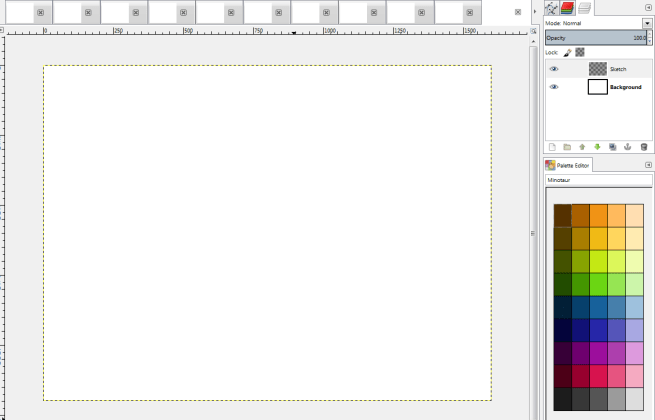
Once I’ve figured out how many pictures I want, I open up the GIMP (GNU Image Manipulation Program). There are other image editors, like Photoshop, but the GIMP is free and I can write plug-ins in Python to, for example, automatically generate any number of empty images with a white background layer and a transparent layer for sketching.

pict4comm.png

(I made a palette so it’s easy to keep colors consistent from chapter to chapter. I won’t pretend to know any color-theory, but I think my palette looks nice. I made it here.)

I sketch all the illustrations in one go; it can take a whole day. I’ve got a Wacom tablet and pen, so I can use natural hand-movements to draw on my computer. The harder I press the pen, the more opaque the line!

pict1comm.png

Then I decrease the opacity of the sketch layers and color all the backgrounds; that can take a whole day, too. I color unimportant background characters like Akayama-DanJay-style mannequins so they don’t distract from the real characters.

pict2comm.png

Then I draw all the main characters in a new layer over the background. It’s often convenient to put each character on their own layer so they can be moved independently, especially if they overlap. Finally I disable the sketch layer.

pict3comm

Pictures are especially helpful for table-war. Whenever a table-war strategy is hard to describe, I know a picture can save my butt.

But sometimes the text and the pictures disagree. I describe huge audiences but draw less than ten spectators. I’ve probably put Homer’s eye-patch on the wrong side more than once, and in the pictures he has hooves instead of fingers. Sometimes when eliding two scenes into one illustration, asynchronous events appear simultaneous. In these cases I’d argue the text takes precedence, if only because text is easier for me to edit and update than illustrations.

But as an author, can I declare how my work should be interpreted?

This has recently come into question with the latest works from J. K. Rowling and, more classically, George Lucas’ Star Wars. Is it appropriate to retroactively declare a character’s race, gender, or sexuality? Must we accept midichlorians as canonical? Who ultimately decides a work’s meaning, its author or its audience?

One of my goals in writing these commentaries is to show that authors only pretend to know what’s going on in their stories. Writing is literally just making things up. An author might plan some plot ahead of time, but that plan is just made up, too. Iterative making-stuff-up is the name of the game.

So maybe an author is the grand maker-upper whose holy word is the only authentic source of interpretation, even if their book disagrees with them. Or maybe an author’s word is worthless, because stories are ephemeral visions appearing differently to everyone and the text is the only thing we can all agree on.

When we talk about our favorite fantasies to fellow fans, we like to imagine our visions of the fiction match, or at least overlap. Hence, I’ve added some pictures. My illustrations don’t perfectly encapsulate the text, but I hope they provide a cohesive universe and showcase characters’ emotions or whatever.

Anyway, thanks for reading. If you’ve enjoyed my rambling, or you like minotaurs and board-games, feel free to follow me and catch the next update.

Next Chapter
Table of Contents

Expansion, Contraction, and Failing Faster

In Homer VS the Sea-Thing our up-and-coming minotaur wins his first match of the tournament. Maybe Homer will fight the dwarven champion to keep dwarfs bound to the treaty that limits bloodshed to table-war.

This chapter used to be 9,000 words long, and now it’s half that. Taking the effort to cut it in half hopefully improved the clarity and pacing. I can’t speak for every writer, but I’m sure we’ve all had the experience of having a High-School professor setting a page-limit (“between five and six pages” or something like that), and having trouble condensing all our ideas into so much text. I would argue this issue is fundamental to writing and, in general, creativity itself.

At UC Santa Barbara, I was a mathematician in the College of Creative Studies. I took the College’s first actual class on creativity where we learned how the creative process often follows a pattern of expansion and contraction. In the first phase of solving a problem, we connect disparate ideas to produce a variety of solutions. In the second phase, we examine those solutions and choose the best to consider further. We repeat until satisfied, alternating periods of generative spit-balling and selective reconsideration.

You can’t shoot down a bad idea unless you have the idea first. You can’t delete text until you have text to delete. First write it down, then get it right. It’s a lot easier to say “this scene didn’t turn out like I wanted” than “how should this scene go.” Fail faster.

For example, I’d like to recall the process of writing and rewriting this chapter.

First I expanded: I wrote 206 pages about a minotaur who plays war games. I never knew what would happen next in the plot, but I hit a nice rhythm and let plot points surprise me.

Then, in the process of rewriting, I arrived at this chapter. I copy-pasted 9000 words from the original file into a new file. I skimmed the chapter as it was, and, with the benefit of hindsight, it was easy to notice plot points which were never important to the story, or scenes which could be cut. The table-war between Homer and Ebi Anago was near-fatally convoluted (I didn’t know how I wanted Homer to win, so I included everything I could think of), and I surgically extracted hundreds of words to save it. In total I contracted the text by a third.

Then I expanded again. I knew eventually Centaurs would be important to the plot, so I added a scene where the gang passes through inspection entering the wild wastes.

Then I contracted again. I read the section more thoroughly and cut unneeded words and sentences. Sometimes I switched sentence order to ease the transitions from subject to subject.

This is really just a pretentious way of saying that when you edit text it can only get longer or shorter, but I still appreciate the notion of expansion and contraction. It’s a license to put words on the page even if they’re not perfect right away, knowing that you’ll circle back to beat them into shape later. It’s a license to cut anything with impunity, knowing if you’re overzealous you can fill in the gaps on the next reread.

Anyway, I hope your NaNoWriMo goes well, if you’re into that. Fail faster, fix it later!

Next Chapter
Table of Contents


The Point

In Homer Vs the Human our minotaur protagonist wins a seat in an upcoming tournament by beating Queen Anthrapas’ champion commander, Harvey.

In my last commentary I talked about the “virtue wheel,” a method of charting a story’s characters to make sure they’re varied. If you want your story to have a point, character variety helps communicate that point.

But do stories need points? Or “themes” or “meanings” or whatever?

Nah. I didn’t write the first draft of The Minotaur’s Board-Game with a point in mind; I just liked minotaurs and board-games and writing. People can write stuff for a reason, or for no reason, or without even considering reason.

But, a point can make a story directed and streamlined. A point helps me, as an author, cut unnecessary prose. Since I believe stories should be as short as possible, a tool to help me trim is always welcome. So, the second draft of my story needs a point.

What’s the point of The Minotaur’s Board-Game?

I’m not sure yet. My opinion about the point will change by the end. But I found clues in my virtue wheel, so let’s start there! Three “virtues” which separate the characters in The Minotaur’s Board-Game are

  • Physical Strength
  • Intelligence
  • Political Power

I’d like to use these “virtues” to make a point about leadership and loyalty.

Board-games suddenly have symbolic meaning. The intelligent characters reduce the strong characters into game-pieces to control their physical forms. Meanwhile those intelligent characters are controlled by characters with political power, as if the real world is a board-game controlled by kings and queens. This makes the conflicts between individuals, nations, and races more abstract, distancing characters from the implications of their actions (is it okay to take a griffon from its natural habitat just to use its physical characteristics for a game-piece?). Even without real war, this isn’t exactly a Utopian environment.

The main characters, Homer and Aria, have a flawed relationship. Homer’s a sentient animal-biped who admires and trusts Aria, but she sees him as a pack-animal she can ride to greatness. Homer is stronger than Aria, and maybe smarter in terms of pure table-war talent, but Aria exploits him. Did Homer really want to fight Harvey? Would Homer prefer living in a labyrinth? Aria doesn’t care. She hardly seems to understand him.

The most powerful person we’ve met is Queen Anthrapas. She’s old and frail, but as queen of humanity, Anthrapas is imposingly unquestionable. Is it okay for her to manipulate her subjects to protect humanity from the threat of war? If so, does that mean Aria can justify exploiting Homer because she misses being a royal commander?

The human answer to this question won’t be the same as the elven answer. I want my elves to be weird and original; they’re insect-like, with a height-based social-system, lace wings, and pheromone-based communication. Their queen enforces loyalty and leadership chemically. They even lay eggs!

Homer will play table-war with seafolk next. Whatever’s up with them, you know their society will present a different commentary on leadership.

If you’ve ever read The Once and Future King, Merlin turns a young King Arthur into animals to show him different political ideologies. I recall ants, birds, and fish among others. Similarly, I hope meeting elves, seafolk, and dwarfs will teach Homer and the reader about different possibilities for the relationship between leaders and the people they lead.

To that end, I think each board-game should present a unique challenge related to the society proposing it. Homer must invent solutions reflecting his maturing ideology.

In his first match, Homer overcame dwarven siege weapons by setting skeletons on fire and flinging them with a trebuchet, immediately after Aria told him that using skeletons at all was a faux pas. As an animal, he’s naturally shameless, and in that particular scenario, shamelessness was enough to win.

In Homer’s second match, Harvey shows humanity’s tendency to exploit strength when he replaces his falcons with the griffon. Homer punishes him by understanding the deeper connections between animals. Maybe Aria taught Homer some sympathy for other species.

In Homer’s next match, what will the seafolk teach him? Follow to find out!

Next Chapter
Table of Contents

PS. In The Minotaur’s Board-Game, animals impact their environment. Scales the ice-dragon makes its surroundings chilly. Homer the minotaur makes mazes when he’s anxious. Humans seem to live in an infinite field of rolling hills, and it’s not clear whether they live there because it’s like that, or if it’s like that because they live there. Dwarfs eat mountains from under their own feet.

I think that’s another major aspect of the point. When two individuals play table-war, they represent their nation and their race. Whole world-views are in combat, and when land is ceded, it’s assimilated into the opponent’s mode of being. The infinite field of rolling hills represents humanity’s stability. If the elves conquered some hills, I’m sure forests would grow there and soon you could hardly tell it was ever human territory at all. Understanding how we shape our environment is instrumental to understanding ourselves.

Nations/races are almost characters in themselves. They’re like amoebas with political borders as their cell-walls, whose interiors are homogeneous terrain. In this view, Queen Anthrapas isn’t a mastermind playing games with subordinates; she’s subject to the national over-mind. The scattered weapons left from the war against demons are the only true symbols of power, representing violence which can smite civilizations. Before them, an individual’s strength, intelligence, and political power are meaningless.

The Wheel of Virtue

In Homer and the Griffon Aria sells her dragonling to humanity’s royal beast-master and meets Queen Anthrapas, ruler of the human race. She’s escorted by Sir Jameson, a military recruiter.

A military recruiter doesn’t do much in this fantasy world where war is replaced with board-games. Jameson just dresses up in armor to inspire people to register as game-pieces. A new recruit has gnomes take their notes, then leaves knowing he’s done his civic duty. His avatar might be fighting for humanity even while he’s asleep!

In my first draft, I wasn’t quite sure what Sir Jameson’s purpose was. I added him because I thought Aria needed another character to bounce off; Homer doesn’t talk at all, and gnomes are sorta robotic. I actually added two characters in my first draft, but now I’ve elided them together into Jameson.

Currently, I think Jameson is a Watson-type character. Sherlock Holmes is a genius, so the reader needs Watson for Sherlock to explain things to in layman’s terms. While Aria, Homer, and the gnomes understand table-war, Jameson doesn’t, so the other characters have a reason to explain things to him, and, simultaneously, the reader.

I’ve heard amnesia is a common trope in fiction for the same reason. If the main character doesn’t remember anything, then they know exactly as much as the reader! Homer, the total newcomer to this strange world, fills that niche.

Still, I don’t want Jameson to be a boring tag-along. I already mentioned YuGiOh is a tongue-in-cheek inspiration for The Minotaur’s Board-Game, and while I’m glad to write about a fantasy-world revolving around geeky hobbies, I don’t want useless, annoying cheerleader characters like those who follow Yugi all day.

A third-wheel character like Jameson can benefit from the Wheel of Virtue. I’m absolutely butchering this idea, but the way I understand it, the Wheel of Virtue a helpful way for me to think about how characters should act. Says Noel Carroll, “some… art can function and is designed to function as a source of moral purposes,” specifically a delineation between vice and virtue. If a novel is meant to convey a message about a particular virtue, it’s helpful to have a cast of characters which accounts for a spectrum of possibilities along the gradient from virtue to vice. A story whose message is “Greed is bad, charity is good” could benefit from characters who are very greedy, a little greedy, a little charitable, and very charitable.

If the novel explores multiple virtues, we can imagine a Cartesian plot of characters on the axes of virtue and vice. If you want your book to convey a theme about virtue X versus virtue Y, say for example, “greed is bad, charitably is good, and also Star Wars is better than Star Trek“, each character should express a unique combination of greediness/charitably and fandom affiliation. This lets the text show the reader how these qualities intermingle.

Comm1.png

Says Carroll, “In literary fiction… these comparisons and contrasts… prompt the audience to apply concepts of virtue and vice to the characters, thus exercising and sharpening their ability to recognize instances of these otherwise often vaguely defined or highly abstract concepts.”

In The Minotaur’s Board-Game I think the relevant “virtues” are physical strength, intelligence, and political power. These three attributes separate characters nicely: some characters are strong (Homer, Jameson), some characters are weaker (Aria, Anthrapas, gnomes, elves). Many characters are intelligent (Homer, Aria, Anthrapas, Stephanie, gnomes) because the story demands it, but they showcase different kinds of intelligence (Homer is mute, Aria is manipulative, gnomes are mechanical). But neither strength nor intelligence make someone politically relevant. These feel like linearly independent attributes.

So Sir Jameson should occupy an untouched area of the virtue-wheel. Let’s make him strong, and not terribly intelligent, but his patriotism for humanity gives him just enough political clout for Aria to leverage. In that respect he’s sort of a human version of Homer. I think that gives him a great vantage-point to be the perfect Tristan: a third-wheel character who just gawks while the real protagonist, Homer, wins table-war.

Untitled.png

The act of actually plotting characters on a virtue-wheel might be a little anal-retentive, but the idea itself is a handy device for conceptualizing what kinds of characters are necessary to complete a narrative and convey a theme. If nothing else, I hope it helps me keep from accidentally populating my work with duplicate characters; if any two characters occupy the same role, it’s often easy to smush them together into one franken-character and maintain thematic integrity.

I hope you enjoyed reading my weirdly analytical thoughts on fiction-writing! I sure enjoyed writing it.

Next Chapter
Table of Contents

PS. Another applicable virtue might be Age, or Experience. Anthrapas is sort of Aria’s “evolved form,” so to speak.

Inspirations

In Homer VS the Dwarf Aria brings her minotaur to the market to sell him, but he proves a force to be reckoned with in a game of table-war.

In this commentary I want to talk about my inspirations for this story, and what I hope it becomes.

Although the idea of a minotaur following “twine” is obviously related to greek myth, and I feature my own twists on the typical gamut of fantasy races (elves, dwarfs), the biggest inspiration for The Minotaur’s Board-Game is the anime YuGiOh. I enjoyed the show as a kid, and while it becomes more ridiculous every time I remember it, I still look back fondly on the series with a campy nostalgia.

In YuGiOh, a boy with improbable hair is possessed by an ancient Egyptian pharaoh who’s great at card-games. He wins every card-game he comes across and saves the world with the luck of the draw. The audience is rarely worried about whether the pharaoh will win, and more eager to see how he wins.

I already spoiled this in the last commentary: Homer the minotaur will win all his table-war matches. He’s not possessed by a pharaoh or anything, but his outsider’s perspective will let him surprise his opponents. I don’t think there are so many table-war games in this story that the reader to get bored of seeing Homer win; I hope the reader will be eager to see how Homer turns the tables, and yet still be surprised when he does.

One major joke regarding YuGiOh, among people in the know, is that the characters basically ignore the card-game’s rules. Occasionally YuGi’s catapult-turtle launches Gaia the dragon-champion at his own swords of revealing light, or whatever, warping the rules to give our protagonist a win. I hope to sidestep this by making up my own game, table-war.

Table-war has few, if any, explicit rules. The gnomes, impeccable machine-creatures, arbitrate each match with their own undisclosed guidelines meant to recreate real life. This way I get to focus on the back-and-forth of combat instead of worrying about a concrete set of rules and whether my characters are following them. The structure of the game is based less on YuGiOh’s hand of trading cards, and more on Warhammer 40k’s table of miniatures; I’ve never played 40k, but its tiny warzones are a striking image.

Another inspiration is The Turk, a book about a 1700’s clockwork machine which played chess. Spoiler alert, it was a hoax: someone hid under the table and directed the machine’s movement. Today we’ve got Deep Blue and other powerful computers which can whup humanity’s ass at chess and basically any other board-game, but a clockwork machine is a still great symbol.

My original conception of this story would have Homer, the minotaur, forced into a box to operate a Turk-style table-war machine. Sort of a Pixar’s Ratatouille thing. I still like this idea, and maybe I’ll return to it, but I’ve decided to have Homer fight against a machine in the final chapters; he’ll face a The Turk/Deep Blue style robot to prove that his unique, creative perspective is more valuable than pure computational power.

Another inspiration is modern warfare. Long-gone are the days of trenches; today we have drones and satellites which abstract war, and the internet delivers propaganda at light-speed. Likewise, in my fictional world, there is no actual war, just table-war. No one dies in battle; their game-pieces die, and the real person they represent probably doesn’t know or care. Rather than diminishing the effects of war, I hope table-war lets my fantasy setting comment on the nature of leadership in our modern era. How do you command people? How do you relate to people you could send to die in your name?

Still, in terms of what I want the story to achieve, I mostly want to have fun writing, because I enjoy writing and I think it’s neat.

But besides myself, who am I aiming the story toward? Honestly, I’m not sure. I hope the story is appealing to all age-groups, but I think I’m writing for people not much younger than me (24) of any gender. I’m minimizing the swearing and adult themes, so maybe I could claim it’s for young adults and teens.

Anyway, thanks for reading. If you’d like to read more, check out the table of contents or follow my site to receive emails whenever I update.

Next Chapter
Table of Contents

And More

In Chapter Z. The End Professor Akayama delivers a last diss to the Enemy Hurricane before returning to Earth and dissolving into Earth’s population.

Thanks for reading Akayama DanJay. I enjoy writing in my free time, and I feel more fulfilled having done it in an area where people can pop in and check it out, and read commentary where I try explaining what I’m on about. It’s also nice to say, “Hey, visit AkayamaDanJay.com!” and have people say, “huh?” and then I spell it out and maybe they check my website later, if they remember.

I’ve learned a lot in the last year and a half or so, and it’s time to move onto new projects. I hope you can join me in breaking new ground. Here’s my plan:

I’ve made a new website called Ted-Writes.com. This will be easier to tell people about than AkayamaDanJay.com, because I won’t have to say, “well, it’s two characters’ names, except it’s really sort of two-and-a-half characters’ names, see…” The new site will be a hub for all my stories and whatever other projects I assign myself. I’ve moved Akayama DanJay onto the new site, in the new order I mentioned before, but I’ve already planned out the next novel-length-work I want to write:

The Minotaur’s Board Game will be a fantasy adventure about a minotaur who escapes his labyrinth only to be embroiled in political conflict. He’ll prove naturally talented at the tabletop-war-game which has replaced actual war, but this only secures his position as a pawn to his superiors. I mentioned this story ages ago because I wrote the first draft before the first draft of Akayama DanJay, and it’s been sitting in my mind ever since. I think I’ll enjoy returning to my weird takes on fantasy races like elves and dwarfs, and the twists and turns of each board-game the minotaur must win.

I’ll be sad to leave Akayama DanJay behind. I’ll admit, sometimes I’ve felt like a Dan agonizing over a Beatrice, but today I feel more like a Jay content with his Faith. Now that I’ve written it out and gotten it all off my chest, I feel connected to the world in a broader sense. Professor Akayama taught me what I needed to know, and now I can move on to prose which is more commercially viable, maybe.

Which isn’t to say I’m leaving Akayama DanJay behind for good. I think I’ve got a totally enjoyable story here, it’s just difficult to imagine marketing my novel about drug-addled hipsters who merge with an anime robot. Maybe I’ll redo the art and compile the whole thing into an e-book people can download off Amazon. Or whatever. Stories are never finished, the writer just decides to let them go.

Thanks again for joining me. I’ll probably have the first sections of The Minotaur’s Board Game ready to read by the end of September. I hope to see you there!

Table of Contents