
Stepping on Toes

In F2: Religious Ceremony Michael leads Jay and the others on a tour of the second island. Since this section includes parallels to real religious activities, let’s take the chance to discuss borrowing from other cultures appropriately.

It’s said that good artists write but great artists steal. Sometimes this is true, but stealing elements of a culture wholesale without careful consideration is just appropriation. Of course, it’s possible to write great stories in foreign countries, using real cultures—but such stories require planning, and you can bet their writers were conscious of the concept of cultural appropriation. To see what happens when the writer is lackadaisical, let’s look at my own first draft.

In the first draft of Akayama DanJay, Jay didn’t go to the Islands of Sheridan. He went to Tibet. Instead of witnessing a nest of eggs surrounded by bird-worshipers, Jay visited a temple where monks contemplated a statue of the Buddha. Virgil Blue’s monastery was in the foothills of Mount Everest. These are well-known images, and I could have convinced myself to keep them. I could have decided making a new area was too difficult, or using Tibet’s status as a religious site would lend the story authenticity. I could have kept the Buddha statue, pretending it’d make my story resonate with Buddhists.

But I drew the line at Mount Everest. Mount Everest has hugely religious connotations in Tibetan culture. If Akayama DanJay sidestepped religion, or if Jay visited a variety of holy areas, that might be fine, but since I’m relating religion to giant anime space-robots, I decided not to lean on Tibet. Using Everest in the context I’d planned might be offensive, and referencing figures like the Buddha just complicates the messages I’m sending. To tell my story, I needed to build a proprietary location from scratch.

To make Sheridan I considered two things: what do I need in a location, and how many different cultures can I draw from?

Akayama DanJay requires hills, mountains, and clouds. Sheridan must be mysterious, so its remoteness was a matter of course. I also need the whole tour group to be stuck together. I moved Sheridan from Tibet to fictional islands at Point Nemo, the most remote region on earth, in the middle of the ocean.

I knew I would still reference real-world religions, as there’s hardly a way around that. To prevent inappropriate appropriation I decided to mix so many cultures Sheridan could hardly be seen as disparaging any one of them in particular.

Sheridan’s first island echoes real tropical tourist traps with its commercialization of culture. They package their religion and sell it to tourists in the bazaar; you can’t take pictures of birds, but you can buy facsimiles. Michael and his brothers Gabriel and Raphael are named after Archangels. Michael’s wife Anaita is named after an ancient Middle Eastern goddess, because I couldn’t find any girl Archangels. Michael’s populous, highly structured, and economically empowered family leads the charge in profiting off tourism—supporting the commercialization of their religion. They are like a massive church which has lost its bearing, maintaining only meaningless structure and rules. Meanwhile the fourth archangel Lucifer is represented by Lucille in LLHST.

Dante’s Inferno is obviously present, as the tour takes a ferry from one island to the next and we’ve heard from Anaita there is a second ferry, paralleling Dante’s trips across the rivers of Hell. I don’t think anyone is offended by allusions to Dante’s Inferno; it’s omnipresent in culture.

The islands themselves are clearly the Gardens of Eden. SherIDAN is a tropical paradise-on-earth allegedly created by the Almighty Biggest Bird, who gave some very specific commandments. We know there used to be snakes here, as well. By combining Dantean structure with Eden-like imagery, I hope to convey gradations of religious meaning. If Eden represents God’s ideal for humanity perverted by sin, then Sheridan shows how the superficial elements of God’s message can be packaged and sold to the masses while maintaining a beacon of real, sacred truth (atop the mountain, protected by clouds). To get from the superficial truth to the real ultimate truth, one must undergo training with Virgil Green on the second island. But dare to sneak a peek at the peak, representing the holy light of the ultimate knowledge of the LORD, and you and your possessions will be utterly annihilated—a reminder to be humble. I doubt people will mind allusions to Eden, and I think my Dantaen take is rather fresh.

To transition the reader from the commercialized religion of the first island to the real but surreal religion of the second, masked dancers appear in the forests. The dancers may remind the reader of all sorts of groups: Native American, African, and Australian aboriginals all maintain masked dancing festivals. This might be a touchier practice to borrow, but as long as I don’t specifically reference any particular group, I think it’s a great way to relate Sheridan to primal and powerful imagery.

The Tibetan monks sitting in stereotypical solemnity before the Buddha are replaced by students who sometimes sit around a bird and who sometimes walk in a circle. Supplementing real religious practices (like seated and walking meditations and chanting) with surreal imagery (like an eight-foot pink tropical penguin) ensures my monks are identifiable as spiritual, but simultaneously inoffensively generic and strikingly unique.

The students are led by Virgil Green, a black man with a white beard in a green robe who chased the snakes off the islands. A recognizable and undiluted splash of Ireland distinguishes Sheridanian monastic culture from any other. It also meshes with what we know about the Sheridanians: they worship birds, they must hate snakes. I considered naming him Virgil O’Sean, like Virgil Ocean, but Virgil Green will work for now.

The inclusion of hallucinogens could potentially be problematic. I wouldn’t write a story about people tripping on Ayahuasca, for instance, because that’s a real plant with real religious connotations. I think bugs are the perfect substitute: putting bugs in your mouth is gross, and smoking them just seems worse, so they should instill within the reader a sense of religious taboo without directly referencing existing religions. In America anti-smoking campaigns are so drilled into us as children that cigarettes and bugs can be thought of as occupying the same level of our abstract mental hierarchy of do’s and don’t’s. Plus, birds eat bugs. I’ll bet the Sheridanian Big Birds could swallow a centipede.

The islands we’re exploring are meant to convey meaning without stepping on anyone’s toes. Rather, I step on so many toes that the pressure is dispersed between them. I hope my use of other cultures allows my story to tap into universal themes, rather than alienate readers.

The red card-stock pamphlet suggested featherprints from the Biggest Bird’s act of creation could be seen in all cultures and religions; therefore Akayama DanJay’s end-goal is to re-contextualize the concept of religion as a lingering memory of epic cosmic events featuring giant anime space robots and giant birds. I think universe-sized anime robots are the perfect vehicle for such galactic battles as those in Paradise Lost and the Bhagavad Gita. We’ll talk about those when the time comes!
Next Section
Table of Contents

Real-World Economics

In F1: Local Cuisine Jay and his tour group eat at a restaurant owned by Michael’s family of 28. This family wields some economic clout, which makes Jay consider the cultural on-goings of the island.

When we read the red card-stock pamphlet, my commentary explained my views on world-building. I noted that if a fictional world is too far removed from feasibility the reader may be taken out of the story. On the other hand, if a fictional world borrows too much or handles borrowed topics without cultural tact, the work can come across as offensive or derivative. Today let’s talk about making a realistic society; we’ll leave cultural sensitivity for next week when Jay meets Virgil Green.

Real places have certain concerns which fictional places should address for authenticity. These concerns include basic things like food, currency, and transportation infrastructure. Including these details in fiction makes cultures seem like they continue when the reader is not present, instead of being backdrops which readers can ignore. There are lots of other things along those lines to consider (like housing. Where do people live? and sewage systems. Where do people do what bears do in the woods?) but a little bit well-conveyed goes a long way.

Think about Harry Potter. The characters interact with magic food, golden coinage, and awesome means of transport. A reader never need ask what Harry eats or how he affords his schoolbooks or how he gets to Hogwarts. These worldly details are woven into the story. These are the elements which truly capture us when we read J.K. Rowling; train station 9 3/4 and Ron’s Dad’s flying car are some of the most memorable modes of transport in any medium. It would be possible to write a story about a magic school without these details, but including living candy and a lunch hall where food mysteriously appears on tables, prepared by house-elves, conveys a broad and interconnected world behind the scenes.

In this section of Akayama DanJay, Jay photographed a crescent-shaped Sheridanian pastry with lettuce, carrots, grains, coconut, and goat meat. This serves many purposes: it tells the reader what kinds of food are available on the islands; it reemphasizes Jay’s journalistic goals; and the pastry’s crescent shape kicks off a series of moon images which will signify increasing religious importance. Multilayered meaning is invaluable for making every scene count. Now readers understand this is an island culture with goats rather than pigs or cows. They are primed for Jay to take more pictures. Those looking for symbolism are ready to find more moons.

Currencies morph to suit their context. Native Sheridanians use sand-dollars while accepting foreign currencies. This combines real-world seashell currencies (like cowry and bead-necklaces) with a foreigner-friendly system of exchange, perfect for a tourist trap. The airport, restaurant, and bazaar expertly separate travelers from their money; when shoppers receive change, they can only spend that change in Sheridan, like theme-park fun-money. It’s a sad fact that many tropical paradises are packaged and commodified for tourists; on Sheridan even the religion is auctioned off bird by bird, feather by feather. The first island is a glorified gift-shop.

Michael’s family seems to lead the charge against unspent cash. While Michael and six of his brothers make a killing running continuous tours, his other seven brothers are chefs. Their fourteen wives are waitresses and landlords, catering not just to tourists but also to airline workers, pilots, and bazaar merchants. The island economy’s gears mesh tooth-to-tooth with the arrival of airplanes, and Michael’s family of 28 is at its head. I hope this provides an acceptable explanation for the island’s economic workings, and conveys a cynical but practical view of nepotism.

But where do all these people live? Some live in Michael’s restaurant’s apartment, but it couldn’t hold a whole bustling bazaar. We’ll see that most of them live on the main island. Merchants arrive by ferry to work in the bazaar, then return the same way. Some merchants might commute every day to peddle their wares to tourists arriving and departing. Some merchants might come only once a week to sell the goods they’d made in the intervening time. I won’t spell out the whole ordeal; I’ll let the reader follow Jay on one of these ferries and the rest of the island’s transport infrastructure will be implied.

In this way, Sheridan insulates itself from the tourism which turns its economy. The commercialization is minimized by outsourcing it to the smallest island, so the embarrassing bazaar of prepackaged culture does not spread. The tourists themselves will visit the other islands, but Sheridan has clearly pushed its false face up to the airport to practice genuinely in relative privacy.

I hope the world-building so far seems realistic. We know what Sheridanians eat, what money they use, and how they get from island to island; that’s a good starting point for understanding any anthropological group. Moreover, the operation of the first island’s economy reinforces some of Akayama DanJay’s religious themes.

Thanks for reading! Next week we’ll see how I try to mix cultures to make something original. Keep eating your worms!

Next Section
Table of Contents

Playing with Fire

In E4: Touchdown Jay arrives in Sheridan. The loud man from the plane keeps up the volume waiting in customs, interrupting Jay’s conversation with two well-traveled Chinese-speakers. The loud man, in his dark sunglasses and Hawaiian shirt, notices that their Chinese Atlas uses swastikas to represent temples. Let’s look at how I try to treat controversial imagery with tact to emphasize my theme. (And if you don’t like how I handled it, yell at me in the comments, or whatever.)

First, a little history from the United States Holocaust Memorial Museum. The swastika is at least 5,000 years old, dating back to the invention of writing itself. The word ‘swastika’ stems from Sanskrit, and the image was a mainstay of symbolism in Hinduism, Buddhism, Jainism, and Odinism (the religion of the ancient Norse). The symbol was common throughout pre-Christian Europe.

In the late 1800’s archaeologist Heinrich Schliemann noticed the symbol in the ancient city of Troy, near modern Turkey. He compared it to similar markings on German pottery, and thus was found an icon for German ultra-nationalism. It was swept up by the Nazi party, who believed Germans were the descendants of the Aryans.

(In the time between the swastika’s rediscovery and its use by the Nazis, the symbol enjoyed some mainstream use as a good luck charm. The French Lafayette Escadrille used one in the insignia for their WWI flight squad.)

The USHMM ends their brief history by noting that “despite its origins, the swastika has become so widely associated with Nazi Germany that contemporary uses frequently incite controversy.” As a symbol for the atrocities committed by one of Earth’s most legendarily cruel regimes, even mentioning it in Akayama DanJay might make the story taboo in Germany, where displaying the swastika is illegal. (Allowances are made for education and satire of the Nazis, but in general such imagery is taken quite seriously.)

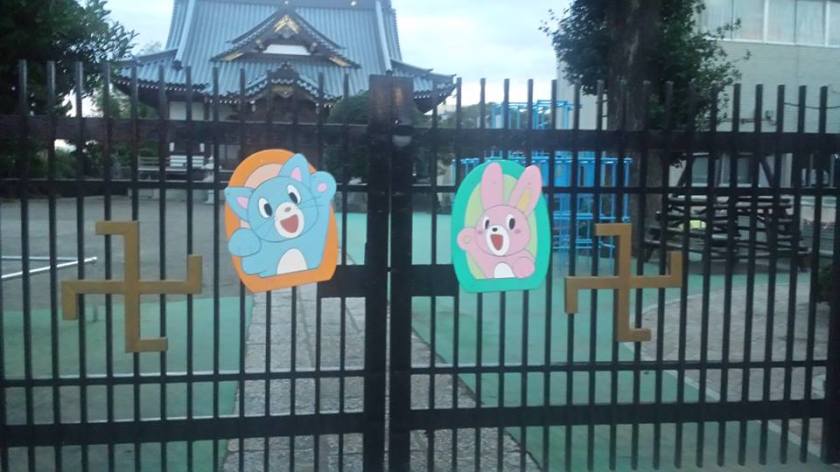
So you can understand why I was caught off-guard by this temple for toddlers in Japan:

10986672_1145829992097104_733232371050964146_n

In recent years Japan has started to limit the number of swastikas in public places, particularly on maps where unknowing tourists might take umbridge. I’d seen the symbol on maps before, but I’d never seen it displayed so prominently and so near Tokyo. It left me shaken, and amused by my shaking. The cartoon characters between the swastikas produced a cognitive dissonance which made me reconsider the psychological foundations of symbols and meaning.

In Akayama DanJay, the loud man with sunglasses asks the Chinese-speaking tourists why there are swastikas in their Atlas. They give several traditional answers. The loud man—whom we will learn is named Henry—turns to his wife and tries to press one of their points onto her. She ignores him, and Jay takes the first opportunity to leave.

By comparing how multiple characters interpret the symbol, and how they try to explain it to others, I hope to use the swastika appropriately to express an idea. On one side of the spectrum is the Chinese couple with the Atlas. Li Ying doesn’t even realize that a cultural miscommunication has taken place when Henry observes the swastikas. Zhang realizes and tries to clarify the use of the symbol. Jay, sitting literally and culturally between the groups, immediately sucks air through his teeth. He sees to the heart of the situation right away, beyond even Zhang’s understanding. Jay knows Henry is feigning ignorance of the swastika. Henry is quite quick to defend the symbol to his wife, who ignores him like she’s heard it a hundred times before.

The Chinese couple clearly represent the old, traditional understanding of the swastika, while Henry represents the modern bastardization eclipsing tradition. What else do we know about Henry? We’ve actually known him since B2: he’s the student in dark sunglasses, and the boy who sold Faith a cricket. In his first spoken line he tells his teacher he could make money selling crickets because they “get you totally bug-eyed.” By D3, now in his late twenties, he’s become the kind of person we’ve all had to sit next to on an airplane whose obnoxiousness made the flight feel twice the length. He dismisses his wife with the phrase “Chicks, am I right?” and seems creepily interested when Jay mentions drugs. He says “guys like us, gotta stick together,” presumably referring to those drugs. And in this section, he’s awfully amused by swastikas.

Henry represents the recent swell of ultra-toxicity in American politics. I’m not talking about Republicans, or conservatives, or Libertarians, or whatever (I’d argue calling him any of those things is falling for his con). I’m talking about edge-lords who might call themselves basically anything to disguise their scorn for human decency and diversity. (EDIT: I wrote this before the white supremacist rally in Charlottesville, VA, but it shows the cultural timeliness of Henry as a character.)

Henry is a misogynistic drug-smuggler who doesn’t know when to shut up. He is enamored by the swastika for its mere power to upset people, and anything he could learn about the symbol’s humble history would only make him more proud of his tattoo. Call him a straw-man if you like, but I’d call him a caricature. He’s an effigy, an object made to be sacrificed.

In Dante’s Inferno, Dante meets real-life political figures from Florence. Through their conversations, Dante scathingly criticizes them, their parties, and their religious beliefs. Dante uses this to present his views on contemporary political drama. He even meets someone who was still alive at the time of writing, claiming their sin was so heinous a demon took over their mortal form and their soul was dragged to hell before they died.

Although I’m trying to avoid naming real-world figures, you can’t write an Inferno allegory without punishing a sinner really condescendingly. Just as Dante criticized ancient Italian politics, so must I tear into today’s. At least I’ve had the courtesy to limit myself to one amalgamated straw-man instead of pointing fingers.

So, while Jay and the Chinese couple understand the multifaceted meaning of the swastika as a symbol which must be handled carefully depending on the circumstance, Henry is proud to see the swastika in this ‘appropriate’ context because it validates a symbol he venerates in other contexts. He immediately tells his wife Eva how popular the symbol is, but she keeps reading to their daughter. Eva has undoubtedly heard him prattle on about this for years, and she’s decided to inoculate her daughter with literacy.

How does Jay react to the situation? When Henry first points out the swastika, Jay inhales sharply through his teeth. It’s like he’s reacting alongside the reader as I play with fire: “Is this really the direction we’re going?” He says nothing during the discussion and leaves as soon as he is able. Remember, in the last section, Jay put on headphones and hummed to avoid talking to Henry. How long can he keep up this up?

Not so long, if his dream sequence is to be believed. In his dream, Jay began at rest atop a dune. Rather than descend either side, he ran away along its crest. But doing so caused the dune to collapse.

In this section, Jay finds himself caught between the Chinese couple and Henry, and chooses to abscond when the conversation turns for the worse. Now the world must collapse around him, leading to metaphorical free-fall.

In his dream, how did Jay escape this situation? By realizing he was dreaming, of course. To resolve the perceived issue of interpreting the swastika, Jay must mentally free himself from the epistemological chains binding meaning to symbols. Then no force will hold power over him and he can change the game.

In terms of overall theme, this should remind readers that the Nazis were not horrible because they appropriated the swastika. They were horrible because they committed atrocities. Nevertheless, Henry’s feigned ignorance of the swastika reflects poorly on him. To Jay, who sees through that feigned ignorance, the tactic makes Henry appear immature, insufferable, and maybe dangerous. In this manner we see the value of symbols despite the subjectivity of the meanings attributed to them: as humans, we choose which symbols to associate ourselves with and which symbols to distance ourselves from. Those decisions align us into groups. To feign ignorance of a widely known, controversial symbol might align one with the unsavory group it represents in the eyes of all who know better.

Next Chapter
Table of Contents

Things Not Shown

A common phrase in writing is “show, don’t tell.” Sometimes “not showing” can be even more powerful than “showing” OR “telling.” Withholding information from the audience is a tactic famous in the horror genre but effective for storytelling in general.

In E2. To the Airport we don’t see any mourning for Beatrice. She was hit by a bus in C4, but Jay and Faith didn’t notice because they were in another dimension. When they returned, Dan didn’t tell them what happened to Beatrice. He finally broke the news by cutting a cupcake into thirds instead of fourths. We didn’t get to see Faith or Jay’s reaction.

Instead, E2 begins with Jay telling his mother about Faith staying indoors and bawling for weeks. Then Faith drives Jay to the airport, showing the reader how she’s recovered. She’s feeling better, but Beatrice’s death still weighs heavily on her and Dan.

There are three reasons I decided not to show Faith’s full reaction to Beatrice’s death:

First, it moves the plot at a brisk pace. I couldn’t describe weeks of depression and recovery without slowing down the story and boring the audience. I instead ramp up the tension by killing Beatrice in B4 and drawing out the reveal until E1, and even then making the character’s reactions a cliffhanger. I then make Jay allude to weeks of depression and recovery, and have his mother react sympathetically. The storm brewed and passed, and the heroes continue their journeys in its aftermath.

Second, withholding that information from the reader forces them to imagine Faith’s reaction for themselves. We know how distraught she must have been at the death of her girlfriend, but without the details, we must imagine her emotional state for ourselves. This is a staple of great horror movies: what the viewer can see isn’t nearly as scary as what they can’t. I hope it works for tragedy as well; by withholding the reaction, I force the reader to react instead.

Third, Faith is meant to be a perky, happy character fueled by inexhaustible childlike curiosity. This doesn’t mean she can’t be sad or angry (in fact, her even temper means her scenes of sadness and anger stand out). But readers understand characters through their actions; if I showed Faith’s period of loss and mourning, a reader might get the wrong impression of her. They might remember her as “the one who was crying,” or “the one whose story is about missing her girlfriend.” She chose to stay indoors, in privacy, so her friends would not see her moments of weakness; likewise, the reader cannot see her either. Faith won’t allow herself to be pigeonholed by one scene of tragedy. We’ll let the tragedy be implied.

With these points in mind, refraining from revealing information to the reader has two almost contradictory results: Faith’s period of mourning is amplified by the reader’s imagination, while simultaneously she escapes being labeled as a tragic character. The reader understands that Faith has been dealt a blow, but also that she can recover. I hope I’ve handled the restriction of information well enough that the technique is effective.

As she drives Jay to the airport, we learn Faith has been painting. Creating art is a good way to deal with emotions in a healthy manner, and Faith has been associated with art before (like in B2and B3), but because of Beatrice’s death Faith’s artistic inclination suddenly seems more earnest. Without Beatrice, Faith falls back on art. It is her solid foundation. Art is the grandchild of God, says Virgil in Dante’s Inferno.

Also notice that Faith helps Jay. Not only does she drive him to the airport, but she also offers him hygiene products if he needs them. (He doesn’t, but this is another chance to remind the reader Jay is trans. I don’t want to focus on that aspect of his identity too much, but I think this moment humanizes both characters.) Faith is always looking for ways to help. She guided Dan in the afterlife until he decided to gamble his soul away. She taught Jillian how to smoke. She put up with her uncle when he was rambling about some conspiracy theory. She even came early to the centipede-smoking-party to ask Dan to keep his distance from Beatrice. She is the glue that holds the group together.

Finally, she gives Jay an envelope containing a card with her art and an original sketch. There are a lot of papers passed around in this story: Dan gets his Eternity Card from Anihilato. Jillian gets a flier from her teacher and studies a map in a pamphlet at the museum. Faith first sees the Sheridanian birds in a brochure in her uncle’s truck, and then receives a red card-stock pamphlet from Jango. Now Faith passes Jay an envelope. Why?

Well, the card in the envelope features art she made after Beatrice’s death. By giving away the fruits of her grief, she shows how she has overcome that grief—or, at least, that she’s on the way. Her struggle made her stronger.

She also says not to open the envelope until after customs, which suggests there are drugs inside. In A1, Dan got a cricket from Jango and then went to the afterlife. In B3, Jillian got a cricket from Faith and then watched an episode of anime. In C4, Dan teaches Faith and Jay to smoke centipede and they spend a whole chapter in the great beyond. The passage of drugs from one party to another leads them into a new world. Here, Faith is ushering Jay towards Sheridan with a gift. More parallels, a la D2’s commentary. And, it offers another perspective on the transaction of papers and pamphlets already discussed.

Next week Jay entertains himself on a plane flight, and I’ll tell you nice folks about JoJo’s Bizarre Adventure. See you there! Keep eating your worms!

Next Section
Table of Contents

Crafting a Culture

In E1. The Red Card-Stock Pamphlet Jay reads the pamphlet Faith got from Virgil Skyy. He’s still hallucinating, so he interprets the pamphlet’s religious message as a command to visit the Islands of Sheridan. In Chapter F, we’ll travel Sheridan and learn about the people who live there. Until then, this red card-stock pamphlet lays the groundwork for world-building.

World-building means making up cultures, places, and peoples for the universe of a fictional story. Good world-building can mean the difference between boring characters against copy-pasted backdrops and interesting characters who interact with fleshed-out areas and ideas. Some triumphs of world-building include Harry Potter and The Lord of the Rings. If anything, Harry’s rivalry with Voldemort is an excuse to give the reader a tour of Hogwarts. Lord of the Rings is just a jaunt across a continent so J.R.R. Tolkien can make readers witness his linguistic inventions.

The common element of stories with great world-building is the interaction of the fictional setting with the themes and plot. Hogwarts changes as much as Harry, sometimes a safe haven and sometimes a war-zone. Tolkien’s linguistic efforts built the elves and dwarves we know today and sent them on a quest.

In Akayama DanJay, the Islands of Sheridan are remote to reflect their reclusive, mysterious, and thematically significant religious traditions. For the same reason, in section A1, I show the islands only briefly before focusing on furtive monks. In B2 Jillian’s teacher warns of secluded islands where crickets grow. Until Virgil Jango Skyy reappears in C1, all we know about Sheridan and crickets and centipedes is hearsay. Even Jango is tight-lipped, refusing to tell Faith a story about the Biggest Bird because she is not a monk in C2. These details make Sheridan seem a secretive place with mysteries to solve. The reader does not know what to believe yet, but should be eager to learn more.

The pamphlet provides the reader with concrete details about the islands, but Jay’s mental state means we can’t trust what he reads. Even if we could, it’s still surreal and raises more questions than it answers. Is the Biggest Bird the same creature as the Heart of the Mountain? Is “the Mountain” the mountain Jay and Faith saw on their drug trip? If so, why did the bird make Sheridan, and why did it leave? What’s its plan? Who is this Nemo person, why were they named Virgil Blue, and why do the islands follow Virgil Blue’s word? Why are the three commandments such random things like “don’t eat centipedes” or “don’t take pictures of birds,” instead of normal religious commandments like “don’t steal” or “don’t murder?”

These are questions the reader might ask themselves, and therefore it’s my responsibility as a writer to make sure most of them are answered. Every domino I set up should be knocked down. Anything which occurs in a story but does not contribute to the themes and plot of the story should be cut, even world-building work the writer is proud of. Make each big element of your world impact the story at least three times: when it’s introduced, once again as a reminder, and one last time as a resolution to some conflict, a payoff.

In Akayama DanJay, Jango mentions the Biggest Bird in a conversation to Faith, but refuses to tell her its story. Then Jay and Faith meet a big bird, and Jay reads about the Biggest Bird in the pamphlet. On the islands we’ll see more reminders of the bird’s presence and influence in worldly events. Eventually we will see its story firsthand, and it will answer some long-lingering questions.

Smaller details might not need to be repeated as much for impact; they may be set up and then later called back for a payoff, or a punchline. In this pamphlet I mention several religious sects who will appear along Jay’s journey. I’ve set them up, Jay will interact with them for the payoff, and the reader won’t mind if they don’t appear again.

So world-building can be fun, but a dedicated writer should make sure it’s in service to the story. There’s another concern which I’ll address in more detail as we see more of Sheridanian culture:

In crafting a culture, one must be aware of cultures in real life. If a fictional society is too far removed from feasible real-world cultures, it may ruin the readers’ suspension of disbelief. Too closely copying a culture will make the writing appear lazy, if not offensive. In the case of Sheridan, I’m trying to make a religion which reminds readers of real religions without stealing those religions wholesale. On these islands exists a complex ecosystem of practices borrowing from island cultures and multiple varieties of monasticism, Christian and otherwise. Maybe I’ll discuss specific influences as we see them.

Meanwhile, thanks for reading! I’m having a great time writing and talking about my process. Next week, let’s see how leaving out details can increase the impact of events. Keep eating your worms!

Next Section
Table of Contents

Scene Transitions

In D4. The Man on the Mountaintop Jay returns to the realm of the living. The way he finds himself back on Dan’s couch demonstrates his still-altered mental state: he transitions from looking outward at a man in the sky, to looking inward at an anime robot on his own T-shirt. If I handled this transition well the reader should feel just like Jay, adrenaline rushing as they remember their location, like waking up in a hotel room. Maybe they’ll reread the paragraphs to take in the magic trick. Like a cinematographic dissolve, this transition aids the flow by moving the narrative while subtly contributing to the themes of the work overall. There may be spoilers for Akayama DanJay ahead, so be warned!

A scene transition can be notated with one of these things:


That line’s a hard break. Maybe the point of view and setting change over that line. A line like that makes a nice place to put a book down and take a breather. Gotta digest the last scene before moving to the next.

That’s precisely the reason I couldn’t use a line to bring Jay back to our world in D4. I didn’t want to allow the reader that pause. I needed to thrust the reader bodily across dimensions. The reader must be as shaken as Jay so that his actions make sense: of course he’s not acting perfectly logically, his world is dissolving around him!

Abstract transitions like this, from one subject to a related subject so quickly that the two concepts fuse in the audience’s mind, are perhaps most popular in film. Directors must carefully choose how to thread scenes together using cuts to transition the viewer from the previous scene to the next. The connection between scenes can be subtle, or it can be emphasized for shock. In a boxing movie you can bet a conversation will be cut short by a shot of a ringing bell. In comedy the Gilligan Cut can draw a cheap laugh: just show a character saying “I’ll never to that!” and then show the character doing that. These cuts can reset the setting, tune the tone, and imply connections between the scenes they combine.

So what does Jay’s transition say? Aside from the way it whisks the reader around, what does it contribute to the piece?

Jay sees a man in the sky. Such a cosmic man should be a deity, or a God. In a Dante’s Inferno allegory, God must be an important figure. Jay is communing directly with the upper echelons. But the godly figure is not in the sky. Jay is actually looking at his shirt. He’s looking at his own chest—inside himself. This transition, and the way I’ve avoided the hard line,


directly shows Jay’s internalization of higher power. Dan died an incomplete person, and his incompleteness drove him to Limbo. Now, reborn as Jay, he contains the celestial whole. He is complete and self-contained. He has traveled to another world and retrieved a symbol of inner holism, and he’ll only get stronger from here.

Moreover, that God turns into the robot on Jay’s shirt—the Zephyr, from LuLu’s Space-Time Acceleration. Eventually we will learn there is literally a giant anime robot in space. The reader won’t get to call bullshit; I’ve spoiled the ending for them with this transition. They should have seen it coming.

Have you seen 2001: A Space Odyssey? In the beginning a monkey throws a bone into the air and it becomes a spaceship, through a jump-cut. It whisks the reader through time and space, implying all of human evolution in an instant. I’m sort of attempting the reverse: a space-man becomes a shirt. It’s one last call of the extra-ordinary before we return to the normal world, giving the reader a taste of what’s to come.

‘Till next time, don’t forget to eat your worms!

Next Chapter
Table of Contents

Anxiety and Panic

In D3: She Has Arrived the new Zephyr is flung into the Mountain. This causes a quake which breaks both Jay’s knees. His knees quickly right themselves, but the psychological impact dealt is devastating. Like Beatrice says in C4, panicking is the worst option on a psychedelic. On centipede dust, panicking leads to the Teeth that Shriek.

As a writer who grapples with issues like anxiety and depression, I find the conflicts in my stories reflect my mental state. In high school, when I worked 14 hours day to keep up with frankly inhumane homework expectations, I wrote a short story about Hercules fighting a multi-headed hydra. When the hydra died, two more hydras appeared. It turned out their tails were connected to a meta-hydra, and whenever one hydra died, two hydras would grow from the meta-hydra. Hercules had to kill the meta-hydra. But having done so, four more meta-hydras appeared. There was a mountain-sized meta-meta-hydra, whose neck birthed four meta-hydras each having hundreds of hydras. Hercules hung himself. I find that especially depressing in retrospect, as Disney’s Hercules was my childhood hero. Somewhere along the way I lost my faith.

During my next project I was taking antidepressants. I wrote a story about a world where recreational drugs were replaced by arcane rituals which also summoned monsters. Some monsters were harmless, but some monsters were huge, dangerous beasts. The main character was a woman who hated these monsters and the people who made them. She joined a group which fought those largest monsters. Injured in the line of duty, she turned to making monsters herself as painkillers. Soon she was addicted. It turned out these drug-monsters were sent by an extra-dimensional deity called the Skull God, who needed humanity to be addicted so he could infiltrate our universe.

After the first draft, some kid shot a bunch of people near UCSB, where I study math. I felt affected by the shooting and didn’t really have anyone to talk to, so the second draft made oblique references to the event: the Skull God was more needy and pathetic. His lines were drawn from the shooter’s manifesto, and when the main character decapitated him and beat his skull to dust, he moaned and cried about having been the supreme gentleman.

In college my workload decreased, but the competition between the students increased. I wrote a story about a man who must win a hundred mile footrace against a horse. By the end, both man and horse were bloody and hallucinating, barely able to lurch forward. The horse’s rider was a cruel man who used any tactic to drive his animal on, leading to its collapse just before the finish line. The main character crawled across the finish line with a torn knee.

For a lot of college, I felt lonely and misunderstood. I wrote a story about a minotaur whose experience escaping a labyrinth helped him excel in a game like chess. The surface world made him a political pawn, having him play the game against ambassadors as a demonstration of military superiority. The main character, a woman who used to be the world champion of the game and a respected political figure, initially reared him to be that pawn. But by the end she learned to appreciate him. When he hid in a labyrinth, she came after him. She found him when no one else could, or even tried. With her help the minotaur made a political statement not just for his home country, but also for other groups of mistreated fantasy animals.

Of course, in The Bucket, alcoholic chemist Arnold vomited up extra-dimensional being Trip. Trip needed Arnold to keep drinking and vomiting to take over our universe. I’m not an alcoholic, but when I learned to really drink (in Japan), I saw how alcohol dependence could affect a person. The Bucket shows my interpretation through Arnold’s struggles appeasing the monster he hurled into a bucket. This marks a turning point for me: I didn’t write about alcoholism because I was dealing with it. I chose the theme purposefully. Addiction is powerful and universally understood.

What I’m trying to say is, I think stories which are just about anxiety, or depression, or loneliness, or love, or whatever—those stories are missing the point. Writing has power to marry the murky objective world to ultimate subjective clarity. Genre is not a backdrop: it is a tool, like a drill. We must select our tools and machine their pieces finely, so our final product has power.

I’ve had panic attacks before. They’re not fun, like the opposite of an orgasm. A great acid reflux of shame and guilt and worthlessness. But just writing that in a book won’t make people understand. To convey the power of panic, I must reach both hands into the wealth of vital human imagery, the realm of the subconscious, where Hercules fights hydras and the minotaur haunts his maze.

This article from NPR shows where we feel emotions. Anxiety is a hot iron ball in our chest. Shame is on our cheeks and in our throat. That’s where Dan and Jay feel the Teeth that Shriek. The words ‘Teeth’ and ‘Shriek’ require a high-pitched whining intonation, which might cause anxiety. To have vulnerable tissues bitten by uncontrollable teeth seems primordially nightmarish, and shrieking would be an appropriate response. This is the symbol which will represent pure, self-destructive panic.

I hope you can agree it’s more powerful and more universally interpret-able than describing a panic attack. Now someone who has never been seized by self-destructive fervor is forced along for the ride.

(Why didn’t Jay panic while falling onto the Mountain? Look back at D2. Jay’s dark humor saves him from losing control. From there he keeps a cool head running through fog from the Mountain’s Heart. When Faith appears he turns maliciously compliant, telling the Mountain’s Heart he had been thrown onto the mountainside. Then he’s solidly assertive. It takes both kneecaps broken to knock him from his high-horse. Jay is clearly a sturdier fellow than Dainty Dan, but he has his limits. Grievous bodily harm would push anyone to panic.)

Next Section
Table of Contents

Constructing Parallels

In D2: The Wheel Spins we see the same brushstrokes I’ve painted since the beginning. In writing, ‘parallelism’ specifically refers to repeated sentence structure, but let’s broaden the term. We’ll call something a ‘parallel’ if it echoes an earlier scene or even another work. As writers we may construct scenes in parallel to one another to highlight differences between characters or show a character’s growth. Today, let’s look at some examples from Akayama DanJay and other stories.

You folks know Star Wars, right? The prequels aren’t great (in fact, they’re not great at all) but at least Anakin is a dark reflection of Luke: they come from the same planet; Luke’s Uncle and Aunt and Anakin’s mom are killed while they’re away; they both get robot bits; and so on. The parallels starkly portray the characters in opposition to one another by forcing them to grapple with the same threats. That’s why it’s so powerful to see Luke in black at the start of Episode Six; we saw Vader’s descent down the same road. It’s Luke’s ability to leave the path to the Dark Side which differentiates them.

In The Matrix, Neo just gets faster and faster. When the Agents have the upper hand at the beginning they kidnap Neo and hold him stationary and put a parasite into his belly; when he’s freed of their parasite, Neo is in a moving car. Then he learns he’s really been totally stationary his whole life, and learns kung-fu on a future spaceship. The Agents start fast, but soon Neo “moves like they do.” In the end he can go all bullet-time and then flies away. Repeating images and events shows Neo’s increasing power. By using the super-speed motif over and over again there’s no way to miss Neo’s improvement. Where he once failed he now excels.

Now let’s look at Akayama DanJay. In C4 Jay smoked centipede dust, then Faith smoked centipede dust, then Beatrice was hit by a bus. In D1 Jay appeared in the desert. In D2 Faith appeared in the desert. At the end of D2 something appeared over the desert. Wham. By using parallel structure and repeating the same beats, we understand Beatrice is accounted for in the afterlife and the Heart of the Mountain recognizes her as a Zephyr, some kind of powerful being. And technically, Beatrice was led here by a Virgil: Dan, Virgil Orange. Dan even wore orange robes in A1. Everything is connected.

Speaking of A1, Virgil Blue (whose real name is Jango Skyy) leads Dan into a kitchen on his way to a furnace. In A2 Faith brings Dan out of the furnace. In A3 Dan enters Anihilato’s underground lair. In A4 he’s obliterated.

In B1 ‘Dan’ follows his cat Django into a kitchen on his way to his parent’s room. In B2 Jillian meets Faith. In B3 there’s some hellish imagery and Jillian becomes Jay (paralleling Dan’s descent to Anihilato’s domain and obliteration).

In C1 Faith enters a lecture hall. In C2 she leaves the lecture hall and Jango Skyy follows her. In C3 she comes to Dan’s apartment. In C4 she smokes centipede dust, signifying obliteration. (Beatrice’s death reflects obliteration, as well.)

In D1 Jay wakes in the desert and the Heart of the Mountain pries him out of a gorge. In D2 the Mountain’s Heart tries to stuff him in a hole and he’s saved by Faith. In D3 Beatrice is… Well… You’ll see next week.

In this manner I hope to convey a message about death, wisdom, and morality. Jango is a leader; he leads Dan to the furnace. But Faith leads Dan out of the furnace and she leads Jango out of the lecture hall in C2. In this way we see how Faith’s wisdom rivals Jango’s; even Virgil Skyy follows Faith. Consider how Faith leads people around. Who leads who? How do they do it?

Dan follows Jango Skyy as Virgil Blue, and then he follows Django the cat. Django the cat is not Jango; it is Dan’s memory of Jango. Dan follows Django because he followed Jango. But Dan’s Django is orange; it is colored by his perspective. It is almost the opposite of Jango’s sky blue. In this manner we see that Jay is subconsciously chasing the afterimage of Jango, but he is unaware of doing so.

Compare Faith meeting Dan in the desert, to the Heart of the Mountain yanking Jay out of the gorge. Faith waited outside the furnace for Dan. The Heart of the Mountain chased Jay across the desert and snaked a tentacle into his hidey-hole. Faith suggested Dan go to the Mountain but led him where he wanted to go. Jay begged the Heart of the Mountain to leave him alone but the Heart threw him over the dunes. Faith stays with Dan until he makes it clear he doesn’t want to go to the Mountain. The Heart of the Mountain will leave Jay because it finds its real goal in Beatrice, the Zephyr. By setting up parallel situations we show how Faith’s approach and the Heart’s approach differ. Faith is patient and compassionate. The Heart demands results. That’s a thesis statement right there, written in parallels.

In B2 Jillian is worried about meeting people in High School and says she didn’t want to come to California. In B3 she tells Dan that her father takes her all over the world. In C4 we learn Jay travels around the world on his own. Soon he’ll be investigating the Islands of Sheridan. I show Jay’s improvement and independence by showing developing reactions and sensibilities to parallel situations. He’s an adventurer, and showing how he copes with his concerns brings the reader along for the adventure.

Finally, I’ve got lots of worm imagery, and now we have the Heart of the Mountain, a giant bird. Maybe the Biggest Bird and the Biggest Worm should get together. See you next time!

Next Section
Table of Contents

Chaining Sentences

In D1: The Chain is Pulled Jay returns to the desert he visited as Dan. Jay sees interesting images and surprises, but I want to talk about how to make sentences which flow into one another naturally.

I’m a mathematician at the University of California, Santa Barbara, where all students are required to take a certain writing course. This writing course had us writing the same old essays I churned out in High School but I loved the last lesson: sentences flow when the subject at the end of the first sentence relates to the subject at the start of the second sentence. This example is so simple the technique doesn’t add a whole lot, but take a look anyway:

I went to a park with my friend and saw a duck. The duck had yellow feathers.

The last word of the first sentence is “duck.” The second sentence starts by mentioning the duck. This is a simple way to ensure each sentence seems to be a natural extension of the previous. Compare to this:

I went to a park and saw a duck with my friend. The duck had yellow feathers.

Here it looks like the speaker forgot to mention the duck’s feathers until after mentioning the friend. This would be fine in spoken conversation, but in writing we have all the time in the world to reread each sentence and see how it flows into the next. At the end of each sentence we throw the reader into thin air. We must ensure they can grasp the next sentence swiftly, like trapeze artists.

Not every sentence has to lead directly into the next, and not all of them should. But when your point of view is transported to a new area (say, the afterlife, via centipede dust) or characters perform actions which may be difficult to visualize, the concrete linking of sentences can help the reader follow along. Here’s some nice chaining I used in D1:

He slid down the mile-high dune and rolled over hot sand. Deeper sand was cooler and damper until he tumbled into a moist, shadowy crevasse. He pressed his limbs against the narrow walls of the crevasse to slow his descent but found no purchase with the sand. Falling sand revealed tiny holes in the walls, tunnels left by worms.

Hot sand, deeper sand. No purchase with the sand, falling sand. In the middle there’s a stumble with “shadowy crevasse. He pressed his limbs,” but here maintaining the motion of the character takes precedence, I think. Jay has been tossed into a crevasse; he must react. An unbroken motion from action to reaction is another way to chain sentences.

The idea made him anxious and he decided to move. He stood and jogged up the shallow dune.

Jay decides to move, so he stands and jogs. The end of the first sentence leads to the start of the second.

When he finally crested the dune he surveyed the desert. The taller dunes blocked his view but he could now see most of the mountain. It sat on a mesa like a king ruling the rippling sand.

He surveyed the desert and saw tall dunes. He saw the mountain and it sat on a mesa.

When he hit the bottom of the valley he turned to see if the shape had followed him.

A sapphire bird joined the mountain in peeking at Jay over the dune. The bird had great green bug eyes.

Did it follow him? Yes it did. This one seems like a cinematography trick: show the character looking at something, then show what they’re looking at. Act-React. It flows smooth and easy.

Another way to link sentences is through parallelisms. Repeated words and phrases in succession can hammer in a point or note a contrast. Look at this:

When my political party was in power, blah blah blah. When your favorite political party was in power, blah blah blah.

Even though it’s abstract we can’t miss the fact that the speaker is comparing political parties. If it weren’t abstract, we would know precisely the perceived difference between the two parties. Politicians must be masters of rhetoric to make their points clear and to make sure their voters have strong-sounding phrases to shout at one another. Here are some parallel lines in D1:

“One, two, three, four, five,” he counted on his left hand. “Six, seven, eight, nine, ten,” he counted on his right. “I’m not dreaming. I’m awake right now.”

Repeated phrases assert structure. This structure reduces strain on the reader. They know what to expect from the second sentence after the first and I satisfy that expectation. In later sections, Jay will actually be asleep. It’ll be a shock to the reader when Jay violates the parallel structure by counting to thirteen. Here, parallel structure aids flow. Later that flow will carry the reader away, surprising them.

As he rest he noticed he was nude. This wouldn’t be a problem if he were dreaming, but without cover in the desert he would shrivel like a raisin. He also noticed he had no genitals: his crotch was a smooth, flat, rounded area like the summit of the mountain over the dune.

First Jay notices one thing. Description expands on it. Then he notices another thing. Description expands on it. I don’t want to spend the whole story inside a character’s head; when Jay must have a moment of quiet introspection I compact it using parallel structure.

These sentences combine both tactics, parallels and matching subjects at the starts and ends:

He pulled himself to his feet using the East and West gorge walls for leverage and looked North and South. To the North the gorge-bottom grew impossibly steep until it became an overhanging sand cliff. To the South the gorge expanded into a wide valley. He clambered South.

First I mention North and South. Then I describe North. Then I describe South. Then Jay makes his decision, and it’s the option most recently described. This clearly lays out the geography of the location, which becomes important when the Heart of the Mountain chases Jay back into the gorge.

As writers, we fling readers from location to location and from action to action. With an eye for flow, we can make those locations and actions crystal clear in the readers mind by making the text easy to read. The reader should not be left in free-fall for long.

Characters, however, can be in literal free-fall for as long as need be. At the end of this section, Jay is flung. The next section starts with Jay airborne. This is analogous to the chaining tactic we’ve discussed today, on a broader scale! Also, Chapter D parallels Chapter A (but we’ll discuss that next week). The techniques we use to link sentences can be used to link sections! As in the sentence, so too in the section. As above, so too below. And always towards the flow!

Next Section
Table of Contents

Killing Characters, and Japanese

You can probably guess what happened in section C4: Beatrice is Hit by a Bus. It’s generally frowned upon to off side characters just to motivate your protagonists, especially if that side character is the only woman in your story and that’s the only reason they existed. I’ve heard it called “getting fridged,” after an eponymous event in superhero comics where a woman ended up in a refrigerator. I already toyed with the trope when Faith was obliterated in A3 and re-materialized in A4. It seems like Beatrice is gone for good, though, being “smeared” across an intersection, and all. Luckily Beatrice isn’t my only female character, and dying isn’t the end of the road in Akayama DanJay. Let’s talk about how I’ve tried to set up a meaningful death:

Beatrice is a side character but she weighs heavily on the context of previous scenes. Dan mentions her back in Section A4 and wagers his soul to save hers. Throughout C1, 2, and 3, Faith reminds us of her affection for Beatrice. Faith’s conversation with Dan before Beatrice arrives at the centipede-party establishes just how important Beatrice is to both of them.

The reader even gets to watch Beatrice open up. In B2 she’s almost silent (perhaps because Dan is staring at her) but in B3 we learn about her through her relationship with Faith. By the time she dies the reader knows her fairly well. Since I’ve always kept her at arm’s length from the reader, she maintains the unattainable aura Dan sees in her—but she’s a person. She’s not just a walking corpse waiting to die to make the conflict personal.

Until, of course, the title of C4 forewarns the collapse of the love-triangle built around her. Along the way we learn she’s a nurse at a religious hospital, she’s concerned about Faith’s well-being, and she’s fairly kind to Dan despite being understandably uncomfortable around him. Since we know she’s about to die, hyping her purity and innocence pumps up the dark humor.

It also highlights her as a moral beacon. Beatrice is a symbol for a direct link to something wholesome and pure, a la the Beatific Vision we talked about in the commentary to B2. In order to demonstrate the main themes of Akayama DanJay we need characters who represent a wide variety of moral platforms. In Dan’s vision Beatrice is the epitome of those moral platforms, an ideal to be sought. So when she arrives in the afterlife, what happens to her must be highly relevant to the main themes of the book. Even after death she will influence the narrative—if only symbolically.

Beatrice Portinari, the woman Dante Alighieri obsessed over, died at 24. My Beatrice dies not much older, and has as large an impact after her death.

Anyway, that’s my two cents. By using proper narrative framing I make Beatrice’s death important and meaningful, instead of predictable and in service to a male-dominated story-line.

Now, let’s talk about Japanese. I’m not fluent in Japanese, and I don’t expect the reader to be, but putting foreign words in context lets the reader learn their meaning on the fly. In B4 Professor Akayama is sometimes called Akayama Hakase, so readers can guess Hakase means Professor or something like that. She cries “Mou iya dawa” when her student Bunjiro is hurt, so readers can guess this is a complaint. That’s good enough to understand the story, and knowing the real translation (more like “I can’t take anymore!” or “Not again!”) adds depth which foreshadows an eventual plot-twist.

At the same time, kanji characters (a system of Japanese writing related to the Chinese alphabet) create the opportunity for meaning hidden in pictographs. Professor Akayama spells it out:

She pulled a clipboard and pen from her lab coat. “You were brave to try writing my name in kanji, but you wrote Akayama…” She drew a sun and moon beside a trident. “Bright mountain. My name is Akayama…” She drew a cross on four legs and another trident. “Red mountain. Akai Yama Hakase, not Akarui Yama Hakase. Understand, deshou ka? Still, not a bad try for an American. Just write in English from now on.”

The title of this book is Red-Mountain DanJay. Dan seeks a mountain in the afterlife, a Mountain with its Peak in Heaven. Clearly Akayama is somehow instrumental to the narrative. There are no coincidences in a book. Everything must be connected.

Speaking of, the phrase ‘continuous and unbroken even in the most minute detail’ could be represented using the Japanese phrase 縷縷 (or 縷々 or るる). That’s pronounced RuRu, and the kanji are composed of several parts. One of those parts is the kanji for ‘woman,’ 女. To me, 縷 looks like a winged woman holding a chainsaw over her head. That’s how I memorize kanji. I make stories around them. Akayama DanJay is just a really long one.

On a different note, Lucia could stand for ‘Lucifer.’ There’s a Paradise Lost allegory hiding in my Inferno allegory. Let’s talk about this once we watch more 縷縷の時空加速 (RuRu’s Spatiotemporal Acceleration)!

Next Chapter
Table of Contents