Trip’s Trap

(This story won the Most Excellent Prose award from the College of Creative Studies at UC Santa Barbara!.)


My colleagues at the lab said my nightly vomiting was a symptom of alcohol poisoning. I would share the hypothesis, except I vomited eyeballs.

I don’t recall swallowing eyeballs, mind you. With optic nerves dangling like spaghetti.

And twitching! I typically vomited into the toilet and flushed the eyes before the horror set in, but after a midnight joust with a bottle of gin, I heaved into the orange, plastic bucket in my closet, where the eyeballs struggled like fish flopping for the water. I slammed the closet shut, and when I regained consciousness in the morning, I saw the eyeballs had died trying to escape under the door.

I elected not to take them to the lab (my reputation already strained), so I turned to the meager equipment of my apartment. According to my bathroom scale, the weight of the eyeballs exceeded one kilogram, yet I’d lost little mass myself last night. I must have conjured the eyes from my stomach.

For a while, I could not even look at liquor without imagining the eyeballs I should surely vomit. Then a spontaneous rendezvous with a handle of whiskey forced my hand. I puked six eyes and a pair of lips into the bucket. The lips squirmed like drowned worms into the shape of a mouth.

“We gotta talk, Arnold.”

I slammed the closet.

After staging a coup on a few more shots, I mindlessly retreated to the bucket. Two more eyeballs, six more lips. My throat’s last spasm threw an ear onto the pile.

“Can I call you Arnie?” asked the lips in unison.

“Please, don’t talk.”

“Your universe ain’t well-developed, so this might be hard to understand. Trust me, the eyeballs were the quickest way to reach you. Hey, it’s not polite to stare, Arnie, don’t give me that look.”

I slumped onto my ass. “Oh god, I’m smashed.”

“Hey, lucky guess. Our universes are on a collision course.” I moved to slam the closet, but the lips interrupted. “Pick up my ear, Arnie, it’s hard to hear ya.”

“Please, no.”

“Into the ear, Arnie. C’mon.”

I leaned into the bucket. “Go away. I don’t want this.”

“You need my help, Arnie. I can’t get into details; it involves trans-dimensional mathematics, and you Stage One universes aren’t hot on that. Can you even make Quantum Foam?”

“What?”

“Okay, time for a crash course. Not literally, I hope,” murmured the lips. “Universes are like bubbles. Our bubbles are about to bash. This ain’t my first rodeo, but you guys are gonna pop.”

“Who are you?”

“Look, you’re bright enough, Arnie, I’ll level with you. I’m not a person, I’m a reality, the whole thing. Consciousness is inevitable, so lots of realities develop self-awareness. We call that Stage Two. Whole ecosystem out here, Arnie.”

“Uh…”

“Yeah, trippy, huh? There we go: call me Trip.”

“Trip.”

“You’re a quick learner, Arnie. Anyway, your universe won’t survive Stage One if you pop now, okay? Gotta work with me here, alright?”

“This is too much.” I sprawled across the carpet. The world blurred in my vision.

“I’m not as mobile as I used to be, but your reality is pretty spry. If you pass me the reins to your universe for a bit, I can jettison some of your space-vacuum. Push you guys out of harm’s way. Dig?”

“How do I… What do you mean?”

“I’ll need your universe’s address. Know it off the top of your head?”

I shook my whiskey. Only a tablespoon remained in the bottle. I drank it. “…Can’t say I do.”

“You know Physics, Arnie?”

“Well… Some. I’m a chemist. I… I mostly study alcohols.”

“Find a Physicist. They’ll know if anyone does.”


The next morning, I fumbled my way to the physics department.

“Arnold? Are you drunk?”

“Not yet, I just…” I pushed my wire glasses up the bridge of my nose. “You don’t happen to know the universe’s address, do you?”

“…What?” They squinted from behind their desks. “Little early to be hittin’ the sauce, Arnie.”


The night’s bourbon made me consider gifting Trip a fresh load of facial features. “Sorry, no one knows what you mean.”

“No prob, it was a long shot. I didn’t know my address in Stage One either.” Trip somehow bit his lips at the bottom of the bucket. “There’s an equation for it, but you can only really solve it at Stage Two or Three…”

“…I can do equations.” I felt bile rising in my throat. “What’s the equation?”

“Nah, nah, it’s too complicated. You guys don’t even have Quantum Foam, no way you’ve got the computing power. Hey, you’re lookin’ a little green, Arnie, you gonna chunder?”

“I can hold it down.”

“Then have another drink. I can’t calculate your address from here. I gotta send you a Neuron Pod. Be careful with this, Arnie, I’ve only got about eighty-six billion. These are Stage Three tech, Arnie.”

The brown bottle’s last drops trickled from its neck to mine. I gagged on the odor. “What’s a Neuron Pod?”

Trip surprised me by licking his lips with a tongue emerging from under the pile of eyeballs. “Ever study biology? Get to mitochondria?”

“Yeah.” I doubled over the bucket and opened my mouth, retching, but nothing came out. Saliva dribbled between my teeth.

“Neuron Pods are like mitochondria. Sub-realities, within me but distinct from me. Gotta delegate, that’s Stage Three. Outsource your computation. I found some Stage Zero podunk realities and converted the mass into brain matter. One Neuron Pod is like a septendecillion human brains. Smart brains, too, like yours, Arnie. Alright, here it comes!”

Huge, like a cantaloupe. It shouldn’t have fit in my throat, and it didn’t fit in my mouth. Trip’s eyeballs watched it flop into the bucket. Trip’s lips smiled.

A Neuron Pod was like a brain with a hagfish mouth and chattering needle-teeth. “Trip—What do I do with this?”

“It’s looking for your address. Just keep it safe.”


Friday night. Party night. In a dark alleyway, I popped the cork off two-dollar wine. Grape foam spilled onto the dirt.

I put the Neuron Pod on a trash-can lid. The needle-teeth were the worst part, like a sex toy from hell. “Can you talk?”

The needle teeth chattered.

“Answer questions?”

More chattering.

“What’s Quantum Foam?”

The Neuron Pod’s needle-teeth shifted and clattered, filling the alley with heinous clicking. Almost… speech. After a quick drink of wine—like fermented olive oil—I held the Neuron Pod to my ear. “Tiny… universes.” The queer, snapping voice had a thick accent from somewhere eldritch.

“Can you elaborate?”

“Quantum Foam is the primal fabric of the multiverse… Each bubble is a universe at Stage Zero, absent of conscious thought…”

When I put down the wine, the bottle was two-thirds empty. “I’m not drunk enough. All this stuff about our universes colliding, it’s all real? We’re going to pop?”

“…My master leaves you with an ultimatum: be annihilated by the ballistic force of a careening reality, or entrust my master with your universe.”

I didn’t like the way the Neuron Pod said ‘master.’ “Well… You’ve known him for a while. Is Trip… trustworthy?”

“My master is… Stage Four.”

“Four? What does that mean?”

The Neuron Pod squirmed on the trash-can lid. “…Stage One universes contain sentient beings. Stage Two universes are sentient themselves… Stage Three is utilization of Stage Zero universes. Stage Four is… enslavement of Stage Three universes.” The hagfish mouth went silent.

“Enslaving universes? Sentient universes?” I looked at the Neuron Pod. “When Trip said you were ‘Stage Three tech,’ he meant—You’re saying Trip enslaved eighty-six billion sentient realities, and you’re one of them?”

“Yes…” The Neuron Pod flopped off the trash-can. When it hit the ground it almost burst, brain-folds expanding with juices. The hagfish mouth puckered. “Kill me.”

I poured the rest of the wine down my neck.

“Please…”

I smashed the bottle against a wall.

“Kill me…”

I threatened the Neuron Pod with the broken bottle.

“Please…”

“I… I can’t.” I dropped the bottle. “If I kill you, Trip will just enslave my reality instead. I need your help.”

The hagfish mouth took a deep breath. The brain’s folds inflated.

“We need to make Quantum Foam.”


I poured a shot of Scotch. “Need a drink?” The Neuron Pod twisted, which I interpreted as a ‘no.’ I downed the drink. “Okay. Okay.”

When I opened the closet, lips, ears, and eyes spilled out. Trip’s twitching eyeballs had toppled the bucket. “Hey, hey, Arnie! What’s the good word? That old Neuron Pod got your address yet? Might take a while depending on the cosmological constants in your reality.”

I put the Neuron Pod on the floor. “What next?”

“Well, ordinarily you’d hafta swallow that thing to send it back to me, but our universes are close enough I can toss you a Synapse Cable. You feel like hurling, Arnie?”

“I’m pretty sober right now.”

“Well, either you hafta swallow that Pod, or you hafta start drinking so I can throw you this Cable.”

Ignoring the shot glass, I drank from the Scotch-bottle. The nausea set in instantly. With one animal-like retch, I felt a thin strand jump up my throat and stick to my teeth. I pulled the strand from my mouth like a circus-clown conjuring a line of handkerchiefs. The strand expanded until a whole rope of meat and fat dangled from my jaw. The Synapse Cable was two inches thick, plugging my esophagus.

“Put it in,” said Trip.

I waggled the meat-rope near the Neuron Pod. The hagfish mouth slurped the frayed ends and locked on with needle-teeth.

“Ah, perfect. I’m getting your address now…”

For a few seconds I choked on the Synapse Cable. The Neuron Pod contorted and flexed in concentration.

“Hey, you’ve got a cool little reality… No wonder you’re still Stage One, with quantum particles like these. These photons are trash… And your Planck Temperature! How do you get anything done?

I nodded. It was all I could do.

“You did good, Arnie. Your universe was almost a splat on my windshield. Just gotta get you outta the way…”

Trip paused.

“You…” The eyeballs turned to me. “Hey, did you give me the wrong addreeeeeaaaugh!”

The lips flopped on the floor. Eyeballs burst into spurts of blood.

“Aaaaaaugh! God, no, what did youuuuooooaaaaaugh!”

The Synapse Cable retracted down my throat. The Neuron Pod detached from it, letting the meat-rope whip through my esophagus like measuring-tape.

“Are you trying to kill me?! What did you do?!”

“Sorry, Trip.”

“Aaaugh! I can’t—”

“We made Quantum Foam, Trip.” I massaged my neck. “We made new universes.”

“We found, in the innumerable realities… one whose cosmological constants were a perfect snare,” clicked the Neuron Pod. “This is how you entrapped me, isn’t it, master?”

“Now that universe is slurping you up like noodle soup,” I muttered, lying on the carpet.

“Of course… if you merely jettisoned space-vacuum… your connection to the snare would be harmless… Your pain indicates, as we suspected, you intended to subsume this universe into your own… or perhaps enslave it, like me and my compatriots…”

Eyeballs, lips, and ears shredded as if stuck in a storm of razor blades. Without lips, Trip’s voice echoed from my throat like shouts from a deep cave. “Arnie, Arnie, c’mon, I’m sorruuughhh make it stop Arnie please I’m begging you—”

I covered my ears. “I can’t, I can’t—”

“Your address! Give me your address, Arnie, let me escape, before it’s too late!”

“Not even if I could.”

“Then—then—”

Nausea pumped my guts.

Fingers from my throat pried my teeth open.

An arm stretched out of my mouth, fist-first.

“If you yak me up, I’ll survive! Vomit harder than ever, Arnie, right now!” The arm grabbed the Scotch. “I’m close, Arnie, I can escape to your universe, but it has to be right now, now, now—”

The arm sank back into my stomach. Before I realized why, it stuck the bottleneck down my throat, pouring liquor into me. I tried to scream.

“Now, Arnie! Now now now!” I couldn’t take the bottle away from the hand in my throat. I flipped onto my belly so the bottle didn’t pour down my neck. “No!”

Two arms opened my jaws wide. One flipped me onto my back and kept my mouth open. The other grabbed the bottle and spilled it on my face.

I groped the floor for something, anything.

A glass beaker.

I smashed the bottle with the beaker. Scotch soaked the carpet.

“No no no no!”

The arms in my mouth pat the damp floor.

“No, no, no…”

The arms slid down my throat until the fingertips brushed along my tongue.

“No…”

I struggled to my knees, teeth clenched, salivating, holding myself.


For twenty minutes, I puked. No eyeballs, no limbs, just ordinary stomach contents. I spent the night cleaning vomit and broken glass. “Hey. How are you holding up?”

The Neuron Pod deflated. “I am well… Thank you.”

“You sure?”

“My torment is at an end… Enslaved realities have been released. It is over.”

I tossed vomit and glass into the trash. “And our Quantum Foam…”

I opened my desk drawer.

Milky sand so fine and smooth it could have been liquid, like cream for coffee. Each speck was a universe. One speck had swelled like a pearl. “That’s Trip’s trap, huh?”

“My old master used the technique quite often.” The Neuron Pod observed the foam with its eyeless gaze. “I am impressed with your ability to synthesize Quantum Foam. You have a knack for it.”

“It wasn’t that hard,” I said, “since you gave me the recipe. It’s just chemistry.”

The hagfish mouth made a toothy smile. “Proper chemistry is vital for an up-and-coming Stage Two universe.”
Back

Running and Memory

If you can’t tell from this story I’m writing, I like running. It’s a uniquely human activity; no other animal runs quite like us. We’re good at it, too—depending on who you ask, humans might have evolved to run prey to death. In Man VS Horse I want to make readers feel the mental states and thought-processes behind running a hundred miles, based on my own experience running marathons and reading about ultra-marathoners.

Stories need characters. It might seem difficult to squeeze a character out of a purely physical challenge like racing against a horse, but thankfully, there’s a huge mental component to running. You might think the biggest bottleneck is strength or endurance, but even if you know you’re capable of running twenty miles, getting out of bed to do so is still tricky. Jonas’ train of thought during the run will be a window into his character and a source of conflict throughout the narrative.

When I’m running, my train of thought goes in weird directions, and I want Jonas to show that. For the first ten miles, Alphonse kept Jonas company, but now that Alphonse has taken the lead, Jonas is left alone with his mind.

I take advantage of this to introduce the reader to Whitney, Jonas’ running partner and ghostwriter. If you’re sensitive to spoilers, close your eyes: Whitney will show up later, around mile 50, I think. Introducing her now lets me set the stage for her arrival.

I think Jonas reminiscing about Whitney is an accurate portrayal of the running mindset. I often find myself recalling the past during long runs. It’s a chance for me to review and reinterpret my history. A long run is the perfect opportunity to reduce a character to their base elements.

I also play dumb games with myself on long runs, like Jonas explaining modern items to a caveman. If you’ve got a dumb endurance-sport mental-game, let me know! I’d love to hear.

Next 10 Miles
Table of Contents

To Mile 20

(This is part two of an ongoing story about an ultra-marathon-runner in a 100-mile race against a horse. The runner might win a million bucks, but doesn’t yet know he stands to lose his legs.)


2019

BEEP. Mile 11: 9:45 / 1:13:14.

Alphonse immediately galloped far ahead. Champ didn’t seem to notice the steepening trail. Already the horse and rider were a dot navigating the switchbacks above me.

After that 4:22 mile, I was in no condition to catch up. I walked a quarter-mile to catch my breath. As if to help me slow down, the incline gradually made each footstep harder than the last, forcing me to trudge.

When this was over, what would I tell my ghostwriter? “That horse, Champ, he’s a beaut. I mostly saw its rear-end, but what a rear-end!”

Why’d I ever think I could beat the horse?

Oh, right. My ghostwriter.

Whitney.

BEEP. Mile 12: 10:15 / 1:23:29.

I met Whitney through my cross-country-running team in high-school. Well, she wasn’t actually on the team, but that’s how we met.

I’d grown up cross-country-skiing in Wisconsin. When my family moved to Colorado, I figured the closest sport would be cross-country-running, but it wasn’t my jam. I could ski for hours and hours over miles and miles of countryside. The running team sprinted across city streets like they couldn’t wait to stop. Every morning during training, they’d say, “six miles!” and finish fast as possible, then collapse.

They left me in the dust every time, but I didn’t mind. Kevin, the quickest varsity runner, didn’t mind lazing in the back of the pack with me until the coach found him slacking and chewed him out. No matter how much Kevin lingered to keep me company, he was always first to finish every run.

Once, when I was left behind during off-season training in the Summer, I met Whitney.

BEEP. Mile 13: 9:44 / 1:33:13.

We both stopped at the same crosswalk signal. She was obviously in the middle of a run; she wore a headband soaked with sweat. I asked if she was on the girl’s cross-country team, because I’d seen her in the hallways at high-school. What was her response? I tried to remember, it was priceless.

“Nope,” she’d said. “I’m a real runner.”

Wow. That ego sparked my interest. “The guys on the team are way better runners than I am. They’re a mile ahead, and probably always will be.”

“Nah,” she’d said. The crosswalk signal changed and we ran across the street together. “After enough distance, the tortoise beats the hare. If you guys were running a marathon, their jackrabbit start would tire them out and you’d pass them up. Over a hundred miles, a human could beat a racehorse.”

God, Whitney, I hope you were right.

BEEP. Mile 14: 9:13 / 1:42:26.

Before the train of thought turned pessimistic, I decided to change my mind. The mental struggle was half the battle. I’m sure every runner has a dumb game they play to pass the time. Mine was talking to Thog.

“Crosswalk signals,” I said aloud. “How would I explain crosswalk signals to a caveman? Well, first I’d explain cars. They’re like fast animals you can climb inside and control.”

The air wasn’t quite cold enough anymore to see my own breath.

“Cars are useful, because they can travel very far very quickly. But if a car hits someone, it would hurt. Imagine a mammoth trampling you—you know about mammoths, right, Thog, mister caveman? So we have crosswalk signals. They’re clever little boxes which put up a hand when it’s not safe because cars are coming.”

I held up a hand for Thog to see as an example—just in time to catch myself, because my foot slipped on a rock and I fell.

BEEP. Mile 15: 9:23 / 1:51:49.

My grunt of pain sounded like Thog: “Ugh!” My left knee and right hand were bleeding. I scrambled to my feet and kept running. From another pocket of my three-liter water-backpack, I withdrew some alcohol wipes and cleaned my injuries as I went. The sanitizer stung.

I could cry later.

I tore open another silver packet of running glop and slurped it down. This one was flavored like peanut-butter, a close competitor to chocolate. I washed it down with a sip from the hose of my three-liter water-backpack, which was almost half-empty. I’d be left thirsty by mile thirty.

My bleeding hand wasn’t a huge issue. It hurt, but lots of things hurt, and in a hundred-mile run, eventually everything would hurt.

My bleeding knee was more concerning. The impact threatened to reignite an old skiing injury.

I also felt a blister growing on my right foot ever since my 4:22 mile. It was about the size of a dime.

But so far so good. This pain was surface level.

Eventually hell would seep into my bones.

BEEP. Mile 16: 9:41 / 2:01:30.

I plugged my left nostril and fired a snot-rocket from the right. It landed in a neatly trimmed rosebush.

I had to hand it to Alphonse, the Bronson Estate was a sight to behold. With territory overlapping Wyoming, Colorado, and Utah, the Bronsons owned a million acres of precisely cultivated wilderness. Alphonse brought business-partners here to ride horses and talk about whatever multi-billionaires talked about. It was the perfect place to luxuriate in richness. The view from the top of the mountain would be glorious.

Once I got there.

I couldn’t even see Alphonse and Champ anymore. They’d passed over the peak. Alphonse had probably made mile 20 and tossed the next flag to choose left or right at the fork. I knew he’d chose whichever trail was helpful for horses and harder for humans.

BEEP. Mile 17: 9:37 / 2:11:07.

The pain in my knee reminded me to watch my step along the trail. I didn’t want to slip again or stumble on a gopher hole.

I narrowly avoided another kind of obstacle: a stinkbug. Stepping on stinkbugs wasn’t the worst, but I’d rather not.

A lizard skittered across the path. A chipmunk or squirrel chattered near a tree.

A cool, low-flying cloud brushed by me on the switchbacks. In the last eight miles, I’d climbed at least 2,000 feet. I turned my head to see the trails stretching behind and below me. The morning sun cast long shadows of hills and trees.

I smiled. This connection to my surroundings was why I enjoyed endurance sports to begin with.

BEEP. Mile 18: 10:13 / 2:21:20.

Then I recalled the severity of my circumstances.

What would Alphonse do if he beat me to the finish line? His lawyers could claim my every possession and it wouldn’t come close to a million bucks.

I hadn’t lied when I said my bestselling book made me a millionaire, but money doesn’t last long when you have a habit of drinking, or gambling, and especially both at once. But that was behind me, and about 81 more miles were ahead. I had to win. I literally couldn’t afford to lose.

Of course, if I won, Alphonse could cut me a check and not even notice a million bucks missing from his bank account. He could blow his nose with a million bucks. He could wipe his butt with it.

BEEP. Mile 19: 9:52 / 2:31:12.

Finally the incline shallowed out and my pace naturally quickened. Within minutes I passed the peak and the landscape opened below me.

I almost cried.

Another mountain stood a few miles away, just as tall and twice as steep. At mile twenty, the trial forked; Alphonse had already tossed the flag toward the right, the quickest path to Mount Doom. I would only have a few easy miles to recover before climbing again.

I refrained from swearing and just ran. On the downhill slope, my strides were long and easy. If I really barreled, maybe I had a chance of passing the horse down the line.

BEEP. Mile 20: 7:32 / 2:38:44.

As I passed the flag, I noticed a note taped to a trashcan. I took the note and walked briskly with it.

“Hello, Jonas,” wrote Alphonse. “I hope you’re enjoying the view. Unfortunately, my accountant has bad news—he says he’s investigated your expenses and calculates that you might not have the funds to pay me back if you lose.

“Don’t worry, Jonas. If it comes to that, I’m sure we can work out an alternative arrangement. If you catch up, we can discuss this in person!”


2009

“And the winner is…”

Alphonse Bronson politely clapped for a cadre of school-children crossing the finish line. He knew he had to clap no matter how bored he really was when the cameras were on him and displayed him on the stadium’s jumbo-tron.

“Isn’t this fun?” A teacher bumped elbows with Alphonse. Alphonse dusted off his sleeve. “What a great experience for these kids, and for such a good cause! Thank you again for your generous donation to our organization.”

Alphonse smiled and nodded. His marketers said donating to charity would help his family’s public-image problems, but he’d have donated elsewhere if he knew this charity would make him waste an afternoon watching kids with medical problems run around a track. “Thank you for inviting me. It’s a pleasure to be here.”

As the next group of kids lined up for the next race, the jumbo-tron displayed a celebrity in a tuxedo. The celebrity threw up peace-signs while an announcement played over the loudspeakers. Alphonse couldn’t hear, but the crowds of spectators cheered.

“What’s happened?” Alphonse asked the school-teacher beside him.

“He’s just made a donation,” she said. “From the cheers, it must have been a big one.”

Good, thought Alphonse. The cameras were off him. He took out a metal toothpick and sucked it. The minty flavoring was an appetite suppressant that kept him slim.

The teacher conferred with a woman beside her. “Really? Oh. Oh, dear. That’s… macabre.”

“What?” asked Alphonse.

“The donation,” the teacher relayed. “People normally donate to the charity itself, but that man in the tuxedo wants to fund medical care for the winner of the next race.”

Alphonse dropped the toothpick when he gaped. “Is that… legal?”

“I guess. And we are a charity—we couldn’t just turn down such a generous offer.” The teacher crossed her arms and shook her head. “Oh, look—that boy has a crutch, and that girl’s in a wheelchair. Those poor kids. It seems cruel to dangle that prize at the finish line.”

Alphonse swallowed. Here he was, bored out of his mind, and he hadn’t even thought to gamble. This changed everything. Suddenly the children looked like racehorses. “I know exactly what you mean,” he said. “The disabled kids were put in the race just for publicity. Neither could possibly win. They’re battling for second-to-last.”

“Well, maybe one of them will win. You never know. It’d be a good underdog story. And surely this will inspire more donations.”

“No, no.” Alphonse took out his wallet—crocodile skin—and withdrew a blank check. He waved it for the cameras. “We shan’t rely on fate. I’ll even the playing-field.”

“Oh! Mr. Bronson!” As Alphonse appeared on the jumbo-tron, the school-teacher kissed him on the cheek. “You’re so selfless!”

“I’ll pay every medical-bill for every kid on the track—for life—except,” he said, smiling wide, “last place. That’ll make this a race worth remembering.”

The school-teacher blinked. Alphonse pressed the blank check into her hands. The crowds cheered, at first, but the teacher’s draining expression on the jumbo-tron made them hush. “That’s… awful. We can’t do that…”

“Could you really turn down such a generous offer?” asked Alphonse. “The little girl’s got the advantage of a wheelchair, but the boy with the crutch is a few years older, taller, and leaner. Maybe he’s a high-school student, and she’s a middle-schooler? It’s really a toss-up.”

“You—you’re a monster!” She slapped his face. The crowds oohed.

“You’ll keep those kids from excellent medical care, just because you think I’m a monster?” Alphonse felt his cheek as he bent over the railing to admire the racers. “Monster-money is legal tender.”

The teacher gasped, then walked away sobbing.

The stadium was otherwise silent as the loudspeakers explained the grim donation. The girl in the wheelchair and the boy with a crutch shared a worried glance.

Alphonse almost drooled when the starting gun went off. All but two kids crossed the finish-line within a minute. Then the crowd watched the last two kids race neck-and-neck, and heard their panting, and the squeak of her wheelchair, and the plod of his crutch.

Next 10 Miles
Commentary
Table of Contents

Story Structure

A race has a beginning and an end. A story has a beginning and an end. But races are linear—you go step by step. Stories might loop around and have flashbacks and other chronological anomalies.

My first idea for Man VS Horse would have been more like a race. We’d start at the starting line and end at the finish. We’d learn about our characters’ backstories through dialog or narration during the race. I even wanted the length of the text for each mile of the race to reflect the protagonist’s mile-times: a ten-minute mile would take a page, while a five-minute mile would take half a page, and a twenty-minute mile would take two pages. I still like this idea. I know movies bother me when a character says, “the bomb’s going off in ten seconds!” and you count to thirty before they defuse it with a second left.

But while restrictions can breed creativity, those rules produced something subpar. I’m glad I tried it, but this time I’ll allow myself some more creative liberty.

Longer miles will still take up more text, I hope; I think that should have an effect on the reader, making them exhausted alongside our protagonist.

But I’ll allow myself some flashbacks at the end of every ten miles. If our billionaire is going to claim the protagonist’s legs, we gotta explore his history and figure out why he thinks that’s a remotely reasonable option.

You’ll notice in commentaries I’ll often call the characters ‘the billionare’ or ‘the protagonist.’ I haven’t settled on names for the characters yet. I just chose ‘Alphonse’ and ‘Jonas’ because they came to mind. Maybe I’ll get attached to those names and decide to keep them, or change them to something more thematic. This is a living document; I reread and make edits every so often.

I hope you have fun reading!

Next 10 miles
Table of Contents

The first ten miles

2019

BEEP. Mile 1: 7:17 / 7:17.

I’d ran hundreds of first miles faster than that. This morning, I paced myself.

The horse had no trouble keeping up. Alphonse tugged the reins to stay alongside me, but his horse Champ begged to pull ahead. “Regretting this, Jonas?”

“Not yet,” I puffed. This was an easy pace; I could speak aloud, coherently, at this pace. “Just ninety-nine more to go.”

“That’s the spirit.” Alphonse Bronson stroked Champ’s mane and brushed dust from the horse’s leather saddle. The Bronson Estate’s million acres were landscaped with artisan dirt for rustic authenticity. “With a million dollars on the line, you can’t let your head get away from you.”

“Uh huh, uh huh.”

“A million dollars. A hundred miles. That’s ten-thousand dollars per mile!” Alphonse laughed. “To some people, that’s real money.” I pretended not to see his grin, focusing on my feet slapping the trail. “You’re sure you’re good for it, Jonas?”

“Uh huh, uh huh.” I sipped water from the hose of my three-liter backpack. I took a sip every mile. I could do it by muscle-memory, even without my GPS watch beeping.

BEEP. Mile 2: 6:33 / 13:50.

“Let’s call that mile a tie,” said Alphonse. “We’re neck and neck entering mile three. How exciting!”

“The only mile that matters is the last one,” I puffed.

“Every step matters,” said Alphonse. “You wrote that in your book.”

Did I? I’d never read the darn thing.

“We tied on mile one and mile two! Allow me to treat you to a tasty morsel.” Alphonse unbuttoned the breast-pocket of his gaudy military jacket.

“I’m not hungry.”

Alphonse took out two toothpicks and picked his teeth with one. He held out the other toothpick for me; his horse was so tall that I had to reach far above my head to take it.

“What’s this for?” I puffed. The toothpick felt oddly smooth, and after steadying my eyes to focus as I ran, I saw the toothpick wasn’t wooden, but metal, like a needle.

“Suck it,” he said. “That’s a ten-thousand dollar custom-order toothpick. It’s made of silver, and the handle is a ruby. I mean it, suck it, it’s mint-flavored! Zero-calorie snacks like this are how I keep my figure.”

BEEP. Mile 3: 6:59 / 20:49.

“I’ll save it for later.” I stuck the toothpick through my shirt-collar. This was my favorite shirt, a prize for finishing my first ultra-marathon, a fifty-miler. I didn’t win that race, but even last-place got a shirt, and it was a good shirt. Its light mesh material never rubbed my nipples bloody like cotton did.

With my hands free, I corrected my form. Form was vital. Sure, the only mile that mattered was the last one, but that last mile was built on every step up to then. I guess my ghostwriter knew what she was talking about.

Champ, the horse, seemed to understand, too. His form was impeccable. His ropy muscles wrapped his legs and shoulders and buttocks. Champ’s breathing was strained not by effort but by desire to run faster than Alphonse would allow.

“I don’t know how the view is down there,” said Alphonse, “but here in the saddle I can see the first flag at mile 10.”

I saw it too. At the base of a mountain, the first flag flapped in the breeze.

BEEP. Mile 4: 6:54 / 27:43.

I let Alphonse explain again while I sipped from the hose of my water-backpack: “Don’t forget, the first of us to that flag chooses if we go left or right at the first fork.”

I knew. I knew. I’d obsessed over maps of the Bronson Estate; I saw the race’s possible paths and elevation profiles when I closed my eyes. With scenic environs and a variety of terrain, it would be a fun place to run under better circumstances.

If we went left at the fork, we’d go through a valley and skip most of a mountain. If we went right, we’d go right over it.

I was no stranger to running up mountains. In fact, I’d won some ultras over mountains. I was king of the mountain. But I reckoned Champ would be the mountain’s champion and leave me in the dust. I had to be first to the fork, and I had to choose left… or, if Alphonse was first to the fork, I had to cross my fingers and pray he’d prefer flatter terrain.

I puffed and puffed. The air was just barely cold enough to see my breath.

BEEP. Mile 5: 6:46 / 34:29.

The weather was perfect for a run. Not too sunny; I hated sun in my eyes almost as much as I hated wearing hats and sunglasses. Buttermilk clouds dappled the sky. I could enjoy a long run on a day like this, but today was not that day.

“Tell me, Jonas. Do you want to go around the mountain, or over it?”

The question caught me off-guard, and I considered lying. Maybe I could use reverse-psychology to make Alphonse choose the flat terrain. “Over,” I said. “Your horse doesn’t know there’s a million bucks at stake. When Champ’s terrain gets tough, I bet he’ll stall and slow down. A man’s more nimble than a horse on rocky mountain trails.”

“Ha! Maybe he’ll fall and break his legs.” Alphonse pat the saddle. “Don’t worry about my horse. Champ could jump over the mountain. What would you prefer, personally, over or around?”

I grimaced. “Over. I’m king of the mountain.”

He laughed again. “Jonas, leave reverse-psychology to businessmen. I’d like to go over, too—I’m calling your bluff!”

BEEP. Mile 6: 6:52 / 41:21.

When I was younger, I imagined an average person trying to keep up with me as I ran. It pumped up my pride: “oh, Jonas, have mercy! Slow down! Six miles is too much!”

“Six miles is a warm-up,” I’d say to my shadow. “Don’t give up now—let’s sprint the next block!”

But today I felt like the shadow. Alphonse allowed Champ to pull ahead a few yards. “You should know, Champ can run a bit faster than this. He’s descended from my father’s race-horses.”

“Believe me, I know.” Alphonse had told me many times before.

“My father’s horses never lost a race,” said Alphonse, “because if his horse ever lost a race, it turned out it wasn’t my father’s horse after all. It was retroactively disbarred to preserve my father’s spotless record.”

“Must be nice to be able to do that.”

BEEP. Mile 7: 6:03 / 47:24.

The horse was leading the pace, faster than I would’ve liked to maintain. “So Jonas, where did you get the money for this little wager?”

“Book-money,” I said. “I’m a national best-seller.”

“I’ve read your book, but could you remind me of the title?” Alphonse put a finger over his smile. I knew he was testing me, and delighted that it took me a moment to remember.

I stalled by panting, but finally recalled: “Don’t Run to Live, Live to Run.”

Alphonse chuckled. “If we live to run, surely Champ here is better at living than you. Wouldn’t you agree?”

BEEP. Mile 8: 5:55 / 53:19.

“He’s a beaut,” I said, not lying. Champ’s pure black coat was intimidatingly sleek. “What does he eat?”

“Nothing that isn’t hand-picked by my professional equine-dietitians,” said Alphonse. “My father founded his own company to produce acceptable foodstuffs for his racers.”

I took a silver plastic packet from the pockets of my three-liter backpack. I tore the packet’s top and squeezed the contents into my mouth.

“What’s that?” asked Alphonse.

“I don’t have any dietitians, but companies make foodstuffs for human racers, too.” I crumpled the packet and tucked it into my backpack. “That one’s chocolate-flavored. One of the only flavors I can stand.”

Beep. Mile 9: 5:48 / 59:07.

The flag was so close. It would be embarrassing to choose the left trail, around the mountain, after I pretended I wanted to go over—my reverse-psychology would be laid out for humiliation, and I knew Alphonse would relish the opportunity—but I could take the shame, and I wasn’t sure if my legs could take the mountain better than Champ’s.

I put on the gas.

I shot ahead of Champ, each stride Olympian.

“Oh ho!” Alphonse let the reins go slack and kicked his spurs into Champ’s ribs. Champ effortlessly kept pace with me. “You’re really not so slow, are you?”

I didn’t have breath to respond.

“But we’re pretty quick, too,” said Alphonse. Champ pulled forward. The horse’s hooves tossed rocks at me, but I ran faster and faster.

BEEP. Mile 10: 4:22 / 1:03:29.

Alphonse plucked the flag from the dirt right in front of me. “Photo-finish! Ten miles, still neck-and-neck, but Champ pulls through in the end!” The sarcasm dripped; Champ wasn’t even winded.

I barely resisted collapsing on my knees. I couldn’t speak for panting, but Alphonse filled the dialog:

“Jonas, I was joking about reverse-psychology,” he said. “I know this is just a friendly wager, so I’ll indulge you by choosing what’s best for both of us in the interest of sportsmanship.”

Through my panting, I managed to smile. “Really?”

“The view of the estate from the top of this mountain is breathtaking, especially this early in the morning. I think we’ll both appreciate it.” He tossed the flag toward the trail to the right. “Let’s go!”


1987

“And the winner is…”

On his eighth birthday, on his father’s lap, Alphonse Bronson cheered for another horse-race. “Daddy, was the winner one of yours again?”

“No, no, I didn’t have a horse in that race.” Father Bronson stroked his beard. “But I’ve got another horse in the next race. Look close, guess which one it is.”

“It’s the one that wins, right?”

His father chewed his beard. “You know, son… in every race, there’s a horse who comes last.”

“Yeah!” Alphonse punched his own palm. “What losers!”

“The Bronsons didn’t build their fortune by racing horses. We began with glue-factories.” His father looked away. “I bought those losing horses for cheap, and made them into glue. So at least they were useful in the end, right?”

“Yeah!”

“I still own those glue-factories and sometimes the horses get mixed up.” His father pointed to the starting gates. “I think the horse racing now might have been destined for paste. You’ll see what I mean.”

The starting gun. The horses raced.

His father’s horse was last.

“What a loser,” said Alphonse.

“Exactly,” said his father. “Sometimes a glue-horse pretends to be a racer. It’s a good thing we Bronsons can tell the difference.” His father’s men led that horse into a white van. His father ripped up some betting slips. Good riddance, thought Alphonse.

Next 10 miles
Commentary
Table of Contents

Coming clean

The only thing I like more than writing is talking about writing as if I know what I’m doing.

I’ve written Man VS Horse before, and I’ve started writing it anew more times than I can recall. I’m never quite satisfied with it, because I feel like the premise deserves better. I’m always intrigued by stories of people who run hundreds or thousands of miles, and racing a horse is a visceral challenge anyone can get goosebumps for. But my attempts were always missing something.

So, I turned to my toolkit. Maybe there was a similar story I’d recently read, or tried to write, which could donate its blood to my project. I’ll borrow from enough sources and put enough spin on them to make something I can pretend is unique.

I found inspiration in Stephen King’s Misery and the anime Kaiji: The Ultimate Survivor. They’ll both show me how to raise the stakes, and Misery might help me translate Kaiji‘s tone into text. The first time I wrote Man VS Horse the protagonist only had money on the line. In Kaiji and Misery, the heroes often face physical harm. Our ultra-marathoner won’t have the funds to make a million-dollar bet, and he’ll have to ante his legs. The eccentric billionaire who takes the bet will have his eccentricity dialed all the way up to the point that such wagers excite him.

Maybe the stakes of this wager won’t be obvious to the reader right away. I think our hero’s pulled a fast one and convinced the rich guy on horseback he’s good for the money if he loses. When it’s revealed our hero’s broke, say, around mile 20, the rich guy cuts a deal for his limbs.

Of course, our hero wins in the end. That’s how things usually go, right? But he can’t be allowed to win unscathed. Running a hundred miles is brutal enough on its own, but our hero needs the kitchen sink tossed at him.

“Man VS Horse” is a working title. I’ll probably change it. Or, maybe, I’ll get attached to it and decide it’s perfect.

First 10 Miles
Table of Contents

The End

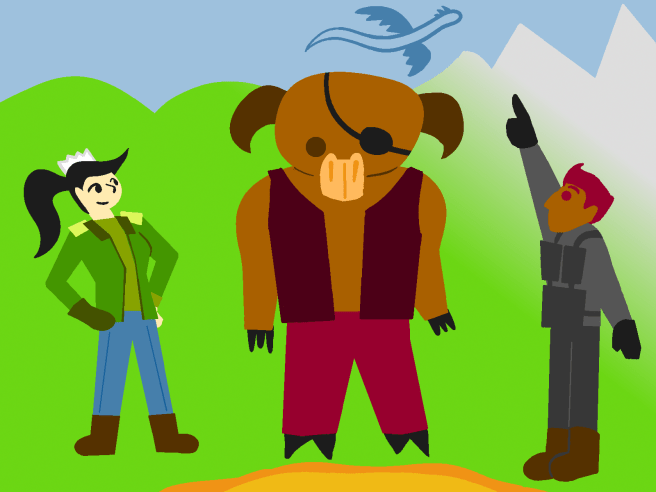
(This is the final and shortest chapter of a fantasy series starting here. Homer saved the world by winning a board-game against a drawven robot. In the process, Homer’s game-piece was killed, and he can no longer play table-war, but Aria won the Mountain Swallower’s rocky brain.)


After the Mountain Swallower encephalectomized them-self, Queen Aria considered putting the brain in a glass box to commemorate Homer’s victory over the dwarfs.

However, the behavior of the remaining dwarfs—even those a continent away—immediately changed after their leader’s death. Their voices were still gravely and they still smelled of carrion, but without the Mountain Swallower commanding them, the dwarfs defaulted to almost gnome-like behavior. They walked aimlessly, and could respond to questions, but had nothing interesting to say. They could be bossed around a little, but without gnomish intelligence, all they could do reliably was carry things, and not even heavy things.

pict1.png

With dwarfs demure, Aria decided displaying the Mountain Swallower’s brain would be poor taste. She had to keep taste in mind, now, being queen. She asked gnomes what they’d recommend doing to the brain, but of course, the gnomes didn’t care. “What happened to the rest of the Mountain Swallower’s body?” she asked. “Did you eat it?”

“Goodness no. We threw it into lava.”

“Seems fitting to me,” said Aria. “Would that be appropriate, Jameson?”

Sir Jameson saluted. “I could burn the brain now, in your royal magma pit.”

“Nah. That’d look conceited in history books.” Aria stood from her throne. “Solemn and dignified-like is the way. In the wild wastes.”

“In the wastes?” Jameson moved as if to press Aria back into her seat. “Queen Anthrapas died in the wastes! It’s simply too dangerous.”

“Shove it. I’m not a nonagenarian, or a spindly elf-queen.” Aria gestured for Jameson to follow, and he had to jog to keep up. “A human queen’s gotta do politics in person. And I traveled through the wastes when I was just a kid!”


Homer lived not far away, just on the other side of the border. Jameson hadn’t even realized they’d entered the wastes. “Wasn’t there a wall where we had to present our brass?”

“The centaurs took it down,” said Aria. “I think it was a metaphor anyway.”

She knocked on Homer’s door and heard him finding the right hallway to greet her. Homer’s house was a little unconventional in layout, but he’d designed it himself, and the sphinx had helped him build it. “Arra!”

“Hey, Homer!” Homer and Aria hugged. Sir Jameson waited until they released each other. “In the mood for a funeral? You’ve never seen one before, have you?” Homer shrugged; he still didn’t understand some spoken language. “Is there a gnomish lava-pit around here?”

Homer led Aria and Jameson over a hill to an openly bubbling pit of molten rock.

“Care to do the honors?” Aria gave Homer the Mountain Swallower’s brain. “You won it for me, so it’s only right.”

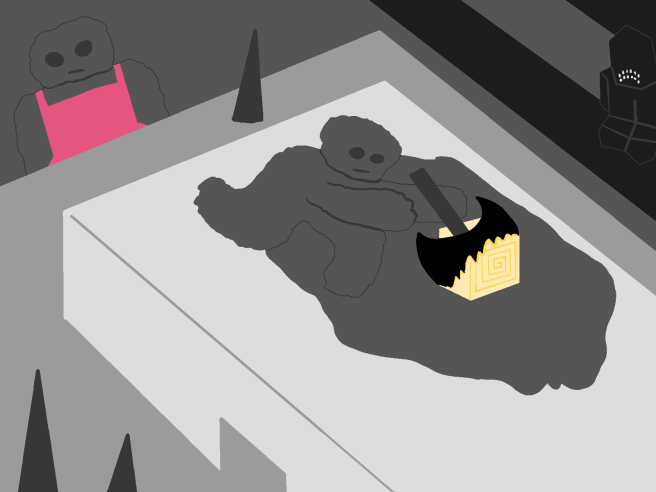
Homer tossed the brain in the lava. It sank slowly, and when it was totally submerged, a bubble popped where it had been.

pict3.png

“Hey, look! Aria—I mean, your majesty!” Jameson pointed to the sky. “Isn’t that your dragon? Is it escaping?”

“Scales!” Aria waved both arms. “I forgot, I arranged for the royal beast-master to release him today. His game-piece is dead, so there’s no reason to keep him. A lot of game-pieces died in the match against the Mountain Swallower, and I’ve made sure the corresponding beasties were released.” Scales disappeared behind some snowy mountains. “I wish I’d seen him take off, but I don’t think he needs my support anymore.”

“Pity, I’d have liked to try riding him,” said Jameson. “Maybe he’ll come back someday?”

Aria smiled. Years ago she, too, had left the human capital when her game-piece died, but sure enough, she’d come right back. Maybe the dragon would come back, too, better for its time away from the table.

THE END


(Like I said, this probably isn’t the final version of this story. I’ll eventually come back and change stuff. Until then, I’m still happy enough to host it online. There’s a nice story here about board-games which determine the fate of fantasy nations, and that’s pretty neat. I like how, since living creatures change their environment in this story, it sort of seems like Aria’s presence caused Homer to appear. Aria feels stuck, and a labyrinth represents an inescapable problem. An ax symbolizing primordial war lets Homer escape his labyrinth, and, at the end of the story Homer and Aria end war’s lingering effect on mankind.

To totally read meaning into this retroactively (and be conscious of that meaning when I change stuff) the wild wastes represent man’s thoughts in the same way dwarfs and gnomes are expressions of the earth, or like the movie Forbidden Planet in which sci-fi protagonists are attacked by monsters of the id. Homer bridges the gap between animals and man, and through him man’s animal nature is resolved. The seafolk are mysterious forces pulling the strings, like wisdom which quiets the mind.

Sorry for the shorter section and commentary this week. I’m devoting more of my time to graduate school and video-editing. I’ll still post on this website, but I’m not sure how often.

My YouTube channel, Thinkster, is lots of fun. I mostly talk about anime. If Kaiji: The Ultimate Survivor sounds a little extreme to you, I made one about One Punch Man’s surprising depth. I even have a vr-ready 360 video of a bird landing on your head!)

Table of Contents

Homer VS the Machine, Part Two

(This is part ten of a fantasy serial starting here. Homer the minotaur managed to beat a dwarven machine at table-war, but then lost to the machine the next round. It’s Homer’s first loss, ever, and he didn’t take it well. A maze has sprung up around him.)


1

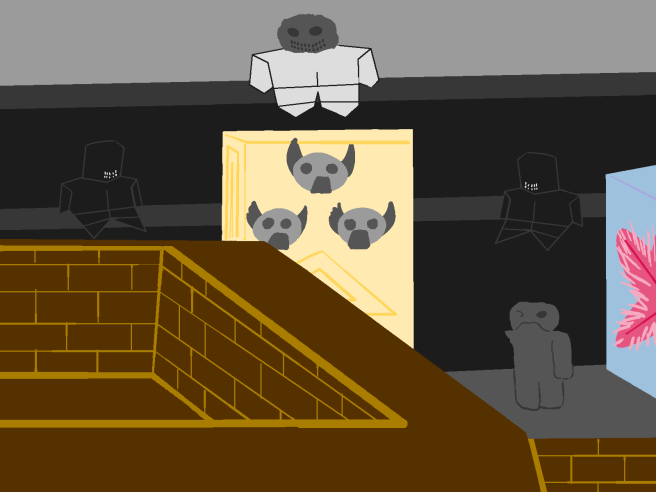
When the ground stopped shaking, half the dwarven throne-room was rubble scattered over a labyrinth. Then the Mountain Swallower’s laughter rumbled the arena. “I suppose my opponent forfeits?”

“We allow breaks between matches,” replied a gnome. “The minotaur has 15 minutes.”

“Hmmm.” The Mountain Swallower sat back on their throne. “The sun sets on our world reclaimed.”

The audience scrambled for safety as the new branches burst from the labyrinth.

“Fear not, gnome.” The Mountain Swallower pat a gnome’s head; this gnome had one arm and no jaw. “Gnomes will have a place in our dwarven future. As fellow creatures of the earth, only gnomes are fit to serve us.”

The crowd hushed. The Mountain Swallower looked up.

2

Aria Twine wore a new military blazer and a blue ring on her left hand.

“Where were you?” asked Jennifer.

“With my tailors, of course.”

“Homer could have used your support,” said Harvey.

“He won a round without me, didn’t he? If I support him too much, I’ll hold him back.” Aria examined the labyrinth. The walls seemed to breathe. “Looks like I arrived just in time.” A shifting entrance opened like a mouth.

“Your highness, please retreat,” said a gnome. “Entering a labyrinth is a dangerous—”

“If I don’t make it out, choose another Queen.” She tossed her crown onto her throne. “I’m not fit for it.”

She stepped into the labyrinth, and the entrance closed to swallow her.


Aria expected total darkness, but a silvery light came from… her hand? The sapphires on her new ring were glowing. With her left arm outstretched, the walls of the labyrinth showed their brickwork.

She had no plan of attack. She walked with her gloved right hand on the right wall. Voices from the audience outside the labyrinth faded away as she turned corners and found dead ends. Aria swore the only sound was slow breathing—her own, or Homer’s.

She tripped on a loose cobblestone. She knew the walls moved because she’d seen them shifting from outside, but didn’t believe it until she tripped on the same loose cobblestone again.

Maybe the maze’s exit had moved as well. Maybe there was no exit.

“Calm down, Aria,” she said to herself.

Now listening for sliding walls, Aria noticed the floors sloped at odd angles or became staircases up and down. Ladders led into dark chasms. She wondered if the floor moved underneath her.

She felt humid heat pouring around a corner. “Homer?” She followed his breath down a staircase and up a ladder. “Homer!”

As soon as Homer heard her, he turned away. A wall slid to divide them.

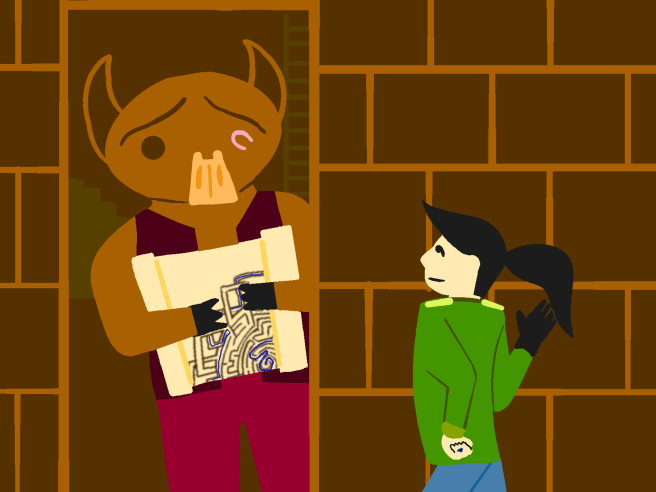
Aria dove for the gap, but knew she’d be crushed if she tried to slip by. Instead she tossed a scroll through the closing slit.

Seconds passed. Aria still heard Homer’s breath through the wall. “It took me months to finish that,” she said, hopefully loud enough for him to hear. “Do you remember when Anthrapas separated us for national security? I spent a lot of time on it then. I guess I missed you.”

The wall slid back open.

4

Homer held the maze he’d drawn for Aria ages ago. Aria had solved it.

“I took advantage of you,” she said, “but you’ve done more for me than you could ever know. And not just me—everyone depends on you.” Homer followed Aria’s escape-line with his one eye. “I should have been there for you—but you handled the first round against the machine, and you showed you don’t need me. But now I’m here for you anyway.”

Homer shook his head. “Alreddy over. Lozt.”

Aria wasn’t sure if he meant he was lost in the maze, or he’d lost to the dwarven machine. Either way: “It’s not over till it’s over.” Homer shook his head again. His horns marked the walls. “Every maze has an exit. Every problem can be solved.”

Homer opened his mouth to speak but knew he couldn’t produce the sounds he wanted. He grabbed Aria’s shoulder so gruffly she recoiled, but then tapped his fingers on her shoulder in gnomish. Aria’s gnomish was rusty, but she’d brushed up since becoming queen. “I can’t win. In the second round, the machine knew everything.”

“But not in the first round?” asked Aria. “Why not?”

“In the first round I made a trap in the real world,” tapped Homer, “but that won’t work twice. The dwarven machine is simulating our reality, and the parallel reality of table-war.”

“Then… the walls moved.” Aria held Homer’s hand in both of hers. “But you’ve escaped a labyrinth with moving walls once before, haven’t you?”

Homer ground his teeth. “Maybe the machine can hear us now. Maybe it can hear our thoughts.”

“Then give it something to really think about.” She hugged him.

Homer nodded.

The walls groaned. The ceiling split. As quickly as it had come the labyrinth was gone, like a passing thunderstorm.

5

Homer threw his eye-patch and goggles at the Mountain Swallower. “Negst round.”

The Mountain Swallower smiled. “Gnomes, how long will it take to prepare a new table? More than three minutes?”

“Of course,” said the nearest gnome, crawling over the rubble.

“Then the contest is over,” said the Mountain Swallower. “You had 15 minutes, minotaur. It’s been twelve.”

Homer matched hands with a gnome. “He has far more time,” translated the gnome. “The contest was interrupted by natural disaster, and its conclusion can be postponed for days.”

Aria smirked as she took her throne opposite the Mountain Swallower, who was agape. “A natural disaster? You destroyed the table yourself, minotaur!”

“And it was a natural disaster,” said Aria. “Anthrapas agreed Homer could represent the wild wastes. As an animal from the wastes who isn’t owned by any army, his labyrinth is legally a natural disaster, just like a blizzard brewing around my ice-dragon if it escaped into the wild.”

The Mountain Swallower slumped in their throne.

“Prepare the table,” said Homer, through his gnome. “I’m ready.”

While the gnomes rebuilt the table and floor and seating, an elf tapped Homer’s knee; it was one of Stephanie’s shortlings. The shortling gave Homer some brass cards and figurines. “These are from Victoria and me, on behalf of the queen.”

6

The sphinx, harpy, and centaur brought their own brasses and figurines. They were all beautifully painted. “I hope you find some use in us,” said the sphinx.

“I’m sure you can use this, too,” said Harvey, with another brass and figurine.

A gnome in jewelry gave Homer yet more to hold. “From Emperor Shobai, and Ebi Anago.”

Homer couldn’t tap messages to gnomes with his hands full, so as respectfully as he could, he set the gifts on the ground and touched the gnome’s shoulder. “I don’t need these,” he tapped.

“You don’t need to use them if they’d be in the way,” said the gnome, “but if you could put these pieces on the table it would mean a great deal culturally speaking, or so I’m told. Feelings of unity, and such.”

“But they might be killed in battle,” tapped Homer.

“That would be even better,” said the gnome.


The table was reconstructed sooner than anyone anticipated, but the dwarven war-machine was always ready. The Mountain Swallower sneered. “Faster, minotaur!”

“Hey!” Across the throne room, Aria Twine lounged across her throne. She pointed her gloved hand at the Mountain Swallower. “That’s my favorite commander you’re addressing.”

“If he’s truly a wild beast, he’s not you’re commander to own, is he?”

“I don’t own him. I’m just his biggest fan.” Aria admired her ring. “Tell you what: let’s make a bet.”

The audience turned to the Mountain Swallower, who already sat beside Homer’s goggles and eye-patch. “When my machine wins, I control the planet. What more could you wager?”

“If your machine won, how quickly could you execute me? I’d still have at least a second left to live, hm?” When Aria raised her ring, it cast blue light across the throne-room. “Time enough to destroy this in front of you.”

“Childish.” The Mountain Swallower chortled. “Dwarfs eat gems, but I’m not so desperate as to grovel for one.”

“But dwarfs aren’t the only ones to eat gems.” Aria gestured for a gnome to come close. “Open wide.”

“Don’t!” The Mountain Swallower’s shout shocked even itself. Aria popped her ring into the gnome’s mouth.

“Nod yes or no,” she said. “Gnomes eat gems, right? Creatures of the earth, and such?”

The gnome nodded.

“But gnomes don’t enjoy it, do they? Gnomes don’t enjoy anything.”

The gnome shook his head.

“So you’re tasting that priceless ring, and you’re not even enjoying it?”

The gnome nodded.

“If Homer loses, swallow, got it?”

The Mountain Swallower grumbled. “Your stalling is embarrassing everyone. What wager were you envisioning?”

“Now you’re talking.” Aria plucked her ring from the gnome’s mouth. “If your machine wins even one point this round, I’ll give you the ring myself. If it wins no points at all, I’ll need…” She reclined across her throne. “Your brain.”

“I accept.”

Murmurs swarmed the crowd. Seafolk bubbled in their tanks.

“My life is a paltry ante for a sure bet. Begin the match. Choose the location for battle, minotaur!”

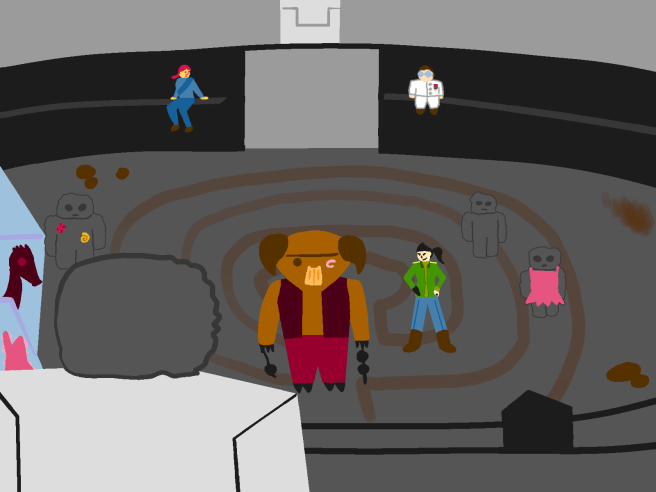
Homer gave a gnome a brass card. Gnomes pounced upon the table and finished the map in a minute. It was featureless and flat.

Homer put all the figurines he’d received onto the table: a centaur, a harpy, a sphinx, a griffon, a giant crab, and three imps. As if that weren’t enough, he added Scales the ice-dragon and, to the murmurs of the crowd, his own likeness.

7

A gnome tugged Homer’s vest. “Are you sure, sir? If your game-piece dies, you won’t ever play official table-war again. The dwarven machine will win by concession.” Homer nodded.

The machine clicked.

A drawer opened containing six brass cards and six metal beads. Gnomes somberly carried the beads to the table. “Truly these are the end times,” said the front-most gnome.

When Aria squinted at the beads, the Mountain Swallower chortled. “The great demons, in their dormant state. Did you think I would bet my brain if I did not intend to win?”

Homer frowned. “Hou?”

The Mountain Swallower explained: “Gnomes, with flawless and rigorous logic, are the only ones who can control the great demons of old. But our machine, with its own gnome-brains, has the same potential. Even the gnomes recognize this, as they obviously permit the machine to use the great demons on the table,” said the Mountain Swallower. “Usher in the day of the dwarf.”

The gnomes around the table turned to Homer. “The loser of the last round may begin.”

Homer pointed to his figurine. His figurine pointed toward the dormant demons. Homer’s army advanced.

The dormant demons, barely big as beads, suddenly swelled. Homer couldn’t imagine the intricate mechanisms in the demons’ figurines so they could expand in size a hundred times.

8

Homer’s sphinx expanded, also, and bounded across the table. She swatted the two-headed demon and sent it sailing. In the audience, the actual sphinx mewled proudly.

Then the other five demons leapt upon her game-piece. They kept expanding in size until they weighed her down. When they were big enough, they swallowed her whole.

Homer’s other figurines shivered with fear—the gnomes were meticulous in portraying the battle’s gruesome detail.

Homer pointed to Scales. His figurine boarded the dragon and led the charge.

The demons kept getting bigger, and bigger, but their forms were swirling, amorphous, and invulnerable. They smashed the imps underfoot. They crushed the centaur with big, clumsy hands. Scales reared back and unleashed a blizzard upon the monsters, but they didn’t even slow down.

One of the demons pulled a great, black sword from their own chest and used it to cut the crab in half. The other demons retrieved their own weapons from inside themselves and rolled toward Homer’s army brandishing them.

Homer pointed toward the ceiling and tapped fingers with a gnome. The gnome showed how Homer’s remaining army scattered; Scales, the harpy, and the griffon flew in different directions.

“Not soon enough, minotaur.” The Mountain Swallower giggled when a demon cracked his great, black whip and snapped the griffon out of the air. Another demon threw their spear and pierced the harpy through the heart.

Scales kept flying upward, with Homer’s figurine clinging to its neck.

11

“Too easy,” said the Mountain Swallower. The largest demon threw their ax into the sky. It cut Scales and Homer into two. “The game ends.”

The audience was silent. At the same moment, everyone in the throne-room realized why the silence felt so suffocating: the dwarven machine no longer clicked and clacked with calculations. It was utterly quiet.

Homer folded his arms awaiting the verdict.

“Indeed, the game ends.” Six gnomes took the table. “It ends with a tie. The contest is now over. Dwarfs remain bound to the treaty limiting bloodshed to table-war.”

The Mountain Swallower stood. “What do you mean? What happened? The opposing commander is dead!”

“Both commanders are dead,” said the gnomes. They showed Homer’s bisected figurine. “Zero points, all around.”

“My machine is not dead,” said the Mountain Swallower. “It wasn’t even on the table!”

“Correct.” The gnomes rebuilt the table to show how the thrown ax spun through the air, landing elsewhere. “Your machine is over here.” They built a model of the throne room, which the ax split open.

12

Homer put his hand to a gnome’s. “We’re more nearby your throne-room than you thought?” translated the gnome. The Mountain Swallower swallowed. “Homer says the first round, he forced your machine start simulating the real world in addition to the parallel world of official table-war. Because your machine has accidentally killed its own game-piece while killing Homer’s, your machine now believes it is dead.”

Now the suffocating silence even seemed to stop the audience’s hearts, until Aria laughed. “Homer, you really had me going!”

Homer released his translator gnome to recross his arms, and puffed out both nostrils. “My piece,” he said aloud, “for your machine.”

The Mountain Swallower swallowed again, and gestured for six dwarfs to open the machine and inspect the contents. The machine was totally inert.

“I see. Then…”

The Mountain Swallower stood.

“A deal is a deal. Your highness, Aria Twine, I present—”

The lord of the dwarfs opened up its own head.

“My brain.”

It pulled its brain out and held it aloft. It looked just like a gnome’s.

13

Final chapter
Commentary


Notes to the future (plus a video about Black Mirror)

This chapter is a little short; I just started graduate school, and on top of that I’m having fun experimenting with video-editing, so I’m beginning to move on from this project.

But I’ve had a lot of fun with The Minotaur’s Board-Game, and I don’t think I’ll be done even after I post the last chapter two Fridays from now. I like the world I’ve made, but I think my exploration of it leaves something to be desired. Maybe a year later I’ll revisit this project and spruce it up a bit.

That’s the good thing about having a website instead of publishing a book. I can always change stuff. It’s a living document. It’s only public because I enjoy sharing my stories with anyone who wants to read them.

So let’s leave some notes for myself in the future. What needs to be spruced up in The Minotaur’s Board-Game?

The beginning needs expansion. I’m in such a rush to introduce core concepts, and just get on with the story, that Homer wins his first table-war the day after meeting Aria. I can convey my world to the reader in a clearer, more compelling, but still compact way. What if Aria put Homer to work on her farm, and they bonded a little over board-games?  Aria could explain table-war to Homer and the reader. Then Homer’s first victory is more plausible, and the bond between Homer and Aria presented in this chapter is more convincing.

Also, I think Homer should get along more with the sphinx. Minotaurs haunt labyrinths; sphinxs propose riddles; they gotta buddy up. In the current draft Homer beats the sphinx at table-war and that’s that. Maybe Homer should run into the desert to console the sphinx on her loss.

I like Homer the minotaur proposing to Aria the human in marriage. The reader has watched Homer’s whole existence on the surface, so obviously he doesn’t know much about marriage. He can’t know that humans don’t marry beasts. But this book has a theme of accepting beasts; is Aria just closed-minded? Their platonic relationship is probably more fitting.

I started this project focusing on the snowflake method, in which a story is built up in phases. It only makes sense to return later to fill in the gaps, and it bodes well that I’m eager to do so. If I have fun writing it, maybe someone will like reading it.

But that’ll have to wait. After The Minotaur’s Board-Game, I’ll be focusing on graduate school and occasional YouTube videos. I’m having a lot of fun making videos about my favorite shows like Kaiji the Ultimate Survivor. It’s a new kind of content I’d like to practice on; I figure people are more willing to watch a ten-minute YouTube video than read ten-thousand words on my website.

Speaking of, here’s my latest video on Thinskter! Karl Pilkington describes Black Mirror episodes. Maybe next time I’ll discuss a dataset I’m studying about witch trials?

Final Chapter
Table of Contents