Homer VS the Machine, Part One

(This is part nine of a fantasy series starting here. Today Homer the minotaur must defeat a dwarven computer at table-war to protect the planet from actual bloodshed.)


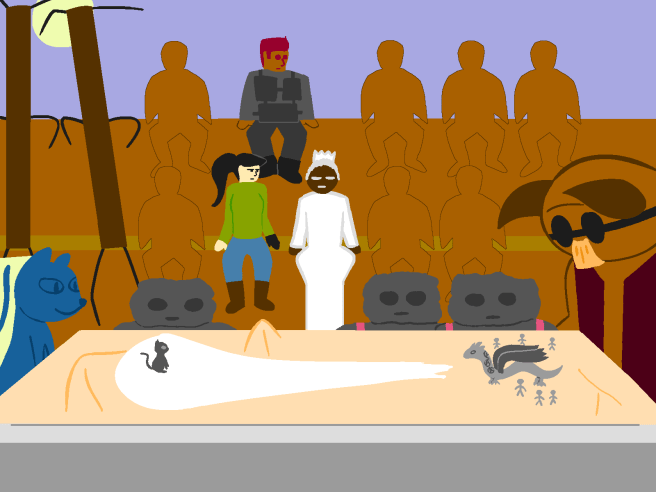
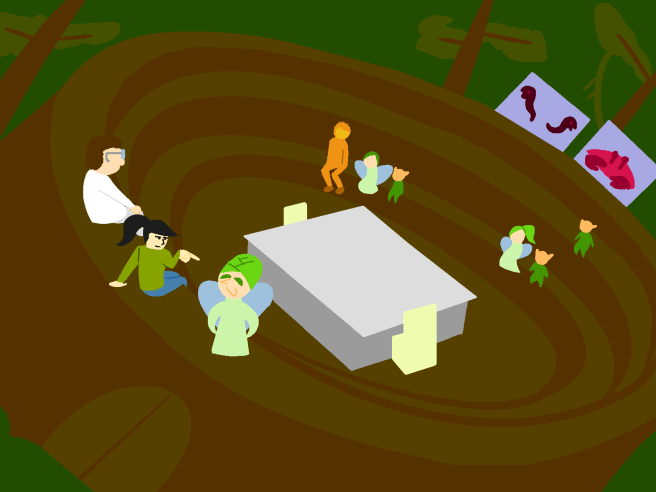
Over centuries, the dwarfs had eaten their corner of the continent to a flat, lava-pocked landscape. At night the glowing magma-pools spat back at the cold, dark sky. Homer warmed himself by a red-hot pit. Radiating heat made his goggles sear him, so he took them off.

pict1

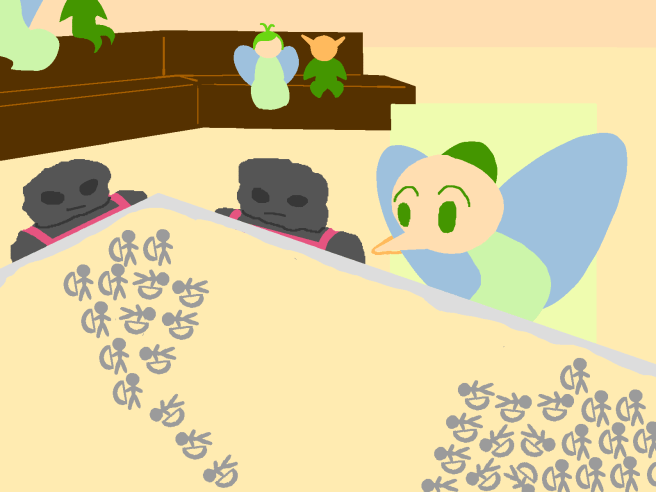
The human embassy was walled off with stalagmites gnawed into shape by the dwarfs. Dwarfs hid behind the spikes to watch Homer through their eyeless helmets. Homer checked his pockets. He had a brass card he’d received as a gift from Ebi Anago, nephew of the emperor of the seafolk.

Homer dropped the brass card in the magma pit. Immediately a gnome crawled from the liquid rock. This gnome’s fresh body was marble-white and crackled as it cooled. “Greetings. I represent seafolk trading services. How may I help you this fine evening?”

“Uedding.” Homer mimicked donning a necklace. “How much?”

“You want to buy a seafolk wedding necklace?” The gnome cocked his head. “Who is it for?”

“Gween.”

“A royal wedding necklace would cost a fortune,” said the gnome. “Forgive me for doubting you have the funds on hand.”

“Ebi Anago.” Homer snapped his palms like lobster claws. “Frend.”

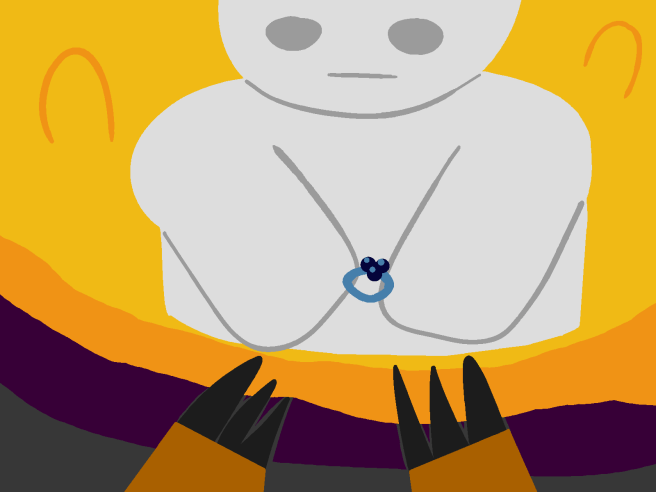
“You know Sir Ebi Anago? Excuse me.” The gnome sank into the magma. After a few minutes, a magma bubble popped and the gnome emerged once more. “The esteemed Ebi Anago is grateful to hear from you, and sent me with this token of appreciation. He says this is more appropriate than a necklace for a surface-dweller’s wedding.”

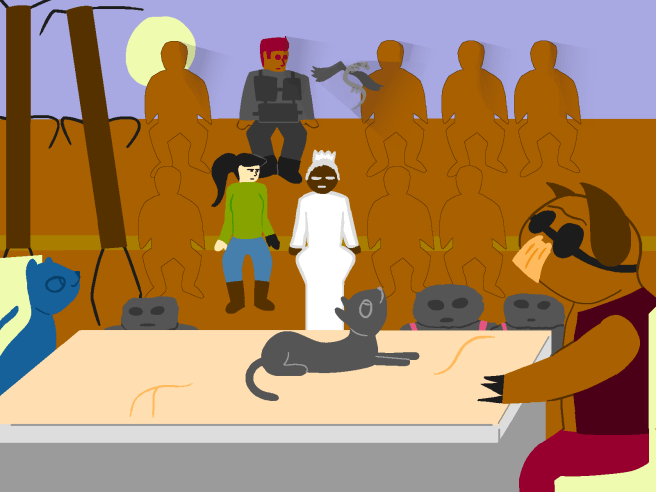
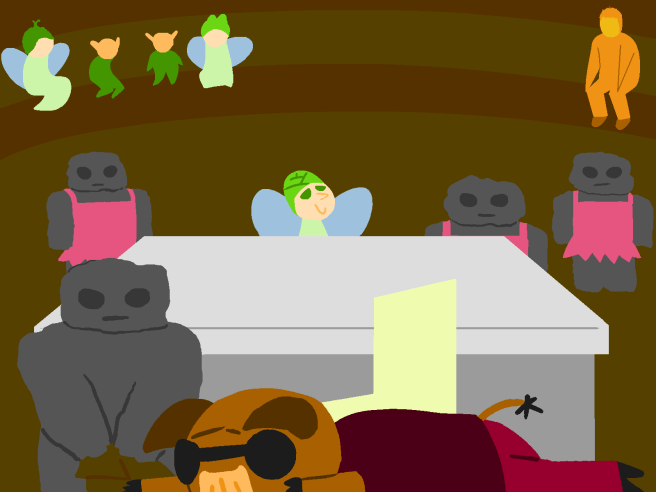
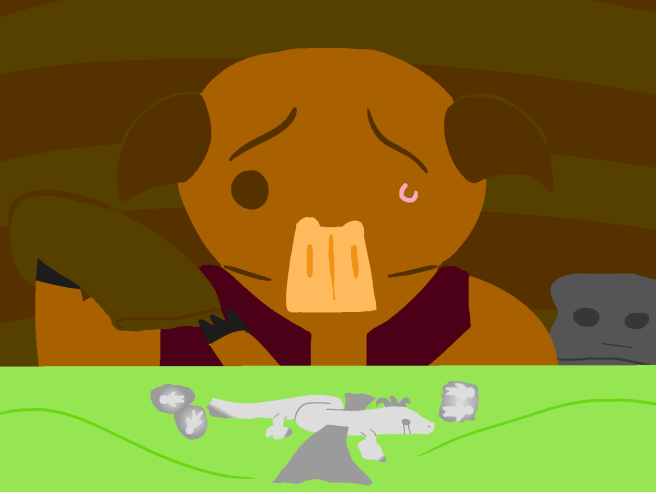
The gnome pulled open his own torso like a chest of drawers. Inside sat a ring fit for a human’s finger, with a band of not gold, nor silver, but some shining blue element. Atop were three dark sapphires.
pict2

“Ebi Anago hopes this demonstrates the eternal gratitude owed you by all sentient beings for your assistance securing sovereignty for the wild wastes. But if it does not please you, he would gladly replace it and fall upon a sword in shame.”

Homer took the ring.


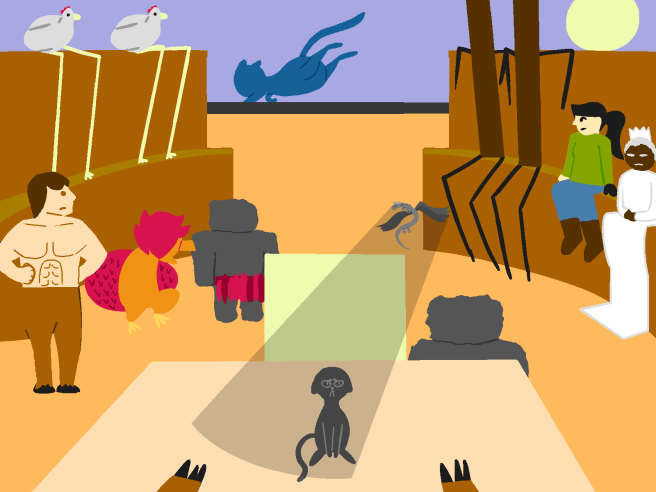
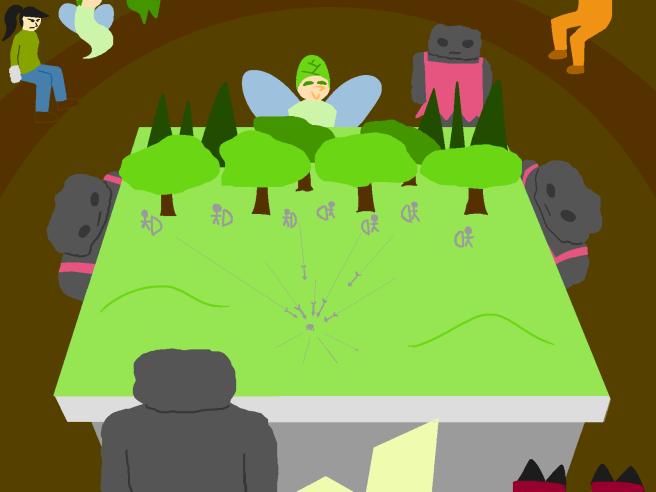
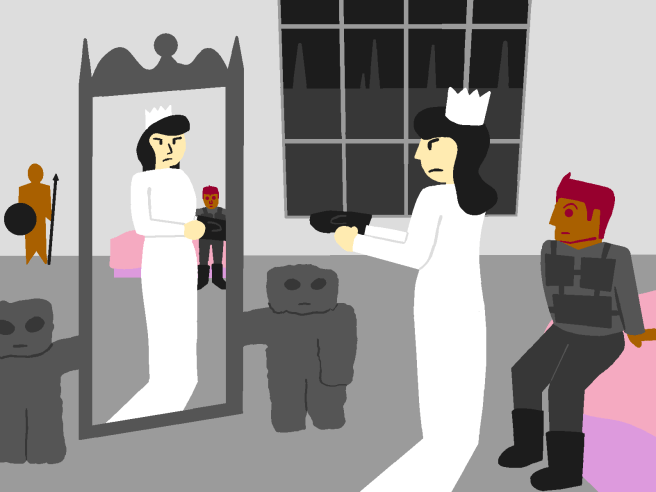
In the human embassy, Aria shook wrinkles from her new white dress. The black glove she wore over her burnt right hand barely fit through the delicate sleeve. Gnomes held a tall mirror for her. Despite the attempts of ten tailors, her arms and legs were still too long for the dress. She felt like an elven brood-mother, twenty feet tall and spindly thin. “I don’t like it at all,” she told her gnomes and royal guards. “Anthrapas wore a dress, but that’s not me. Would a military uniform be queenly enough?”
pict3

“I suppose it’s up to you,” said Sir Jameson, “but Anthrapas never dressed like that.”

“I’m queen. I’ll wear what I want.” Aria smeared off her make-up with her black glove. “Everyone out. I’m changing again.”

Aria appreciated her bedroom more when it was empty. The human embassy in dwarven land was adorned with luxurious crystal chandeliers, but smelled like rotten dwarfs.

Aria sighed and looked back into the mirror. “Maybe I could wear this just during Homer’s battle, to prove I’m queenly.” She tried to walk; her heels speared her dress’ hem and tore it. “Uugh. No.” She kicked off her shoes and stepped into her boots. “They’ll have to take me as I am.”

Someone knocked at the door.

“Come in.”

Homer stooped to slip his horns through the slim doorway. “Arra?”

“Hey, Homer.” Aria stuffed all her make-up into a drawer. “I’m glad to see you. Ever since I became queen, I’ve had to talk with just royal guards and gnomes. And—eugh—dwarfs, and elves. How are you? Are you ready for your match? The first to ten points decides the fate of the planet.”

Homer looked her up and down. “Dress.”

“I hate it,” said Aria, “and not just the dress, I hate all of it. It’s just like Anthrapas to leave me all the heavy lifting.” She tied her hair in a ponytail. “She knew me too well. I’ve gotta be a great queen, not because I care, but because failure would humiliate me. I’m too prideful not to give it my all.”

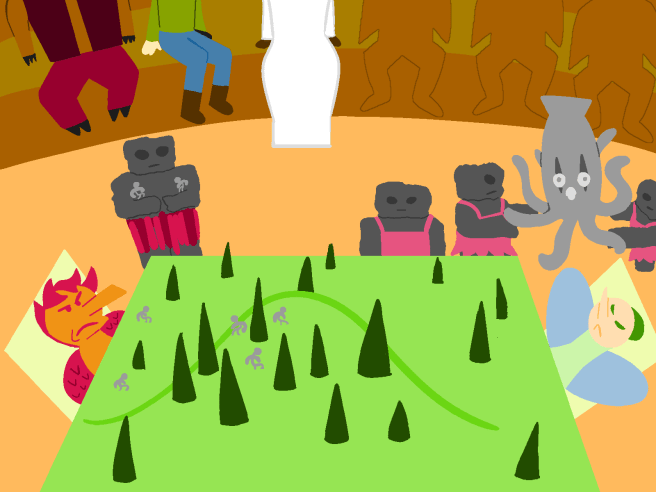
“Nod alone.” Homer lifted his goggles and presented the wedding ring.

pict4

Aria Twine caught her knees before they buckled. “N-no.”

Homer didn’t recognize the disbelief on Aria’s face. Maybe she just didn’t understand. “I lov—”

“Don’t say it.” She struggled for balance. “Oh god, this is wrong.”

“Arra?”

“No, no, no… I’m so sorry.” She couldn’t keep her hands from trembling. She turned away. “I’m a human and you’re a—it’s just not right, Homer. You can’t love me like that. I was—” She shook her head. “I’m taking advantage of you, Homer. Like a beast of burden.”

Homer pointed to her black glove. “Burned your hand.”

“I burned my hand for me, not for you.” She cried onto her white dress. “Homer, you’re an intelligent, emotional animal. Don’t you deserve to love someone who isn’t just using you? I can’t do this. I just can’t.”

Homer looked at the ring. He left it on Aria’s dresser. “Gift, then.”

“Homer!” Aria chased him to the door, but Homer was already gone.


Homer wasn’t sure where he was running—just away from the embassy, away from the dwarfs, and away from any life he remembered. His breaths became fog banks in the night, clouding his vision and his mind. He tore off his vest and pants and goggles. His hooves hit the hard earth, and his back hunched forward until he bounded over the ground like a wild animal on all fours. Propelled by the vacuum left in the pit of his stomach, he finally left the jagged dwarven mountains behind and entered the wild wastes.

The full moon cast his shadow across the shifting terrain: icy plains, then baked deserts, then grassy hills, then gaping craters. He navigated not by starlight or compass, but by red madness at the corner of his eye. Even without knowing what he searched for, he knew when he found it.

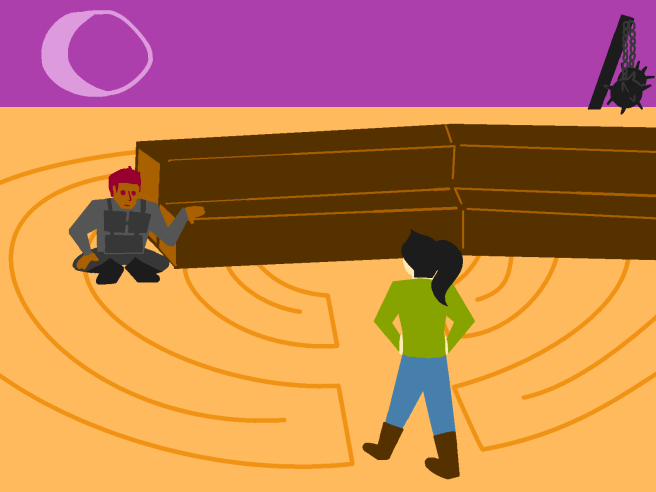
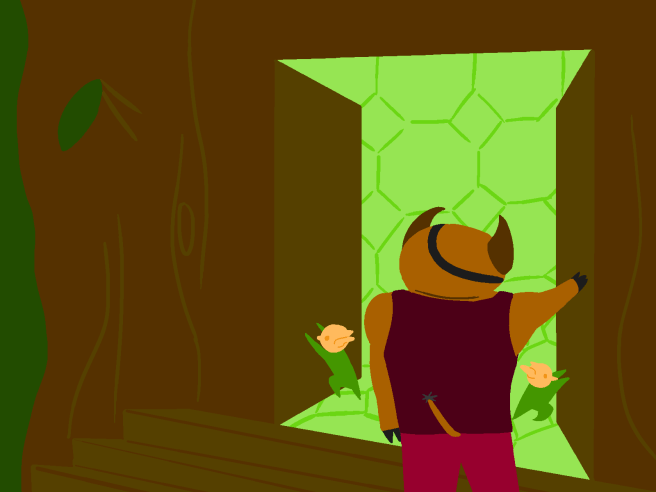
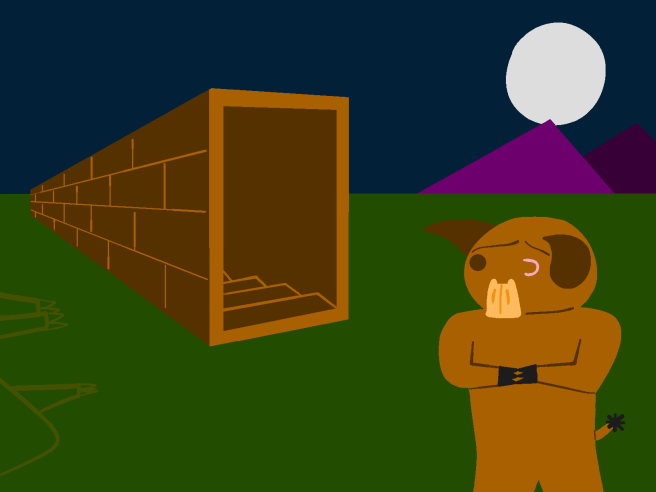
A rectangular hallway protruded from the earth. Hewn of solid stone, the hall led into the darkness of an underground labyrinth.
pict5

The door was large enough for Homer to enter at full height without hitting his horns. His hooves recognized the cobblestone floor. A fork in the hall ahead split into two paths both leading deeper into the dark.

Scents made Homer recall buried images. Curving corridors. Sloping stairwells. Facades, forks, branches, and ladders. For every month Homer had lived on the surface, he’d previously wandered a year in the maze. It called to him.

What had the surface ever done for him? He felt the scars on his chest. At least the maze would host more minotaurs for company. Whenever Homer had met another minotaur, they had kindly shared their food and their maps of the maze.

He smelled minotaurs even now. Where? He sniffed left and right at the fork, but the scent was strongest behind him, at the maze’s exit. Homer jogged back to the surface; maybe his new minotaur friends had escaped the maze just recently.

There they were, lying in the grass. He’d missed them in the dark: a male, a female, and a child.

Their heads were missing. Their bodies were warm.

They reeked of dwarfs.


“Homer?” Three gnomes lounged by the dwarven magma pits, just far enough away that their dresses didn’t catch fire. “What are you carrying?”

Homer slung the three minotaurs onto the ground. “Dwrfs.”

“Oh dear.” The gnomes inspected them. “You think dwarfs killed them? We are supremely sorry. There is no law against killing animals in the wild wastes, not until the sovereignty of the wastes is ratified.” Homer pointed to the boiling pit behind them. “You wish to burn them?” Homer nodded, shoulders quivering. “Homer…” Two gnomes held Homer’s hands. “Only gnomes are rejuvenated by magma.”

Homer nodded. He knew that already. He dropped the three bodies in the pit. Fire spread across their dried fur like burning grass. The bodies slowly sunk.

“There was a time gnomes knew sorrow. The whole collective gnomish consciousness could cry and cramp in anguish.” The gnomes removed their dresses to join Homer by the pit without combusting. “I say this not to diminish your pain, but to say that although centuries have passed since that time, we understand. If I were still capable of emotion, I would feel such agonizing empathy for you that dormant demons might split open the earth to rip me limb from limb to end my suffering.”

For a minute the only sound was bubbling magma.

“Make no mistake, Homer, emotions are perhaps the most powerful force in the universe. These scars will shape you, but, they do not constitute you. You are more.”

A gnome gave Homer his goggles. Homer put them on.


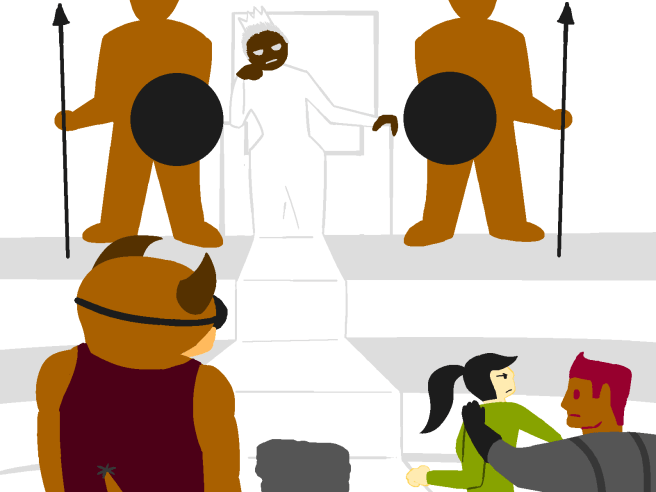
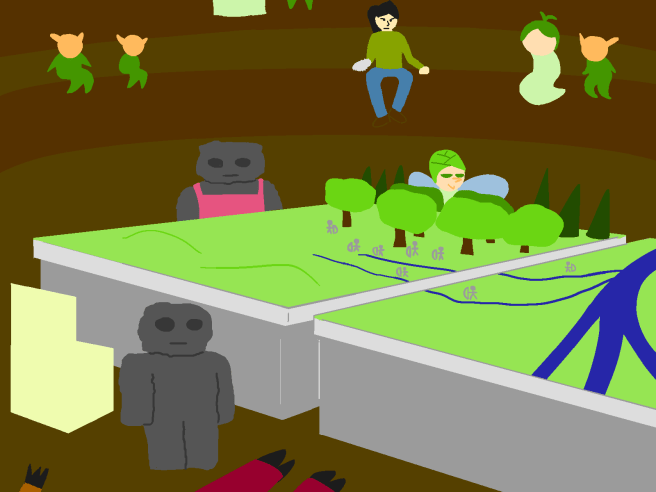
The Mountain Swallower’s throne room was ten times larger than the whole human capital, and had enough seats for armies. Dwarfs filled the northern half the room around the Mountain Swallower’s vacant throne. Their eyeless helmets watched the other races enter. The elves fluttered in with the humans, and then gnomes wheeled in the seafolk trapped in their glass tanks.

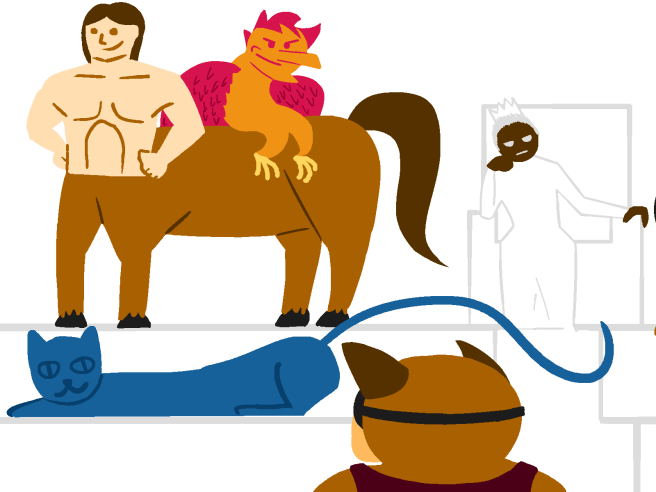
Emperor Shobai wiped morning dew from his tank with a long crab leg. His wife floated beside him. At Shobai’s direction, the gnomes wheeled them to the eastern side of the room beside Ebi Anago and Sir Hitode, the lobster and starfish commanders. The centaur, sphinx, and harpy took seats beside the seafolk, each bowing to the other races in whatever manner they were able.

On the western side of the room, Madam Commander Victoria took the center chair to represent the elven queen many miles away. Stephanie sat beside her, pouting.

Humans sat on the south side. Harvey and Jennifer waited for their queen.

pict6

The Mountain Swallower’s footsteps echoed and shook the room. Their voice shattered the air. “Shobai.”

The seafolk emperor released bubbles from his maw.

“Victoria. Standing in for your queen?”

Victoria nodded.

“Beasts.”

The centaur, sphinx, and harpy nodded.

“The human queen is absent,” said the Mountain Swallower. “A pity she won’t witness the end of the world.”

The room stirred. Emperor Shobai tapped his gnome on the shoulder. “The emperor is concerned about your intentions today,” said the gnome. “Could you clarify your aim?”

The Mountain Swallower didn’t move. “When we defeat the minotaur, we will be freed from the treaty limiting us to table-war. We will wipe out all other life and restore our kingdom to its former glory. Before you protest, recall that dwarfs have never violated the law. Our means justify the end.” The Mountain Swallower barked at the door. “Enter, minotaur.”

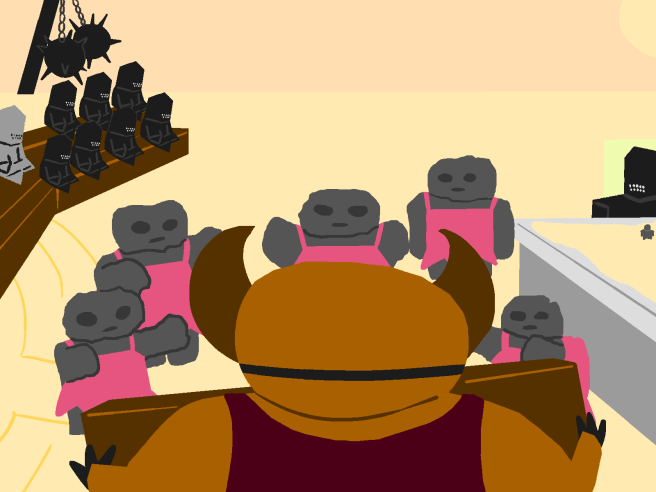
Homer’s goggles and strong jaw seemed like a stone statue’s, as if he were carved from a mountain. He sat at the war-table with a bag of brass cards and figurines.

The Mountain Swallower leaned forward in their throne. “How sad that the dwarven race’s final challenge is scarred and disfigured.”

Homer considered words carefully, and eventually decided his mouth wasn’t adequate. He put his hand on a gnome’s shoulder. “I’m not your final challenge,” translated the gnome from Homer’s finger-taps.

“Mm?”

“And you’re not my final challenge, either,” translated the gnome. Homer organized brass cards on the table. “You’re just another fork in my path.”

The Mountain Swallower laughed. It was ear-splitting, like a violin played with a steel wool bow. “Such arrogance,” it whispered. “Bring the machine.” The room flooded with shadow. Gnomes had covered the windows—these gnomes had limbs gnawed off by dwarfs.

The machine was no longer merely a silent dwarf. It was a box five feet wide, five feet thick, and ten feet tall, covered in dwarven relief. The box wore a skirt of gnome arms, palm out, fingers spread, ready for input and output.

Its front face was decorated with minotaur skulls.

pict7

“Inspired by your success, we briefly experimented with minotaur brains. We’ve concluded your heads are best as ornaments.” The Mountain Swallower beckoned their gnomes to deposit the machine opposite Homer at the war-table. “This box has one thousand gnome brains wired together. It is unbeatable.”

Homer grieved over the minotaur skulls. Their horns curved up like the trunks of broken trees. The bony smiles reflected in his dark goggles.

“The first to ten points will decide the fate of the planet, minotaur,” said the Mountain Swallower. “Let us—”

Homer interrupted through his gnomish translator. “When I win five points in the first round, I want your helmet.”

The Mountain Swallower chuckled. “Ha! And when my machine wins five points in the first round, I claim your goggles. Begin the match!”

Twenty gnomes poured from the stands. Some were bare, others in elven dresses, others decorated with jewels. The dwarfs’ gnomes stumbled out half-blind, feeling with hobbled arms and legs. One gnome stood on the table. “The minotaur may choose the location of the first battle. Oh…” Homer gave the gnome a brass card. “The battlefield is chosen.”

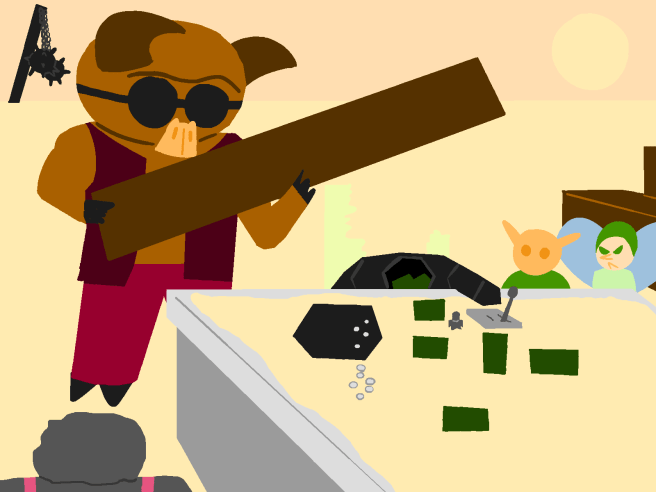
“Gnomes!” shouted the Mountain Swallower. “Tell our machine where the war will be!” Gnomes surrounded the machine and matched the disembodied hands around the circumference. The gnomes conveyed the location to the machine, and the machine buzzed and hummed. A brass card popped out a slot detailing the army the machine would bring to battle. A gnome pulled open a drawer on the machine and retrieved two figurines: a dwarf and its ballista. The gnome aimed the ballista exactly as the machine dictated.

Homer took a figurine from his bag: Scales, the icy dragon. Scales had hatched only a year ago, but Aria’s prescribed diet of elven insects had built him into a massive beast who breathed blizzards.

The gnomes swiftly built the table’s terrain. Black spires and sandy wastes were signatures of dwarven territory.

“Over before it even begins,” said the Mountain Swallower.

Homer nodded in agreement and put his dragon on the table.

pict8

“The game starts,” said a gnome.

“Ennd.” Homer extended a hand. “Hellmet.”

The crowd murmured, perplexed. A gnome met Homer to inquire digitally. “He says inspecting the battlefield’s physical location will prove he has already won.”

The Mountain Swallower barked. Ten dwarfs picked up a gnome each and hustled from the throne-room. “Don’t waste my time, minotaur.”

As minutes passed, humans and elves chatted and pointed at the machine. The seafolk traded their gnomes from tank to tank carrying conversation between them.

“Homer, are you okay?” Jennifer pat his shoulder.

“We’re all here for you,” said Harvey.

Homer shook his head. “Arra?”

Jennifer sighed. “We don’t know where she is. She’s probably busy with queenly duties, but I can’t imagine anything more important than this.”

“Mmm.”

The dwarfs reentered and tossed their gnomes onto the table. “Upon closer investigation,” said a gnome, “there is a deep hole in this exact spot, underneath your units.” He dug with his hands. “It was disguised with thin branches and leaves smoothed over with brown dust. The hole is lined with sharp, pointed sticks.” He dropped the dwarf and ballista into the pit. “Five points to Homer.”

pict9

Seafolk bubbled in their tanks. Humans and elves cheered.

The Mountain Swallower’s teeth barely parted. “Cheat!”

Homer shook his head and matched hands with a gnome. “Homer says he dug the hole himself last night.” Homer took Scales’ figurine. “Would you protest the death of your armies if you commanded them to swim into the sea? You lost because of our adherence to physical accuracy.”

The Mountain Swallower rapped the stone throne. “…Very well,” it said. “You win the first round.”

Homer extended his hand. “Hellmet.”

The lord of the dwarfs paused, teeth together, then pulled off its helmet.
pict11

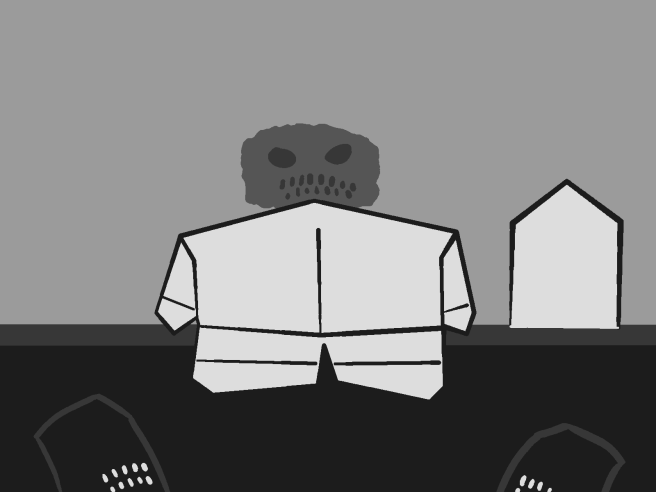
Under the helmet was the lipless and misshapen, but unmistakable, face of a gnome. The Mountain Swallower tossed their helmet onto the war-table. The audience was silent. The Mountain Swallower explained for the stunned mortals:

“There was a time gnomes and dwarfs were the same. When the earth was born, we were born with it.” All the gnomes in the room nodded in agreement. “We ate rocks. We craved gems. He enjoyed the heartbeat of hell. The earth was ours and all was right.”

Homer took the helmet and looked into its face-plate.

“But soon, we had siblings. The seafolk were first, cretinous, chitinous creatures scuttling in the depths. Then the land bore humans, elves, and animals. We despised all these lifeforms for daring to invade our existence. We thought we would never be rid of you parasites. But then, a thousand years ago,” said the Mountain Swallower, removing a gauntlet, “between the inner mantle and the core, where heat and pressure blurs the line between reality and the immaterial, we found them.”

The Mountain Swallower raised their bare forearm. It was scarred as if by a branding iron in the shape of a twisted screaming face.

“Nameless demons from beyond the pale. This is the demon with the great black axe.” They removed another gauntlet to show another scar. “Who wielded the great black sword.” Under the chest piece were many more intricate wounds. “Whose great black whip cracked the continent. Who bore the great black spear. The twin-headed monster with great black twin-headed flail. And their leader with a great black trident.”

pict12

Homer squinted at the dwarf’s chest. Symbols from hell burned their rocky skin to charcoal. The scars circled like chains or snaking serpents.

“The demons were trapped in that hot, dark place by unknown entities from bygone eons. Their fiendish intelligence soon convinced us: if we freed them, the earth would be ours again. We made deals with each one, and with each deal the demons grew, until they blotted out the sky.

“True to their word, the demons wreaked havoc on the surface. Humans, elves, and seafolk all struggled to kill them, then to subdue them, then to flee from them, and then, finally, to merely survive them.

“But soon we realized our mistake. The demons’ footsteps, and their malicious laughter, shook the planet to its core. We were hurting our own mother. The demons had to be stopped. But we had already given ourselves to them, and were therefore powerless against them.

“But the planet reacted as if consciously. The core cracked, and we were split into gnomes and dwarfs. Only dwarfs were saddled with the pacts they’d made, and gnomes escaped those promises by ejecting the natural greatness of our race.”

The Mountain Swallower leaned forward.

“A thousand years ago, we were Eden’s members. The sensation of being primordial, and being connected by magma to all sentient beings—I lost that. And gnomes, poor gnomes, are the only creatures who can globally commune through magma, and regenerate their injuries, but they don’t enjoy it. Dwarfs aren’t afforded those luxuries, even being more deserving for the crosses we bear.

“But the demons were powerless before the gnomes, who were unburdened by desire. When the gnomes were finished renegotiating our pacts, the demons were barely bigger than beads. The gnomes also organized a treaty limiting the surface-world to table-war. For our own safety, we dwarfs conceded to that treaty. Until today.” The Mountain Swallower stood tall and folded its arms. “Today our machine defeats table-war and binds those demons to our whim once more. Today the earth reclaims its chosen race.”

Homer bit the helmet. His flat, bovine teeth worked the metal until it tore. He threw the helmet on the ground and stepped on it. “Negst round.”

pict13

The Mountain Swallower beckoned three dwarfs to remove a panel from the machine. They rearranged gnome brains, twisted screws, and filed brass cards. “Minotaur, my machine is improved and will not lose again. Would you accept another wager?” Homer glared at the lord of the dwarfs. “If you earn even one point this round, I’ll give you all the wealth of the dwarfs. If you earn nothing, I’ll take your goggles to replace my helmet.”

Homer nodded.

“As loser of the previous round, the dwarven machine has the choice of battlefield,” announced the gnomes. They surrounded the machine to let its skirt of hands tell them where the next battle should be. The map they built on the table had sinister, burnt-black trees jutting from the ground.

While he waited for gnomes to finish the map, Homer wondered if the machine was watching him. Was it blind like a dwarf? Maybe the gnomes informed its skirt of hands of Homer’s every movement.

Homer snapped from wonder when the gnomes put a figurine on the table: a giant squid, like the one Madam Victoria had used in the battle against the harpy. The harpy gasped, and Homer realized it was in fact that same squid: in official table-war canon, the squid’s corpse had rested here since that battle. “What happened to my homeland?” squawked the harpy. “It looks like a cemetery, bukawk!”

pict14

“It is a cemetery,” said the Mountain Swallower. “Your battle was a bloodbath.”

If the gnomes put any figurines on the table at the machine’s behest, Homer didn’t notice them doing so. This made him anxious. Homer won his first-ever table-war using undead skeletons, so he reasoned the squid might be his main antagonist. He put six men on horseback onto the table.

“That match begins,” said the gnomes. “Homer has the first move.”

Homer held up four fingers and moved them in a circle. The gnomes made four of his horsemen trot circles around the squid; the horses left flames in their wake. “My Night Mares!” whispered Jennifer to Harvey. “Good choice!” The squid’s corpse was ringed by fire.

pict15

The machine was silent. For a moment Homer wondered if the machine even realized a battle was underway. Then the gnomes made the squid wriggle. The Mountain Swallower laughed. “I suspected my machine would infest the table with dwarven grave-worms. Ordinarily we consider them pests for filling cemeteries with fragile, worthless zombies, but when you won your first match with skeletons, we learned the value of the undead.”

Homer frowned. “You sah my madch?”

“Of course,” said the Mountain Swallower. “Dwarfs can’t communicate through magma, but I can still know anything any dwarf knows, and I relay my knowledge to my machine. Observe.” The Mountain Swallower bit the head off the nearest dwarf and swallowed without chewing.

The squid clambered toward the ring of flame. Homer muttered. “Firr.”

“I’m sure your fire could contain my squid,” said the Mountain Swallower, “as old corpses are hardly hardy. Let us see what my machine has planned.”

As soon as the lord of the dwarfs finished speaking, gnomes extinguished the ring of fire, and even the manes of Homer’s Night Mares. “It’s raining,” said a gnome.

Homer grabbed that gnome by the shoulder and asked, with gnomish finger-taps, “Did it really just start raining in the harpy’s homeland?”

“No,” said the gnome, “but the harpy’s real homeland is not a cemetery, and cemeteries rain quite often. The machine surely predicted this, having a thousand gnome-brains. Anything we know, it knows.”

Homer gnashed his teeth.

The gnomes made the squid lumber toward the Night Mares, bind them in tentacles, and eat them and their jockeys. “Check brasses!” Homer seethed. He raised two fingers, for the two Night Mares who hadn’t run circles around the squid.

The gnomes reviewed the Night Mares’ brasses. “These two Night Mares are not carrying jockeys,” they said for the audience. “They are carrying mannequins stuffed with poison.”

The Mountain Swallower’s teeth parted. “It is toxic to squids?”

“It is,” said the gnomes, “but not squids who have already died. The squid remains reanimated. Zero points to the minotaur.”

Homer’s fur stood on end. The human audience behind him murmured at the maze of scars revealed on his back.

“This is the first time in the history of table-war that a commander has ended the battle with more troops than it began with,” said the gnomes. “So, for the first time in the history of table-war, we award nine points to the machine.”

The floor around Homer cracked.

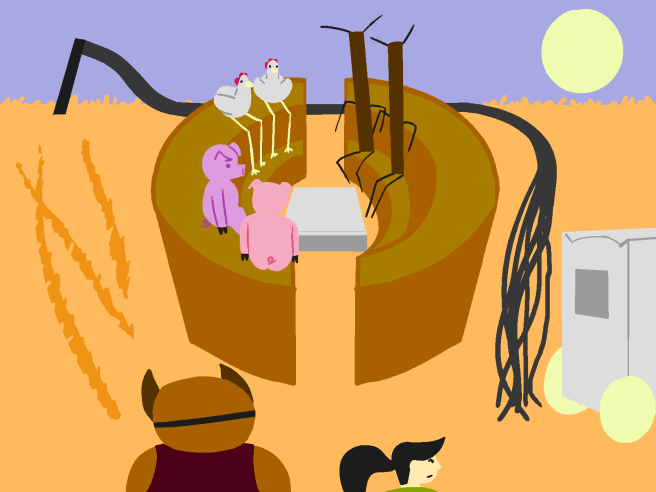
A labyrinth erupted around him, showering the room with debris and tossing the war-table into the air.
Commentary
Next Chapter

I made a YouTube video!

I figure nobody reads anymore, so I’d might as well board a sinking ship and make videos about anime on YouTube. I embedded the video below, but first I’d might as well talk a little about the chapter of The Minotaur’s Board-Game I posted today.

When Aria breaks Homer’s heart, Homer runs into the wild wastes and finds an entrance to (exit from?) a labyrinth. We’ve been warned minotaurs get homesick, but Homer’s commitment to stay on the surface and defeat the dwarfs redoubles when he sees that dwarfs have killed some minotaurs for their heads.

Homer wins a table-war against the dwarven machine, but loses the next round. For the first time ever, gnomes award a commander more than five points when the dwarven machine’s victory earns nine.

Awarding points is a great knob for me to twist, as a writer. What I mean is, it’s easy to replace nine points with eight points, if I decide I need to. I strongly believe no how much planning a writer does, the act of writing is just making things up as you go; if I notice something doesn’t make sense, I can go back and change it. Nothing is written in stone, and having gnomes award points makes the story quite pliable.

I also like the reveal that gnomes and dwarfs used to be the same race. There’s a lot of baggage in using classic creatures like elves, dwarfs, gnomes, and all that, because in many fantasy stories, these races are essentially copy-pasted, but I’ve tried to shake things up. Giving dwarfs and gnomes a peculiar, entwined history makes them stand out in a world of Lord-of-the-Rings knockoffs.

So anyway, here’s that video. It’s about Kaiji: The Ultimate Survivor, an anime about a guy who gambles his limbs. Spoilers!


Next Chapter
Table of Contents

Homer VS the Sphinx

(This is part eight of a fantasy series starting here. So far, Homer the minotaur is the front-runner in a board-game tournament whose champion will protect the world from a dwarven robot. Today’s final round of the tournament will determine the fate of the monsters of the wild wastes.)


The centaur, sphinx, and harpy entered the tournament after the first round, so they agreed to host the final round in the wild wastes to wrap up all their matches at once. On the way there, Homer and Aria watched the ever-changing horizon from their carriage; Aria wore a black glove over her burnt right hand. Sir Jameson rode in a mysterious white carriage behind them. “Big day, Homer,” said Aria. “If you win well, you’ll be champion for sure. But the monsters will give it their all; I’ve heard Queen Anthrapas won’t recognize the wild wastes as sovereign unless they win two matches today.”

As they stepped from the carriage, Homer sniffed the air. On the journey through the wild wastes he’d passed icy tundra, baking desert, and dense jungles. Now he entered broad savanna. The arena was circled by a great black whip three miles long. “Arra.”

“Hm?” Aria followed Homer’s gaze. “The whip is one of those demon’s weapons, like the ax, or the sword.” The savanna was still scarred by the whip’s ancient lashes.

pict1

The arena bustled with animals Homer had never seen: tall chickens sat beside upright pigs, and towering stick insects threatened to block the back row’s view of the table. These intelligent creatures of the wild wastes communicated with clucks, grunts, and clicks.

“Homer.” Aria elbowed his ribs, and Homer joined her in saluting Jameson’s white carriage. Sir Jameson opened the carriage door and helped Queen Anthrapas step out. With aid from Jameson and two gnomes in pink elven dresses, Anthrapas sat between ten royal guards to watch the table. “You should feel honored,” Aria whispered to Homer. “It’s been years since Queen Anthrapas left her throne-room to watch table-war.”

Homer nodded and sat at the table. “Sfinks?”

“That’s right. You’re up against the sphinx.” Aria pat him on the back. “You and the sphinx have both won ten points in two rounds. It’s only natural to pit you against each other.”

The gnomes brought Homer his bag of brass cards and figurines. Homer prepared his throat for a few unnatural words. “Houw sfinks uin?”

“How’d the sphinx win?” Aria licked her lips. “I asked audience members from those matches what happened. They say the sphinx fought with only one figurine: her own. She’s tougher than she looks and nigh invulnerable. Makes sense to me; if she weren’t, humanity would have captured her to use as a game-piece by now.” Homer puzzled over that while searching through his brass cards. He showed one to Aria. “Scales? Yeah, you can use my dragon. But if he escapes into the wastes, he’s never coming back. Good luck.” Aria sat beside Anthrapas and Jameson.

The sphinx entered the arena flanked by her centaur and harpy friends. The animals in the arena cheered; stick insects twiddled their antennae in satisfaction. Queen Anthrapas clapped by limply slapping the back of her other hand.

The sphinx leapt upon the seat opposite Homer. “How do you do?” Before Homer could answer, the centaur turned to show he carried three gnomes in strange costumes: one had a skirt of feathers, one had a horse’s tail, and one had ivory claws. The one with claws dismounted and gave the sphinx her brass card and figurine. “Have you selected your army?”

pict3

Homer inspected the sphinx’s figurine. It looked just like her, and if it were killed, the sphinx would never play table-war again. If the sphinx was confident enough to play on the board, and had already won two table-wars, Homer would need his strongest units. He pulled out Scales’ figurine.

pict4

Scales’ new figurine had an odd pattern on its neck. Homer recognized the brand of Queen Anthrapas, and apparently the sphinx did, too, because her whiskers twitched. “That figurine has suffered your selfsame fate.” Homer’s brow furrowed. “I heard you emerged from your labyrinth into human territory and you’ve fought for humans ever since. You and your dragon are both branded.”

Homer looked at Queen Anthrapas and Aria Twine.

“That’s why I’m fighting.” The sphinx’s tail swished. “I’ll never fight for anyone else, not as commander, not as game-piece.”

“Mmslf.” Homer put both hands on his chest.

“You fight for yourself?” The sphinx grinned. “Everyone says so, but humans and elves fight for their queens, and dwarfs fight for the Mountain Swallower. We in the wastes are slaves only to our natures.” Homer arranged more figurines. The sphinx’s tail’s tip flitted and she bit her lip with her fangs. “That said, I can’t resist a good riddle. I suppose it’s my nature. Is it your nature to hear my riddle?” Homer kept his hands on his figurines. “I told the same riddle to the other commanders before our matches. Neither of them seemed to get it. I can’t imagine you would, either,” she added, “having little control of the language.”

Homer nodded. “Rriddle.”

Said the sphinx:

“It’s weightless. It’s silent. It hides in the dark.
It’s grounded, but flies; it leaves not a mark.
We’ve all got our own, but they have the same name.
If you guess it, it might win you the game.”

Gnomes sculpted sandy dunes on the war-table. The sphinx pushed her figurine forward with a paw. Homer reconsidered the riddle and his choice of figurines; he set Scales beside six soldiers with slings. He reminded his gnomes that his troops wore desert-appropriate clothing, even though Scale’s presence chilled the air. Homer gestured to the sphinx to offer her the first turn. She declined by shaking her head.

“The game begins,” said a gnome in a dress. “Homer moves first.”

Homer pointed at Scales’s figurine, and at the sphinx’s figurine. He tapped fingers with his gnomes. “The dragon unleashes its icy breath.” The gnomes moved Scales’ articulated limbs and wings to show the awesome power of the maturing dragon. Scale’s figurine even had a hinged jaw so the gnomes could open its mouth. The gnomes scattered white powder to demonstrate the snowy aftermath of Scales’ freezing exhalation.

pict6

The sphinx’s figurine was at the snowy epicenter, but the sphinx herself was unfazed. “The cold is weightless and silent, and flying snowflakes fall to the ground without leaving a mark, but they hardly hide in the dark, and you ignored line three entirely. Gnome.” Her gnome with ivory claws pulled the sphinx-figurine’s tail. The figurine ballooned twenty times in size.

pict7

Homer grunted, and the sphinx giggled. “You didn’t know? Etiquette demands I restrain myself in public, but in my desert and on the table I’m free to expand to my true volume.” Her figurine was almost big as her, and mercilessly colorless.

Homer pointed to his soldiers. The gnomes showed how they gathered rocks around the desert and slung them at the giant sphinx, who batted the stones out of the air. With feline poise she sauntered to Homer’s side of the table and smacked his soldiers off the edge. The sphinx mewled with pride. “Slung stones are ‘grounded’ and could be called weightless and silent, and I suppose you can’t aim in the dark, but leaving no mark? And line three is giving you trouble, isn’t it?”

pict8

The sphinx figurine leapt upon Scales and bit at his neck. Homer pointed to the sky; Scales flew five feet above the table, supported by almost invisible gnomish scaffolding. The sphinx pounced high enough to nip his wingtips; Scales sailed five feet higher before circling safely.

pict9

“What a poor place to end the game,” said the sphinx. “Gnomes, what’s the score?”

The gnomes in dresses convened with the gnome with ivory claws. “You have four points for killing Homer’s men and injuring his dragon. Homer has two, for at least escaping with Scales alive—unless the dragon decides to flee from humanity’s custody.”

The sphinx watched Scales circle above the table. “What say you, Homer? Time to throw in the towel?”

Scales kept flying between the sun and Homer’s eyes, casting a—“Shdow,” said Homer. “Jadow. Sh—Shadow.” He pressed his hand against a gnome’s to tap a message. The gnome made Scales fly away from the table.

“It’s over, then?” The sphinx purred. “Pity I couldn’t get five points, but four will do.” As Scales’ shadow tracked across the table, the sphinx’s eyes widened. “Oh! No, no, no!” She whipped her tail against her gnome, who made her figurine try dodging Scales’ shadow, but too late. Scales’ shadow pinned the sphinx’s figurine in its tracks. She seemed unable to move a muscle. “I surrender,” said the sphinx. “Please spare my game-piece.”

pict10

The gnomes convened. “The sphinx wins two points for killing Homer’s men and injuring his dragon. Homer wins four points for winning the round. If this were not a tournament-match, the sphinx and her land would be forfeit to humanity.”

Sir Jameson whispered to Aria: “What just happened?”

“I can’t tell.” Aria squinted at the table.

The sphinx’s mouth twitched like she couldn’t decide if she were outraged or impressed. She finally jumped from her chair and dashed out of the arena, growing larger and larger until her powerful bounds were shakily audible as she passed over the horizon.

pict11

Homer collected his figurines, saluted to Queen Anthrapas, and sat beside Aria. As the harpy strutted toward the table and his feathery gnome scraped away the old map, Aria whispered to Homer. “She had you on the ropes. Why’d she forfeit?” Homer shook his head; for some reason he didn’t feel like disclosing the sphinx’s weakness. “Anyway, swell work—you’re tournament champion for sure. We’ll see what the gnomes say after all this.”

An elf approached the table. Homer recognized her as Madam Commander Victoria. She won five points against Thaddeus in the first round, but lost with zero points to the sphinx in the second, so her score was tied with the middling harpy. “Let’s make this quick,” she said. “Neither of us is tournament champion, but don’t imagine I’ll let you win out of the goodness of my heart.”

Her three gnomes in pink dresses built the map on the table. The harpy’s homeland was a hillside of pine trees. The harpy scooped figurines onto the table with his wings. Every figurine was a harpy. “These are my friends! They volunteered for battle, bukawk!”

pict12

Madam Victoria’s gnomes brought her one enormous figurine. It was the giant squid Stephanie had used against Aria months ago. The harpy’s gnome objected. “Can you tell me how this giant squid will reach the landlocked location of the match?”

Victoria’s gnomes gave the harpy’s some brass cards. “These are elvish shorties,” they announced for the audience. “They prod the squid with spears to encourage it from its coastal home to this map.” The gnomes demonstrated how the squid could clamber over any obstacle the terrain presented. “The shorties keep the squid hydrated with barrels of water brought from nearby rivers.”

The harpy squawked at the size of its opponent. “Can I at least have the first turn?”

“I can’t even give orders to my untrained squid,” said Madam Victoria. “Make your move.”

The harpy pointed his wings over the table. “My friends fly in circles above, out of the squid’s reach!” The gnomes erected almost invisible scaffolding to hold the harpy-figurines five feet above the table circling the squid.

Victoria shrugged. “Go on.”

The harpy puzzled. Victoria’s gnomes made the squid’s tentacles wiggle threateningly. “We’ll dive-bomb,” said the harpy. “One by one, we’ll streak by and strike!” The figurines zoomed down.

Victoria yawned. Her squid snatched harpies and ate them alive. “Nice try. Your harpies couldn’t scratch my squid.”

The harpy chuckled. “Your squid?” The harpies who slipped past the squid pulled shorties into the sky and dropped them onto rocks from a great height.

“Spear them!” Victoria’s remaining shorties fought back with spears, but harpies flanked them and ripped the shorties to shreds. Then the squid snatched those last harpies and ate them, too. “Hm,” said Victoria. “Well, the table is mine.”

The gnomes convened. “Not quite correct, ma’am.” The gnome with the feathery skirt stood on the table. “All the harpies and shorties are dead. The squid has no one to care for it, and will die of dehydration in days.” The gnomes marked every brass card as unplayable and confiscated the figurines. “There is no clear winner. One point to both sides.”

“No clear winner?” The harpy squawked. “I killed the squid, bukawk! I won! I won!”

“You killed the squid by sacrificing the land’s inhabitants,” said the gnome. “We cannot say you won.”

Sir Jameson folded his arms. “How immature,” he said to Aria. “I’ve never seen a commander debate the gnomes like that before. And the harpy couldn’t be champion with even five points.”

“You didn’t know?” said Aria. “The creatures of the wild wastes don’t care about having a champion to fight the dwarfs. They needed two wins today for Queen Anthrapas to recognize the sovereignty of the wild wastes. The sphinx lost; if the harpy lost, too, then the centaur can’t salvage them.”

“I won! I won! My enemy has no army! Bukawk!”

“Your army was eaten alive,” said the gnomes. “We considered giving you no points at all.”

Homer looked over his shoulder at Queen Anthrapas. The queen seemed unmoved. “Gween.”

Queen Anthrapas spared him a glance. “What?”

“Animl.” Homer pat his own chest. “Ma uin.”

Aria grabbed Homer’s shoulder. “Don’t worry, Queen, it’s nothing.”

“Ma uin,” Homer said again. “Animl.” He took one of his gnomes by the hand and tapped a message:

“Homer says that when you introduced him to the creatures from the wild wastes, you called him an animal and made him prove his allegiance to humanity. If he’s an animal, shouldn’t his win count for them?”

Aria stomped on Homer’s hoof. “Homer!” she seethed under her breath, “Keep this up and you’ll never play table-war again!”

Anthrapas waved a hand. “Fine.”

“What?” Aria turned. “Really?”

“If it matters to you that much, I’ll consider your opinion, Homer.” Anthrapas watched the centaur approach the table. “If the centaur wins this table-war against the seafolk champion Namako, I’ll agree to treat the wild wastes as an independent nation.”

Homer looked to the centaur and back to Anthrapas. “Sank yu.”

“Thank you,” said Aria. She wasn’t sure if she was translating for Homer or thanking the queen on her own.

The centaur’s opponent rolled into the arena: Namako was a sea-cucumber in a giant tank of water. His gnomes processed ahead of him; they were adorned with shells and jewels.

pict14

When the tank reached the table, Namako’s whole body convulsed. White thread blasted out one end until the whole tank filled with forking innards. Gnomes explained: “Commander Namako preemptively surrenders. Five points to the centaur.” They rolled the tank from the arena while the audience murmured and pondered.

pict15

“I think those were his intestines,” said Sir Jameson. “I’d surrender, too, if my intestines fell out.”

“I guess you did it, Homer,” said Aria. “The wild wastes are sovereign territory.”

Anthrapas fell from her seat. Her crown crashed on the ground.


The royal guards lay her in her long, white carriage to rest. Around sundown, Sir Jameson opened the carriage door. “Aria? She wants to see you.”

Jameson stepped out of the carriage and Aria stepped in. She and Anthrapas were all alone. “Your highness? Are you alright?”

pict16

“Shove it.” Anthrapas tried to cough, but couldn’t. “Aria, it’s my time. I won’t live to see the sun again.”

“What’s wrong?” asked Aria. “Is your heart failing? Are your lungs weak?”

“I’m old, Aria, that’s what’s wrong. It’s my time,” she said again, “and yours. Tomorrow morning, you’re queen.” Aria’s face crunched in pain, but she shook her head and opened her eyes. Anthrapas managed to cough, and cleared her throat. “Your minotaur. He’s got to beat the dwarfs.”

“We don’t know for sure he’s champion yet. The gnomes haven’t—”

“He’s champion, Aria. He’s got fourteen points. Your minotaur has got to beat the dwarfs.” Anthrapas didn’t look Aria in the eye; she didn’t seem to know where she was. “Do you know what happens if that dwarven robot wins?” Aria nodded, but Anthrapas continued. “War. Real war, for the first time in centuries. The dwarfs have prepared for it. No one else has. It’ll be a bloodbath, and there’s no telling who’d survive to see the end.”

“The end of humanity,” said Aria.

“The end of everything,” said Anthrapas. “Can your minotaur beat the robot?”

Aria made fists. “I’m sure he can.”

“Can, or will?”

“He will.” She folded her arms. “Homer will beat the machine. He’s loyal to me. And did you see Scales fight the sphinx? That dragon’s game-piece could have fled to the wild wastes, and we’d have a worthless dragon in our stables, but it returned, out of loyalty.”

“Loyalty?” The queen rolled her eyes. It was all the movement she could muster. “Your ice-dragon returned because it was in the middle of a baking desert. It didn’t know where else to go. It cares for humanity only because humanity can keep it comfortable. If that sphinx had lived on a glacier, we’d be a dragon down. And your minotaur—”

Now Aria glared. “What about my minotaur?”

Anthrapas searched for words. “Homer… Homer is a man, Aria.”

“And?”

“And you’re oblivious,” said Anthrapas.

“Our relationship isn’t like that,” said Aria. “Homer wouldn’t be attracted to me anyway. I’m no minotaur.”

Anthrapas nodded, unconvinced. “You’ve lived alone in a shack too long.”

“Not anymore,” said Aria. “Now I’ve got a throne, and I’ll do it proud.”

“Thrones need no pride. No one does.” Anthrapas turned her head so her sightless gaze pointed to the window, as if looking for a great black sword. “Just… keep humanity going. Even if it means partnering with animals—or, god help you, even elves—keep humanity going.”

Those were her last words.

Commentary
Next Chapter

Stories about politics

In Homer Vs the Sphinx everyone’s favorite minotaur beats a sphinx at the board-game which shapes nations, table-war. The sphinx can’t help but present her own weakness with a riddle, and Homer, the perfect protagonist, solves it on his third try.

What does it mean for a story to contain politics? As a tabletop RPG-player, to me a story with ‘politics’ is one which focuses on feuds between competing factions. Since The Minotaur’s Board-Game is inspired by tabletop war-games like Warhammer 40K, it’s natural to have themed groups in constant conflict.

I don’t write a lot of these ‘political’ stories. The Minotaur’s Board-Game is sort of my first try. But, hey, write what you don’t know! Let me retroactively justify my thought process focusing on Aria Twine, the character at the center of our wheel of virtue.

Aria Twine starts as a homeless orphan child and becomes queen of humanity. On the face of it, this is an inspirational tale, sort of a rags-to-riches story. In reality, Aria’s been exploited for her talent every step of the way, and she didn’t even want to be queen. How can a street-urchin like Aria refuse the exploitation which feeds her? Anthrapas roped in her disciple for decades.

In this light it’s easy to pity Aria, but Aria also exploits Homer. If Anthrapas’ exploitation of Aria justifies Aria’s exploitation of Homer, is Anthrapas excused by her own inescapable duty to protect humanity? My view of a political story has every character subject to something: Stephanie and Madam Victoria are under the elven queen, who fears dwarven war; the dwarfs work under the mysterious Mountain Swallower. The ancient memory of war motivates characters whether they like it or not.

The sphinx doesn’t want to serve anyone. She says she’s under nothing but her own nature. Her nature is her strength, by giving her invulnerability and imposing size, but her nature is her weakness, by freezing her in shade and compelling her to reveal that through riddles. I hope this links the sphinx’s riddle to political themes without seeming convoluted and janky. She literally can’t stand being in someone’s shadow. She’s a walking power-vacuum struggling to stay free.

In Red Mountain DanJay I compared all life to colossal anime robots piloted by thousands of people. The Minotaur’s Board-Game goes the opposite direction by comparing war to miniature board-games, making battles look like skirmishes between white blood cells and invading bacteria.

And in The Circular Pangolin the protagonist’s peculiar guide says

“The cactus is like all organisms: it transmutes foreign substances into its own flesh.”

From every cell’s semipermeable membrane to every cactus retaining moisture, and from every pilot of a giant anime robot to every fantasy race securing their borders, the nature of ‘politics’ and reality itself is a decomposition of phenomena into groups.

Homer the minotaur doesn’t fit easily into any group. Half man, half beast, he’s only allowed to fight for humanity because of his utility. But this utility makes Homer indispensable, giving him a rare upper hand against humanity’s queen: when he says his victory should count for animals everywhere, Anthrapas immediately concedes. Anthrapas knows Homer is the best option to protect humanity—and everything else—from dwarves. On her deathbed, she seems to tell Aria that protecting humanity is worth accepting the fantasy world’s diverse population.

But the seafolk figured out “togetherness” centuries ago. Emperor Shobai is a clam with crab legs married to a seahorse with a tentacled lobster-nephew. Unlike the surface world, where humans, elves, and dwarfs segregate themselves, the sea is a mishmash of incongruity, and it works. While landlubbers force their oddballs into the ‘wild wastes’ and then capture the best to exploit, the seafolk are unified oddballs, like the centaur, harpy, and sphinx. Maybe Namako ejected his intestines on purpose because seafolk see kindred spirits in the ostracized monsters.

Next chapter, Homer must confront the dwarven table-war robot, and Aria will take her place as humanity’s queen. Follow me if you’d like to catch it!

Next Chapter
Table of Contents

Why Table-War, Why Minotaurs

In The Elf vs The Dwarf Homer the minotaur watches the mysterious dwarven champion beat an elf at a board-game, claiming land on the border of the two races. This is actually the first time we’ve seen land trade hands because of a table-war, but supposedly this happens pretty often. Table-war makes battle abstract, so nations have no reason to avoid conflict. I hope this reflects the futility of war in general and war in the age of computers in particular.

When I started writing what would become The Minotaur’s Board-Game I thought I’d make the minotaur play chess. I gave up because anyone who actually enjoyed chess would see I was talking out my butt. Chess has strategies and a history I couldn’t do justice without loads of research, and research is hard. Plus, even if including chess made the story popular among chess-fans, it would simultaneously limit the audience to mostly chess-fans.

For the same reasons, I wouldn’t include any real game. If I used Poker I’d have to study up or else skilled readers would think “that’s a dumb move” with every play.

One of my inspirations for this story is the anime YuGiOh, in which teens play children’s card-games to save the world. I can appreciate the cheesiness of a card-game ballooning to such high stakes. Unfortunately, while the card-game actually exists in the real world—we call it YuGiOh—the anime TV-show doesn’t follow the real rules. Rules are ignored or invented on the spot to increase tension and let the hero win. The anime invented its own game and still can’t get it quite right.

My solution to these problems is to make a game without stated rules. Table-war is supposed to be a perfectly accurate replacement for war, and war doesn’t have ‘rules’ beyond the laws of physics, so I can put war on a table and it’ll turn out okay.

The good news is I can still make up rules whenever it’s convenient for me. Do I need Homer to look clever? Let him paint his figurines; no rule against that. Do I need Aria to accidentally screw herself over? She can—by adding new rules for one match. I can always retrace my steps and fiddle with rules as I go.

The really good news—for me, not for my characters—is that dwarfs can use the war-simulation to their advantage. In a real war, dwarfs could be outsmarted; the dwarfs called upon demons to win their last war, and it didn’t even work. In table-war the dwarven robot is indomitable, and without real war, there’s nothing any other nation can do about it.

The bad news is that war isn’t always interesting. So far, most table-wars have been won before the match even started: commanders imagine how their opponents will play, and whoever thinks farther ahead wins. A game of chess can flow back and forth; a game of poker can have a twist; most of my table-wars are one-sided. Sometimes table-wars can showcase counter-play, but still, I hope my one-turn matches can be compelling. Two characters go in, the reader is on-edge because of the stakes, and the better commander wins.

At the same time, the “one-turn war” isn’t necessarily unrealistic. War, like life, can be nasty, brutish, and short. Said Dwight D. Eiserhower, “In preparing for battle I have always found that plans are useless, but planning is indispensable.” So wars and plans for wars must be indispensable for the point of my story.

Computers can beat humans at chess. In the long run, I’ll bet computers can beat humans at Poker. If computers haven’t already taken war, it’s just a matter of time. The dwarven champion—a bunch of gnome-brains wired together—is a war-computer. When Homer eventually fights the machine, he’ll need to prove humanity (and elves, and seafolk, and monsters, and life in general) is more important than pure mechanical efficiency.

I figure table-war is the best place to prove that. If Homer won a game of chess, he’d just prove he’s better at chess. If Homer won a game of Poker, he’d just prove he’s lucky and steel-eyed. When Homer wins table-war, he’ll prove life has value.

Why is Homer the minotaur going to stop the dwarfs? The elvish queen seemed to think elves deserved the honor because elves and dwarfs are enemies, but I think a minotaur is the perfect symbol for life’s value in the face of machinery. Minotaurs are classically trapped in labyrinths; like an allegory for all sentient beings, they wake in the dark and stumble through an unhelpful world. Maybe minotaurs could be replaced with robots that walk aimlessly through mazes, but “one must imagine Sisyphus happy” and one must imagine minotaurs explore mazes with intent. Homer’s endless trials, in and out of his labyrinth, have shaped him and made him more than a maze-walker. He’ll never be free, because the outside world is a political labyrinth with no exit, but minotaurs can handle labyrinths.

In myth, Ariadne helped Theseus navigate the minotaur’s maze with a roll of thread. In The Minotaur’s Board-Game, Aria Twine ignores possible pupils like Thaddeus to lead her minotaur by the nose. Then, Aria realizes she herself has been led by the nose by Queen Anthrapas. In my next commentary maybe I’ll talk more about Twine’s role in the story, but so far I’m happy with how I’ve repurposed mythical figures.

Next Chapter
Table of Contents

The Elf VS the Dwarf

(This is part seven of an ongoing fantasy series starting here. Last week, Aria Twine reached into a fire trying to save a melting metal figurine from the traitorous human Thaddeus. Her minotaur Homer beat an elf at table-war without the figurine anyway. Now Aria has to confront Thaddeus before the queen of humanity.)


Aria wished she could revel in Stephanie’s defeat, but rage distracted her. She never knew she could feel this angry at a human like Thaddeus. She clenched her left hand; her right hand was bandaged and misshapen.

A gnome approached her on the bench outside Queen Anthrapas’ throne room. “Ms. Twine, I have come to change your bandages.”

“Not now,” Aria grumbled. “I’m waiting for the queen to call me in.”

Nevertheless, the gnome took her right hand and unwound bandages. “The queen sent me, ma’am. This will only take a moment.”

Aria shook her head. “My minotaur is hundreds of miles away, probably worried half to death without me. How could the queen make me come back to human lands n-ow!”

pict1.png

The gnome took the bloody bandages. Aria’s hand was red, withered, and covered in coin-sized blisters. She squirmed on the marble bench as the gnome poured cold water over her palm. “You need physical therapy to prevent scarring. Burns on the hand can—”

“I get it, I get it.” Aria covered her eyes as the gnome wrapped her hand with fresh bandages. “Can I go now?”


Queen Anthrapa’s marble throne-room was as sterile as Aria’s new bandages. Thaddeus polished his jacket’s buttons with his own freshly bandaged right hand.

pict2

Thoughts wrestled behind the queen’s tired eyelids. She rubbed her aching temples. “Aria. Thaddeus. Both of you contacted me at the same time with the same story. Thaddeus, tell me what happened again. Aria, be quiet.”

“Like I said, Queen Anthrapas, your majesty, it was terrible.” Thaddeus agonized over his bandaged hand. “I knew Aria might sabotage her minotaur. She’d already sold imps to the elves, hamstringing me and Harvey in the tournament; who knows Aria’s true intentions? I followed her to elven lands, and sure enough, I saw her melting her minotaur’s best game-piece, the silver dragon, after stipulating only accurate figurines could be used.”

With sarcastically arthritic effort, Queen Anthrapas gestured for Thaddeus to continue.

“Thinking quickly, without regard for personal safety, I reached into the flames and grabbed the figurine! But, too late. It was already half-melted.”

Aria made fists with both hands. Her right palm burned. “I see,” said Queen Anthrapas. “Thaddeus, do you know the outcome of the minotaur’s board-game? Don’t say anything, just nod or shake your head.” Thaddeus shook his head. “Homer won. Five points to zero.”

“Thank goodness,” said Thaddeus.

“Cut the act.” Queen Anthrapas silenced him with one hand. “If Twine had sabotaged her minotaur, she’d’ve done it right and her minotaur would’ve lost. Thaddeus, this is your last chance to confess to treason.”

Thaddeus shrugged. “Even if you don’t believe my story, there’s no way you could prove me guilty. It’s my word against hers.”

Anthrapas nodded. “Gnome.” The marble doors opened and a gnome entered holding ragged bloody bandages.

Thaddeus gripped his seat.

The gnome held the bandages for Queen Anthrapas to inspect. She sighed. “When you both contacted me with the same story, I knew the real perpetrator would try to brand themselves on an identical figurine after the fact. So I preemptively branded the dragon—the real dragon, Scales.” The bandages had distinct patterns of blood in the shape of Anthrapas’ seal. “The perpetrator bought Scales’ figurine at a hobby shop. It was authentic enough to feature the dragon’s latest brands.”

pict3

“You branded my dragon?” Aria huffed.

“Whose bandages are these?” asked Anthrapas. Her gnome pointed to Thaddeus.

“There’s an explanation,” said Thaddeus. “Aria must have realized you’d do this and—”

“There was a time,” interrupted the queen, “I’d have you drawn and quartered. Each quarter would be fed to a different wild animal. Then I’d personally burn your intestines and strangle you with them.” Thaddeus soaked tears with his bandages as two royal guards flanked him. “That time is gone—not long gone, but gone. Maybe I’ll just bring you to the great black sword outside my window. I’ll tie both your legs to different horses and whip them so they run on either side of the blade. It would be quick.”

“Forgive me, Queen—”

“You’re nobility, aren’t you? Your parents own land. Maybe I should donate the territory to the wild wastes. Or the elves. Or seafolk. Or dwarfs.”

“Please, just—”

“Or maybe,” she said, “Humanity’s Path to Victory should choose your punishment.”

Aria chewed her lips. “You branded my dragon.”

“It’s my dragon, Aria. Get over it.”

“Well, elves always need more shortlings.” Aria watched Thaddeus sweat. “Trade him for dragon fodder to make it up to me.”

“I’ll consider it.” Anthrapas waved Thaddeus away. “Guards, escort him to the dungeon. Gnomes, follow them out.”

The throne room suddenly emptied. Aria had fought a hundred table-wars here, and had never seen it empty of even gnomes and guards. The queen and Aria sat in silence. Beneath the marble floor, magma gently bubbled.

“Shall I leave?”

“You shall not.”

Aria stayed. The setting sun shined through the window, and the great black sword in the distance cast shade over the queen’s face. She sighed and released tension from her shoulders. “Twine, close the window.”

pict4

“Yes, ma’am.” Aria rushed to a long hooked pole near the back wall, and used it to close heavy drapes. Only flickering from the underground magma lit the throne room.

“I’m getting old, Twine.”

“I’m sorry, ma’am?”

“Don’t play dumb.” Anthrapas felt the bones in her hand, and pushed blue veins over her knuckles. “I watched Emperor Shobai take his throne decades ago. I’ve lost track of my age.”

“You’re ninety-seven, ma’am.”

Aria expected a rebuke, but the queen just watched the flickering magma. “For decades, my council of nobles has wanted me to declare a successor. Hubris, I suppose, kept my hand. Humanity grows impatient for my retirement or my death.”

“I’m not eager for your death, ma’am. You took me in when I was just a kid.”

“You’re it, Aria. You’re queen when I croak.”

“What? No!” Aria shook her head. “I don’t want to be queen!”

“You’re slippery, Aria, but I’ve got you good.”

Aria spoke through her teeth. “I never wanted this.”

“But I always did, and you walked right into it.” For the first time Aria could remember, Anthrapas laughed. “I was worried when your game-piece was assassinated and you left to live in a shack, but you rode back to me on a minotaur. I didn’t even have to nominate you to my council of nobles; they recommended you after Homer beat Ebi Anago.”

“I refuse.”

“You reached into fire for humanity. You can’t refuse.”

“Of course I can.”

“Legally, yes. But you, Twine, I know you can’t refuse.” Aria looked away. “We both win. You seek personal glory. I seek humanity’s safety. Now your glory hinges on humanity.”

“I didn’t ask for that responsibility,” said Aria. “I like table-war. I like raising monsters. I never did it for humanity. I reached into fire for myself.”

“You can still back out,” said Anthrapas. “My council could choose another.”

Aria paused. “Who… who is the council’s next choice?”

“Thaddeus.” Anthrapas laughed until she coughed and choked. “He’s noble blood. He’s not bad at table-war. He’ll gladly accept, if it means he’s not sold to the elves.”

“But he’s awful. He’s a scumbag.”

“So you suddenly care?”

The magma cracked and spat. “…You win. I’ll be queen.” Aria sat. “You beat me, and I didn’t even know we were playing. But now, Homer needs me.” She crossed her arms. “I haven’t seen him in days. Where is he?”

“I had Sir Jameson escort him to the baked caldera,” said Anthrapas. “It’s contested territory on the elven/dwarven border. The Mountain Swallower’s champion has challenged the elves for the land; as the tournament front-runner, Homer should see the dwarven champion in action.”


Homer sniffed smoke which dimmed the sky. The flat, featureless horizon was quiet ash. The audience of elves somberly filled benches in the impromptu arena.

pict5

“When are the dwarfs coming?” complained Sir Jameson. “If they declare table-war, they should at least have the decency to show up.”

“They should arrive shortly.” Quattuor sat patiently. “Dwarfs are many things, but never late.”

The elves clapped for an elderly elf scowling her way to the table. Her hair was in a tight bun to make her look tall—almost five feet—but her nose was raised even higher. “Llf?” asked Homer.

“The elf is Madam Commander Victoria. Her first tournament match was against Thaddeus, and she won handily. She was meant to fight the sphinx next, but she postponed that match to defend the baked caldera.”

“They should just let the dwarfs have this place, to be honest,” said Sir Jameson. “What an eyesore.”

“If dwarfs claim it, they will be a step closer to the elven capital,” explained Quattuor. Homer smelled the dwarfs before he saw them. Their stench attracted buzzards, and elves covered their noses. Dwarfs filed into the arena. Their clanging coal-colored armor covered every inch of skin. The first dwarf in line wore thicker, brighter, silver armor; this dwarf’s teeth were black. “The Mountain Swallower,” whispered Quattuor to Homer.

The Mountain Swallower’s voice made the scars on Homer’s chest itch: “Fight.” The king of the dwarfs sat opposite the elves in the arena. More dwarfs surrounded their leader leaving one lone dwarf, their champion, sitting at the central table across from Madam Victoria.

pict6

Homer sniffed. He pointed at the dwarven champion, and tapped Quattuor on the shoulder. “What’s he say?” asked Sir Jameson.

“The dwarven champion does not smell as foul as an ordinary dwarf,” said Quattuor.

Jameson chuckled. “The smartest dwarf ever is the first one to figure out how to bathe.”

Victoria summoned five gnomes in pink dresses. “Have you no gnomes?”

The dwarven champion said nothing.

“I’ll need more gnomes to help set my figurines.” Victoria pointed to Quattuor. “I’m borrowing you.” Quattuor obediently joined the other gnomes powdering the table to make it look exactly like the baked caldera in miniature. Then they helped Madam Victoria arrange her army of elves.

The dwarven champion placed three figures on the table: a dwarf, a catapult, and pile of stones.

“Are you serious?” Victoria stood on her chair to see the dwarf’s side of the table. “Is that all you’ve got?”

The dwarven champion raised one hand. Quattuor matched fingers with the dwarven greave to communicate in gnomish. “These are all their figurines,” confirmed Quattuor.

Victoria sat and admired her army. “This will be easier than I thought. For a moment, I might have been worried.”

“So sure?” The Mountain Swallower stood. Its crumbly voice made shorties cry. “A wager, then. If you win, you’ll take my helmet. If you lose, I’ll claim a gnome.”

Homer’s fur bristled. Sir Jameson put a hand on his shoulder. “The elf has this in the bag, big guy. And it’s only a gnome anyway.” Homer shook his head so hard his horns almost hurt someone. He pointed to his eye and drew his thumb across his jaw and across one shoulder. “Huh? Oh, right—you rescued Quattuor from dwarfs, all beat-up and abused. But gnomes don’t care that dwarfs cut off their limbs, and a magma-bath fixes them right up. You know that.”

Homer puffed.

“I accept your wager, Mountain Swallower.” Victoria’s army was arranged with precision befitting an experienced commander. “I offer the dwarven champion the first move.”

The dwarf raised another hand and another gnome jogged to join Quattuor in translating. The two gnomes struggled to keep up with the dwarf’s rapid finger-tapping. “Assistance, please,” called Quattuor, and all six gnomes clustered around the dwarf messaging each other. They tapped information onto the dwarf’s shoulders, too, which Homer found disturbing. He couldn’t imagine sending different signals with both hands while receiving different responses with both shoulders.

pict7

After thirty seconds, the gnomes broke formation and surrounded the table to show how the dwarf loaded its catapult with stones and launched them. Gnomes debated the effects of wind on the payload to make every stone follow a perfectly simulated arc.

pict8

“Slow down,” said Victoria. She allowed the gnomes to move the stones to their zenith. “Stop there. My elves clear this area.” The gnomes moved the elven army to make an empty circle where the stones would land. “Easy.”

pict9

The stones landed in the empty circle and ricocheted in all directions. “Your troops cannot react in time to the ricochet. The closest are stoned to death.” Gnomes scooped out figurines in an annulus of impact. “The next closest survive with debilitating injuries.” Gnomes knocked down elves in a much larger ring.

pict10

“What!” Victoria braced herself against the table. “You expect me to believe each of those rocks killed one elf and wounded two more?”

“I do not expect you to believe it, ma’am, but it is true.” The gnomes meticulously demonstrated the path of each stone individually. “While you consider your next command, the dwarf is reloading its catapult.”

Victoria surveyed her surviving troops. “I surrender,” she decided. “The remaining elves retreat. I suspect we’ll need them to fight another day.”

“The baked caldera is mine.” The Mountain Swallower stood. “I claim this gnome, the one with no dress. Dresses catch in my teeth.”

“Oh, dear.” Quattuor nodded to Homer and Jameson. “Perhaps we’ll meet again someday. Tell Ms. Twine I said goodbye.”

“Speak not.” The Mountain Swallower ate Quattuor’s head.

pict11

Homer bellowed as the Mountain Swallower chewed Quattuor’s shoulders and arms. The sound, like crushing gravel, made Homer’s fur bristle and showed the maze of scars on his chest. “Calm down, Homer.” Jameson patted Homer’s knee. “Dwarfs eat rocks, so gnomes are a delicacy, like fine cheese.” The Mountain Swallower finished with Quattuor’s legs and feet. “We’ll buy a new gnome from the elves.”

“Rrr!” Homer stood with enough force to knock over the bench, toppling Jameson and some dwarfs. “Rrarrr!”

The five gnomes in pink dresses stood between Homer and the Mountain Swallower. “The wager was accepted and the dwarven champion won. The Mountain Swallower’s actions are admissible.” The Mountain Swallower licked its teeth. Its tongue was blue and gray.

The ground pulsed around Homer. Dust puffed up like wild animals were bursting from shallow graves. Elves scattered. Homer lifted the bench above his head. “Homer, this is your last warning!” said the gnomes.

pict12

Homer smashed the bench over the dwarven champion. The coal-colored armor cracked and hard green gnome-brains spilled out. False teeth fell from the helmet. Homer dropped the broken bench. “Nno smell,” Homer explained.

pict13

Gnomes and elves gathered around the armor. “Their champion’s a fake!” said an elf. “The dwarfs cheated!”

The Mountain Swallower laughed. This rare dwarven laugh was like distant thunder rolling over ruins. “Ask any gnome—that pile of brains is a legally registered dwarven commander.”

The gnomes didn’t bother matching fingertips. “This dwarven commander was obviously registered under false pretenses, but is nonetheless registered.”

“Don’t act surprised. Dwarfs have built war-machines since the dawn of time,” said the Mountain Swallower. “Recently we’ve experimented by decapitating gnomes for their cold, calculating brains. When you beat the nine-brained seafolk, Ebi Anago,” it said to Homer, “we decided to wire up ten brains at a time.” More brains slopped from the dwarven champion. “We’ll add more if we like.”

“This is a flagrant breach of the intent of law.” Victoria pointed at the broken champion. “No one could beat ten gnomes at table-war, not if they can cripple armies with a handful of stones!”

“Nonetheless, it is registered,” said another gnome. “A registered commander can only be disbarred from play because of their own death or the death of their game-piece, or for violating the treaty. This ‘dwarven’ commander has done none of those things. Speaking of which,” he said, turning to Homer, “ordinarily you would be ejected for assault, but in these extenuating circumstances, we allow you to remain a commander.”


Aria didn’t wait for her carriage to stop before she jumped out and ran for the arena. “Jameson!” She waved for him with her bandaged hand. “Where’s Homer? What happened here?”

“Homer’s cooling off somewhere.” Sir Jameson flipped a toppled bench. “You need a new gnome; the Mountain Swallower ate yours. Homer got mad and smashed the dwarven champion, who’s apparently some gnome brains wired together. Look what Homer did to this dust! He was so angry this just sort of… happened!”

Aria slid her boot to trace a maze drawn in the dust. “I feel you, Homer. I really do.”

pict14

Commentary
Next Chapter

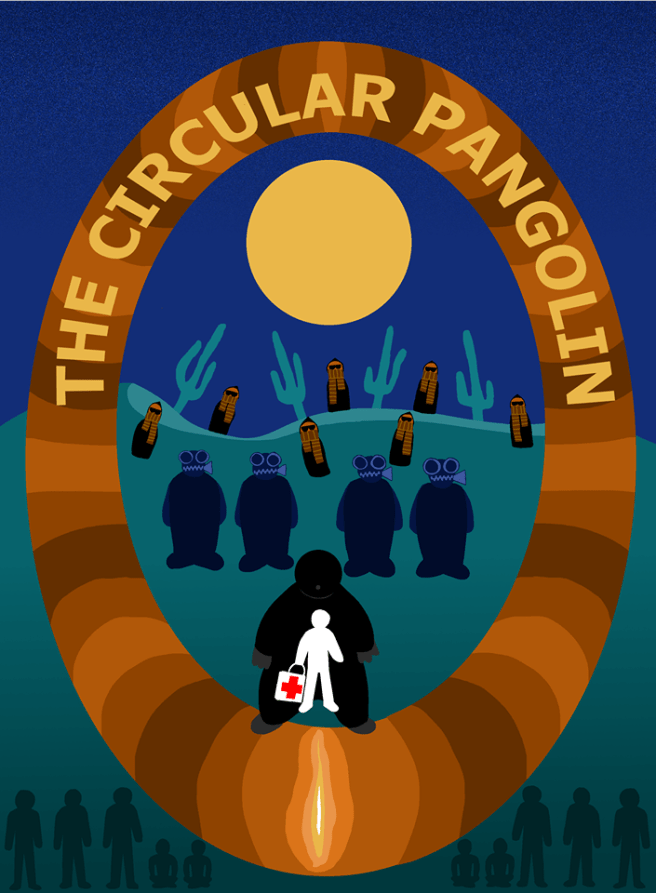
The Circular Pangolin

(I wrote this in 2017 and it won second place at UCSB’s 2018 Most Excellent Prose competition! I was inspired by an anthropology class where we learned about pangolins, small armored mammals often compared to armadillos. In Mary Douglass’ classic anthropology book Purity and Danger the pangolin stars in Lele rituals despite being “always spoken of as the most incredible monster of all” for its peculiar physiology. Douglass’ examination of religion’s paradoxical fascinations made me imagine my own weird fantasy pangolin cult.)

Circular Pangolin

In the desert you’re always leaking. When you’re out of sweat, and you’ve pissed your last drop, your sanity seeps into the sand. Clouds drift into the drought just to die. Only curled-up critters can handle the caustic heat. Them, the cacti, and the cultists.

Townsfolk call me Doc because that’s what I am. I used to have a nurse named Fernando, but Fernando lost his mind, so I lost Fernando. I spend most of my days reminding townsfolk to hydrate, but sometimes I get to stitch someone together, or cut them open, and they’d better hope I care to sew them back up when I’m done.

Night’s the only time you can take a decent walk, so one full moon I staggered out with a bottle of tequila. I liked to circle the farms drinking until the dunes looked like waves and I could pretend I was lost at sea. That night, before I could enjoy myself, a cultist confronted me on my porch.

The junior cultists came to town on moonless nights to beg for food. They wore black, hooded robes and slippers made of old rubber tires, and sunglasses, and scarves. That’s how I knew this particular cultist meant business: he (she?) wore the full rubberized regale. His black rubber bodysuit had footies an inch thick. I couldn’t see eyes through his dark glass goggles. He unzipped his fetishy face-mask to talk. “Doc, we need help.” Having spoken, he zipped his mouth shut.

“I’ve got plans tonight.” I shook the tequila. He just motioned for me to follow. “C’mon, cactus-herder! Can’t you even tell me what’s wrong?”

He unzipped again. “God is leaking.” And, zipped.

Well, what can you say to that? I brought my first-aid kit and followed him over the dunes.

We walked hours over the sand. Dunes looked like arctic tundra in the moonlight. Ordinarily I’d never venture so far from town, but the cultist seemed to know the way. “How do you navigate out here?” The question wasn’t worth unzipping; the cultist just pointed at the sky. His rubber gloves were so thick his fingers could barely bend. “You can see the stars through those thick goggles?”

He nodded.

“Doesn’t that suit get uncomfortable?”

He nodded, vigorously.

“So what’s it for?”

He unzipped, and I never thought I’d hear something so sane from that black mask: “In the desert you’re always leaking.” And, zipped.

When we crested the next dune a sandy caldera opened before us. Junior cultists scrambled from cactus to cactus like bats sucking nectar from flowers. They cut limbs from cacti to replant and propagate the species. They wrapped wax paper around red blossoms to preserve pollen. They sliced fruits and pulled down their scarves to lick the liquid which dripped. Not one member of the strange congregation revealed an inch of skin under their tunics and rubber.

I heard my guide unzip as he led me through the throngs. “Avoid eye contact with the students. Life-essence leaks at every opportunity.” And, zipped.

“Is that all you folks drink? Cactus-juice?”

Unzip. “The cactus is like all organisms: it transmutes foreign substances into its own flesh. But the cactus doesn’t lose what it drinks. We drink the cactus to become like the cactus. We don’t lose what we drink.” And, zipped.

We walked past scattered huts made of animal skins draped over long bones. I thought twinkles in the huts were stars, but realized they were glints off voyeuristic sunglasses and goggles. The huts’ inhabitants looked away when I noticed.

“What do you eat? Cactus?”

Unzip. “We grind cactus into a paste. This paste sustains us without causing us to urinate or defecate.” And, zipped.

“How do you fuck with these suits on?”

Unzip. “To do so would be unthinkable.” And, zipped.

“Now that’s no way to live.”

Deep in the caldera the sand was pebbly and coarse. Past the last of the huts more rubber-suited figures like my guide stood across the pathless path. My guide unzipped. “I am not holy enough to go further. You must approach the caldera’s center alone.” And, zipped.

Another rubber guide unzipped. “Stomp and shout when you reach the center. A holy man lives there whose renunciation leaves him almost totally senseless, who therefore has not lost a drop of essence in a decade. His sacred potential is so great, a cut in his robes would beam like the moon. He will lead you to God.” And, zipped.

“Okay, okay. I get the picture.” The sand below was rocky and steep. I put my first-aid kit in my lap and descended the slope on my ass. “What’s the name of this holy man?”

Unzip. “To utter it would tarnish its purity.” And, zipped.

I climbed down into the caldera longer than I thought was possible. The depth dimmed the moon and the stars. The sand turned into stones turned into rocks until the ground was paved with boulders. I finally came to a place where the boulders sloped upward in all directions, so I reckoned it was the center. I stomped and shouted at the dark.

Movement rumbled from the dark: a silhouette I thought had been a boulder stood up and lumbered toward me on a gait restrained by thick black rubber. The holy man looked like an inflated cartoon character with outlines eight inches thick on all sides. His rubber gloves allowed only the barest use of his fingers. His rubber helmet was spherical with a mere pinprick for breathing and no other orifices.

“Listen,” I started, then, realizing he probably couldn’t hear me, amended myself: “If you can, I mean, listen. I’ve been more than cooperative.” The holy man managed to move his arms to twist his helmet so the pinprick for breathing was aligned with his left ear. I spoke quickly so he wouldn’t suffocate. “Just show me what I’m here to do.”

He swiveled his helmet back to breathe. Slowly as dunes roll over the desert, slowly as stars roll over the sky, he shifted weight from one foot to the other to walk. I followed, wondering if I could roll him to his destination faster than he would waddle. He led me to a gap between boulders in the ground. The gap was just large enough for someone to spelunk. I prayed it would not be necessary.

The holy man tugged my collar. “What? No clothes allowed underground?” He nodded, somehow, and I unbuttoned my jeans. “Am I here just because you don’t fit down the crevasse with your dumb rubber suit?” He shook his head. “Well, why am I here, then?”

The holy man drew letters in the air with a bulky glove. He spelled, “because you’re the best, Doc.”

I paused on my descent into the ditch. “Fernando?” I covered my mouth. “Sorry. I’m not supposed to say your name, am I?”

The holy man pat my head, and he pushed me downward.

Deep in the crevasse the age of the air weighed on my shoulders. I lowered myself ledge by ledge while holding my first-aid kit with my teeth. The ditch was so dark I had no clue how deep it ran. More than once I cut my soles on black cacti. I realized I didn’t know whether I was approaching God’s wound, or climbing inside it. Either way, the innermost lacerations would need to be sutured first.

After a duration whose length I couldn’t guess I felt nothing below me but cacti. I bouldered left and right but still felt sharp spines below. I whimpered, having no strength left to climb from the crevasse. I cursed myself for following cactus-herders.

When my strength gave out I fell. My back cracked cactus fronds and three-inch spines stuck me like a porcupine.

I landed in an empty cavern. I hardly remember falling, or how long I fell, and only recall waking nude and bloody. The walls of the cavern were dimly lit by shelves of glowing fungi.

I crawled to my first-aid kit. I started by injecting painkillers, though it felt counterproductive to puncture myself more. Then I set to work plucking each spine with tweezers. When I plucked my left arm bare it was polka-dotted with pox-like perforations. Before plucking my right arm, I examined my surroundings. The cave rocks were bigger than the boulders in the caldera above; they were sheets of stone slotted together like plates of armor.

Behind the glowing fungi, the walls were subtly transparent. I shuddered when I looked deeper: human figures were frozen in stone like bugs preserved in plastic. Some stood at military attention. Some sat with crossed legs. Some were balled in the fetal position. I turned away to pluck spines from my flesh.

When I was finally spineless I packed my first-aid kit and walked around aimlessly. Maybe God would transport me to the surface if I patched him up, but I didn’t find anything Almighty, just more rocks and fungi. I wandered to the walls for guidance. “I don’t suppose you frozen folks know where to find God, do you?”

“They already have.” The voice boomed from everywhere. I felt stones beneath me rumble and writhe. “I did not hear you come in. Welcome, Doctor.”

“What kind of God can’t feel someone crawling on them?”

“I feel everyone crawling on me,” said the earth. Rocky plates unfolded like flower petals with only more petals underneath. Sliding sheets of stone threatened to crush me, but I found a safe spot to stand: the center was stationary like the eye of a hurricane. The surrounding rocks bunched up like a bundt cake. When it finally finished moving, it looked like a circular pangolin wrapped around me.

“So.” I brushed stones with my fingertips. “Where does it hurt?”

Stone sheets rustled. Plates parted like elevator doors. More plates behind them parted vertically. More plates behind them parted diagonally and pure white light leaked through a slanted slot. “Prepare, Doctor. This will not be a sight for which your vision is accustomed.”

“Tell me what happened.”

“I cannot.”

I donned sterile gloves and ran a finger along the shining slot. The circular pangolin’s inner light showed me the shadows of bones in my finger. “I can’t help you if I don’t know what’s wrong.”

“The holy man said you were the best available for sewing someone up.”

“It helps if I know what cut them open.”

The circular pangolin’s plates contracted. “I harvest mana from ether. The astral planes resist me with a hazardous…” It searched for a word. “Exoskeleton.”

“You cut yourself cactus-herding?”

“Metaphysically speaking.”

“Lemme take a look.”

The innermost plates parted and the brightness increased ten-thousand-fold. I couldn’t tell the difference between opening and closing my eyes, so I closed them and covered them with both hands. This hardly dimmed the light, and I felt utterly transparent. I wondered if my thickest bones still cast shadows or if the light penetrated even my pelvis and femurs when I walked into the rocky armor. I heard the stone sheets close behind me like air-locks. I felt labored breathing from all directions. The floor was warm and wet. I blindly felt for walls.

“So, why am I naked?”

“My inner light would disintegrate your clothing. The holy man will guard your garments.”

My hands brushed a warm wall. “Is this you?”

“It is.”

“Am I close to the wound?”

“You’ve been walking inside it.”

I considered the contents of my first-aid kit. “I didn’t bring enough anti-bac.”

“It is not necessary.”

“We can’t leave foreign objects when I sew you up. It’ll getcha whatever the metaphysical equivalent of an infection is.” In the blinding light I had to assess the wound by touch. I could barely brush both sides of the laceration with my arms outstretched. I couldn’t reach the top of the wound even jumping with my hands above me. I walked hugging the left wall to gauge the laceration depth: the left wall ended twenty paces from the deepest portion of the wound. I’d found the pangolin’s real flesh: even under plates of stone armor, its skin was a foot thick and covered in hard, sharp scales the size of my palm.

“Doctor, what is your professional opinion?”

“I need to perform debridement.” I tugged a loose scale until it popped off. “The astral plane burned your tissues. I have to remove the char.”

I used the scale to cut dead flesh from the walls and floor. The circular pangolin contracted mysterious musculature to bring the roof within reach, too. I was blind in the impossible light, but I knew which flesh to flay because the dead flesh was dry. Each time I brought a new armload of dead flesh from the wound, my old pile of dead flesh was gone. I suspected the pangolin ate them. I estimate the debridement took eight hours in total.

“Now I’m going to sew you up,” I said. “I’ll start by suturing the deepest parts of the wound.” I carefully opened my first-aid kit so each instrument remained in position. I felt where I expected needle and thread. I blindly, painstakingly threaded the needle. When I tried to pierce the pangolin’s internal flesh, the needle snapped. “Damn!”

“What?”

“You’re tough.”

“But you removed flesh with my scale!”

“I can’t sew with a scale.” I felt the wet floor for my first-aid kit and searched for another needle. I pricked myself on a cactus spine. “Ow!” It must have slipped into my kit in the fungus room. “I might be able to work with this.” I tied thread to the spine. Just as I suspected, the spine pierced the pangolin’s innards easily. The pangolin rocked and rolled; I struggled for balance mid-suture. “Stay still!”

“It hurts!” The circular pangolin squirmed as I sewed a zig-zag at the back of the gash. I retreated and tugged the thread taut.

“Just twenty more times, big fella.”

The pangolin groaned, but subsequent sutures were swifter. Soon enough I poked the cactus spine through the full foot of thick skin and pulled the whole wound shut. My roll of bandages was barely enough for a courtesy-wrap. “I’m afraid that’s all I can do.”

“Thank you, Doctor.”

I felt my way back to the stone-plated outer walls. “Can you open up your armor and let me leave?”

“But Doctor, you haven’t claimed your reward.”

I turned to the circular pangolin. Its light was brightest along the sutured wound, so its edges were shaded and I saw its silhouette. It stretched like a serpent into the infinite distance. “I just wanna drink myself to sleep in my own bed.”

“You’ve rendered unparalleled service to me,” said the pangolin. “You must join my highest order.”

“You mean the folks frozen by the fungi? No thanks.” I pried at the plates. “Let me out!”

“But you must have some reward,” said the pangolin.

I gave up opening the armor. I wasn’t leaving without a gift. “How about…” I searched the bloody floor. I collected the scale I’d removed and stowed it in my first-aid kit. “How’s that? Can I go now?”

“Thank you, Doctor. Yes, you may.”

The plates opened.

I couldn’t see anything as I walked out because my eyes were adjusted to the bright light, but I felt a cool evening breeze. The plates closed behind me and sunk under the sand, leaving only the bulge of a new-born dune. When my eyes adjusted to the dark I found myself a quarter-mile from town, and my clothes were folded beside me.

I haven’t seen any cultists since then—at least, not on purpose. On new moons junior cactus-herders come to town to beg for food, and when they do, they stop by to pay respects. Not to me; I have to let them worship the razor-sharp pangolin-scale.

I asked, one time, “why do you want to see it? This is sharp enough to cut through the thickest rubber suit.”

The junior cultist pulled down her scarf and said, “you can only worship what you fear. It’s the only way to keep yourself from leaking. In any case, this scale touched the skin over the muscle connecting the bones around the heart of God, and therefore it gleams like the moon in my eyes.”

Whatever floats their boat. I use the sharp edge for whittling.

But I always carry the scale when I step out at night to drink. It reminds me to climb the new dune the pangolin left bringing me home. There I drink tequila until the dunes are waves and I’m lost at sea.


(I think this short story conveys the meaning of Akayama DanJay in 2% as many words. If you liked it, why not follow me? I try to post something every week.)

Back

Homer VS the Elf

(This is part six of an ongoing series starting here. Last time, Homer the minotaur won a board-game against a lobster. Today he’ll have to beat an elf.)


Homer and Aria stood before Queen Anthrapas’ throne. The elderly queen was slumped casually with her head on one hand. “I congratulate you on your victory.”

“Thank you, your majesty.” Aria bowed. “It wasn’t easy.”

“I wasn’t talking to you.” Anthrapas pointed at Homer. “Even the best commanders have trouble with seafolk. Good work. Now, to business.” She gestured to Sir Jameson at the back of the room.

Jameson took Aria by the shoulder. “I’m sorry, Aria. You need to leave for a few minutes.”

pict1.png

“What? No.” Aria shrugged him off, but Jameson took her wrists behind her back. Homer moved to protect her, but Quattuor stood between them. “Get off me! I’ll see myself out!” Jameson followed her and shut the door behind himself.

“I’m sorry about this,” whispered the queen. “Aria always wants her way, and she doesn’t mind causing international incidents to get it. I have to make sure she’s not using you for self-interested reasons.”

“Yuzing?” Homer shook his head.

“Your next match is against an elf,” said the queen. “An elf killed Aria’s game-piece. I’d hate for her to delegitimize your match for personal reasons by, say, overstepping her boundaries in anger. Therefore, I forbid you and Aria to meet again until after the match.” Homer furrowed his brow; his forehead wrinkled against his goggles. “You and I are not yet done. Enter, ambassadors.”

The doors opened. Royal guards escorted three figures into the throne room: a centaur (whom Homer recognized from the wild wastes’ border wall), a bent man with scrawny red wings whose clawed feet scratched the floor, and a big blue cat who seemed too squat for her length.

pict2

“Centaur, harpy, sphinx.” The queen glared at each in turn. “If the creatures of the wild wastes want to participate in the tournament to prove their sovereignty as an independent nation, you’ll have to assuage my concerns.”

“Oh, come on! We’ve got a border wall and everything!” The centaur whinnied and rapped his hooves against the floor. “Why do other nations get to divvy up ours and play with the pieces?”

The harpy squawked. “Elves and seafolk already gave us tournament seats! Bukawk!”

The sphinx purred. “There are more animals in the wild wastes than there are humans, elves, and dwarfs combined. We deserve representation.”

Queen Anthrapas pointed to Homer. “We’ve already got an animal in the tournament. Would you want his seat, or would you make me give up another? The tournament would have two humans and four animals.” She pointed her thumb down. “Homer, choose one of these beasts to capture for humanity’s army. Only the other two will be seated in the tournament.”

“What!” The centaur stamped. “You can’t keep kidnapping us! That’s the whole point!”

Homer pointed to the sphinx. “Why?” asked the queen. “The centaur or harpy would be better in battle, surely? A centaur could carry two men on his back. A harpy could fly above the battle and return with intelligence.”

Homer tapped gnomish onto Quattuor’s shoulder. “But sphinxes are notoriously clever,” translated Quattuor. “Homer would rather take the sphinx to the stable than fight it at the table.”

The sphinx’s fur bristled along its spine. Anthrapas nodded. “Relax. I’m just testing the minotaur. He’s clearly allied with humanity. If the elves and seafolk have already agreed to do the same, I concur in relinquishing one of my tournament seats to the wild wastes. My lowest-performing commander will be booted; I think it’s Thaddeus.”

The centaur, harpy, and sphinx bowed to her in whatever way their shapes allowed.

“Homer, leave,” said the queen. “I must test Aria, too.”

As Homer left the throne room, Sir Jameson escorted Aria before the queen. Homer made himself turn away from her.

pict3

“Take a good look.” Outside the throne room, Thaddeus leaned against a pillar. His smug smile and doofy hair made Homer’s blood boil. “You’re never seeing Aria again. Queen Anthrapas won’t let you two in the same country once I testify.”

“Saddeuss.”

“You and Aria shouldn’t’ve crossed me.” He turned up his collar to enter the throne room. “Thanks to you, Anthrapas is giving my tournament seat to a sphinx. How embarrassing! But you’re an animal, too, aren’t you? Aria’s far too compassionate toward creatures to be trusted in the tournament, with so many monsters involved. I’ll bet I can get her executed if I play my cards right.”


In the front carriage, Homer read wooden cards with his fingertips. “Can you really read those?” asked Sir Jameson. Homer nodded. “I can’t read gnomish to save my life. Who are those cards?”

“Llfs.” Homer sketched high elves and shorties with a piece of charcoal on a scroll.

pict4.png

“I hate escorting elves around Queen Anthrapas’ castle. They’re always pulling tricks, like filling my boots with jam. Where are your brass cards, by the way? And don’t you have figurines to play with?” Homer pointed to the carriage behind them, where Aria and Quattuor had all the official metal material. “We’ll have to wait for your gnome to bring them to me for inspection. You know I can’t let you and Aria see each other, or pass notes.”

Homer nodded. His goggles reflected the passing trees. The elven capital was like a forest and a jungle combined. The hot humidity left dew on Homer’s horns. It smelled like dizzying elven pheromones.

“I bet I know why Aria’s double-checking your figurines,” said Jameson. “Ten years ago she lost her status as a royal commander when an elf killed her game-piece—I think the elf was named Stephanie. Before the game, Stephanie switched out all Aria’s brass cards. When Aria used those cards to declare her army, she immediately lost: her rank was infiltrated by elves who assassinated her own game-piece—it didn’t matter that Aria’s figurines showed which units she’d intended to play. So for your upcoming match, Aria’s stipulating that figurines physically match the descriptions on their cards. That’ll protect you from elvish tricks!”

The carriages wound around trees fifty feet thick and hundreds tall. Vines like boas snaked down the bark. Falling leaves drifted like hang gliders. Under the canopy, the sunlight was dim enough for Homer to remove his goggles. He put on his eye-patch.


Elven shorties led Homer to his private room carved into the side of a tree. The walls were lined with translucent pipes pumping sap and water. The shorties showed him how to drink right from the walls, but Homer was more interested in the shorties themselves. They hardly seemed the same species as high elves, and never wore lace wings.

pict5

Someone knocked at Homer’s open door. “Permission to enter?”

“Guattuor.”

Quattuor entered and gave Homer a jug of cold water. Homer drank thirstily. “That’s from Ms. Twine, and Sir Jameson has already inspected it for national security purposes. Ms. Twine and I are still corroborating your brass cards and figurines. Ms. Twine demanded from the elven queen that your opponent follow the same stringent procedures. Your match will be scrutinized for authenticity.”

Homer nodded.

“The queen of the elves extends her invitation,” said Quattuor. “Please report to her crystal hall.”


The largest tree in the forest had massive doors guarded by two shorties. They apparently knew Homer had been invited, as they both started opening the door. It was a little big for them, so Homer helped.

pict6

The crystal hall was so brightly lit, Homer searched his pockets for the goggles he’d removed. He could hardly see five feet in front of his face, but smelled pheromones thick like soup. From the back of the room called a voice: “Homer, isn’t it? So glad to see you.” The voice was motherly like a hearth. “Approach, please!”

Homer stumbled, almost blind in the light, until he bumped a wall. The wall was patterned with octagons and squares. Each shape capped an alcove filled with blue-green goop. In some, Homer saw dark elven eggs. In others, shorty larvae ate the goop they’d been born in. The comb covered the walls, floor, and ceiling of the crystal hall.

pict7

“Don’t let my children distract you, Homer. Come here!” The elven queen was twenty feet tall but thin as an ordinary elf. She was noodly, spooled over her throne in immobile opulence. Uniquely among elves, she had real, luxurious wings which cushioned the throne under her. They were red with angry black eye-spots, offsetting the queen’s disarming smile.

Four high elves climbed their queen to massage her limbs, helping her overworked heart.

pict8

“Sit, Homer, please. Would you like some sap?”

Homer sat on the floor. “Zab?”

“Oh dear.” An attending high elf covered her queen’s smile so she could chuckle politely. “You hardly know human customs, and here I am, expecting you to know your way around elven ritual. I should have warned you: it’s impolite to turn down offers of sap.”

Homer scratched his chest. “Zab.”

“Bring us some sap, please.” An attending high elf skipped out of the hall. The queen noticed Homer investigating the octagons and squares underneath him. “The octagonal chambers are for high elves,” she explained. “The squares are for shorties. The square chambers are smaller, so their larvae molt into smaller elves.”

Homer quizzaciously pointed at the elven queen.

The queen laughed. “My larval chamber was this whole crystal hall. Every brood mother has their own crystal hall, but mine’s biggest. That’s why I’m the tallest, and why my pheromones make me queen.”

Homer nodded.

“That’s the power of elven society: my subjects worship me on a cellular level. Your table-war opponent tonight is a high elf named Stephanie, but her patriotism means your opponent is, symbolically, me.”

“Zdefany?” Homer felt the scars crisscrossing his chest.


“Stephanie?”

“Oh! Aria Twine! Fancy meeting you here.” Stephanie had expertly zeroed in on Aria from across the elven arena built into an enormous tree-stump. “I thought you’d never want to visit ever again!”

pict9

“Buzz off,” said Aria. “And remember! If any figurines on the board don’t properly represent their brass, we’ll start the game again! No tricks!”

“Gosh, Aria, you sure are strict.” Stephanie put a hand to her chest. “Don’t you know I never pull the same trick twice?”

“Good.” Aria surveyed the crowd. There were no dwarfs (thank goodness) but too many elves. A few seafolk observed from murky tanks. “Homer won five points in his first match. Beating you is just his next step to winning the whole tournament.”

“I won my first match with five points, too, Aria.” Stephanie giggled. “Poor Harvey.”

“Harvey didn’t have a silver dragon. Let’s see how elves handle a blizzard. And Harvey’s a geek anyway, Homer whupped him easy.”

A voice made Aria jump: “Thanks, Twine.” Harvey slumped on a wooden seat. His glasses were fogged with humidity, and his shirt was dripping with sweat from pit to pit. “Stephanie killed my birds with imps. I don’t suppose you know how she got those?”

Aria puffed. “If there are no tricks tonight, Homer has this in the bag.”

“Speaking of ‘in the bag,’” said Stephanie, “are you sure Homer has all his supplies?”

“Of course. I personally checked every brass and every figurine. My gnome is sending them right now.”

“But your gnome gives them to an impartial human representative for inspection, right?”

“Um… Yes.” Aria blinked. “Sir Jameson.”

“Oh, if only some human were eager to stab you in the back…” Stephanie skipped toward the center of the arena. “I’m setting up my side of the table. I’ll say hi to Homer for you!”

Aria gripped her seat.

“Who’s she talking about?” asked Harvey. “What human would betray Humanity’s Path to Victory?”

Aria shoved elves as she fled the arena.


“…So, you see, shorties are the only males. All high elves are female, but only brood mothers are fertile…”

Homer nodded, pretending he understood. He couldn’t have responded if he wanted to; his teeth were glued together after two servings of sap. It was painfully sweet.

“Homer, dear, are you feeling alright?” The queen sent high elves to fetch more sap.

Homer wavered and looked at his hands. “Aight,” he managed.

“Can I show you something, Homer?” The queen pointed out the crystal hall’s doors. “You can’t see it from here, but imagine a demon’s great black trident stabbed in the forest.” Homer had already seen a great black ax and a great black sword, so he could imagine the trident. He sipped more sap as it was offered to him. “And far past that, in the swamps near the elven-dwarven border, there’s another weapon. A flail with two spiked heads.”

pict11

“If you double-count the two-headed demon with its two-headed flail, three of the seven great demons attacked elven lands. I’m physically unable to leave my throne, but I know my land, Homer. Humans don’t even share a border with dwarfs. Only elves have the right to vengeance against the Mountain Swallower. You can understand why I had to drug you.”

It took five seconds for Homer to catch on and turn to the queen.

“A spoonful of sap will knock out a human in minutes. For you, we quadrupled the dosage.” When the queen smiled, her teeth were needle sharp. “Isn’t it almost time for your match?” On jellied limbs, Homer loped for the door. He tripped down the steps. “Best of luck!” said the queen.


Aria sprinted up four steps at a time around a tree. She panted and pounded against Homer’s door. “Homer! Quattuor! Are you in there?”

Silence. She put her ear to the floor to peek under the door.

Thaddeus had started a fire and was melting Homer’s figurines.

pict12

Aria bashed the door with her shoulder. WHAM. “You little brat!”

“Go away!” Thaddeus threw kindling and figurines into the fire. “You had this coming!”

Aria threw herself against the door again. WHAM.

“You think you’re special, Twine?” Thaddeus prodded the kindling with a fire-iron. “You almost stole my tournament seat for your minotaur. Now I’ve lost my seat to a sphinx. It’s obvious why Anthrapas would boot me instead of your minotaur—he’s not playing at all, he’s just your pawn! You’re cheating my nobility its due glory!”

WHAM.

“You even gave him humanity’s silver dragon.” Thaddeus held the figurine in his trembling hands. “It could be mine. It should be mine! But you let that bull carry it for you.” He dropped the dragon in the fire.

WHAM. The door popped off its hinges and Aria’s left shoulder dislocated.

Thaddeus stood between her and the fire. “Go away!” She shoved him with her right arm. He pushed her back. She punched him in the jaw so hard she broke two fingers on her right hand. Thaddeus fell and didn’t get up.

Aria knelt by the fire, held her breath, and grabbed the half-melted dragon. “Aaaugh!” She threw the dragon from the fire. Molten metal scalded her right palm. “Nnng—” She pressed her palm on the cool, mossy wall and shuddered.

“You’re crazy!” Thaddeus squirmed toward the dragon figurine.

Aria stomped her boot on his back and pinned him to the floor. “Anthrapas is gonna hang you for treason!”

“Who will she believe,” asked Thaddeus, “you or me?”

“Quattuor!” Aria yelled loud as necessary to call the gnome from the next room. “Did you really give our figurines to this brat?”

Quattuor collected the remaining figurines from the floor. “He intercepted me on my way to Sir Jameson’s room, and he was qualified, so technically—”

“Cancel the match,” said Aria. “This is blatant espionage.”

“I cannot. No gnomish laws have been broken.” Quattuor put the figurines in a bag. “Destroying or doctoring brass cards is illegal; only gnomes may officially alter them. But figurines are outside our adjudication. For example, I have seen you represent a dragon on the table with a roll of tape. Of course, for this match, you demanded only accurate figurines be used, so most of Homer’s game-pieces are ineligible.”

Aria cried into her burning hand. “I’ll contact Anthrapas before I come to the match,” she said. “Just get Homer his gear.”

“I cannot,” said Quattuor. “You know Queen Anthrapas has banned you from sending messages to Homer before the match. Technically, this bag still hasn’t been approved by a qualified human representative yet.”

“Take it,” said Thaddeus. “I approve.” He stood and wiped dust from his red jacket. “I melted all the good stuff anyway.”


Homer burst through the doors of the arena. In his haze he couldn’t remember why he’d come, but he was determined to find the table in the center. The humans in the crowd clapped respectfully. The elves howled sarcastic cheers as Homer missed his chair and splayed on the ground.

pict14

Quattuor offered him his bag of brasses and figurines. “Just in time. Any longer and your absence would officially count as surrender.”

“Zab.” Homer struggled to his knees. “Gween.”

“I’m sorry?”

Homer managed to sit in the chair. He tapped a message in gnomish on Quattuor’s shoulder, but didn’t know the pattern for elvish sap, or the name of the queen, or how to say he was drugged.
“I’m sure he’s fine.” Stephanie giggled behind a hand. “Let’s start the match!”

When Homer saw Stephanie he made fists and took off his goggles. The audience gasped at his pink eye-socket. “If you’re ill,” said Quattuor, “you could surrender.”

“No,” said Homer. More gnomes scrambled over the table, building the map. They wore pink elven dresses.
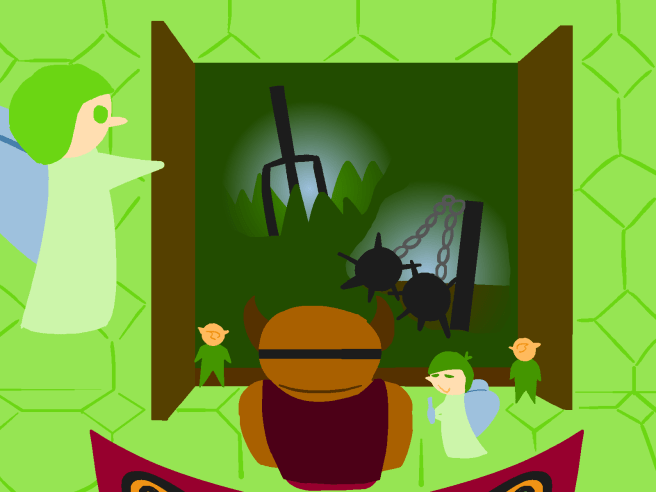
“I was right to let Aria take you,” said Stephanie. “You’re more useful losing to me than you could ever be as one of my game-pieces.”

Homer ignored her and poured his bag of brasses and figurines onto the table. He deflated, seeing most figurines mostly melted. His dragon was defunct.

pict16

Even Stephanie jumped when Homer swept brass cards and figurines off the table. His fur rose and anxious steam puffed from his nostrils. “Oh, no,” said Stephanie. “Did something happen to your big, bad dragon?”

Homer bit his hand between his thumb and forefinger just to stay awake and focus on his few remaining figurines. His rising fur revealed a maze of old scars. He gave Quattuor one brass card, tapped a message to him in gnomish, and collapsed. He lay motionless on the floor.

“Homer says he does not surrender.” Quattuor put Homer’s brass card onto the table and found its figurine. “Let the game begin.” The chattering audience of elves watched gnomes finish the map. Seafolk bubbled in their tanks.

Soon Aria arrived with her right hand bandaged by helpful gnomes. Sir Jameson meant to ask her what was wrong, and why Quattuor hadn’t given him Homer’s figurines to inspect, but her sour expression shut him up. She didn’t recognize the figurine on Homer’s side of the table; she’d packed a huge variety of game-pieces, and his was too small to see.

“My opponent can move first.” Stephanie giggled.

Gnomes prodded Homer’s body. “The first turn is yours, ma’am.”

“My fifty elvish archers take aim from afar.” Gnomes marked the trajectory of arrows from the model forest to Homer’s only figurine. “These shorties are trained just to shoot. They could hit an insect a mile away!”

“They have,” said Quattuor. “Homer brought this beetle to battle and you blasted it.”

pict18

“I win, then?” Stephanie beamed.

“You could choose to end the game here,” said Quattuor, “but your final score would be tarnished. Homer’s beetle was brimming with eggs, and its offspring will infest the area. Of course, only the table would be infested, not the actual physical region it represents, but it would impact your score.” He corroborated with other gnomes. “You would win three points, the minotaur, zero.”

“Ew.” Stephanie watched the gnomes replace the beetle’s figurine with a thousand scattered eggs eager to hatch. “Well, for a perfect five points, my shorties stomp on the eggs.”

The gnomes bunched into groups to debate with tapping fingertips. “Unfortunately, your units aren’t quite quick or thorough enough: some eggs hatch before they can be smashed. The larvae are poisonous; twenty of your units develop a fever. The rest of your units consider abandoning the scenario.”

Stephanie glanced at Aria. “I suppose you had a hand in this, Twine?”

Aria jumped from her fixation on the table. She held her bandaged hand. “You’re a riot, short-stuff.”

“I gotta hand it to you, the eggs are a tricky gimmick,” said Stephanie. “Gnomes! One of my archers has a vial of pheromones which he now uncorks. I got this from my lovely queen!” The gnomes showed how every elf on the table perked up immediately when they smelled the vial. “Now my shorties obey my order, fevers or no fevers. Speed up the table. They’ll comb the area for as long as it takes, just to be safe.”

Three gnomes joined hands in a triangle. The rest set upon the table. Whenever one tired, they hopped off the table to replace one of the three in the triangle. The gnomes worked so quickly it seemed the figurines marched across the board under their own power. Stephanie’s troops cut and burned tall grass to destroy eggs and larvae. They beat branches from trees and bashed every leaf. They turned every stone and found larvae already becoming pupae.

“Pause!” shouted Stephanie. “That’s enough. How long was that?”

“Two months,” said a gnome, “and not long enough. You missed some larvae who dug deep underground. Black beetles crawl up from the dirt. If you end the battle now, the infestation will still cost you points, and your units are diseased. Your final score would be one.”

Stephanie blushed. “My archers shoot down beetles as they emerge. How long would it take to dig deep enough to kill the last of those pupae?”

“There is no way to know, ma’am.”

She rapped her fingers on the table. “We’ll flood the area. Are there any bodies of water near this map?”

“In fact, there is a river.” Gnomes carried a second table into the arena and set it beside the first. They extended the map to show a powerful river rolling mere miles away.

“We’ll start irrigating immediately,” said Stephanie. “It shouldn’t take more than a few weeks if we open another vial of pheromones.”

All the gnomes joined hands; water-dynamics seemed to require their full combined attention. Finally they returned to the table and showed how trenches diverted the river. Stephanie pointed exactly where she wanted to flood the map to drown any underground pupae.

pict21

“All done.” Stephanie saw nowhere a beetle could be. “What’s the verdict now? The minotaur’s got no game-pieces, and I’ve got all of mine!”

“Actually,” said a gnome, “most of the elves on the table are dead.” Gnomes collected figurines and marked their brass cards as deceased. “The match began on today’s date in September. Three months have passed on the table, making it December. Some of your units have died in the snow; some have died of their diseases. Even your survivors will collapse unconscious when you run out of pheromones. We can award you no points. Having demolished your army, Homer lost only a beetle and its offspring. Five points to the minotaur.”

Homer snored on the floor.

Commentary
Next Chapter

Illustrations and Authorial Intent

There are 15 illustrations in Homer VS the Elf. I won’t pretend they’re any good, but they’re probably the best so far, and I had fun making them. Today I’d like to describe my illustrative process and illustration’s relation to authorial intent, which is the latest buzzword I see online nowadays and might get me some views if I put it in the tags.

I started making little illustrations with Akayama DanJay because the psychedelic anime-robot-fight felt deserving of art to draw people’s attention. I didn’t worry much about making the illustrations actually match up with the text. Sometimes I’d elide scenes so the illustration transitioned from one to the next. The style is minimal with flat colors, and each character is color-coded. I started with only one illustration at the end of each section, then returned later to add another to each section’s beginning. Some sections have more than ten pictures.

A chapter of The Minotaur’s Board-Game might have thirty illustrations. The first step is always rereading the chapter and writing “pict1,” “pict2,” and so on whenever the readers meet a new character or visit a new location, or if the text could be clarified with pictures.

Once I’ve figured out how many pictures I want, I open up the GIMP (GNU Image Manipulation Program). There are other image editors, like Photoshop, but the GIMP is free and I can write plug-ins in Python to, for example, automatically generate any number of empty images with a white background layer and a transparent layer for sketching.

pict4comm.png

(I made a palette so it’s easy to keep colors consistent from chapter to chapter. I won’t pretend to know any color-theory, but I think my palette looks nice. I made it here.)

I sketch all the illustrations in one go; it can take a whole day. I’ve got a Wacom tablet and pen, so I can use natural hand-movements to draw on my computer. The harder I press the pen, the more opaque the line!

pict1comm.png

Then I decrease the opacity of the sketch layers and color all the backgrounds; that can take a whole day, too. I color unimportant background characters like Akayama-DanJay-style mannequins so they don’t distract from the real characters.

pict2comm.png

Then I draw all the main characters in a new layer over the background. It’s often convenient to put each character on their own layer so they can be moved independently, especially if they overlap. Finally I disable the sketch layer.

pict3comm

Pictures are especially helpful for table-war. Whenever a table-war strategy is hard to describe, I know a picture can save my butt.

But sometimes the text and the pictures disagree. I describe huge audiences but draw less than ten spectators. I’ve probably put Homer’s eye-patch on the wrong side more than once, and in the pictures he has hooves instead of fingers. Sometimes when eliding two scenes into one illustration, asynchronous events appear simultaneous. In these cases I’d argue the text takes precedence, if only because text is easier for me to edit and update than illustrations.

But as an author, can I declare how my work should be interpreted?

This has recently come into question with the latest works from J. K. Rowling and, more classically, George Lucas’ Star Wars. Is it appropriate to retroactively declare a character’s race, gender, or sexuality? Must we accept midichlorians as canonical? Who ultimately decides a work’s meaning, its author or its audience?

One of my goals in writing these commentaries is to show that authors only pretend to know what’s going on in their stories. Writing is literally just making things up. An author might plan some plot ahead of time, but that plan is just made up, too. Iterative making-stuff-up is the name of the game.

So maybe an author is the grand maker-upper whose holy word is the only authentic source of interpretation, even if their book disagrees with them. Or maybe an author’s word is worthless, because stories are ephemeral visions appearing differently to everyone and the text is the only thing we can all agree on.

When we talk about our favorite fantasies to fellow fans, we like to imagine our visions of the fiction match, or at least overlap. Hence, I’ve added some pictures. My illustrations don’t perfectly encapsulate the text, but I hope they provide a cohesive universe and showcase characters’ emotions or whatever.

Anyway, thanks for reading. If you’ve enjoyed my rambling, or you like minotaurs and board-games, feel free to follow me and catch the next update.

Next Chapter
Table of Contents

The Broiler

(I wrote this in ten minutes with my writing group. I like it!)


My sixth-grade science-teacher Mr. Huffman assigned us a chapter to read about heat and thermodynamics. I, like my classmates, read nothing. The next day Mr. Huffman made us take out pens. “Only pens,” he barked, “and just one piece of paper, put everything else away.” Then he asked, “did you read the chapter? Write it down.”

“Yes,” I lied.

“Next,” said Huffman, “list the three methods of heat transference, and if you can’t, but wrote ‘yes,’ write your parents a letter apologizing for being a liar. Make them sign it and bring it in tomorrow as homework.”

I’d never felt fight-or-flight adrenaline. It broiled me from within. I knew nothing about heat, but couldn’t face my parents as a liar. Sweat slicked my palms and I looked to my friends, who already morosely resigned themselves to writing apology letters. I wouldn’t have it.

My textbook was under my desk. With the toe of my shoe, I opened to the table of contents. Under the Thermodynamics chapter heading the first three subsections were Radiation, Conduction, and Convection . I scribbled those words and stomped the book shut before Mr. Huffman saw.

I pinky promise that’s the only time I’ve cheated in class. On the plus side, on Mr. Huffman’s final exam, I remembered the three methods of heat transference, and I still do.


I’m trying to recall whether Mr. Huffman was all bark and no bite. His barks definitely made me skittish.

Back