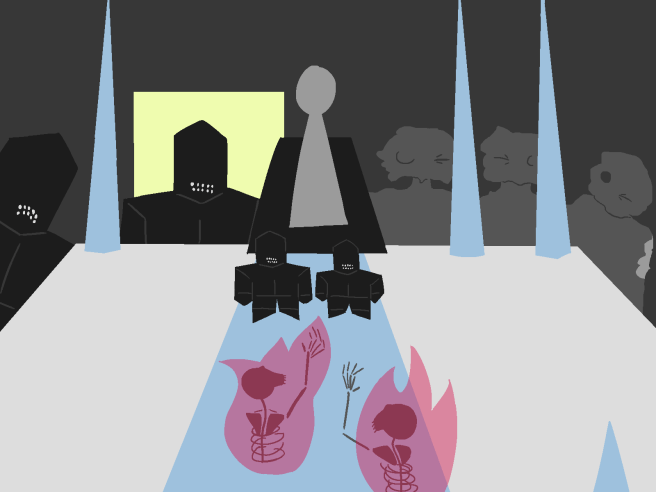
The Wheel of Virtue

In Homer and the Griffon Aria sells her dragonling to humanity’s royal beast-master and meets Queen Anthrapas, ruler of the human race. She’s escorted by Sir Jameson, a military recruiter.

A military recruiter doesn’t do much in this fantasy world where war is replaced with board-games. Jameson just dresses up in armor to inspire people to register as game-pieces. A new recruit has gnomes take their notes, then leaves knowing he’s done his civic duty. His avatar might be fighting for humanity even while he’s asleep!

In my first draft, I wasn’t quite sure what Sir Jameson’s purpose was. I added him because I thought Aria needed another character to bounce off; Homer doesn’t talk at all, and gnomes are sorta robotic. I actually added two characters in my first draft, but now I’ve elided them together into Jameson.

Currently, I think Jameson is a Watson-type character. Sherlock Holmes is a genius, so the reader needs Watson for Sherlock to explain things to in layman’s terms. While Aria, Homer, and the gnomes understand table-war, Jameson doesn’t, so the other characters have a reason to explain things to him, and, simultaneously, the reader.

I’ve heard amnesia is a common trope in fiction for the same reason. If the main character doesn’t remember anything, then they know exactly as much as the reader! Homer, the total newcomer to this strange world, fills that niche.

Still, I don’t want Jameson to be a boring tag-along. I already mentioned YuGiOh is a tongue-in-cheek inspiration for The Minotaur’s Board-Game, and while I’m glad to write about a fantasy-world revolving around geeky hobbies, I don’t want useless, annoying cheerleader characters like those who follow Yugi all day.

A third-wheel character like Jameson can benefit from the Wheel of Virtue. I’m absolutely butchering this idea, but the way I understand it, the Wheel of Virtue a helpful way for me to think about how characters should act. Says Noel Carroll, “some… art can function and is designed to function as a source of moral purposes,” specifically a delineation between vice and virtue. If a novel is meant to convey a message about a particular virtue, it’s helpful to have a cast of characters which accounts for a spectrum of possibilities along the gradient from virtue to vice. A story whose message is “Greed is bad, charity is good” could benefit from characters who are very greedy, a little greedy, a little charitable, and very charitable.

If the novel explores multiple virtues, we can imagine a Cartesian plot of characters on the axes of virtue and vice. If you want your book to convey a theme about virtue X versus virtue Y, say for example, “greed is bad, charitably is good, and also Star Wars is better than Star Trek“, each character should express a unique combination of greediness/charitably and fandom affiliation. This lets the text show the reader how these qualities intermingle.

Comm1.png

Says Carroll, “In literary fiction… these comparisons and contrasts… prompt the audience to apply concepts of virtue and vice to the characters, thus exercising and sharpening their ability to recognize instances of these otherwise often vaguely defined or highly abstract concepts.”

In The Minotaur’s Board-Game I think the relevant “virtues” are physical strength, intelligence, and political power. These three attributes separate characters nicely: some characters are strong (Homer, Jameson), some characters are weaker (Aria, Anthrapas, gnomes, elves). Many characters are intelligent (Homer, Aria, Anthrapas, Stephanie, gnomes) because the story demands it, but they showcase different kinds of intelligence (Homer is mute, Aria is manipulative, gnomes are mechanical). But neither strength nor intelligence make someone politically relevant. These feel like linearly independent attributes.

So Sir Jameson should occupy an untouched area of the virtue-wheel. Let’s make him strong, and not terribly intelligent, but his patriotism for humanity gives him just enough political clout for Aria to leverage. In that respect he’s sort of a human version of Homer. I think that gives him a great vantage-point to be the perfect Tristan: a third-wheel character who just gawks while the real protagonist, Homer, wins table-war.

Untitled.png

The act of actually plotting characters on a virtue-wheel might be a little anal-retentive, but the idea itself is a handy device for conceptualizing what kinds of characters are necessary to complete a narrative and convey a theme. If nothing else, I hope it helps me keep from accidentally populating my work with duplicate characters; if any two characters occupy the same role, it’s often easy to smush them together into one franken-character and maintain thematic integrity.

I hope you enjoyed reading my weirdly analytical thoughts on fiction-writing! I sure enjoyed writing it.

Next Chapter
Table of Contents

PS. Another applicable virtue might be Age, or Experience. Anthrapas is sort of Aria’s “evolved form,” so to speak.

I had a lucid dream last night

(Another 15 minute flash-fiction from my writing group. We got a sheet of prompts inspired by Mary Oliver; I put the ones I used in bold.)


I had a lucid dream last night—I’d been trying for a while. Mid-dream, I walked outside and saw the ground curve up vertically and then curve over me as if I were in a hollow cylinder, a la Rendezvous with Rama. I knew then that I was dreaming.

On the rare occasions I dream lucidly, I’m impressed with the fidelity of my surroundings. Awake I can’t imagine a tree so lifelike and present as while I’m asleep, when every leaf on the mountain is aflutter. 

Everyone around was made for me, but acts nonchalant as if they don’t want to clue me in. It just so happens that wherever I am, the world comes after me. It offers me its business.

When I realized I was dreaming, I saw the people walking with me as skilled actors. I saw them through the veil, secretly, joyfully, clearly. Oh lord, how shining and festive is your gift, the mind, if we only look and see it.

I am always trying to figure out what the soul is, and where hidden, and what shape. I decided to tell a dream-character—-my mother—that they didn’t exist because they were an actor in my dream, like a hand-puppet I controlled with one of my own hands which was itself asleep and numb.

Her eyes flared like matches. “You lie!” she shouted, and I woke up. Maybe I was close to discovering something.

I drank water and returned to sleep, and regained lucidity immediately. I ran to some dream-characters and said, “You don’t exist.”

They laughed. “Sure, sure.”

I took an online course about Buddhism where I learned of no-self, the idea that there is no self. When I told my mom she doesn’t exist, does that mean I also don’t exist? In dreams, the vessel of my ego is only one tendril of myself. My self includes the mountain of fluttery leaves and all the characters around me. My mothers shouts “You lie” because disowning the self is fighting every impulse of my literal being. But the other characters, who said “sure, sure,” are a more subtle distraction from no-self. “Maybe the self doesn’t exist, so what? Tomorrow you’ll need groceries. You body has desires from which a layman’s grasp of the nature of the mind cannot free you.”

Suddenly, as I drift awake, I live in the open-mindedness of not knowing enough about everything. My dream only shows me that I am not a human experiencing the universe, I am the universe experiencing a human, a human who sometimes has the opportunity to shed his sense of self by getting a glimpse behind the curtain. All that must be done, is done.


(I enjoy trying to use as many prompts as possible, but I think my own ideas shine through clearly. See you next time!)

Back

The Painting

(I wrote this in fifteen minutes for a writing group. The prompt was “I doubt she’ll remember me.”)


“I doubt she’ll remember me,” said the painter. I asked what he meant as we walked through a throng of people into the museum. “I meant what I said. Look at all these people. Crowds come to admire her. I painted her, but I’m just one man among many.”

I wasn’t sold on the idea. “Paintings don’t remember anyone, let alone forget them later.”

“You don’t know her like I knew her.” The painter and I cut through crowds photographing exhibits with their cellphones. “When I painted her, she spoke. When I added lips, she told me why she was smiling. When I added eyes, she told me how she saw the world. And I responded by obliging, painting what she told me to make sure I got her just right.”

Finally we pushed our way to the painting. I resisted gasping; the sparkle in her eyes and the laugh on her lips made it feel like the portrait was meeting me for the first time. I was speechless for our introduction.

Soon the flow of people pushed us to the next exhibit. I asked the painter, “did she remember you?”

The painter nodded, tears in his eyes. “She greeted me like an old friend. She hasn’t aged a day.” Before leaving the museum, we wandered through the gift-shop. I bought a poster of the painting, but the painter scoffed when I showed him. “That’s not the way I remember her,” they argued. “A soulless copy just can’t cut it.”

I hung the poster in my apartment anyway, but now I understand the painter’s point. The poster greets me every morning as if for the first time, and it’s hardly a conversationalist.


(We often think artists produce art exactly as planned, but more often, I think, art in the making directs the artist toward its completion. Have you ever started a project, then realized your initial plan couldn’t be completed because the project demanded something else?)

Back

Homer VS the Dwarf

(This is part two of a series starting here. Our story so far: Aria Twine raises monsters in a fantasy world where war is replaced with board-games. She recently acquired a minotaur.)


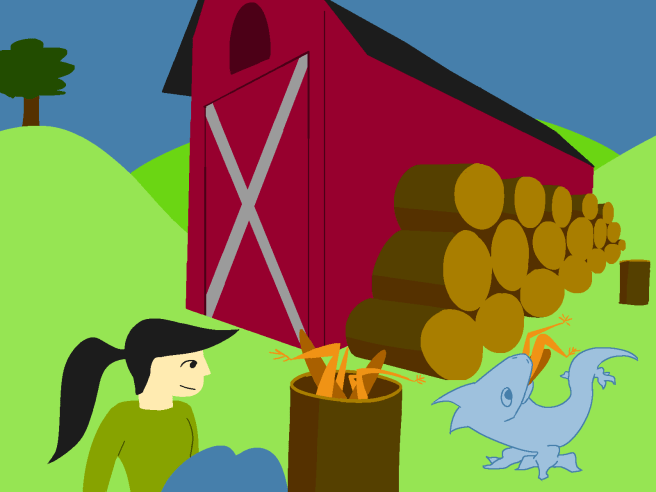
That evening, the stench of unwashed bovine made Aria’s eyes water when she entered the barn. “Eesh…”

She checked her sleeping minotaur’s bandages. They were bloody, but the wounds under them had already half soldered shut. Scars crisscrossed like the maze from which the minotaur escaped. Aria had never heard of minotaurs escaping their labyrinths, because the walls shifted and morphed to trap them at every turn; just like Scales the ice-dragon froze nearby terrain, or like turtles carried their homes, minotaurs’ mazes moved with them. The Great Ax’s fracture must have opened an escape route.

“Healing pretty well.” She lifted the minotaur’s eye-patch. “Oooh. That’s never gonna be the same. Pity.”

She left the barn to let the minotaur rest. Outside, Scales slithered around twenty barrels of dragon-fodder. Aria opened a barrel and the icy dragonling opened its maw. Aria tossed Scales a dried grasshopper bigger than her forearm. “Pure protein, perfect for a young dragon. I had to buy these from elves.” While Scales devoured the grasshopper, Aria patted the dragon’s back with her gloved hands. “Your wing-nubs haven’t grown in yet. You’re not ignoring your veggies, are you?”

HomerVStheDwarfA

“Squraaa.” Scales opened its maw to ask for more. “Squraqura.”

“You’ll get more tomorrow. Go eat your veggies.” Aria put her hands on her hips. She’d have to store the barrels in the barn, or Scales might break into them, but it took all her strength to roll a barrel with the brunt of her shoulder.

The barn-door opened.

The minotaur stepped out onto the grass. He shaded his eye from the setting sun and picked at his bandages.

“Whoa! Hey! Easy, there!” Aria ran to him and pressed bandages back on.

HomerVStheDwarfB

The minotaur looked first at her and then the bandages.

“Go back!” Aria pointed back to the barn. She resumed rolling dragon-fodder.

“Rrr.” The beast easily hefted a barrel in each hand, tucked them under his elbows, and grabbed two more.

“Whoa. Don’t overexert yourself,” said Aria. “Those are each three hundred pounds.” The minotaur twisted his thick neck, cracking his back. “Well, if you’re up for it. Bring ’em in.”

The minotaur followed Aria back into the barn and set down the barrels.

“Um… Yeah. That’ll do.” She gave him a thumb up. “Perfect.”

He tilted his head to the left. His horns looked like they might catch on the rafters. He tried to emulate her thumb up with both his three-fingered hands.

“Yeah, good!” said Aria, with two thumbs up. “You’ve saved me some time! Can you bring in the rest?”

HomerVStheDwarfC

The earth trembled under the minotaur’s weight when he returned with six more barrels. Soon he brought the last barrels into the barn, then sat with his arms folded over his chest. His eye watched Aria, eager for more thumbs up.

“Sort of clingy, aren’t you,” she mumbled. “Well, I’m glad to have company. I’ve been talking to imps for weeks, and they don’t do yard-work.”

The minotaur nodded as if it understood.

“You need a name. How about Homer?”

The minotaur blinked.

“Aria.” Aria pointed to her own chest. “Homer.” To the minotaur.

Homer pointed to himself and grunted twice. “Rrm-rr.”

“Yeah!” She gave a thumb up. “Homer!”

Homer pointed to Aria. “Arr-rra.”

“Yeah, Aria. I won you in a game of table-war.”

“Rra-rr rar.”

“Table-war. You saw me fight the elf. Here, follow me.” Aria led Homer behind her cabin to a table ten feet by ten feet square. She reached under the table for chests of wooden figurines and wooden cards. “I used to play with table-war geeks all the time. I’ve still got some hobby-supplies. Look, this is a good one.”

The horse-figurine had jointed legs; she made it gallop for Homer, who watched with limited comprehension.

HomerVStheDwarfD

“You know, you’re healing pretty well. I’ll bet I could enlist you with the human military right now.” She pat her minotaur between the horns. “Let’s visit the market tomorrow.”


The market was hours away nestled in a valley. Humans trickled down hillsides to flood between tents and booths. A few elves shouted of their wares, and gnomes wandered assisting official transactions.

“You’re a pretty smooth ride,” said Aria. Homer pulled her wagon between booths. “Left! Left!”

HomerVStheDwarfE

Homer veered left. The awed stares from passerby didn’t bother him; he just shaded his eye from the sun.

“Homer, check this out!” Aria pointed to a glass tank of murky water the size of a swimming pool. The walls of the tank were soldered with gold. “Seafolk. Probably wheeled that tank all the way from the pier.”

A green face pressed against the tank from inside. Its glowing egg-shaped eyes ogled Aria’s minotaur. Webbed hands with suction cups rubbed gold coins against the glass.

“Trading, huh? You got a gnome?” asked Aria. The seafolk pointed to a gnome standing outside the tank. The gnome was adorned with jewelry and shells. “What’s your name?”

“Nonoginta Novem. My English being not good.”

“Tell your merfriend I’m selling my minotaur to the human military. If they don’t give me a good deal, we’ll talk more.”

The gnome and the seafolk communicated with finger-taps through the glass wall. “Giving a thousand golds for the walk-cow. It is the offer final.”

Aria licked her lips. A thousand gold coins could buy another dragon-egg. “I’ll think about it.”

She led Homer around a corner to an enlistment booth. Behind a wooden counter, a red-headed human man in iron armor reviewed brass cards with two gnomes. These gnomes were nude; humans didn’t often decorate their help. The armored man noticed Aria and squinted at the beast she’d brought. “I was warned you’d surprise me, Twine.”

HomerVStheDwarfF.png

“One minotaur, for the human military,” said Aria. “Whadya think, Sir, uh…”

“Sir Jameson.” He signaled his gnomes, and the gnomes vaulted the counter to measure the minotaur’s muscles with string. Homer lifted his arms and tried not to step on the rocky creatures. “Never taken a minotaur.” When Sir Jameson stood, his armor-plates clanged. “They’re hard to pull from their labyrinths, and some say it’s not worth the effort.”

“Really?” Aria hopped from the wagon. “Why?”

“Homesickness. Minotaurs just keep drawing mazes in the dirt. If you get two of them together, it’s all they ever do. One draws a maze, the other navigates it.”

The gnomes felt Homer’s calves.

“So what’ll you give me for him?” asked Aria. “Seafolk over there offered a thousand gold coins.”

“Yeah, but that’s seafolk,” said Jameson. “Queen Anthrapas gave you all you needed to start a farm, and you promised you’d only ever sell to us.”

“Sure, for any monster raised on my farm, but I didn’t raise this guy. He showed up just yesterday from the Great Ax’s fracture. He’s on the market.”

Jameson shrugged. “I’ll give you voucher for fifty gold coins, and you’ll be first in line to claim any monster we catch in the wild wastes. Best I can do.”

“A hundred gold, and I’ll take three monsters.”

“I don’t suppose you’ve heard,” said Jameson, “we’re in a state of emergency. Human farmers are required to sell to the military at market value. Fifty gold coins is generous, Aria.”

Aria crossed her arms. “I haven’t heard about any emergency.”

“Ten more gnomes were found decapitated near the dwarven border,” said Jameson. “We learned just yesterday that dwarfs challenged the elves to an official table-war match for land. War’s on its way.”

Aria considered her minotaur. The gnomes crawled up his fur to measure his horns; they noted his eye-patch in the grid of dots they engraved on a brass card. “Don’t worry, Homer, they’re harmless.” She turned to Jameson. “Why are you in armor, Sir? You’re not getting brassed today, too, are you? Is this your first day on the job? Posing for a figurine in your best get-up?”

“Take it easy, Aria.”

“Don’t talk down to me. Ten years ago, you’d be following my orders. I wouldn’t even know which figurine was yours among all the others under my command. How much will you pay for my minotaur?” she asked again.

Jameson sighed. “If you do me a favor, I’ll cut you a deal.”

“Whadya need?” Aria looked down when a gnome rugged her shirt. He passed her the brass card whose grid of holes described Homer.

“There are dwarfs nearby and its making my gnomes skittish,” said Jameson. “Make them leave.”

“Dwarfs?” Aria put her hands on her hips. “Well, that’s unpleasant, but they’re allowed here, aren’t they? It’s a market, people sell stuff.”

“They’re not selling anything,” said Jameson, “and if it worries my gnomes, it worries me. Make them leave or accept my original offer. If you sell your minotaur to the seafolk, I’ll get Queen Anthrapas to come down on you like a ton of bricks.”

“Geez, okay,” said Aria. “Where are they?”


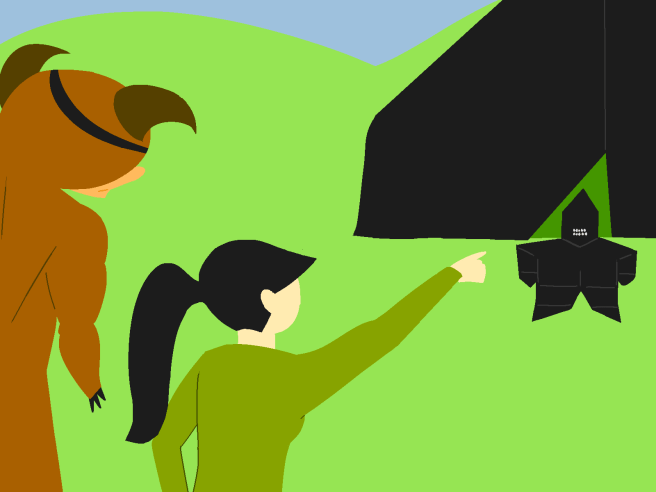
As Homer and Aria approached the drawfs’ black tent at the edge of the market, the crowds thinned. Humans checked over their shoulders. Gnomes shuffled hastily. Elves avoided the area entirely. Even Homer sensed dark tension. He sniffed the air and flared his nostrils.

Aria understood. On the deepest level, there was something wrong with dwarfs. While gnomes emerged from magma in subterranean caves but frequently visited the surface, dwarfs mostly ate downward. They mined mountains like anthills until the peaks collapsed. Their faces were featureless and flat with foreheads down to their nostrils, leaving no space for eyes.

A dwarf in coal-colored armor opened the flap of its black tent. Homer touched Aria’s shoulder. “Sorry, Homer, we’re going in. Hey! You! What are you doing here?”

HomerVStheDwarfG.png

The dwarf turned. It was four feet tall and four feet wide. The only area exposed by its armor was its teeth, dingy like the hull of a shipwreck. Its teeth crunched a stone into crumbs, and it swallowed the crumbs hungrily. Dwarfs had no lips. Maybe they were born without them, or maybe they cut them off. “Here to play. Training new commander.” The helmet was constructed to reveal only teeth, even while it spoke. Gnomes were genderless and accepted male pronouns. With dwarfs, you just couldn’t tell.

“Play? Like, table-war?” asked Aria. “Sure, I’m in. Just one game, and win or lose you have to leave. I used to be a royal commander, so you know it’ll be a good one.”

“Accepted.” The dwarf shouted as if testing a battle-screech, shaking Homer’s fur. “Gnomes!”

From the black tent, three gnomes stepped into sunlight.

Aria’s stomach turned. She hadn’t seen dwarf-owned gnomes for years; the reintroduction made her bile churn. Homer balled his hands into fists.

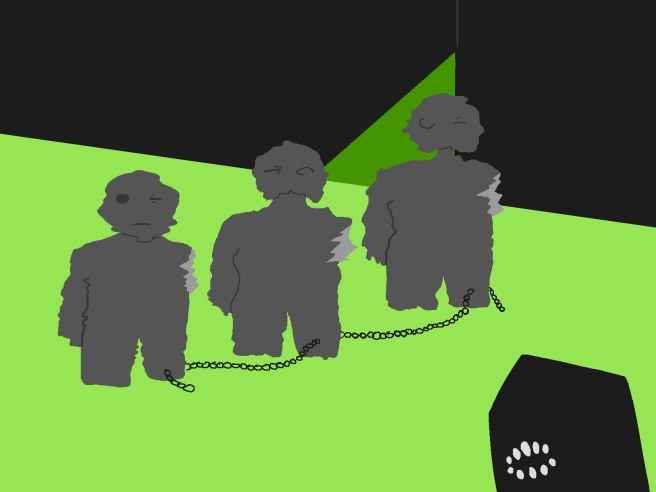
Each gnome was missing its left arm. Their ankles were pierced by a chain connecting the gnomes in a line. The front-most gnome had only one eye, while the other two gnomes had no eyes, no lower jaws, and no tongues. Their rocky skin had chipped and fragmented.

HomerVStheDwarfH.png

The dwarf shoved its gnomes toward Aria. “Give brass,” said the gnome with a tongue.

Aria held her brass card for the gnomes, who read its pits and grooves with their remaining fingertips.

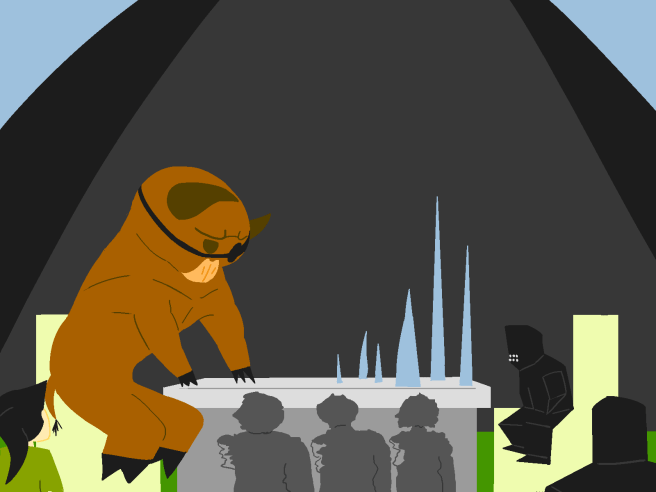
Inside the black tent another dwarf sat at an official war table, twenty feet by twenty feet square. The table’s terrain reflected the dwarven north in miniature: icy peaks reached like stalagmites.

The gnomes looked up from Aria’s card. “Says deceased.”

“Is that alright?” asked Aria. “If you’re just training a new commander, we can play unofficially.”

Somehow, without lips, the first dwarf sneered. “Leave.”

“You’ll play with me or you won’t play at all.” Aria crossed her arms. Homer investigated the table’s sculpted peaks and glacial crevasses. “No one else will even come near you.”

“Won’t play. Leave.”

“You haven’t got a choice, you morons.” Homer tapped Aria’s shoulder. “What, what is it?”

He made a rectangle with his hands. “Rrrss.” When Aria raised an eyebrow, he pointed to her pockets. “Rrrss.” He raised one hand and waggled his fingers. It was like a gnome reading a card. “Rrrss.”

“…Brass?” Aria showed him the brass card representing himself.

Homer gave two thumbs up, then took the card and held it for the gnomes to evaluate. “Intelligent creature,” said the gnome with a tongue. “Technically allowed to command.”

While the first dwarf spat, its seated companion remained silent. “An insult! You dare!”

Aria watched her minotaur sit at the table and survey the landscape. “Do you understand what you’re doing? This game is complicated. I played for years before my first official match. You’ve seen me play, just once.” Homer mimed moving figurines across the field, then looked back at Aria. She chewed her lips. “Hey, dwarfs, take it or leave it.”

The first dwarf squeezed its gauntlets. “Fine. Play.”

“Rrrr!” Homer pointed at the mutilated gnomes, then looked at Aria. She didn’t understand what he wanted. He pointed at the dwarfs, made a fist, and pointed back to the gnomes. He then gestured over the hills, toward Aria’s farm.

“You want…” She stood up straight. “If we win, we’re taking your gnomes. It’s a fair bet, he’s never played before.”

No one knew how dwarfs perceived the world without eyes. Aria suspected their trained nostrils could detect emotions. The first dwarf sniffed in quiet contemplation. “Accepted,” it murmured, “if it plays with its brass.”

Homer nodded. “No, that’s bad,” Aria told him. “When something dies in the game, gnomes mark its brass. They can never play again, as a figurine or as a commander. If you die, I can’t sell you to the military.”

Homer didn’t seem to hear her. His eye was cool and calculating, but anger leaked from behind his eye-patch like lava trickling from a volcano as he stared at the eyeless gnomes.

HomerVStheDwarfI.png

“If you lose, and I can’t sell you, you’re working on my farm for life,” said Aria. “I’ll get you some pieces.”


“Hey! Sir Jameson!”

“Aria.” Jameson saluted, probably out of habit. “Are the dwarfs gone?”

Jameson’s gnomes sniffed the air. “No. They remain.”

“They want to play table-war,” she said. “Do you have some brasses you don’t mind losing in battle?”

Jameson squinted. “You’re not allowed to play, are you? You were killed by an elf.”

“It’s not an official match,” she lied.

Jameson sighed and tapped his fingers on the counter. “I suppose I can trust you. Aria Twine, humanity’s path to victory. We’ve got plenty of brasses from enlistments at the market.”

She drew air through her teeth. “How about game-pieces you don’t mind losing?”

“Let’s see what we’ve got.”


Tiny dwarven catapults sat atop the spires of ice. Model dwarfs in full armor manned them.

Homer aligned his own figurines. His side of the table was a snowy expanse crossed with icy gorges. A handful of humanoid figurines surrounded three trebuchets.

HomerVStheDwarfJ.png

“These are skeletons,” explained Aria. Professional military quality meant their bones were individually sculpted. “These guys are totally disposable. We’ve got lots, and no commander likes to use them. Skeletons pop up in abandoned cemeteries, and it’s sort of a faux pas to make them battle.”

“Rrg-lr-drr.”

“Skeleton, right. They’re not bright, but they can follow basic orders like ‘man the trebuchet.’ Okay?”

“Silence.” The first dwarf surveyed their field. “No helping.”

“What good would that be?” asked Aria. “You can’t train against an opponent who doesn’t even know his pieces. Anyway, Homer, see this ammunition? It’s a supply of exploding barrels. You get me?” Homer shook his head. Aria put her fists together and blasted them apart. “Kaboom.”

“Gr-brrm.”

“Yeah. Dwarfs aren’t superb at table-war, but they know their way around a siege-engine. If your skeletons load your trebuchets with explosive barrels, I give you fifty-fifty odds.” She pulled a roll of bandages from her backpack. “Take care of this, okay? This is your game-piece, Homer.”

The minotaur took the roll of bandages. He pointed to it, then to his chest. “Rrm-rr.”

“Exactly. No, no, why—” He pressed the roll of bandages into position at the head of his army. His nostrils flared. “Hey, your funeral.”

“We tire! Begin!” shouted the first dwarf.

The three mutilated gnomes each pressed their remaining right hands onto each other’s left shoulder stumps. After communing with finger-taps, the gnome with a tongue addressed the table. “Minotaur begins.”

“Okay, it’s your move first, Homer. Tell—”

“Silence!” said the first dwarf.

Aria sat beside her minotaur. Homer waved his hands over the skeletons, then pointed to his trebuchets.

“What says he?” asked the first dwarf. With just one eye among them, the gnomes somehow understood. They scrambled over the table showing how skeletons loaded explosive barrels into the trebuchet’s slings.

“Our turn,” said the first dwarf. “Obviously our superior army would finish loading their catapults first.” The first dwarf patted its silent comrade on the back. For the first time, the second dwarf uttered the guttural language of the ore-eaters. The gnomes made the dwarf figurines launch their catapults.

“Projectiles land here, here, and here.” One gnome ran a hand through the fake snow, making tracks left by the projectiles. The other gnomes scooped away skeletons and marked their brass cards as unplayable. Aria puzzled; the dwarfs could have struck Homer if they’d care too.

HomerVStheDwarfK.png

Homer motioned like he was throwing a spear.

“Human trebuchets are fired.” The gnomes tapped each others’ shoulders… for minutes.

Aria knew that no human, dwarf, elf, or seafolk understood every rule of table-war. Only gnomes could simulate the arena with accuracy. Aria wondered what had happened to make the gnomes lag. “It’s just barrels,” she said. “Plot the trajectories and move on.”

The gnome with the tongue shook his head. “Not completely true.”

“What?” Aria turned to her minotaur. Homer’s serious expression echoed the icy spires across from him. “What did he do?”

“Skeletons loaded themselves in the explosive barrels,” said the gnome. “A thousand pounds of flaming grapeshot sailing through the sky.”

“Hm.” Aria punched him in the arm. “Nice.” The almost-silent dwarf did not react, but the other covered its own teeth.

“Two dwarven catapults on fire,” said the gnome. “These dwarfs are dead.” He removed most of the dwarf-figurines from the table.

The almost-silent dwarven commander spoke in its grating language.

“Surviving dwarfs load final catapult,” translated the gnome.

Homer crossed his arms.

“Some skeletons still partially intact, and still on fire,” said the gnome. He pointed to the icy spires. “They ignite the final catapult.”

HomerVStheDwarfL.png

The almost-silent dwarven commander let a single word escape its teeth. The gnomes conferred. “The dwarfs surrender.”

The first dwarf turned to Ida. “Five hundred gold coins for your minotaur.”

“Seafolk offered twice that.”

“Ten thousand pieces of gold for the minotaur!” shouted the dwarf.

“Sorry,” said Aria. Homer lifted all three mutilated gnomes. “He’s not for sale.”


“Hey. Sir Jameson.”

Jameson stretched and yawned. “The dwarfs are gone?”

“Yep. Some of these skeletons are still usable, I’m pretty sure, and all your trebuchets.” Aria returned the brass cards.

Jameson sighed and stood at ease. “We’ll pay double market value for your minotaur.”

“I’ve had a change of heart.” Aria watched Homer lay the dwarfs’ mutilated gnomes on the grass. They sprang right up and began communicating with the humans’ intact gnomes, forming a ring of five gnomes tapping each others’ hands and shoulders. “I want to meet with Queen Anthrapas. I can’t leave my dragonling on the farm, so I’ll have to take Scales with me. Can you give me a ride?”

“I suppose,” said Jameson. “What business do you have with the queen?”

Aria watched her minotaur raise his hands and flick his fingers, trying to emulate the gnomes’ rapid hand-language. “I’m taking an apprentice.”

Next Chapter
Commentary


Inspirations

In Homer VS the Dwarf Aria brings her minotaur to the market to sell him, but he proves a force to be reckoned with in a game of table-war.

In this commentary I want to talk about my inspirations for this story, and what I hope it becomes.

Although the idea of a minotaur following “twine” is obviously related to greek myth, and I feature my own twists on the typical gamut of fantasy races (elves, dwarfs), the biggest inspiration for The Minotaur’s Board-Game is the anime YuGiOh. I enjoyed the show as a kid, and while it becomes more ridiculous every time I remember it, I still look back fondly on the series with a campy nostalgia.

In YuGiOh, a boy with improbable hair is possessed by an ancient Egyptian pharaoh who’s great at card-games. He wins every card-game he comes across and saves the world with the luck of the draw. The audience is rarely worried about whether the pharaoh will win, and more eager to see how he wins.

I already spoiled this in the last commentary: Homer the minotaur will win all his table-war matches. He’s not possessed by a pharaoh or anything, but his outsider’s perspective will let him surprise his opponents. I don’t think there are so many table-war games in this story that the reader to get bored of seeing Homer win; I hope the reader will be eager to see how Homer turns the tables, and yet still be surprised when he does.

One major joke regarding YuGiOh, among people in the know, is that the characters basically ignore the card-game’s rules. Occasionally YuGi’s catapult-turtle launches Gaia the dragon-champion at his own swords of revealing light, or whatever, warping the rules to give our protagonist a win. I hope to sidestep this by making up my own game, table-war.

Table-war has few, if any, explicit rules. The gnomes, impeccable machine-creatures, arbitrate each match with their own undisclosed guidelines meant to recreate real life. This way I get to focus on the back-and-forth of combat instead of worrying about a concrete set of rules and whether my characters are following them. The structure of the game is based less on YuGiOh’s hand of trading cards, and more on Warhammer 40k’s table of miniatures; I’ve never played 40k, but its tiny warzones are a striking image.

Another inspiration is The Turk, a book about a 1700’s clockwork machine which played chess. Spoiler alert, it was a hoax: someone hid under the table and directed the machine’s movement. Today we’ve got Deep Blue and other powerful computers which can whup humanity’s ass at chess and basically any other board-game, but a clockwork machine is a still great symbol.

My original conception of this story would have Homer, the minotaur, forced into a box to operate a Turk-style table-war machine. Sort of a Pixar’s Ratatouille thing. I still like this idea, and maybe I’ll return to it, but I’ve decided to have Homer fight against a machine in the final chapters; he’ll face a The Turk/Deep Blue style robot to prove that his unique, creative perspective is more valuable than pure computational power.

Another inspiration is modern warfare. Long-gone are the days of trenches; today we have drones and satellites which abstract war, and the internet delivers propaganda at light-speed. Likewise, in my fictional world, there is no actual war, just table-war. No one dies in battle; their game-pieces die, and the real person they represent probably doesn’t know or care. Rather than diminishing the effects of war, I hope table-war lets my fantasy setting comment on the nature of leadership in our modern era. How do you command people? How do you relate to people you could send to die in your name?

Still, in terms of what I want the story to achieve, I mostly want to have fun writing, because I enjoy writing and I think it’s neat.

But besides myself, who am I aiming the story toward? Honestly, I’m not sure. I hope the story is appealing to all age-groups, but I think I’m writing for people not much younger than me (24) of any gender. I’m minimizing the swearing and adult themes, so maybe I could claim it’s for young adults and teens.

Anyway, thanks for reading. If you’d like to read more, check out the table of contents or follow my site to receive emails whenever I update.

Next Chapter
Table of Contents

Aria VS the Elf

When Aria woke, she was frigid. Her wood cabin’s interior was frosted with frozen dew. Her blankets’ edges dangled icicles. “Uuugh.” She pulled herself from bed. “Scales! Scales, get out of here!”

She quickly donned overalls, thick wool socks, and boots and finally stopped shivering. She pulled two heavy leather gloves over her hands and knelt to peer under her bed.

“Scales! I said get out!”

AriaVStheElfA.png

A chill wind blew through her hair. There was a dragon under her bed, four feet long and covered in silver scales. Its white muzzle puffed icy flakes from two slim nostrils. When it stretched, the icy armor it accumulated overnight cracked and slid to the floor. Its stubby legs made Scales look like a salamander, but no ordinary lizard had talons quite so much like jagged icebergs.

“Come on. You belong outside.” Aria reached with her heavy leather gloves, but Scales slipped from her grasp. “You’re lucky I’m in a good mood this morning, Scales.” She stood again. “Hungry?”

She returned to the bed waving a long carrot and Scales stopped slithering to watch. Aria offered the carrot, but when Scales bit its tip, she nabbed the dragon by its neck and plucked it into the air.

“Gotcha.” A smile trickled across her face as she pushed open the cabin’s door with her shoulder. “You’re getting new fodder today, Scales. Soon you’ll be too big to sneak indoors.”

The cabin’s interior was twenty degrees colder than the summer morning air outside. The sun’s first beams rolled over grassy hills. The light was split by the shadow of a colossal black ax lodged in a forest near the horizon. The ax’s handle towered a mile tall, dividing clouds just like its head scarred the glade.

Aria released Scales. She threw the carrot and the dragon scampered after it. Its footsteps strangled grass with frost tendrils. Aria knew it wouldn’t roam too far, because it could hardly leave her alone.

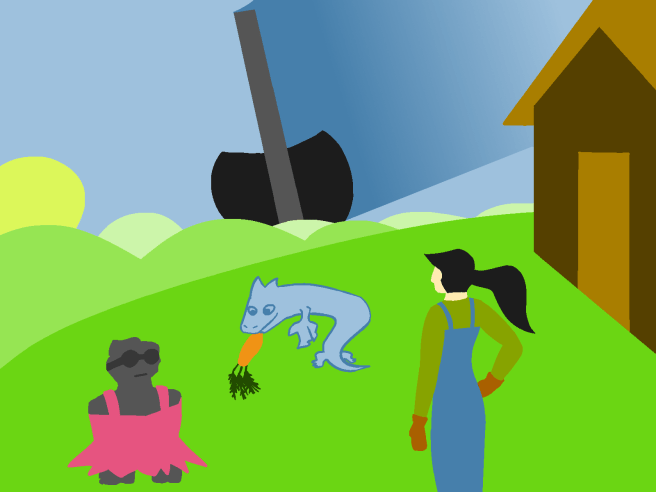
“You’re early, Mr. Gnome, sir.”
AriaVStheElfB.png

The gnome stood between three and four feet tall. His rocky skin seemed to have gravel embedded in it. He wore a frilly little pink dress and dark goggles. “Good morning, Ms. Twine. I’m here on behalf of the elves buying your imps.”

“You don’t need to wear a dress just because elves tell you to. I’ve got wee overalls you could borrow.”

The gnome shrugged. “Novelties like wardrobe mean little to me. Dresses and overalls are equivalent.”

“Then change into overalls.” Aria tossed him a pair. “This is a monster farm. Dress like it.”

“Of course, Ms. Twine.” The gnome removed and folded his dress before donning the overalls. His skin was rough and gravelly all over.

“Follow me, the imps are in their enclosure. And call me Aria. What should I call you?”

“I am Septem Decim. Please show me your identification.”

“Right here.” As they walked she gave him a slim brass card about the size of her palm.

Septem felt the card with his stubby fingers. Engraved in the brass was a grid of tiny holes; the gnome’s fingertips detected their varying depths with perfect accuracy. “…This says you are deceased.”

“In the game, yeah. Ten years ago.”

“Ah, I see…”

“Hey, you speak great English for a gnome. Have you ever refereed?”

“I am a diplomat. I have only refereed unofficially in table-war hobby-shops.” Septem returned Aria’s brass.

“Oh really?” She gave him a slim wooden card. “How much would this be worth?”

Septem manually inspected the card. “This is a reproduction of your old brass for table-war hobbyists, isn’t it?”

“It’s me at my prime. Do the geeks use it often anymore? Do fans win matches in my honor?”

Septem didn’t sugarcoat it as he returned her card. “Perhaps it would have some value to historians, but I’ve never seen it used in competitive play.”

AriaVStheElfC

Aria sighed and tucked both cards in her overall pockets. “Let’s change the subject.”

“Another gnome was found decapitated by the dwarven border.”

“Sorry to hear it.” They approached an apple-tree covered by translucent mosquito-netting. Aria untied a rope to open the net. “Breakfast! Piknik, Togdag, Gumdrop, get your milk.”

A tinny voice like a squeaking rat called from under the apple-tree’s roots. “We saw! Don’t think we didn’t see!”

“What did you see, Togdag?” Aria pulled the cork from a jug and poured milk into a shallow saucer.

A different voice, like a chirping bird, called from the upper boughs. “You fed Scales!”

“Why was he fed before us?” called a voice in a knothole.

“Tell you what.” Aria dropped three cherries in the milk saucer. “I’ll add cream today. Will that make up for it?”

“Barely!” called Piknik.

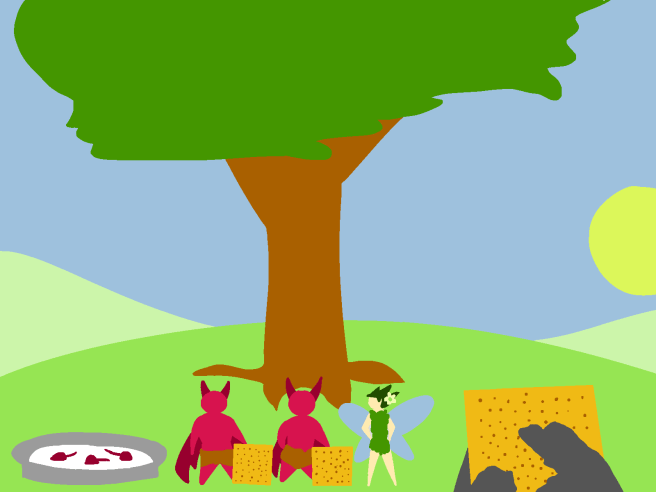
“But you all have to line up for Mr. Decim, here,” said Aria. “Bring your brass! Chop chop!” While Aria measured cream from a smaller jug, Septem Decim watched the imps emerge from hiding. Two were red, bat-winged creatures in loincloths of weeds and bark. The third was a fairy in a dress of leaves with an apple-blossom tied in her wild green hair. They all fluttered to the ground, barely a foot tall apiece, carrying brass cards almost too large for them to hold.
AriaVStheElfD.png

The gnome scanned each brass card with his fingertips. “If it’s any consolation, to a table-war hobbyist, your imps would each be worth ten of you.”

“Thanks, I guess,” said Aria. The fairy-like Gumdrop giggled, revealing teeth longer and sharper than her pretty face suggested. “You three, come eat breakfast.” The imps swarmed her. “Ow! Gumdrop!”

“A parting gift!” giggled Gumdrop. Aria held her finger. The imp had drawn blood even through heavy leather gloves. “We’ll miss you, Twine!”

“What’re you trading us for?” asked Piknik. “You’d better not give us back to the dwarfs. You’ll never see imps like us again!”

“Ah, shoo. I’m glad to be rid of you,” she joked. “I’m trading you to the elves for dragon fodder.”

“It is not my place to speak of such things,” said Septem, “but the elven queen is procuring many powerful game-pieces. Tensions on the elvish/dwarven borders have heated. The pressure will only escalate. Ms. Twine, would you like me to brass your dragon, just in case?”

“No, not yet.” Aria cast her gaze around her farm.”Where are your elves, anyway? I thought they’d arrive with you.”

“We came across a distraction.” When the gnome left the net, the two red imps tried to sneak out with him. “Perhaps you could assist?”

Aria shoved the cork back in the milk jug. “What’s wrong?”

“You are a monster tamer, correct?”

She smiled. “Or so I’ve heard.” The gnome tilted its head, confused. “Sorry. Yes. I’m a monster tamer.”

“A minotaur escaped its labyrinth near the Great Ax’s fracture. The elves sent me ahead while they captured it.”

“A minotaur?” Aria scowled and adjusted her gloves. “Let’s go.”


The Great Ax had stood there for as long as Aria could remember. Its double-bladed dwarven design was hungry for war. Its massive head was buried in the forest as if some giant had tried to cleave the earth in half, creating a clearing ten yards wide and hundreds long.

“Ugh.” Aria groaned. “The Demons’ weapons have always freaked me out.”

“You are too young.” Septem adjusted the hem of his pretty pink dress. “What is ‘freaky’ are the monsters which forged them.”

“What?” Aria adjusted the straps of her backpack. “The Demons didn’t make those weapons, the dwarfs did.”

“I stand by my statement.”

“Oh. Harsh.”

“Not harsh enough,” said Septem. “Even the dwarfs agreed to a peace treaty to escape the war they started. You can’t imagine how awful it was, for even dwarfs to regret it.”

Aria held her tongue. Dwarfs and gnomes could live long enough to remember the war against Demons centuries ago, but humans didn’t have that luxury.

When they entered the thin clearing, Aria saw a few figures near the narrow crevasse carved by the Great Ax. She squinted to count three elves, two gnomes in dresses, and one big brown minotaur. “Septem, hurry!” Septem’s tiny legs carried him as quickly as they could while Aria sprinted ahead rummaging in her backpack.

The minotaur stood ten feet tall and was covered in fur like dead brown grass. Its twisted horns sprouted from its forehead like dead trees clinging to a mountaintop. The two shorter elves pinned the minotaur to the cold metal ax with spears. The spears made deep gashes across the minotaur’s torso when it struggled with the strength of ten men.

“You’re hurting it!” said Aria.

The tallest of the three elves scoffed. “Who cares? Look what it did to my cute little gnome!”

One of the gnomes lay on the grass with his head split open. A green, rocky brain rest coldly in its skull. The second gnome held the brain in place with one hand while gesturing to Septem with the other.

Septem reached into his dress for gnomish surgical implements. “All will be well, Octoginta Tres. Merely a cranial fracture.” Septem sat to tend to the fallen gnome’s exposed brain.

“See? He’s fine,” said Aria. “Get off that minotaur, these are human lands!”

The tallest elf’s eyes glittered like emeralds, and her skin sparkled; so-called “high elves” bathed in gold dust if they could afford it. Her beehive hairdo added a foot to her height. She wore a long dress which no doubt concealed platform shoes, and lace wings which made her seem to float. Nonetheless she stood five-foot-eight, about seven inches shorter than Aria. “Gosh, if it’s not Aria Twine! It’s me, Stephanie! Are you the farmer trading us imps?”

AriaVStheElfE.png

“Not traded yet, Steph.” Aria dropped her backpack on the grass. “Tell your shorties to let the minotaur go.”

“Hmm, I don’t know, Aria,” said Stephanie, “under what jurisdiction?”

“You can’t steal game-pieces from human land,” said Aria. “He belongs to us. And you’re hurting him!”

Stephanie stroked her tall hairdo. “Hm… Shorties, let the beast go.”

The shorter elves—almost four feet tall—lowered their spears.

The minotaur’s gasps filled lungs the size of barrels. Its arms, packed with muscles like stacked melons, lifted three-fingered hands to rub the wounds on its chest and stomach.

“Let’s get something on those cuts,” said Aria.

Its ox-head turned on her. “Raaugh!”

“Hey! Easy, now! I’m here to—”

Its hooves stomped the grass.

It fled into the forest.

“Oh, what a shame,” said Stephanie. “We’ll have to go after it.”

Aria scowled. “You’ve done enough damage here.” The shorties looked to Stephanie, who shook her sleeves to the trees. The shorties took off after the beast, spears at the ready. “You’re out of line, Steph!”

Stephanie covered her mouth with her sleeve to hide a fake laugh. “Perhaps the gnomes have a different idea?”

Octoginta Tres was only distinguishable by his bandaged head-wound, and Septem Dicem by his goggles. Otherwise the gnomes were identical. “The high elf is correct,” said Septem. “An escaped game-piece belongs to no one. As you allowed the minotaur to flee, Aria, you relinquished humanity’s jurisdiction. The elves have the right to chase it and claim it.”

Stephanie giggled. “There you go, Twine. Perhaps you’ve forgotten the finer points of table-war?”

Aria picked up her backpack. “I challenge you for the minotaur.”

“The minotaur is already mine, dear. And besides,” smirked the elf, “your own game-piece is dead, isn’t it? That means you can’t command!” Aria grit her teeth. Stephanie coyly held her chin. “Who killed you, again? I can’t seem to remember.”

“You did,” Aria admitted, “but our match doesn’t need to be official. And I have something you want. I’m not ordering dragon fodder for nothing. I’ll wager my dragonling for the minotaur.”

Stephanie beamed. “Why, Aria, you just had to ask politely! Gnomes, would you care to referee?”

The three gnomes stood. After joining hands in a triangle, their fingers tapped messages in the same gnomish language written on brass cards. Septem nodded. “That is acceptable.”

Stephanie clapped. “Let’s set up a board!”


Stephenie’s tower of brass cards threatened to topple. Octoginta ran his fingers over each card apparently oblivious to his bandaged head-wound.

Aria had only a few brass cards. After Septem inspected them, he helped the third gnome prepare the table.

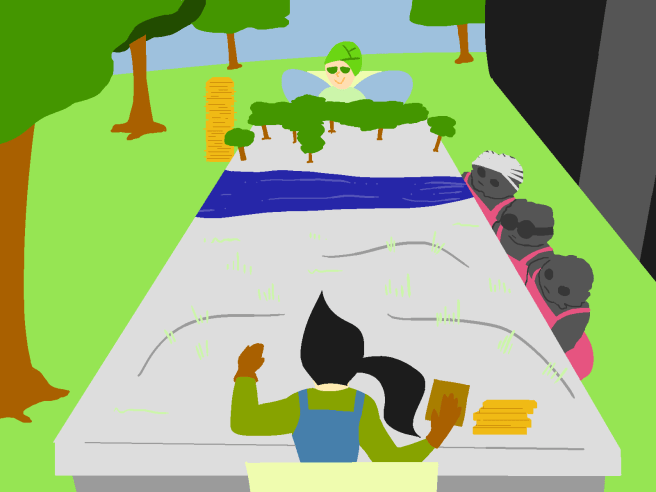
The table the elves had brought with them was sub-standard size, only five feet across and ten feet long. Stephanie demanded they construct the elven capital, but that required a full board. Aria and the gnomes talked her down to a smaller map.

Aria had played on this map before; it was popular among hobbyists. Stephanie’s side featured a thick forest. Aria’s side held rolling hills. The two sides were divided by a wide river. Even for an unofficial battle, the gnomes detailed the table intricately and effortlessly. Special gnomish clay built up the features of the terrain. The gnomes’ precise fingers carved trees and even grass. Beads in shades of blue painted the river’s speed, separating rapids from gentle banks.
AriaVStheElfF.png

“It’s hardly a match if it doesn’t represent a real area.” Stephanie arranged silver figurines on her half of the table. Each one represented an elven soldier described by a brass card. “Do you have game-pieces, Aria?”

“Sure do.” She poured the contents of her backpack onto the grass. Besides medical supplies she brought for the minotaur, she carried five wooden figurines. “Whittled ‘em myself.”

“Aww, how rustic!” As the sun rose, the Great Ax’s shadow shortened. Stephanie cooled her delicate features with a broad fan. The fan must have cost a fortune, because it was decorated with seashells. Seafolk always charged exorbitantly. “I suppose when I killed you, your official figurines were confiscated? My figurines were made by the elven queen’s own smiths.”

Stephanie smirked when her gnomes brought another metal figurine: a giant squid, pulled from the depths of the ocean. “You must’ve made general,” said Aria, refusing Stephanie the satisfaction of seeing her expression sour. “That’s a powerful beast. Buy it from seafolk?”

“Commander, darling! I’m a commander. I have much more powerful monsters, but they don’t fit on this tiny board.”

“The elf-queen must be pretty desperate if you made commander.”

Stephanie blinked. “She’s a better judge of talent, perhaps, than you are. The dwarfs are preparing for war; we elves must protect ourselves.”

AriaVStheElfG.png

“Septem.” The gnome turned to Aria. “Can you make me a brass for my dragonling, Scales?”

“I have not inspected it, ma’am. You must use the generic ice-dragon brass instead of one customized to your creature.”

“Fine.” Aria gathered her five wooden figurines from the grass. First she placed the wooden figurine representing herself—or, the version of herself described by the wooden hobby card, as her official brass claimed she was dead. Her figurine, accurately tall and lanky, stood behind three wooden imps.

“Are you just using any old units lying around your farm?” Stephanie hid her mouth with her sleeves to snicker.

“Plus one.” Aria placed a wooden cockatrice on the front lines. Aria remembered wearing dark glasses for two years raising the creature from an egg. “When I sold this monster to the human military, they said it was too volatile for table-war. I got to keep its brass. You can read on the card, I keep the cockatrice blindfolded for safety.”

The elf had perhaps a hundred game-pieces, while Aria’s side of the table felt more barren with each figurine she set on the field.

“Here,” said Aria, “we’ll use this roll of medical tape for the dragonling.” She placed it atop a grassy hill.

AriaVStheElfH

Octoginta tugged Stephanie’s lace wing. “Hey! This is elven silk, gnome.”

Septem hopped off the board to hold hands with his wounded companion. “He says your army can’t fit on this map. You can use the giant squid or the army of elves, but using both would pack units too densely.”

“Fine.” The elf waved her hand over the board. “Aria, as you’re clearly outmatched, I leave the option to you.”

“Keep both.” Aria straightened her wooden figurines. “You’ll need them.”

Stephanie’s lower lip wavered. “You pompous—”

“I’m ready. Hurry up.”

“Is that really all you’ve got?” asked Stephanie. “Your biggest monster is a dragon barely months old! Your cockatrice has to be blindfolded or it petrifies its allies! You’ve even put your own game-piece on the board! Embarrassing.” Aria swallowed as Stephanie arranged the enormous squid-figurine’s horrible tentacles to infest the forest canopy; internal mechanisms allowed the figurine to be realistically puppeted. Hidden buttons controlled the squid’s beak and eyes. “It’s a tad one-sided, isn’t it?”

“I agree.” Aria brushed hair from her face. “You go first, to even the odds.”

Stephanie hid a grimace with a smirk. “All my elvish units march forward. My archers ready their bows.”

The three gnomes linked hands to communicate and calculate. Then they scrambled over the board. “Elves are not hindered by forest terrain,” said Septem. “They move unimpeded. Say when.”

The gnomes made the metal elf figurines march halfway to the river. In the dappled shade of the model trees, Aria saw the features of the figurines’ faces. These were no mass-produced generic figurines, but actual models of real elves down to their freckles and pointed ears. “Stop there,” said Stephanie. The gnomes halted the elves.

“My dragonling allows the imps and cockatrice to mount it,” said Aria.

Gnome fingers clacked together. “The dragonling is strong enough, and the cockatrice and imps are small and light enough, to perform the action requested. Because your own figurine is present on the table, Ms. Twine, your expertise in taming monsters keeps them from fighting each other.”

“My dragonling runs across the river.” She pointed to a specific spot on the board. The gnomes used white beads to show how the river froze under the dragon’s footsteps, forming a path. “Perfect,” said Aria.
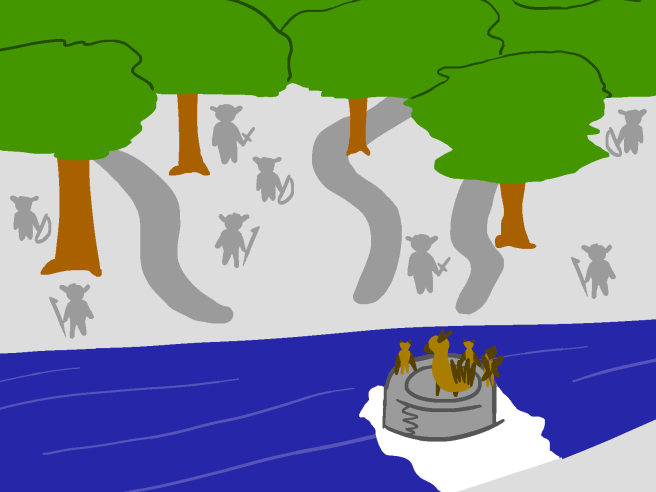
AriaVStheElfI.png

Stephanie covered her mouth. “Your dragon is too young to use ice-breath, isn’t it?”

“Maybe.”

Stephanie looked at the roll of bandages. “Better safe than sorry, right? My army retreats to the forest.”

The gnomes moved the elven figurines. “Is that all?”

“Not yet.” Stephanie leaned over the table. “Have you ever fought a giant squid, Ms. Twine?”

“Nope.”

“Then you might not know, being born in the arctic deep, they’re impervious to the cold! My squid engulfs my men with its tentacles, protecting them from the dragon’s breath.” She moved the tentacles herself. “There.”

Aria nodded. “Of course I knew that.”

“Ah, a guest!” Stephanie clapped. Her shorties dragged a net behind them. The minotaur pushed his three-fingered hands against the net, grunting with animal pain. The shorties pinned the beast with their spears. Aria noticed blood trickling from the minotaur’s closed eye. “Put it aside. This game ends soon. My archers will use Ms. Twine’s beasts as target practice.”

“It’s my move.” Aria pointed to the imps. “My imps remove the cockatrice’s blindfold, and Scales leaps face-to-face with the squid.”

“…My squid shuts its eyes!” Stephanie pressed hidden buttons to make the squid’s figurine blink.

“That kind of squid doesn’t have eyelids,” said Aria. “Too bad whoever made your figurine didn’t know that.”

The gnomes conferred. “The squid has turned to stone.”

Stephanie frowned.

“My imps fly through the stone tentacles.”

“My archers fire! The rest defend themselves from the imps with knives!”

As the gnomes held hands in deliberation, Aria left her chair to inspect the minotaur. “Let it out of the net. It’s calmed down.”

“No! Keep it restrained,” said Stephanie.

“Then put away the spears. You’re hurting it.”

Septem cleared his throat. “The stone tentacles are wrapped too tightly to draw a bowstring or swing a knife. Only the imps may move freely.”

Stephanie bit her lip. Gnomes showed how the imp figurines massacred her army. “…I forfeit.” Stephanie flicked over an elvish archer. “Why would I want a smelly, brainless beast, anyway?”


“Hold still.” Aria stroked the minotaur’s dense, prickly hair. “Shh, shh, shh.”

“It can’t understand you, you know.” Stephanie admired Aria’s imps in their tiny wooden cage. “Shorties, bring me their brass.” The cages were cramped even for imps. The devilish Togdag and Piknik pulled the metal bars with crimson claws. Gumdrop looked forlornly at their netted apple tree. “Are we sure this one’s an imp?” Stephanie stuck a finger into the cage to prod Gumdrop’s dragonfly wings. “It looks more like a fairy—Aaaugh!”

Gumdrop snickered as Stephanie clutched her chipped fingernail. “We’ll miss you, Twine!”

“Keep out of trouble, Gumdrop.” As the minotaur slept, Aria wrapped an eye-patch around its head. The shorties had injured its right eye; it would never see properly again. “Shh, shh, shh. It’s okay.” She poured clear liquid over the minotaur’s wounded chest. The sleeping beast grumbled at its stinging cuts. “You must be scared, so far from home. You’ll make plenty of friends when I sell you to the army.”

AriaVStheElfK

The shorties rolled barrels from the elven wagon. There were twenty barrels in all. “Your dragon fodder is ready,” said Stephanie. “You know, Aria, if you knew what was best for you, you could live in elven lands. You could help tame that giant squid. You could even be royalty.”

“I wanna be royalty because I’m awesome, not because I’m taller than you.”

Stephanie bared pearly teeth. “Come, shorties.” One shorty pushed the wagon from behind while the other pulled it from the front. “We’ll be back in elven lands within a week if you trudge fast enough.”

“Take care, dear,” said Aria.

Next Chapter
Commentary